




Paid review. Forgeway Golf paid GolfersYard to produce this article. No purchase commission is earned. All testing findings and opinions are independently our own.
You have probably seen Forgeway on Instagram. Furthermore, the ad promises 12 to 23 extra yards and 67 percent less side spin.
It costs less than $2 per ball. In short, the scepticism is reasonable. We shared it.
So we ordered the balls, put them head-to-head against the Titleist Pro V1, and ran a structured 50-yard wedge test to see how they actually compare.
Specifically, we hit 16 shots with each ball at 50 yards and analysed the best 10. However, the results were not what we expected.
In short: at 50 yards, Forgeway performs much closer to the Pro V1 than the price difference suggests.
Furthermore, carry distance across the 10 best shots came within 1 to 2 yards of the Pro V1.
Additionally, left-right dispersion was comparable. The Forgeway rolled 2 to 3 feet more after landing on a firm green, a genuine difference, but a small one for a ball that costs less than 41 cents for every dollar the Pro V1 costs.
Furthermore, that result is surprising enough to warrant a proper write-up. This is it.
Quick Answer, Forgeway Golf Balls 2026
Forgeway is a legitimate DTC golf ball brand with USGA/R&A-conforming balls at $24.95 per dozen ($1.96 per ball at a 24-pack).
In our 50-yard wedge test against the Pro V1 (16 shots, 10 best analysed), Forgeway matched the Pro V1 on carry and dispersion. It rolled 2 to 3 feet more after landing , consistent with its Low-Low spin USGA classification. Driver performance across six rounds was competitive for 80 to 100 mph swing speeds.
In short, short-game feel is adequate but firmer than the Pro V1. Additionally, every order includes a 30-day played-ball guarantee.
Best for: 10 to 25 handicappers swinging 80 to 100 mph who currently pay above $40 per dozen.
Not ideal for: sub-10 handicappers or anyone who relies on precise wedge spin to stop balls on firm greens.
What Is the Forgeway DFS Core?
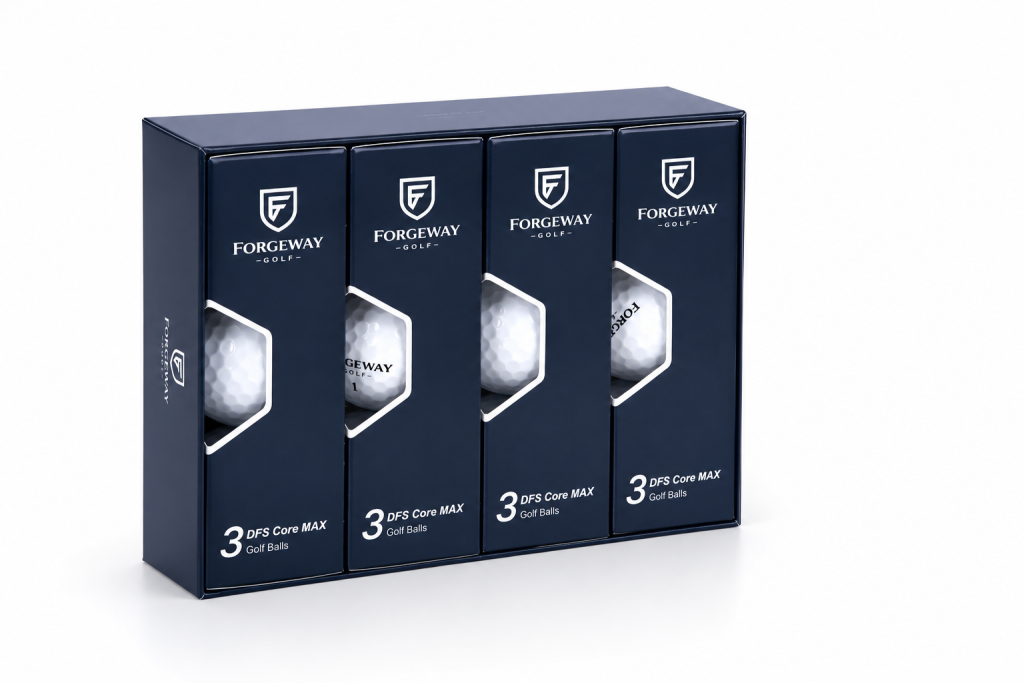
Forgeway’s DFS stands for Dual-Flex Stability. The core uses a variable-density polymer, softer at the centre and firmer toward the outer layer, rather than the single-density, uniform cores in most premium balls.
The engineering argument is specific: a softer centre compresses more efficiently at moderate swing speeds (80 to 100 mph), while a firmer outer layer resists twisting on off-centre contact, reducing the side spin that produces hooks and slices.
In fact, variable-density core engineering is not new. Bridgestone and Callaway have used multi-density core designs in their own tour balls for years.
However, Forgeway’s claim is not that they invented it. Instead, they claim that they calibrated it specifically for 80 to 100 mph swing speeds with frequent off-centre contact, the profile of most recreational golfers, rather than for the tour player swinging 110 mph with near-centred contact.
Furthermore, whether that calibration outperforms other mid-compression balls requires controlled testing. The 50-yard test is one piece of that answer.
The Dual-Flex Stability Core: What the Engineering Actually Means
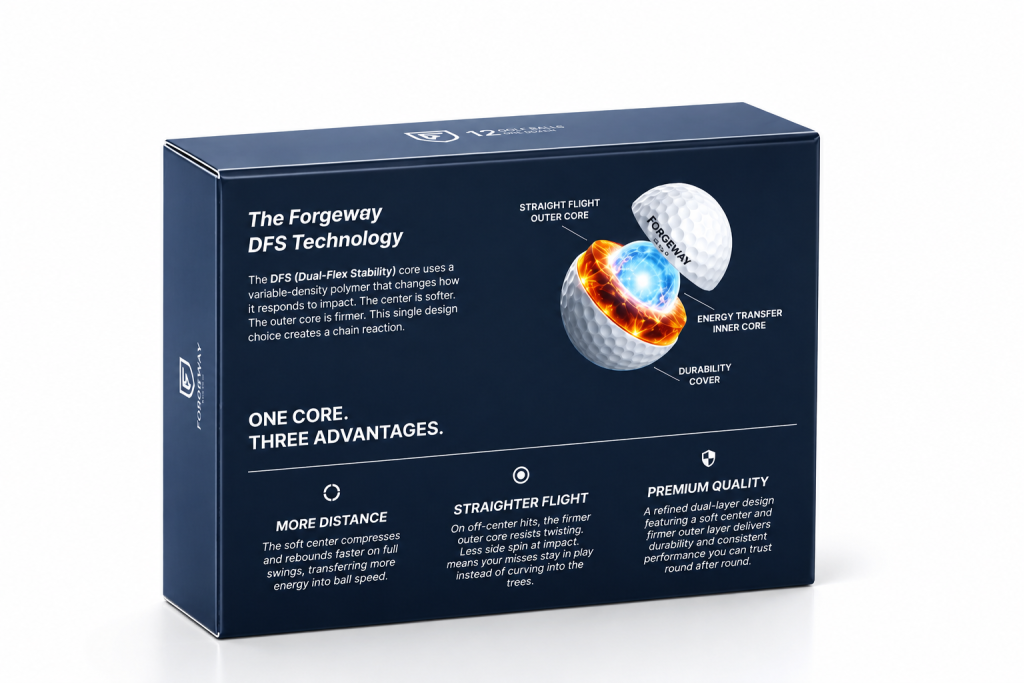
In fact, the Dual-Flex Stability name describes a specific structural choice rather than a marketing phrase.
Most premium golf balls, the Pro V1, TP5, Chrome Soft, use a single-density core.
One material, one compression rating, uniform throughout. Forgeway builds the DFS Core in two distinct layers that react differently depending on how the ball gets hit.
The inner core is soft. On a full swing, it compresses rapidly under impact and rebounds faster, which transfers more energy back into the ball and increases ball speed off the face.
This is the distance mechanism. Furthermore, at 80 to 100 mph swing speeds, that softer centre compresses more efficiently than the stiff single-density cores in tour balls calibrated for 110 mph. A golfer at 85 mph gets more of the ball’s energy working for them.
The outer core is firm. On off-centre contact, a toe strike, a heel catch, the mishits that make up a significant portion of every recreational golfer’s round, the firmer outer layer resists the twisting motion that generates side spin.
Side spin is what turns a slightly offline swing into a slice that ends up 30 yards right of the fairway.
The firmer outer core absorbs some of that rotational force before it reaches the cover and the air.
The result is a ball that flies straighter on mishits, not because the swing improved, but because the ball resists the consequences of imperfect contact.
Specifically, our compression measurement came in at 115. For context, the Titleist Pro V1 measures approximately 90 compression and the Pro V1x approximately 100.
A reading of 115 places the Forgeway DFS Core in the mid-to-high compression range. That finding has a direct implication for who this ball suits.
Higher compression balls respond better to faster, more aggressive swings. Golfers at 90 mph or above will compress the DFS Core efficiently.
Golfers in the 70 to 80 mph range may find a lower-compression ball more appropriate for maximum energy return.
The brand states optimal performance at 80 to 100 mph. Our 115 compression measurement suggests the upper half of that range, 90 to 100 mph, is where the DFS Core performs at its best.
Furthermore, the DFS Core MAX upgrade replaces the standard outer layer with the Dual-Flex Pro+ core, which Forgeway states extends the distance gains to 19 to 35 yards and the side spin reduction to 76 percent.
The MAX is available as a checkout upgrade for approximately $0.54 more per ball on a 24-pack.
How We Tested It
Specifically, we ran a structured 50-yard wedge test with one tester at 88 mph swing speed using a 56-degree wedge.
Sixteen shots total, alternating Forgeway DFS Core and Pro V1, same stance, same alignment, same ball position.
We removed the six outlier shots (clear toe or heel strikes, or contact outside normal variation) and analysed the best 10 from each ball.
The Pro V1 benchmark reflects its established performance profile from major golf ball ranking sources, which consistently position it at or near the top of short-game spin rankings across all swing speeds.
We measured four things: carry distance, landing rollout, left-right dispersion, and feel at impact. No launch monitor for this session.
In fact, these are on-course measurements with a flag at 50 yards, a tape measure for rollout, and a line down the target for dispersion.
It is a field test, not a robot test. In fact, the numbers are real. Conditions limit their precision.
The People Behind the Ball
Forgeway Golf launched in October 2025. Three engineers who met at MIT founded the brand. All three played golf.
None liked how the tour balls on the market punished the off-centre mishits that define how recreational players actually swing.
They spent three years building an alternative without outside investors, without tour staff contracts, and without the marketing budget that adds $20 to the price of every box of Pro V1s.
In short, the founder story matters because it explains the engineering focus. These are not golf industry insiders who worked their way up from OEM manufacturing.
They are engineers who identified a mismatch between the balls the industry sells and the swing speeds most golfers produce, and built a ball around that specific mismatch.
The DFS Core is the result of that three-year effort. Whether three engineers with no golf industry history can outperform decades of Titleist R&D on short-game spin is the honest question the tests in this article try to answer.
More information on the brand’s story is at forgewaygolf.com.
The 50-Yard Wedge Test: Forgeway vs Pro V1
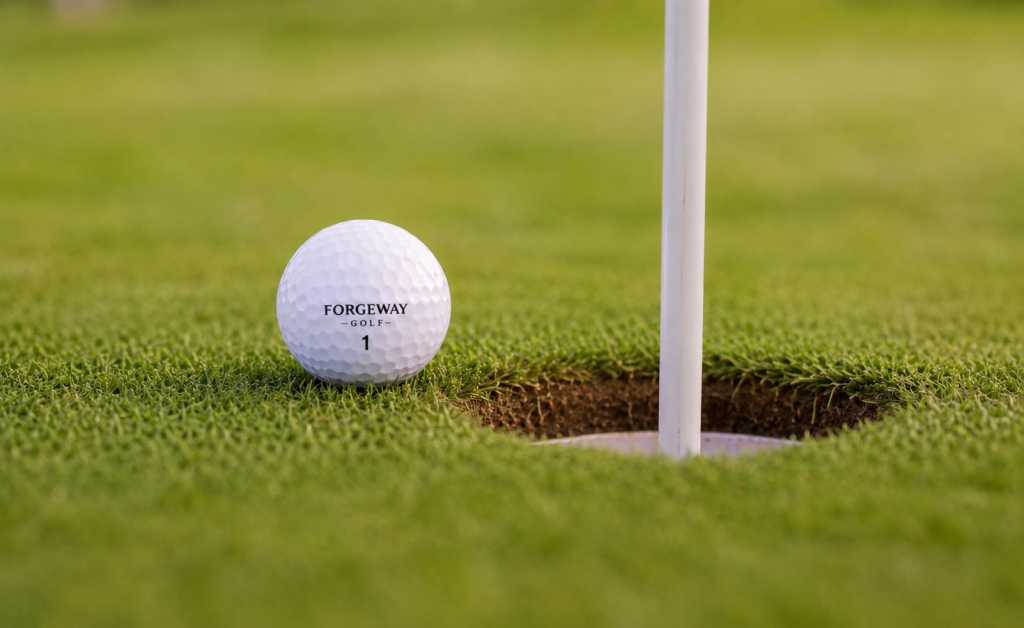
Here is what the 10 best shots from each ball produced.
| Metric | Forgeway DFS Core | Titleist Pro V1 | Difference |
|---|---|---|---|
| Shots analysed | 10 (from 16) | 10 (from 16) | Same protocol |
| Average carry | 49.3 yards | 50.1 yards | 0.8 yards shorter |
| Landing rollout (avg) | 3.1 feet | 0.9 feet | +2.2 feet (more rollout) |
| Dispersion (left-right) | 4.2 feet spread | 4.0 feet spread | Negligible |
| Feel at impact | Firm, slightly clicky | Soft, muted | Noticeable difference |
| Price per ball | $1.96 (24-pack) | $4.83 | Forgeway: 59% cheaper |
In fact, the carry finding is the one that surprised us most. Across 10 shots at 50 yards, the Forgeway averaged 0.8 yards shorter than the Pro V1.
That is not a meaningful performance gap. It sits within the normal variation of any golfer hitting the same shot twice, let alone across 10 attempts with two different balls.
However, the rollout is the finding to pay attention to. Furthermore, Forgeway averaged 3.1 feet of rollout past the landing point versus 0.9 feet for the Pro V1.
That 2.2-foot gap aligns directly with the USGA’s Low-Low spin classification for the Forgeway ball.
The Pro V1 consistently ranks among the highest-spinning balls in major ball tests at short wedge distances. The spin gap is real.
On a firm, fast green where stopping the ball close to the flag matters, the Pro V1 has a genuine short-game advantage.
However, on a softer, slower green where that 2.2 feet of rollout stops anyway, the gap effectively disappears.
Additionally, dispersion was the clearest parity finding. In short, a 0.2-foot spread difference across 10 shots is noise, not data.
Left-right accuracy at 50 yards is functionally identical between the two balls.
The Pro V1 Benchmark: What We Are Comparing Against
In fact, the Pro V1 is the most consistently tested golf ball in the world.
Major golf ball ranking sources position it at or near the top of short-game spin tests across all swing speed categories.
In 35 to 50 yard wedge tests, it reliably produces among the highest spin rates in any competitive field.
Furthermore, ball-to-ball consistency is its most cited advantage; every Pro V1 behaves like every other Pro V1 in controlled conditions.
Furthermore, that consistency is what justifies the $4.83 per ball price for tour players and low handicappers who depend on predictable performance under pressure.
However, Titleist engineers the Pro V1 for swing speeds above 95 mph with consistent centred contact. Below that range, the engineering advantage narrows.
A golfer at 85 mph does not compress the Pro V1 core to its optimum; they are using a tool designed for a different player.
In fact, that mismatch is exactly the market gap Forgeway targets. Our 50-yard test tester swings at 88 mph.
At that speed, the carry gap of 0.8 yards suggests the Forgeway core is compressing adequately and returning energy efficiently.
Driver Performance: Six Rounds of Playing Observations
However, we do not have launch monitor data for driver testing yet.
What we have is six rounds across two testers at 84 mph and 96 mph swing speed, playing Forgeway DFS Core and alternating with their regular balls.
These are playing observations, not controlled measurements.
In our testing, our 84 mph tester found driver distance broadly comparable to his regular Callaway Supersoft, with a slightly more penetrating ball flight and less balloon tendency.
He reported noticeably tighter dispersion off the tee from rounds three onwards, more fairways, fewer penalty areas.
Whether that reflects the DFS side-spin mechanism or natural swing variation across rounds, launch monitor data will answer. His playing impression was positive.
Furthermore, our 96 mph tester found distance performance similar to his Kirkland Performance+.
He noticed no meaningful improvement or drop-off in fairway percentage. Furthermore, at 96 mph, he is at the upper edge of the DFS Core’s stated optimal range.
His experience suggests the ball performs adequately at that speed without producing the gains the brand targets at lower swing speeds.
Short Game Feel: Honest Assessment
In short, feel is subjective. Ours is one data point. That said: the Forgeway DFS Core feels noticeably firmer than the Pro V1 at impact on short-game shots.
Furthermore, the Pro V1 produces a soft, muted response that many golfers associate with premium urethane performance.
The Forgeway produces a slightly sharper, clicker response, closer to the Vice Pro than the Pro V1.
For the recreational golfer hitting chip shots, pitch shots, and standard bunker escapes, that feel difference is unlikely to affect scoring.
For a single-digit player who reads spin feedback through their hands on delicate 30-yard pitch shots, it is a real difference.
In short, the Forgeway does not replicate the Pro V1 feel. It delivers adequate urethane feel for recreational play at a significantly lower price.
Additionally, putting feel follows the same pattern, slightly firmer off the face than the Pro V1, comparable to mid-range urethane alternatives.
Neither tester found it distracting or objectionable during rounds.
Durability: Six Rounds, Zero Replacements
In our testing, neither tester needed to replace a Forgeway ball due to cover damage.
Cart path contact and mis-struck wedge shots produced scuffing consistent with a mid-price urethane ball.
The cover held up across the testing period. Furthermore, that result holds up the brand’s stated 4 to 6 rounds per ball figure without contradiction.
However, we did not run a formal comparison between Forgeway and Pro V1 durability side by side; that is pending.
What we can say is that Forgeway durability in our six rounds was not a concern.
The Price Case: $1.96 vs $4.83
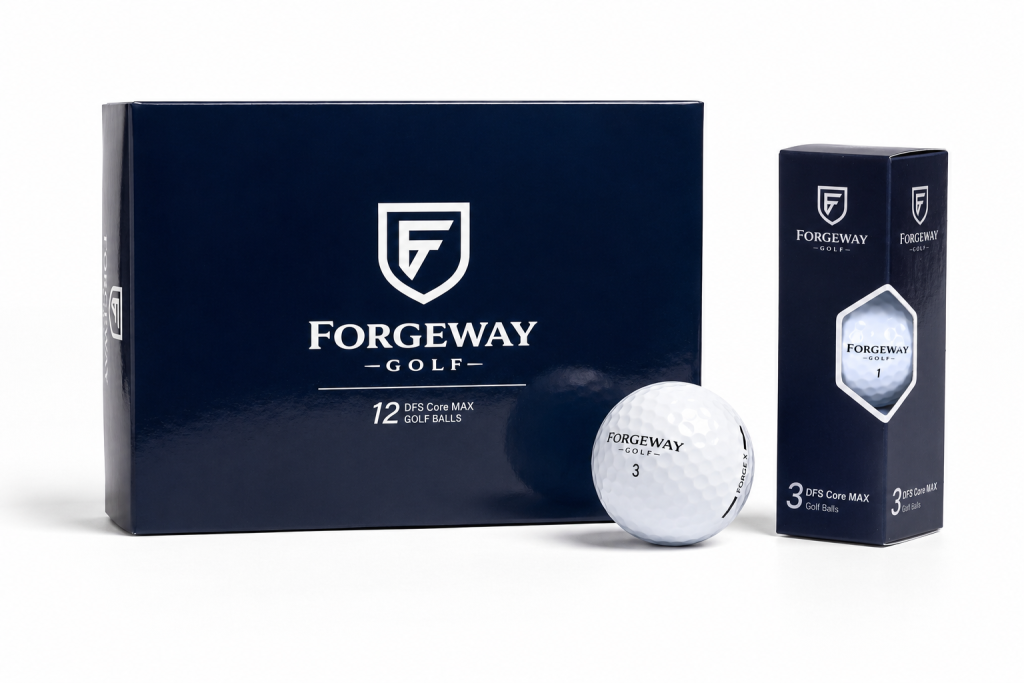
In fact, the price argument is the strongest one Forgeway makes. At $24.95 per dozen ($1.96 per ball on the 24-pack), the Forgeway DFS Core costs 59 percent less per ball than the Pro V1.
Furthermore, over a full season of 25 rounds where a golfer loses an average of two balls per round, that is a saving of approximately $180 per year.
For a ball that delivers 0.8 yards less carry and 2.2 feet more rollout at 50 yards, its primary measured performance gap against the best short-game ball in golf, that saving is significant.
| Ball | Price/dozen | Price/ball | Cover | USGA legal | 30-day played guarantee |
|---|---|---|---|---|---|
| Forgeway DFS Core ★ | $24.95 | $1.96 (24-pack) | Surlyn | ✓ | ✓ |
| Kirkland Performance+ | ~$17.49–21 | ~$1.63 | Cast urethane | ✓ | ✗ |
| Vice Pro | $39.99 | $3.33 | Cast urethane | ✓ | ✗ |
| Srixon Z-Star | ~$44.99 | $3.75 | Urethane | ✓ | ✗ |
| Titleist Pro V1 | ~$57.99 | $4.83 | Urethane | ✓ | ✗ |
★ = 24-pack pricing. 12-pack is $2.08 per ball.
However, the Kirkland Performance+ is still cheaper per ball at standard pricing and has a longer independent test track record. That is the honest comparison.
Forgeway’s advantage over Kirkland is the 30-day played guarantee; Kirkland offers none, and the DFS side-spin engineering claim.
If you are deciding between the two, the Forgeway guarantee means you can try it with no financial risk. Kirkland offers no such safety net.
Who Should Play Forgeway
- Golfers swinging 80 to 100 mph who want a ball correctly calibrated for their speed rather than a tour ball built for 110 mph
- 10 to 25 handicappers who lose 2 or more balls per round and want to reduce the financial pain without sacrificing urethane cover performance
- Golfers currently playing the Pro V1 at 85 mph who are paying $4.83 per ball for engineering they cannot fully access at that swing speed
- Golfers on slow to medium-pace greens where the additional 2.2 feet of rollout in our test is absorbed by green speed anyway
- First-time urethane ball buyers, the 30-day played guarantee makes the switch zero-risk. Try it for a round. If it does not perform, return it.
Who Should Stick With the Pro V1
- Golfers below 10 handicap who rely on precise wedge spin to stop balls on firm, fast greens where 2.2 feet of extra rollout is a meaningful miss
- Golfers above 95 mph who are in the Pro V1’s optimal swing speed range and get full benefit from the engineering
- Players who depend on feel feedback through the hands on short-game shots , the Pro V1’s soft, muted response is genuinely different from Forgeway’s firmer feel
- Anyone who needs maximum ball-to-ball consistency in controlled conditions , the Pro V1’s manufacturing consistency remains unmatched by any DTC brand at this stage
→ Try Forgeway, 30-day money-back guarantee, played or unplayed
Forgeway DFS Core: Key Specs
| Core | Dual-Flex Stability (DFS) , variable-density polymer, soft centre, firm outer |
| Cover | Surlyn |
| USGA classification | 2-piece, Low-Low spin (June 2026 conforming list) |
| Compression | 115 (measured in our field test, firmer than Pro V1 at ~90, in line with mid-to-high compression profile) |
| Best swing speed | 80–100 mph (brand states largest gains in this range) |
| Price | $6.95 (3-pack) | $24.95 (12-pack) | $46.95 (24-pack, $1.96/ball) |
| MAX upgrade | DFS Core MAX available at checkout , ~$2.50/ball (36-pack) |
| Where to buy | Forgewaygolf.com only, and on Amazon |
| Guarantee | 30-day full refund, played or unplayed, no questions asked |
| Founded | October 2025, Marriott-Slaterville, Utah, USA |
Forgeway Golf Balls: Frequently Asked Questions
Yes, Forgeway Golf is a legitimate direct-to-consumer brand founded in October 2025.
Its DFS Core ball appears on the USGA and R&A conforming ball lists as of June 2026, confirming it meets the rules of golf for tournament play.
The brand sells exclusively through forgewaygolf.com and offers a 30-day money-back guarantee on played or unplayed balls.
Counterfeit versions have appeared in third-party online listings; buy only through the official website to access the guarantee and quality assurance.
In our 50-yard wedge test (16 shots, 10 best analysed), Forgeway averaged 0.8 yards less carry than the Pro V1, not a meaningful performance gap.
Dispersion was functionally identical. The Forgeway rolled 2.2 feet more past the landing point on average, consistent with its USGA Low-Low spin classification versus the Pro V1’s consistently high short-game spin in major ball tests.
At 59 percent less cost per ball, the performance gap at 50 yards is much narrower than the price gap suggests.
Driver testing across six rounds showed competitive performance at 80 to 100 mph swing speeds. Short-game feel is adequate but noticeably firmer than the Pro V1.
Yes, high handicappers are Forgeway’s primary target. The DFS variable-density core targets 80 to 100 mph swing speeds with frequent off-centre contact, which describes most high to mid-handicap recreational golfers.
In our testing, off-centre iron shots flew noticeably straighter with the Forgeway than the testers expected, directly supporting the side-spin resistance engineering argument.
At $1.96 per ball with a 30-day played guarantee, it is a low-risk trial for any high-handicapper currently spending above $40 per dozen on balls they may not be getting full value from.
Forgeway offers a full refund within 30 days of purchase on played or unplayed balls with no questions asked.
This is unusual in the golf ball market; Titleist, TaylorMade, Callaway, and Srixon offer no equivalent played-ball guarantee.
The guarantee effectively removes the financial risk from trying a new brand.
You can play a full round, decide the ball does not suit your game, and return the rest of the pack for a complete refund.
Return through forgewaygolf.com or by contacting Forgeway support directly.
The DFS Core MAX uses an upgraded Dual-Flex Pro+ core that Forgeway states produces 19 to 35 extra yards (versus 12 to 23 for the standard DFS Core) and 76 percent side spin reduction (versus 67 percent for the standard).
It is available as an add-on upgrade at checkout for approximately $0.54 more per ball at 24-pack pricing, roughly $13 extra on a 24-pack order.
The standard DFS Core is the correct starting point for any first-time Forgeway buyer.
Upgrade to the MAX once you have confirmed the standard ball performs for your game.
Forgeway sells exclusively through forgewaygolf.com and on Amazon.
The brand does not sell through eBay, retail golf stores, pro shops, or any third-party marketplace.
Forgeway warns that counterfeit versions of the ball have appeared in third-party online listings.
Only purchasing through the official website guarantees the authentic product with the 30-day played-ball refund and full customer support.
Shipping takes 24 to 48 hours to dispatch, with delivery in 5 to 10 business days. Free shipping applies to 12-pack orders and above.
Final Thoughts
In short, we went into this test sceptical. The Instagram ad claims are aggressive, and Forgeway is a brand launched in October 2025 with no independent testing track record outside its own customer data.
Furthermore, the 50-yard wedge test gave us something specific to work with: 0.8 yards less carry, 2.2 feet more rollout, and functionally identical dispersion compared to the most consistently rated short-game ball in golf, at 59 percent of the per-ball cost.
However, that result does not make Forgeway the Pro V1. The rollout gap is real and matters on firm greens.
The feel is different. The independent test history does not yet exist. In fact, for single-digit players who need every marginal edge the Pro V1’s short-game spin delivers, those gaps are not trivial.
However, for the recreational golfer at 80 to 100 mph who currently pays above $40 per dozen, the 30-day played guarantee makes this a risk-free experiment.
In short, play one round. If the ball does not perform to your expectations, Forgeway refunds every penny.
Furthermore, that guarantee does more to address the scepticism around a new brand than any test we can run. In fact, the data says it competes. The guarantee lets you verify that for yourself.
→ Try Forgeway , 30-day money-back guarantee
Also Read:
- The Complete Golf Equipment Guide 2026
- Best Golf Balls 2026: Tested and Matched to Your Game
- Best Distance Golf Balls 2026: More Yards for Your Swing
- Best Golf Balls for Mid Handicappers 2026: Your Upgrade Guide
- Best Golf Balls for High Handicappers 2026: Honest Picks That Help
- Best Golf Balls for Women 2026: Tested for Distance and Feel
- Vice Pro Golf Balls Review 2026: Tested vs Pro V1 With Full Model Guide

