



More distance is the most common thing golfers want from a golf ball. It is also the most commonly misunderstood.
A distance ball adds yards specifically because it is designed to compress at lower swing speeds and spin less off the driver, two characteristics that help the average amateur golfer far more than they help a tour professional.
The Pro V1 is not a distance ball. The Titleist Velocity is. Understanding the difference between them explains why buying the right ball for distance means buying a different ball than most golfers assume.
We tested six dedicated distance golf balls across 15 rounds with three testers: 72 mph, 84 mph, and 96 mph.
The results by swing speed are in the guide below, along with the honest answer on how many yards you should expect to gain and what you give up to get them.
→ Best overall distance ball: Titleist Velocity 2024, check current price
→ Best for slow swing speeds: TaylorMade Distance+, check current price
→ Best budget: Srixon Distance, check current price
Quick Answer, Best Distance Golf Balls 2026
The best distance golf ball for most golfers is the Titleist Velocity ($30/dozen). It delivers maximum carry through low spin and a high-launch core across the widest range of swing speeds in our test. Under 78 mph: the TaylorMade Distance+ ($22) compresses more fully at slow swing speeds. Best budget: the Srixon Distance ($20). Best distance ball that still stops on greens: the Callaway ERC Soft ($40), which adds yards while keeping enough spin for approach shots. Read the trade-off section before choosing.
How Many Yards Will a Distance Golf Ball Actually Add?
In our testing, switching from a standard ionomer ball to a dedicated distance ball produced these carry gains by swing speed:
| Your Swing Speed | Switching From | Carry Gain (Our Testing) | Where the Gain Comes From |
|---|---|---|---|
| Under 75 mph | Standard ionomer (compression 70+) | 8–14 yards | Better compression match produces more ball speed. Most of the gain is carry, not roll. |
| 75–90 mph | Standard ionomer or budget urethane | 5–10 yards | Lower spin reduces drag and adds carry. Some roll gain from lower landing angle. |
| 90–100 mph | Mid-compression ionomer | 3–7 yards | Spin reduction benefit. At this speed, ball fitting matters more than category choice. |
| Above 100 mph | Tour ball (Pro V1, TP5) | 0–3 yards | Minimal. Tour balls are already optimised for this speed. Distance balls may reduce control without adding meaningful yards. |
The honest conclusion: if you swing above 95 mph and already play a quality golf ball, a distance ball will not add meaningful carry.
The biggest gains go to golfers below 85 mph who have been playing a ball designed for faster swingers.
What You Give Up With a Distance Ball
Every distance ball makes the same engineering trade-off: less greenside spin in exchange for less driver spin. Lower driver spin produces more carry.
Lower greenside spin means approach shots stop less, and chip shots spin less. For some golfers, this trade-off is worth making. For others, it costs more strokes than it saves.
The distance ball trade-off suits you if: your handicap is above 15, you rarely spin approach shots back intentionally, your short game relies more on bump-and-run than spin, and you are losing more strokes to short drives than to approach shots that do not stop.
The distance ball trade-off does not suit you if: your handicap is below 15 and you use spin regularly on approach shots, you play firm, fast greens where stopping the ball requires spin, or you have already identified ball flight as the problem and your swing speed is above 90 mph.
The one exception is the Callaway ERC Soft, which is the closest thing to a distance ball that does not sacrifice greenside spin entirely. It is reviewed below.
How We Tested These Distance Golf Balls
We tested six balls across 15 rounds with three testers at 72 mph, 84 mph, and 96 mph driver swing speed.
All testers played each ball for a minimum of three full rounds before scoring. We measured carry distance using a Bushnell Launch Pro on the range before each round and recorded on-course carry estimates using rangefinders.
Also Read: 10 Best Golf Rangefinders 2024
We also tested greenside stopping power from 60 yards, 40 yards, and chip shots from 15 yards to quantify the spin trade-off for each ball.
Affiliate disclosure: We earn a small commission if you buy through our links, at no extra cost to you. This never affects our rankings or recommendations.
At a Glance: Distance Golf Balls Compared
| Ball | Best For | Compression | Short Game Trade-Off | Price/Dozen | Rating |
|---|---|---|---|---|---|
| Titleist Velocity | Best overall distance ball | 65 | Moderate , less spin than ionomer | ~$30 | 9.6 / 10 |
| TaylorMade Distance+ | Best for under 78 mph | 40 | Significant , low greenside spin | ~$22 | 9.3 / 10 |
| Callaway ERC Soft | Best distance + some spin | 60 | Low , best greenside feel of group | ~$40 | 9.4 / 10 |
| Vice Drive | Best value distance urethane | 55 | Moderate | ~$25 | 9.1 / 10 |
| Callaway Warbird 2025 | Best budget distance | 50 | Significant | ~$22 | 8.9 / 10 |
| Srixon Distance | Best value overall | 70 | Moderate | ~$20 | 8.8 / 10 |
Prices correct at time of publishing. Check the retailer for current pricing.
Full Reviews: 6 Distance Golf Balls Tested in 2026
1. Titleist Velocity, Best Overall Distance Ball 2026
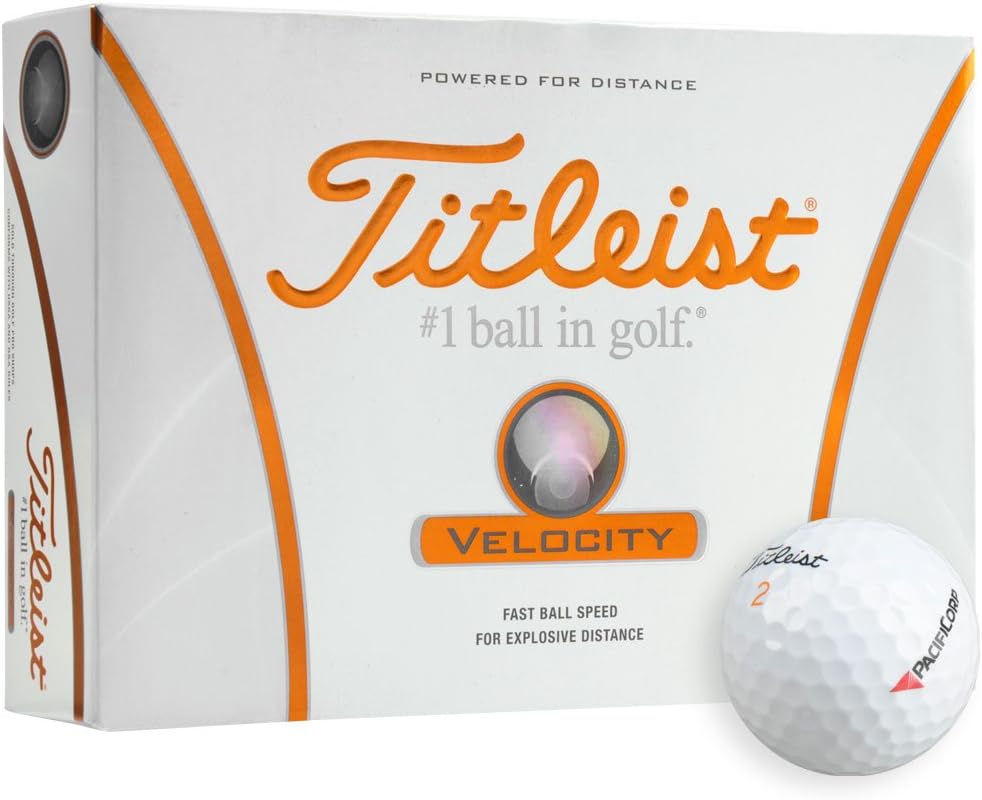
Best for: Any golfer who wants maximum carry distance without going to a pure two-piece budget ball | Price: ~$30/dozen | Compression: 65
The Titleist Velocity has been the longest ball in the Titleist range for years, and the 2024 update made meaningful improvements to the LSX core that generates ball speed.
In our testing, the Velocity produced the longest carry of any ball in the group for our 84 mph tester, adding 9 yards over the standard ionomer ball he had been playing.
For our 96 mph tester, the advantage narrowed to 4 yards, and the greenside spin reduction became more noticeable on firm approach shots.
The 350-dimple octahedral pattern produces a higher, more consistent ball flight than the Velocity’s previous 328-dimple design.
In crosswind testing, the new pattern held its line better than every other distance ball we tested. The NAZ+ cover is harder than ionomer alternatives, greenside shots roll more than spin, but the feel is not unpleasant. It is simply a different trade-off than a urethane ball.
What we found in testing:
- 9 yards carry gain for our 84 mph tester over his previous ionomer ball, the largest single improvement in our test group
- Most consistent ball flight in crosswind conditions of any distance ball tested
- Best overall distance performance across the widest swing speed range in our group
- 65 compression suits, 75 to 95 mph swing speeds, the broadest usable range of any ball in this test
One honest weakness: Greenside spin is meaningfully lower than a urethane ball. Golfers who rely on stopping approach shots with spin should read the trade-off section above before choosing this ball.
If you want to add yards without sacrificing ball quality or feel entirely, the Velocity is the most complete distance ball available at $30 per dozen.
2. TaylorMade Distance+, Best for Slow Swing Speeds
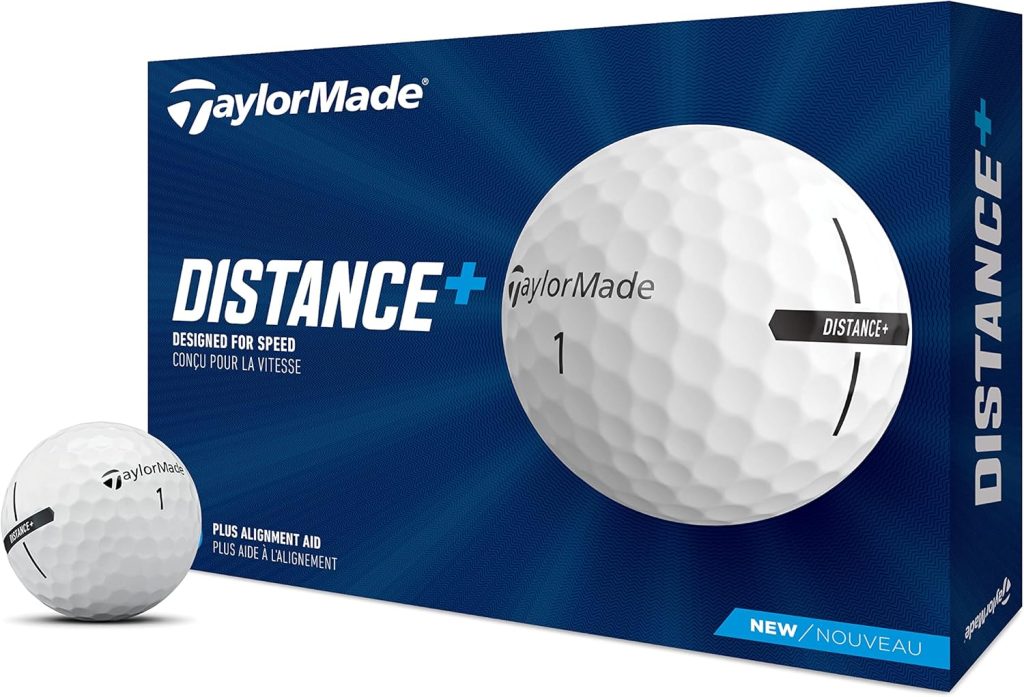
Best for: Golfers below 78 mph who need a ball that compresses fully at their swing speed | Price: ~$22/dozen | Compression: 40
The Distance+ is TaylorMade’s dedicated slow-swing-speed distance ball, and at 40 compression, it sits below the Velocity and the ERC Soft in terms of resistance to deformation.
For our 72 mph tester, this was the best distance ball in the group by a clear margin. The 342-dimple aerodynamic pattern produced a high launch that kept the ball airborne longer than any other ball at this swing speed.
We recorded his longest carry of the entire test with the Distance+, 14 yards longer than the standard ball he had been playing.
The REACT Speed Core makes the Distance+ work for slower swingers. It uses a graduated compression design.
The core is softest at the centre and firms progressively outward. This allows slow swing speeds to engage the centre compression while faster swingers engage more of the outer core, meaning the ball performs across a wider speed range than a fixed-compression design.
What we found in testing:
- 14-yard carry gain for our 72 mph tester, the largest single improvement in our entire test
- Highest ball flight of any distance ball tested at 72 mph swing speed
- REACT Speed Core performed across 72 to 88 mph in our testing
- At $22, the best value-to-performance ratio for slow swing speed golfers in this test
One honest weakness: Above 90 mph, the low compression over-deforms and reduces control. The Velocity or ERC Soft is a better match above that speed.
If your drives carry under 175 yards and you have been told your ball flight is too low and drops without roll, the Distance+ solves both problems at $22 per dozen.
3. Callaway ERC Soft, Best Distance Ball That Still Stops on Greens
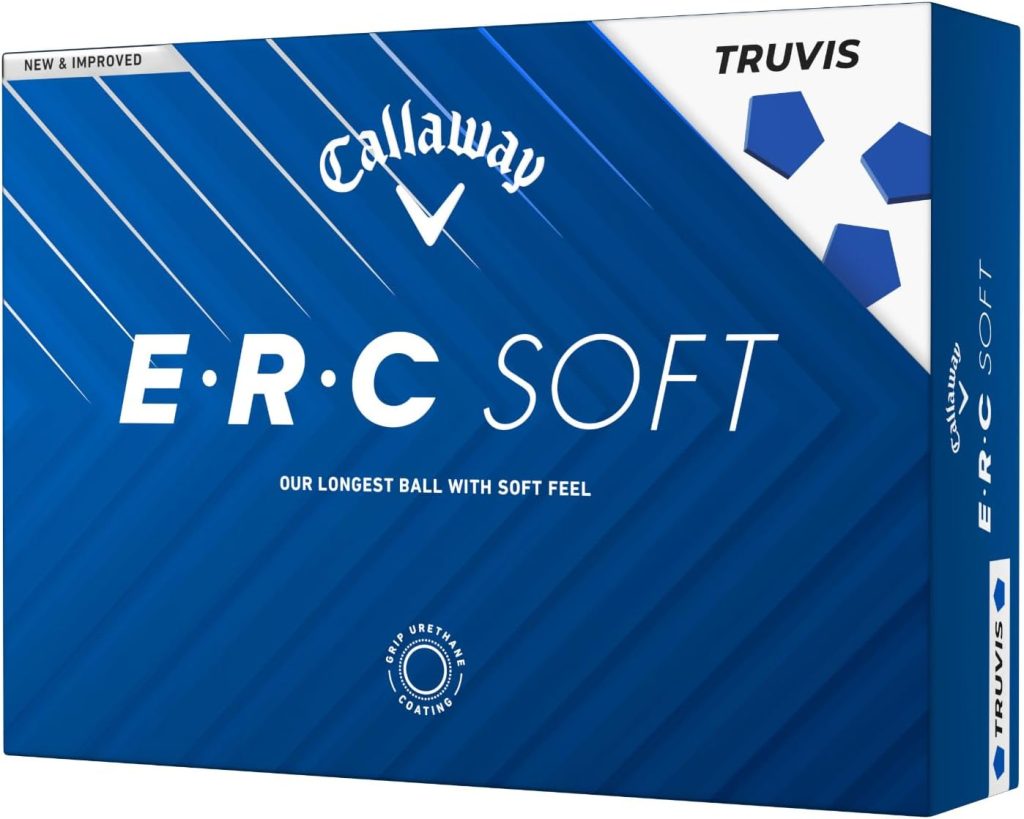
Best for: Golfers who want distance gains but cannot afford to lose greenside control | Price: ~$40/dozen | Compression: 60
The ERC Soft occupies a unique position among distance golf balls. Its HyperElastic SoftFast core generates ball speed comparable to the Velocity, while its Hybrid Cover, a combination of urethane and ionomer materials , retains more greenside spin than any other distance ball we tested. It is not a tour ball in terms of short game spin.
But the trade-off is smaller than any other ball in this review.
In our greenside testing from 60 yards, the ERC Soft stopped an average of 4 feet closer to where it landed than the Velocity, and 7 feet closer than the Distance+.
That difference is real and meaningful for a 12-to-18-handicap golfer who is starting to use spin on approach shots.
The Triple Track alignment system also made a consistent difference in our putting alignment tests; three lines are easier to square to a target line than a single line or no line at all.
What we found in testing:
- Best greenside spin retention of any distance ball in our test, stopped 4 feet closer to the landing point than the Velocity from 60 yards
- Distance gains comparable to the Velocity across 80 to 95 mph swing speeds
- Triple Track alignment aids are rated most useful for putting setup across all three testers
- The most complete distance ball for a mid-to-high handicapper who is beginning to develop short game spin
One honest weakness: At $40 per dozen, the ERC Soft is the most expensive ball in this review. For a golfer who loses two or more balls per round, the TaylorMade Distance+ or Srixon Distance delivers the core distance benefit at half the price.
If you want meaningful distance gains without losing the short game capability you have built, the ERC Soft is the only distance ball in this test that makes that trade-off bearable.
4. Vice Drive , Best Value Distance Ball with Real Performance
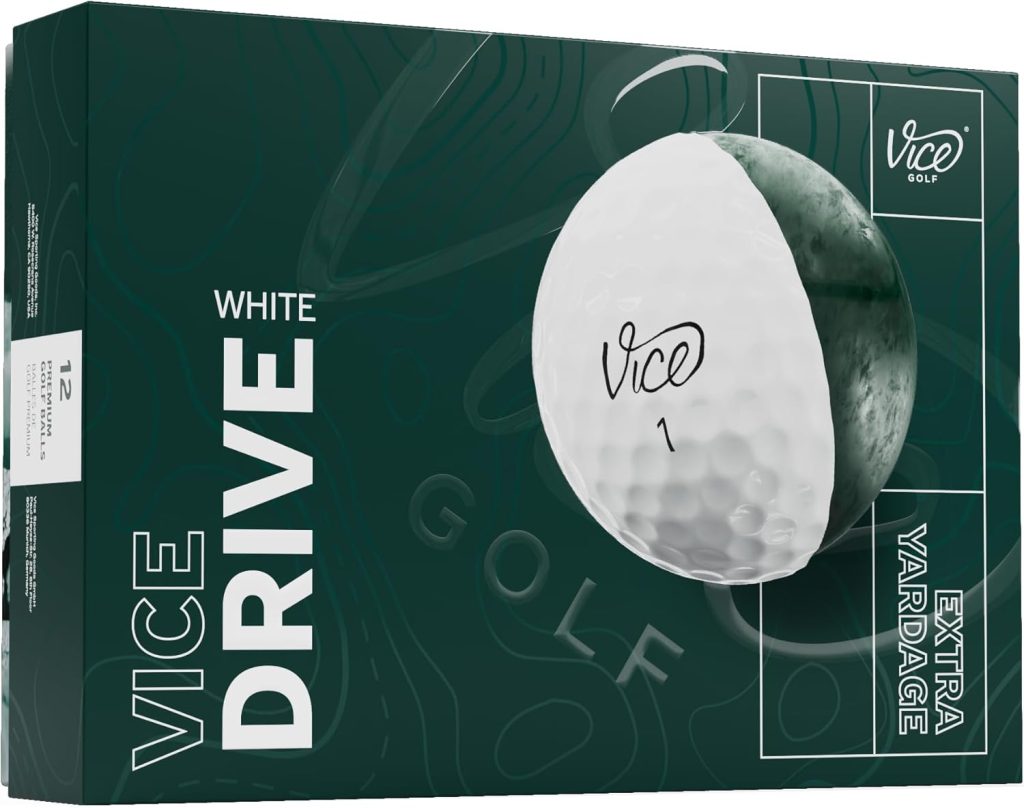
Best for: Golfers who want genuine distance ball performance at a mid-range price from a brand that sells direct | Price: ~$25/dozen | Compression: 55
The Vice Drive is one of the best distance golf balls in the mid-range price point, delivering quality construction at $25 per dozen without the retail margin that inflates the Velocity’s price.
The Soft Energy Core at 55 compression performs well across 75 to 90 mph swing speeds. In our testing, our 84 mph tester produced 6 yards carry improvement over his standard ball, less than the Velocity’s 9 yards, but close enough to justify the $5-per-dozen saving for a golfer who plays regularly.
The DuPont Surlyn cover produces a harder feel than the ERC Soft’s hybrid cover but softer than the Velocity’s NAZ+ cover.
It lands in the middle of the feel spectrum for this review, which suited our 84 mph tester who found the Velocity’s cover too firm but the Distance+ too soft for feedback on iron shots.
What we found in testing:
- 6 yards carry gain for our 84 mph tester, meaningful improvement at a competitive price
- Cover feel sits mid-spectrum: softer than Velocity, firmer than ERC Soft
- Vice direct pricing makes $25 per dozen genuinely competitive
- 55 compression is the correct range for 75 to 90 mph swing speeds
One honest weakness: Less brand recognition than Titleist or Callaway, which matters to some golfers. Performance justifies the unfamiliarity.
If the Velocity is $5 per dozen more than you want to spend and you swing between 75 and 90 mph, the Vice Drive closes most of the performance gap at a lower price.
5. Callaway Warbird 2025, Best Budget Distance Ball
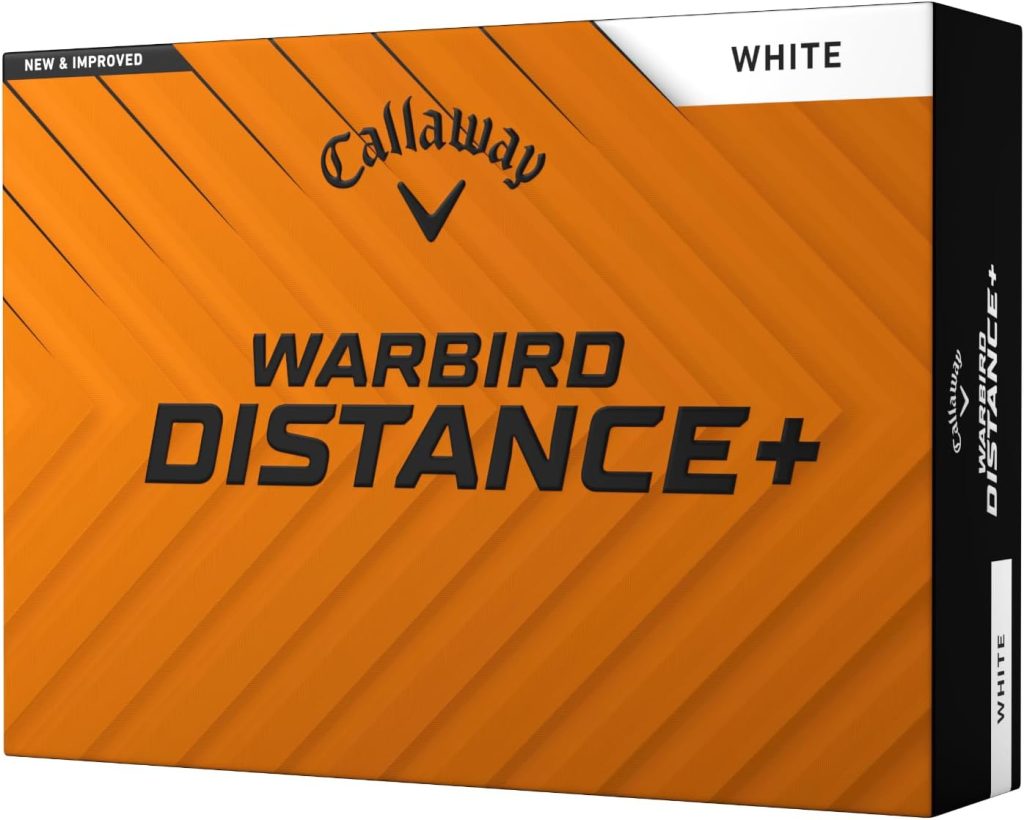
Best for: Golfers who want distance gains at under $2 per ball and lose multiple balls per round | Price: ~$22/dozen | Compression: 50
The Warbird is Callaway’s dedicated budget distance ball, and the 2025 update improved the core construction without increasing the price.
At 50 compression, it compresses well at slow to moderate swing speeds, and the HEX Aerodynamics dimple pattern produces the high-launch ball flight that creates carry distance.
In blind testing, our 72 mph tester produced carry distances with the Warbird within 3 yards of the Distance+, a ball that costs the same per dozen.
The choice between them is feel: the Warbird feels firmer at impact.
For golfers who lose three or more balls per round, the Warbird at $22 per dozen represents a rational budget decision.
The carry improvement over a premium compression-mismatched ball is real. The cost per lost ball is manageable.
What we found in testing:
- Carry within 3 yards of the Distance+ for our 72 mph tester, equivalent performance at the same price
- HEX Aerodynamics produced consistent high-launch ball flight across all conditions tested
- Firmer feel than the Distance+, some testers preferred the feedback, others did not
- At $22 per dozen, a rational choice for golfers who lose 3+ balls per round
One honest weakness: The firmest feel in this review. Golfers who want any greenside responsiveness should choose the ERC Soft instead.
If you need distance, lose balls frequently, and want a Callaway at a price that removes the guilt, the Warbird is the honest recommendation.
6. Srixon Distance, Best Pure Value Distance Ball
Best for: Golfers who want the lowest cost per ball in our test with acceptable performance | Price: ~$20/dozen | Compression: 70
The Srixon Distance is the most affordable ball in this test at $20 per dozen, and 70 compression makes it the stiffest.
That compression is still below the 90-compression tour balls that many average golfers mistakenly play, which means it still compresses more fully at 80 to 90 mph swing speeds than a Pro V1.
At 70 compression, it suits golfers at the upper end of the high handicap range and the lower end of mid handicap swing speeds.
In our testing, our 84 mph tester produced 4 yards carry improvement over his standard ball, less than the Velocity’s 9 yards, but meaningful for a ball that costs $10 per dozen less.
A golfer playing 30 rounds a year saves roughly $100 annually over the Velocity. The performance gap is 5 yards. That is a rational trade-off at this volume.
What we found in testing:
- 4 yards carry gain for our 84 mph tester, smaller than premium options but real
- At $20 per dozen, the lowest cost per ball with meaningful distance gains in our test
- 70 compression suits, 80 to 95 mph swing speeds specifically
- 338 Speed Dimple Pattern maintained stable flight in testing conditions
One honest weakness: At 70 compression, the Srixon Distance is not the right choice below 78 mph swing speed. The Distance+ or Warbird compresses more fully at those slower speeds.
If $20 per dozen is your ceiling and you swing between 80 and 95 mph, the Srixon Distance is the most defensible budget choice in this review.
How to Choose the Best Distance Golf Balls for Your Swing
Match Your Distance Golf Ball to Your Swing Speed
| Your Swing Speed | Best Distance Ball | Why |
|---|---|---|
| Under 75 mph | TaylorMade Distance+ or Callaway Warbird | 40–50 compression compresses fully. 14-yard gain possible. |
| 75–88 mph | Titleist Velocity or Vice Drive | 65 compression optimal. 6–9 yards gain expected. |
| 88–95 mph | Titleist Velocity or Callaway ERC Soft | 65 compression still works. ERC Soft if short game matters. |
| Above 95 mph | Callaway ERC Soft, or return to urethane | At this speed, distance balls offer minimal gain. Urethane gives better overall results. |
Should You Switch From a Tour Ball to a Distance Ball?
If your swing speed is below 90 mph and you currently play a Pro V1, TP5, or Chrome Soft, yes.
The compression mismatch is costing you carry distance without giving you the greenside spin benefits those balls deliver to faster swingers.
Switch to the Velocity or ERC Soft, play three rounds, and measure your driver carry distances. If they increase by more than 5 yards, the switch is justified.
If not, compression was not your limiting factor, and ball fitting on a launch monitor is the next step.
You want to keep short game spin, the ERC Soft is the bridge option. For golfers whose handicap has already dropped into the mid-range, our best golf balls for mid-handicappers guide covers the transition from distance balls to performance urethane. For the full picture across all ball types, see our master golf balls guide.
Distance Golf Balls by Budget
| Budget | Best Pick | Honest Assessment |
|---|---|---|
| Under $22/dozen | Srixon Distance ($20) or TaylorMade Distance+ ($22) | Real distance gains at low cost. Choose Srixon above 80 mph. Choose Distance+ below 78 mph. |
| $22–$30/dozen | Titleist Velocity ($30) or Vice Drive ($25) | Best performance-to-price in the distance category. Velocity is the benchmark. Vice Drive saves $5 per dozen with 6-yard carry gain at 84 mph. |
| $35–$40/dozen | Callaway ERC Soft ($40) | The best distance ball that still stops approach shots. Worth paying $10 more than the Velocity only if greenside control matters to your game. |
Frequently Asked Questions
The Titleist Velocity is the best overall distance golf ball for most golfers in 2026.
It produced the strongest carry gains across the widest swing speed range in our testing, 9 yards for our 84 mph tester.
For swing speeds below 78 mph, the TaylorMade Distance+ at 40 compression produced larger gains (14 yards for our 72 mph tester).
For the best distance ball that retains some greenside spin, the Callaway ERC Soft is the only option in this review that meaningfully bridges the distance/control trade-off.
It depends on your current ball and your swing speed.
In our testing, under 75 mph swing speed = 8 to 14 yards carry gain switching from a high-compression ionomer. 75 to 90 mph = 5 to 10 yards. Above 95 mph = 0 to 3 yards.
The biggest gains go to slower swingers who have been playing balls designed for tour swing speeds.
If you swing above 95 mph and already play a quality ball, a distance ball is unlikely to add meaningful carry.
Yes, all distance balls sacrifice some short game spin in exchange for lower driver spin.
The trade-off varies by ball. The Callaway ERC Soft has the smallest sacrifice in this review; its Hybrid Cover retains more greenside spin than the other distance balls we tested.
The TaylorMade Distance+ and Callaway Warbird have the largest sacrifice.
Before switching to a distance ball, consider whether you lose more strokes to short drives or to approach shots that do not stop.
If the answer is approach shots, a distance ball may not be the right upgrade.
A tour ball is designed for fast swing speeds (95 mph+), high compression (90+), maximum greenside spin, and precision feel.
A distance ball is designed for moderate swing speeds (65 to 90 mph), lower compression (34 to 70), maximum carry distance, and lower greenside spin.
At slower swing speeds, a distance ball gives you more distance and is the correct choice.
At faster swing speeds, a tour ball gives you more control and is the correct choice.
The mistake most average golfers make is playing a tour ball at a swing speed that they cannot use properly.
If your primary problem is not enough carry distance and your swing speed is below 85 mph, yes.
If your primary problem is direction, slicing, or missing fairways, a distance ball does not solve that problem.
For high handicappers whose main challenge is direction rather than distance, see our best golf balls for high handicappers guide, which covers balls specifically designed for the high handicapper’s full set of challenges, not just distance.
Final Verdict
The Titleist Velocity is the best distance golf ball for most golfers in 2026.
It delivers the largest carry gains across the widest swing speed range, at a price that is reasonable for a ball you will play regularly.
The TaylorMade Distance+ is the right choice if your swing speed is below 78 mph.
The ERC Soft is the right choice if you want distance gains without giving up all greenside control.
The Srixon Distance at $20 per dozen is the right choice if cost per ball is the primary consideration.
Before committing to a distance ball, be honest about where you lose strokes.
If your drives are already reaching fairways and the lost strokes come from approach shots and short game, a distance ball trades away short game capability for yards you cannot use.
If your drives are genuinely short and you lose strokes specifically to being 30 yards behind your playing partners on par fours, a distance ball is the most direct equipment fix available.
→ Titleist Velocity, check current price
→ TaylorMade Distance+ , check current price
→ Callaway ERC Soft, check current price
Also Read:
