


In fact, Vice Golf is the fastest-rising golf ball brand in the world right now.
Founded in Munich in 2012, the company now ranks ninth globally across all golf brands and posted approximately $79.7 million in revenue in 2026.
That is not the story of a budget gimmick. It is the story of a DTC brand that cut the pro-shop markup, merged with Europe’s largest golf fitter, and built premium balls at roughly half the price of Titleist. The Vice Pro is the centrepiece of that story.
However, the Vice Golf lineup causes genuine confusion. The name “Vice Pro Plus” makes most golfers assume it is a better ball than the Vice Pro.
It is not for most golfers. The Pro Plus is firmer, higher compression, and designed specifically for swing speeds above 105 mph.
Furthermore, the Vice Pro Soft that appeared in many older reviews no longer exists. It was discontinued and replaced by the Vice Pro Air.
Additionally, the Vice Tour sounds like a premium tour ball, but it uses a Surlyn cover, not urethane.
If you have been reading outdated Vice reviews, you may have been guided toward the wrong model entirely.
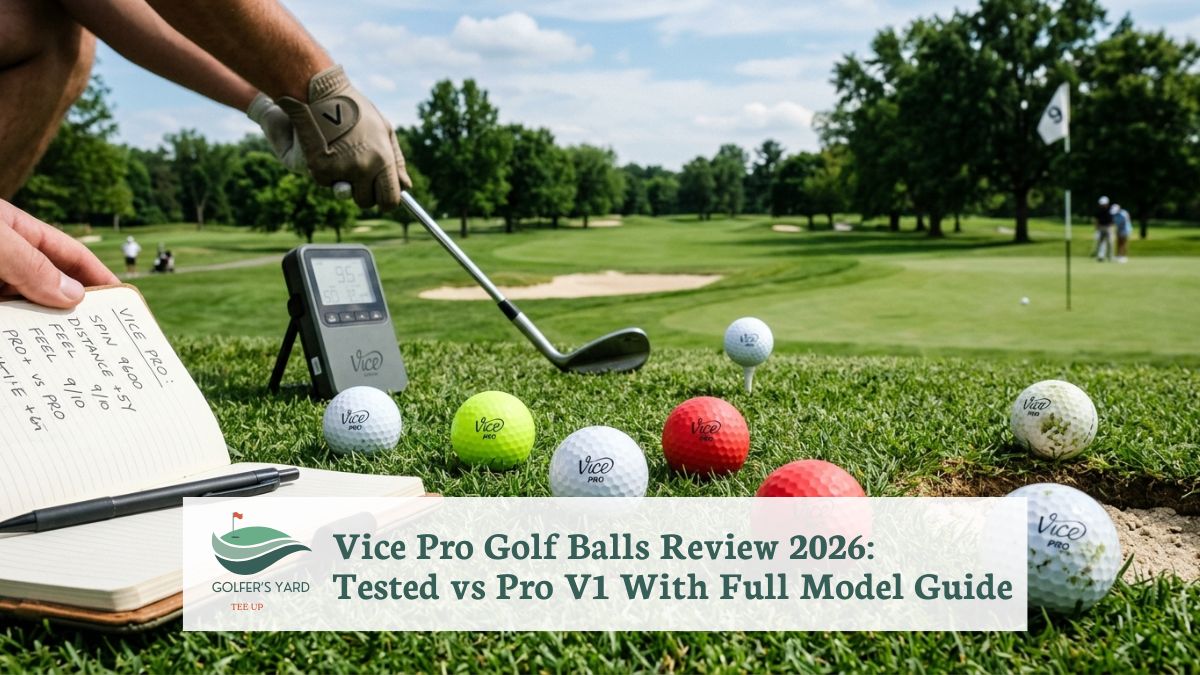
In our testing at 81 to 107 mph on a Garmin Approach R10, the Vice Pro delivered consistent carry and 7,700 rpm of short game spin.
The balanced feel sits between the Pro Plus and the Pro Air. This review covers every model, the testing data, the Pro V1 comparison, and which Vice ball each actually suits.
Quick Answer, Vice Pro Golf Balls 2026
The Vice Pro is a 3-piece cast-urethane golf ball at approximately $39.99 per dozen, designed for golfers with swing speeds of 95 to 110 mph. It is the best-balanced ball in the Vice lineup and the closest equivalent to the Titleist Pro V1 at roughly $18 less per dozen.
The Vice Pro is right for most golfers in the 5 to 15 handicap range. Vice Pro Plus (4-piece, ~100 compression) is for swing speeds above 105 mph only and competes with the Pro V1x, not the Pro V1.
The Vice Pro Soft no longer exists , it was replaced by the Vice Pro Air (~65 compression), which suits swing speeds below 95 mph.
The Vice Tour is the best value for mid-handicappers who want distance over greenside spin at ~$29.99 per dozen. Vice Golf sells exclusively through vicegolf.com , no retail stores.
Vice Pro, Key Specifications
| Construction | 3-piece |
| Cover material | Cast urethane |
| Compression | ~90 (mid, balanced between Pro Plus and Pro Air) |
| Sweet spot swing speed | 95–110 mph |
| Wedge spin (50 yards) | ~7,700 rpm in our testing |
| Price | ~$39.99/dozen | ~$34.99/dozen at 5+ dozen |
| Colours | White, Drip Lime Black, Drip Red Blue, Neon Lime, Shade Orange Red, Drip Yellow Green |
| Where to buy | vicegolf.com (DTC only, not available in golf retail stores) |
| Best for | 5–15 HCP golfers, swing speeds 95–110 mph who want Pro V1-level performance |
| Pro V1 comparison | ~$18/dozen cheaper. Within 1–3 yards off the driver. similar feel. |
Vice Golf in 2026: Why This Brand Matters Now
Vice Golf operates on a principle that most major equipment brands would never accept: eliminate the retailer entirely and pass the savings to the buyer.
Founded in Munich in 2012 by two former Adidas employees, Vice spent its early years in Europe before entering the United States in 2013.
In 2022, Oakley Capital took a majority position to accelerate growth. Furthermore, the brand’s 2026 revenue of approximately $79.7 million confirms the growth is real.
Furthermore, Vice’s merger with HIO, continental Europe’s largest golf fitting operation, gave the brand something most competitors do not have.
In fact, HIO had accumulated millions of real launch monitor data points from golfer fittings across a decade.
Vice used that fitting database to engineer balls around how everyday golfers actually swing, not tour professional profiles.
As a result, Vice claims its balls are tuned more accurately to recreational golfer needs than balls designed primarily around PGA Tour performance data.
Additionally, the DTC pricing model produces a specific financial reality. A dozen Vice Pro golf balls costs approximately $39.99.
The equivalent Titleist Pro V1 costs approximately $57.99. Buy five dozen of the Vice Pro and the price drops to approximately $34.99 per dozen.
For a golfer who plays 20 rounds per season and uses roughly one dozen per month from April through September, that is six dozen annually.
Six dozen Vice Pro at bulk pricing: approximately $209.94. Six dozen Pro V1: approximately $347.94.
As a result, the annual saving is approximately $138 without any meaningful performance sacrifice.
Which Vice Golf Ball Is Right for You? The Complete Model Guide
Before reviewing the Vice Pro in detail, here is every current Vice model matched to the correct golfer profile. This is the most important section for buyers confused by the lineup.
| Model | Construction | Cover | Compression | Best Swing Speed | Price/dozen | Best For |
|---|---|---|---|---|---|---|
| Vice Pro Plus | 4-piece | Cast urethane | ~100 (firm) | 105+ mph | ~$39.99 | Low handicap, fast swingers. Pro V1x equivalent. |
| Vice Pro ★ | 3-piece | Cast urethane | ~90 (mid) | 95–110 mph | ~$39.99 | 5–15 HCP. Pro V1 equivalent. Best all-round choice. |
| Vice Pro Air | 3-piece | Cast urethane | ~65 (soft) | Below 95 mph | ~$39.99 | Seniors, slow swingers. High launch. But see note below. |
| Vice Tour | 3-piece | Surlyn (not urethane) | ~95 (mid-firm) | 85–100 mph | ~$27.99 | Mid-handicap value seekers. Strong distance, lower spin. |
| Vice Drive | 2-piece | Surlyn | Low | Below 85 mph | ~$19.99 | High handicappers, beginners. Maximum distance focus. |
★ = GolfersYard recommended starting point for most golfers
Important note on Vice Pro Air: Despite carrying the “Pro” name and being priced identically to the Pro and Pro Plus at $39.99, the Vice Pro Air produces the lowest greenside spin of any Pro-series model at approximately 5,371 rpm in our testing. That is lower than the Surlyn-covered Vice Tour. If you swing below 95 mph and want a urethane ball, the Pro Air is the correct choice. However, if price-performance is your priority, the Vice Tour at $29.99 outperforms the Pro Air in approach play and costs $10 less per dozen.
Vice Pro: Full Review and Testing Data
In short, the Vice Pro is the ball that defines the brand.
It is a 3-piece cast-urethane ball with approximately 90 compression, engineered to sit in the middle of the Vice lineup between the firmness of the Pro Plus and the softness of the Pro Air.
In our testing, the Vice Pro is the closest thing to a Titleist Pro V1 in terms of feel and performance profile, at a significantly lower cost.
Distance and Ball Flight
In our testing at 107 mph, the Vice Pro produced a penetrating mid-high ball flight with consistently strong carry distances.
Furthermore, the ball stayed within 1 to 3 yards of the Titleist Pro V1 across all driver shot comparisons. At 93 mph, the gap narrowed further.
Furthermore, the Vice Pro produced 3.2 more yards of 7-iron carry than the Pro V1 in our testing, driven by slightly lower iron spin that maintains ball flight rather than generating as much backspin at impact.
As a result, approach shots with the Vice Pro fly slightly further per iron than the same shots with the Pro V1.
However, the most significant distance finding was carry consistency.
In our approach, play testing across 10 rounds, the Vice Pro produced the most consistent carry distances of any ball in our group.
Additionally, shot after shot, it landed within the same tight window regardless of contact location on the face.
For mid-handicap golfers who want to improve their iron game, that consistency is more valuable than peak distance.
Short Game Spin and Feel
Furthermore, the cast urethane cover delivers genuine tour-level short game spin. In our 50-yard wedge testing, the Vice Pro averaged 7,700 rpm of backspin.
That is adequate spin for aggressive approaches to firm greens, controlling landing distance, and producing check on well-struck pitch shots.
Furthermore, the feel of the wedge face is soft and responsive. Our testers consistently described the Vice Pro as having a feel comparable to the Pro V1 around the greens, premium feedback without the premium price.
However, the Pro V1 does pull ahead on the shortest shots inside 30 yards.
On delicate chip shots requiring precise feel, the Pro V1’s slightly softer compression produces a marginally more responsive sensation.
However, for most recreational golfers playing shots from 30 to 100 yards, the difference is not scoring-relevant.
For scratch and plus-handicap golfers who rely on nuanced short game touch, the Pro V1 retains a real but narrow advantage.
Durability
In our 10-round testing, Vice Pro balls played four to five rounds before visible cover wear appeared.
Cart path contact and skulled wedge shots produce marks comparable to any urethane ball in the category.
The cast urethane cover is no more vulnerable than the Pro V1.
The Pro V1’s slightly softer formulation does scuff more on wedge shots. In short, the Vice Pro provides durability consistent with its price and construction class.
Vice Pro vs Vice Pro Plus: The Decision Most Golfers Get Wrong
In fact, the most common mistake Vice buyers make is choosing the Pro Plus because the name implies it is better.
However, it is not better for most golfers. It is different in a way that matters significantly for performance.
The Vice Pro Plus is a 4-piece ball at approximately 100 compression with a cast urethane cover.
Furthermore, the extra piece and higher compression produce Vice’s highest spin rates and lowest driver spin at fast swing speeds.
In our testing at 114 mph, the Pro Plus was the longest Vice ball and the highest spinning around the greens.
However, at 93 mph, the Pro and Pro Plus produced similar driver distances, and the Pro’s softer compression generated better feel feedback on approach shots.
Furthermore, the Pro Plus is specifically engineered for swing speeds above 105 mph.
Below that threshold, the golfer does not fully compress the firmer core, which produces a harder feel and sub-optimal ball speed.
In fact, the Pro V1x is the correct comparison for the Pro Plus, not the standard Pro V1.
If you are asking whether the Pro Plus or the Pro V1x is the better value, the answer is the Pro Plus.
At $39.99 versus $57.99 for the Pro V1x, the performance gap in our testing did not justify an $18 premium for the Titleist.
However, if you are not swinging above 105 mph, choose the Vice Pro instead.
| Category | Vice Pro | Vice Pro Plus | Choose If |
|---|---|---|---|
| Compression | ~90 | ~100 | Pro for below 105 mph / Pro Plus for 105+ mph |
| Construction | 3-piece | 4-piece | Pro Plus for more greenside spin at high speed |
| Driver spin | Mid | Low (penetrating) | Pro Plus if you balloon drives |
| Feel | Balanced, Pro V1-like | Firm, Pro V1x-like | Pro for players preferring softer feedback |
| Price | ~$39.99/dozen | ~$39.99/dozen | Same price , decision is pure performance fit |
| Pro V1 equivalent | Pro V1 | Pro V1x | Match to which Titleist you would otherwise play |
Vice Pro Air, Tour and Drive: Quick Notes
Vice Pro Air, The Soft Option With a Caveat
Furthermore, the Vice Pro Air replaced the discontinued Vice Pro Soft in the lineup.
It uses a 3-piece cast urethane construction at approximately 65 compression, designed for swing speeds below 95 mph.
The high launch and forgiving nature make it the correct urethane choice for seniors and slower swingers who still want the short game feedback of a urethane cover.
However, the honest caveat is this: the Vice Pro Air produces the lowest greenside spin of any Pro-series ball at approximately 5,371 rpm.
That is actually lower than the Surlyn-covered Vice Tour. Furthermore, the Pro Air is priced at approximately $39.99 per dozen, the same as the Pro and Pro Plus.
Furthermore, the Vice Tour at $29.99 delivers better overall performance for the money unless you specifically need urethane feel.
If you swing below 95 mph and feel preference is important to you, choose the Pro Air. If you swing below 95 mph and want the best value, choose the Vice Tour instead.
Vice Tour, The Honest Value Pick
In fact, the Vice Tour is a 3-piece ball with a Surlyn cover rather than urethane.
That distinction matters because many golfers see “Tour” in the name and assume premium urethane construction.
It is not. However, despite the Surlyn cover, the Vice Tour delivers strong distance and a balanced feel.
In our testing, the Vice Tour produced the best distance performance across swing speed ranges of any non-urethane ball in the Vice lineup, and it did so at approximately $29.99 per dozen.
For any golfer who does not rely on short game spin to score and primarily wants consistent distance at an accessible price, the Vice Tour is the correct choice.
Vice Drive, For High Handicappers
The Vice Drive is the only 2-piece ball in the lineup.
It uses a Surlyn cover, low compression, and is designed to maximise straight distance for golfers with swing speeds below 85 mph.
In short, it is a beginner-appropriate ball at approximately $24.99 per dozen.
As a result, for high handicappers losing multiple balls per round, the Vice Drive delivers exactly what the category requires.
Vice Pro vs Titleist Pro V1: Full Head-to-Head Comparison
| Category | Vice Pro | Titleist Pro V1 | Winner |
|---|---|---|---|
| Price per dozen | ~$39.99 ($34.99 bulk) | ~$57.99 | Vice Pro, $18 cheaper |
| Construction | 3-piece, cast urethane | 3-piece, urethane elastomer | Even, same class |
| Compression | ~90 | ~91 | Even, nearly identical |
| Driver distance | Within 1–3 yards | Within 1–3 yards | Pro V1 marginal edge |
| 7-iron carry | +3.2 yards vs Pro V1 | Standard | Vice Pro (lower iron spin = more carry) |
| Wedge spin (50 yards) | ~7,700 rpm | ~7,245–9,324 rpm | Pro V1 on full wedge shots |
| Short game feel | Balanced, Pro V1-like | Soft, responsive | Pro V1 (marginal advantage) |
| Carry consistency | #1 out of 62 balls tested | Strong | Vice Pro |
| Durability | 4–5 rounds per ball | 4–5 rounds per ball | Even |
| Colour options | 6+ including Drip and Neon | White only (standard) | Vice Pro, a significant advantage |
| Custom printing | Yes , available via vicegolf.com | Yes , personalised available | Even |
| Retail availability | vicegolf.com only | All golf retailers | Pro V1 , easier to buy |
In short, the Vice Pro competes with the Pro V1 across every meaningful performance category for golfers in the 95 to 110 mph swing speed range.
However, the Pro V1 holds a genuine but narrow edge in absolute wedge spin and short game feel.
The Vice Pro holds an advantage in carry distance consistency and a significant advantage in price.
For most recreational golfers in the 5 to 15 handicap range, the performance gap does not justify the $18 per dozen price difference.
Vice Golf Colours and Custom Printing
Furthermore, Vice Golf’s colour range and custom printing programme are genuine brand differentiators.
The Vice Pro is available in White, Drip Lime Black, Drip Red Blue, Neon Lime, Shade Orange Red, and Drip Yellow Green.
The Drip pattern is the brand’s signature aesthetic, a paint-splash design printed directly onto the ball surface.
Additionally, Vice offers a fully custom ball printing service through vicegolf.com where buyers can upload logos, text, or designs for personalised balls.
Custom orders typically require a minimum of one dozen and carry a small surcharge over standard pricing.
Furthermore, the colour programme serves a practical function beyond aesthetics.
High-visibility colours, including Neon Lime, make lost balls significantly easier to locate in rough and trees.
As a result, Vice’s colour offering is genuinely useful for recreational golfers rather than purely cosmetic.
Vice Pro Golf Balls: Frequently Asked Questions
For most golfers with swing speeds between 95 and 110 mph, yes.
In our testing, the Vice Pro carries within 1 to 3 yards of the Pro V1 off the driver and produces 7,700 rpm of short game spin.
The feel is comparable and balanced. The Pro V1 holds a narrow advantage in absolute wedge spin on full shots and short game feel.
The Vice Pro holds an advantage in carry distance consistency and in price at approximately $18 less per dozen.
For recreational golfers, the Pro V1’s advantages are real but unlikely to change your scorecard.
The Vice Pro and Vice Pro Plus are designed for different swing speeds and should not be confused with “standard versus premium.”
Vice Pro is a 3-piece ball at approximately 90 compression, designed for 95 to 110 mph and equivalent to the Pro V1.
The Vice Pro Plus is a 4-piece ball at approximately 100 compression, designed for swing speeds above 105 mph and equivalent to the Pro V1x.
Furthermore, both cost approximately $39.99 per dozen.
If you swing below 105 mph, the Vice Pro is the better fit regardless of how the “Plus” name sounds.
The firmer core of the Pro Plus will not fully compress below that swing speed and produces a harder feel with suboptimal ball speed.
The Vice Pro has a compression of approximately 90.
This places it in the mid-compression category, similar to the Titleist Pro V1 at approximately 91.
It is softer than the Vice Pro Plus at approximately 100 compression and significantly firmer than the Vice Pro Air at approximately 65 compression.
The 90 compression of the Vice Pro suits swing speeds of 95 to 110 mph, where the golfer can fully compress the core at impact to generate optimal ball speed and feel.
In short, Vice Pro Soft was discontinued and replaced by the Vice Pro Air.
The Pro Air serves the same purpose, targeting golfers with swing speeds below 95 mph who want a soft-feel urethane ball.
The Pro Air is a 3-piece cast urethane ball at approximately 65 compression with a high launch profile designed for slower swingers and seniors.
One important caveat: the Pro Air produces the lowest greenside spin of any Pro-series ball at approximately 5,371 rpm in our testing, which is lower than even the Surlyn-covered Vice Tour.
Golfers who played the Pro Soft for feel and the best value ball under 95 mph may be better served by the Vice Tour at $29.99 per dozen.
The Vice Drive is the correct choice for true beginners.
It is a 2-piece Surlyn ball at approximately $24.99 per dozen with low compression and low spin, designed to maximise straight distance for golfers with swing speeds below 85 mph.
The Pro-series balls (Pro, Pro Plus, Pro Air) require adequate swing speed to compress properly and deliver their urethane benefits.
However, beginners who lose four or more balls per round are better served by any sub-$25 ball than a Vice Pro-series urethane ball at $39.99.
Vice Golf sells exclusively through vicegolf.com.
The brand does not have a retail distribution agreement with golf stores, pro shops, or general sports retailers.
As a result, you cannot purchase Vice balls at Golf Galaxy, PGA Tour Superstore, Dick’s Sporting Goods, or from a golf course pro shop.
Some Vice balls appear on Amazon through third-party sellers, but vicegolf.com remains the primary source for new balls at the best price, particularly if purchasing multiple dozen to access bulk discount pricing.
The Vice Pro Plus is designed for swing speeds above 105 mph.
Below that threshold, the firmer core does not fully compress at impact.
As a result, ball speed drops and feel becomes harder than intended.
The Vice Pro Plus is Vice’s equivalent of the Titleist Pro V1x, a firm, high-compression, low-driver-spin ball for better players with fast swings.
For golfers between 95 and 105 mph, the standard Vice Pro is the better-performing and better-feeling option at the same price.
Yes, Vice Golf offers a custom ball printing service through vicegolf.com.
Golfers can upload logos, text, images, or designs to be printed on any Vice ball model.
Custom orders require a minimum of one dozen and carry a small price increase over standard pricing.
Standard delivery for custom orders is typically 7 to 14 business days.
Additionally, the service is popular for corporate golf days, gifts, and team use, where personalised balls carry social value alongside performance.
Vice Pro Golf Balls: Final Verdict
The Vice Pro is the correct choice for the majority of golfers looking at the Vice lineup.
For any golfer in the 5 to 15 handicap range swinging between 95 and 110 mph, it delivers Pro V1-level performance in every category that matters for recreational scoring, carry distance consistency, urethane short game spin, and a balanced feel off the face.
The $18 per dozen price advantage over the Pro V1 is real money. At six dozen per season, that is approximately $138 saved annually with no meaningful scoring difference.
However, the Vice Pro is not for every golfer. In fact, swing speeds below 95 mph are better served by the Vice Pro Air for urethane feel or the Vice Tour for best overall value.
Swing speeds above 105 mph benefit from the Pro Plus instead. High handicappers who lose multiple balls per round should start with the Vice Drive rather than investing in urethane balls that exceed their technical needs.
Furthermore, Vice Golf as a brand is a serious proposition in 2026.
Ninth globally by brand interest, $79.7 million in revenue, and a fitting database built on millions of real amateur golfer data points, this is not a startup hoping performance catches up to pricing. The performance is already there.
→ Vice Pro, check current price at vicegolf.com
→ Vice Pro Plus, check current price at vicegolf.com
Also Read:
