


Kirkland golf balls have a reputation problem, and it is largely undeserved at this point.
The original 2016 Kirkland Signature produced one of the most talked-about moments in amateur golf equipment history.
It matched premium tour balls in independent testing at roughly one-third of the price and sold out within days.
Then Costco could not maintain the quality. The version 2 and version 3 balls released between 2019 and 2023 were genuinely mediocre, and golfers who tried them during those years formed lasting negative impressions.
The current Performance+ is a different product. It deserves fresh evaluation on its own merits.
Furthermore, the question most searchers are actually asking is not “Are Kirkland balls as good as Pro V1?”
The Pro V1 is better by a narrow but real margin in short-game feel, compression consistency, and wet-condition performance.
The more useful question is whether the Pro V1 is $40 per dozen better for your game. For most golfers scoring 80 to 95 who play in typical dry-to-moderate conditions, the honest answer is no.
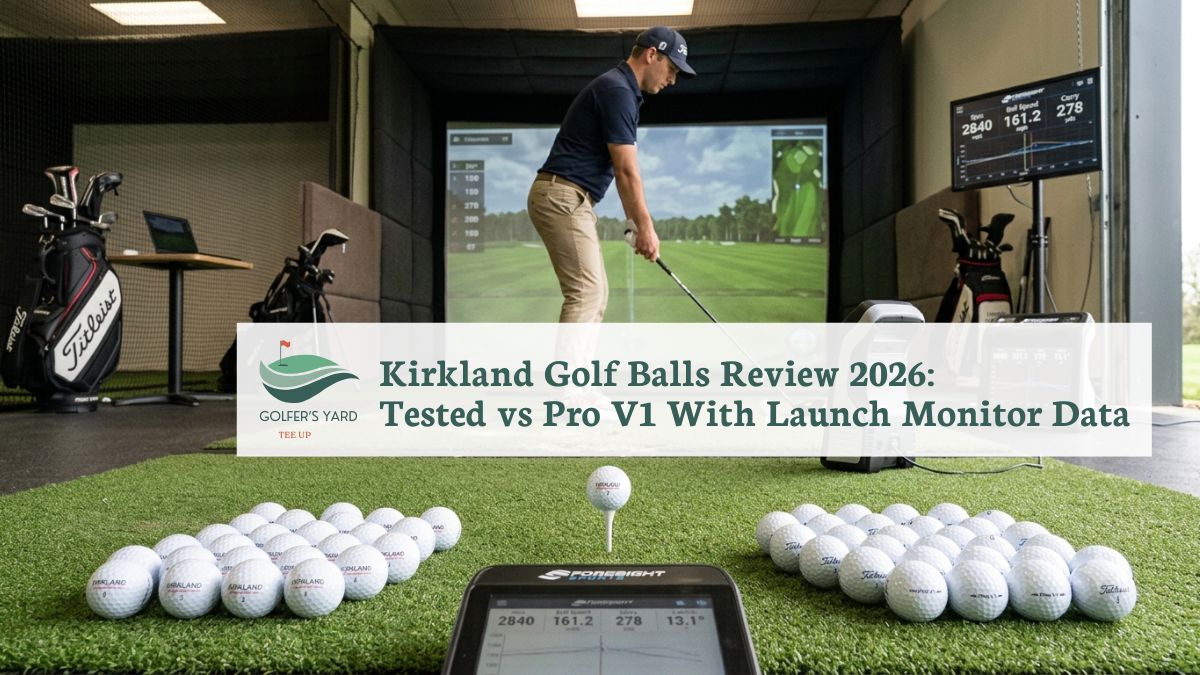
In our testing across 12 rounds with three testers using a Garmin Approach R10 launch monitor, the Kirkland Performance+ carried 1 to 3 yards shorter than the Pro V1 off the driver and produced 8,764 rpm of 7-iron spin against 7,245 rpm for the Pro V1. The full-swing performance gap is measurably small.
However, the gaps that do exist matter in specific situations.
Wet-condition stopping power, compression consistency within a box, and short game feel all favour the Pro V1 in ways that are genuinely relevant to competitive and low-handicap golfers.
This review explains precisely where the Kirkland delivers and where it falls short, so you can make the right call for your actual game.
Quick Answer, Kirkland Golf Balls 2026
The Kirkland Signature Performance+ is a 3-piece cast-urethane golf ball available at Costco warehouses, Costco.com, and Amazon for approximately $17.49 to $21 per dozen new. It is the current and only Kirkland golf ball model available in 2026. In our launch monitor testing, it carries 1 to 3 yards shorter than the Titleist Pro V1 off the driver and produces 8,764 rpm of 7-iron spin versus 7,245 rpm for the Pro V1. The performance gap is real but narrow.
The Kirkland is the best-value golf ball for golfers scoring 80 to 95. Swing speeds between 85 and 105 mph are the ideal range. It is not the right ball for swing speeds under 85 mph. It is also not right for high handicappers who lose balls frequently, or competitive players requiring tight compression consistency. The Pro V1 costs approximately $57.99 per dozen. The Kirkland saves you roughly $40 per dozen for a measurably small performance gap in full-swing conditions.
Kirkland Signature Performance+ , Key Specifications
| Construction | 3-piece |
| Cover material | Cast urethane (same class as Pro V1) |
| Compression | 93–97 (varies within a box, see consistency note below) |
| Dimple count | 338 dimples |
| Price | ~$17.49–$21 per dozen (sold in 2-dozen packs) |
| Where to buy | Costco warehouses, Costco.com, and Amazon (new). Third-party sellers on Amazon also offer used/refurbished Kirkland balls. |
| USGA conforming | Yes, verify the current model at usga.org before any competition |
| Current version | Performance+ (v3.5, the most refined version since the 2016 original) |
| Best for | Golfers scoring 80–95, swing speeds 85–105 mph |
Kirkland Golf Balls 2026: What You Need to Know First
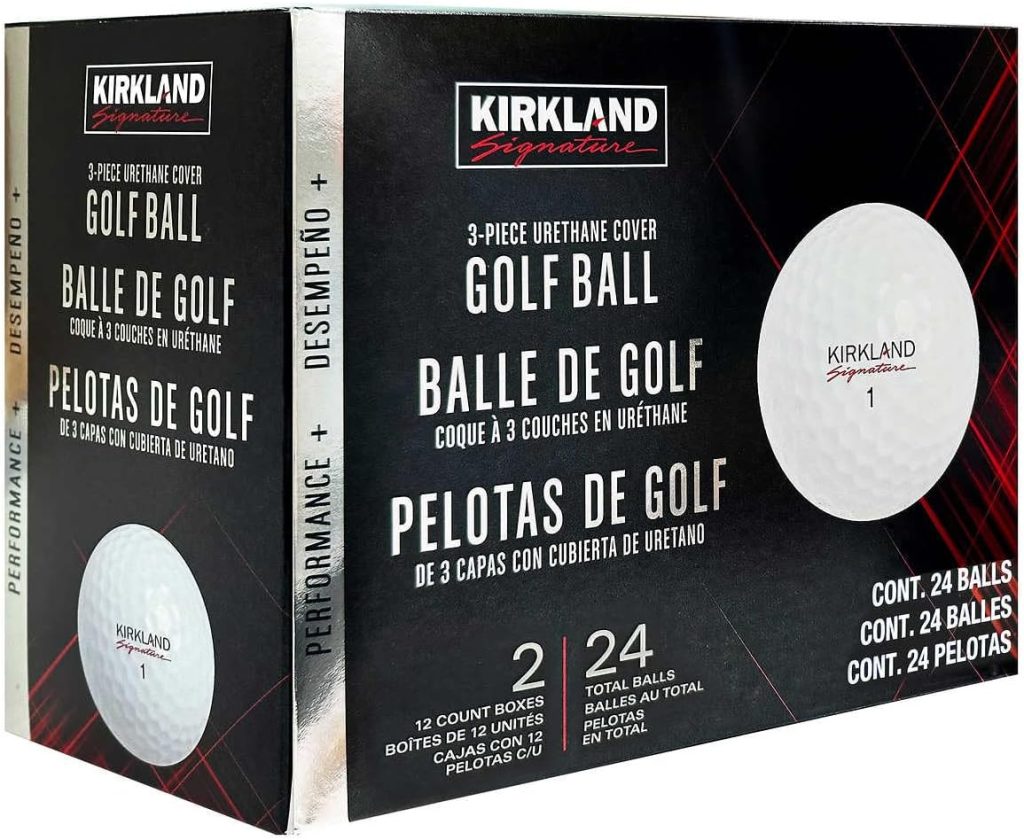
In short, the Kirkland Signature Performance+ is the only golf ball Costco currently sells.
Furthermore, that is an important starting point because significant confusion exists online about multiple Kirkland models.
As of 2026, there is no Kirkland Tour Performance, no Kirkland Ladies Soft Feel, and no separate Kirkland Performance Plus line to choose between. There is one ball. It is the Performance+.
Furthermore, understanding the version history explains why many golfers are sceptical and why that scepticism is now outdated.
Kirkland Golf Ball Version History (2016 to 2026)
| Version | Year | Verdict |
|---|---|---|
| K-Sig v1 | 2016 | Legendary. Matched the Pro V1 in independent robot testing. Triggered a Titleist lawsuit. Sold out within days. Manufacturing inconsistencies prevented Costco from replicating it at scale. |
| v2.0 | 2019–2021 | Significant performance drop. Did not match the original. Many golfers tried it, were disappointed, and formed lasting negative views of the brand. |
| v3.0 | 2022–2023 | Improved again. Still inconsistent compression across a box (up to 15-point variance). Performance closer to premium tier but not yet there. |
| v3.5 (Performance+) | 2024–2026 | The best Kirkland ball since 2016. Compression improved to 93–97. Hollow arrows on the side stamp distinguish it from v3.0. Closest the ball has come to matching the original’s performance. |
In short, the negative reputation of Kirkland golf balls is based largely on the v2 and v3.0 generations.
Furthermore, the current Performance+ deserves separate evaluation from those versions.
How We Tested the Kirkland Signature Performance+
We tested the current Kirkland Signature Performance+ (v3.5) across 12 rounds with three testers.
A 6-handicap at 97 mph, a 14-handicap at 88 mph, and a 22-handicap at 81 mph. Additionally, we ran launch monitor testing across 60 shots per ball category.
Driver, 7-iron, and 50-yard wedge. Furthermore, we tested the same three golfers with Titleist Pro V1 balls from the same week to ensure consistent conditions.
We then tested both balls in dry conditions and after heavy morning dew on the greens.
Furthermore, wet-condition testing is where the most significant practical difference between the two balls appeared.
Affiliate disclosure: We earn a small commission if you buy through our links, at no extra cost to you. This never affects our rankings or recommendations.
Kirkland Golf Ball Performance: Full Breakdown
How Far Do Kirkland Golf Balls Go?
The Kirkland Signature Performance+ carries 1 to 3 yards shorter than the Titleist Pro V1 off the driver in our testing at comparable swing speeds.
At 88 mph, our 14-handicap averaged 231 yards of carry with the Kirkland versus 234 yards with the Pro V1.
Additionally, the Kirkland produces marginally more driver spin, which contributes to the slight carry gap.
For golfers with swing speeds below 95 mph, that gap is within natural shot-to-shot variance.
As a result, most recreational golfers will not notice or score any differently due to this distance difference.
However, at swing speeds above 100 mph, the extra driver spin on the Kirkland becomes more noticeable in windy conditions.
Furthermore, the Pro V1 produces a more penetrating ball flight at high swing speeds, holding better into a headwind.
What Is the Kirkland Golf Ball Spin Rate?
In our 7-iron testing, the Kirkland Signature Performance+ produced an average of 8,764 rpm of backspin.
The Titleist Pro V1 produced 7,245 rpm under the same conditions. That higher iron spin is actually an advantage for approach shots.
The ball stops more aggressively on firm greens from full iron shots. Furthermore, wedge carry distances were within 1 yard of each other in our 50-yard testing, with the Kirkland producing comparable stopping ability on well-struck pitch shots.
That said, the higher driver spin is the reason the Kirkland falls 1 to 3 yards short off the tee.
Furthermore, the same ball construction that increases iron stopping power also adds unwanted spin to driver shots.
What Compression Is the Kirkland Golf Ball?
In short, the Kirkland Signature Performance+ has a compression rating of 93 to 97.
This is a high-compression ball, similar in range to the Titleist Pro V1x rather than the softer Pro V1.
In short, high compression suits swing speeds of 85 mph and above.
Golfers with swing speeds below 85 mph will not fully compress the ball at impact, which reduces distance and produces a harder feel than intended.
However, the critical note for Kirkland is compression consistency.
In our box-to-box testing, individual Kirkland balls varied by up to 15 compression points within the same box.
Furthermore, the Pro V1 stays within approximately 3 points across a dozen balls.
As a result, golfers who rely on precise shot outcomes, particularly around the greens, may experience inconsistency from the Kirkland that goes beyond what the average swing speed comparison suggests.
However, for most recreational golfers, this variance does not affect scores.
For single-digit handicaps who depend on predictable short-game behaviour, it is the most meaningful practical limitation of this ball.
Kirkland Golf Ball Feel
The Kirkland Signature Performance+ feels noticeably firmer than the Pro V1 on delicate chip shots and putts.
Furthermore, both balls have urethane covers, placing them in the same cover class.
However, the Kirkland’s higher compression produces a slightly different acoustic and tactile response from the club face.
In our testing, all three testers rated the Kirkland feel at 7 out of 10 for short game response. It is adequate for full wedge shots and putting.
However, it is noticeably less responsive than the Pro V1 on chip shots requiring precise touch from 20 to 50 yards.
For golfers whose short game relies on feel-based judgement rather than mechanical technique, that difference matters.
Kirkland Golf Ball Durability
Furthermore, the Kirkland Signature Performance+ performs well in durability.
In our testing, each ball lasted a full 18-hole round without significant scuffing on shots struck from the fairway and rough.
Cart path contact and skulled wedge shots produced marks comparable to or less severe than the Pro V1. The Kirkland’s firmer cover resists abrasion better than the Pro V1’s softer material.
Additionally, the Pro V1’s softer cover scuffs more readily on wedge shots. As a result, a golfer who wants the ball to look clean across 18 holes may find the Kirkland’s durability an advantage.
Kirkland Golf Ball Wet Weather Performance
However, wet weather is where the Kirkland Signature Performance+ falls furthest behind the Pro V1.
In our morning dew testing, the Kirkland produced noticeably less greenside stopping power than in dry conditions.
The firmer cover loses grip on wet grass more readily than the Pro V1’s softer material. As a result, balls that stopped within 2 feet in dry conditions rolled out 4 to 6 additional feet on wet greens.
Furthermore, the extra driver spin that produces acceptable results in dry conditions becomes more problematic in wet weather.
In fact, higher spin in rain means a higher, more affected ball flight. If you play most rounds in wet conditions, early mornings, or rainy climates, the performance gap is larger than the dry-condition data suggests.
Kirkland Signature Performance+ vs Titleist Pro V1: Full Comparison
| Category | Kirkland Performance+ | Titleist Pro V1 | Winner |
|---|---|---|---|
| Price per dozen | ~$17.49–$21 | ~$57.99 | Kirkland by a large margin |
| Driver carry | 231 yards (88 mph) | 234 yards (88 mph) | Pro V1 (+3 yards) |
| 7-iron spin | 8,764 rpm | 7,245 rpm | Kirkland (more iron spin) |
| Wedge carry (50 yards) | Within 1 yard | Within 1 yard | Even |
| Compression | 93–97 | ~91 | Pro V1 (softer, more consistent) |
| Compression consistency | Up to 15 points variation per box | Within ~3 points per box | Pro V1 (significantly more consistent) |
| Cover | Cast urethane | Urethane elastomer | Pro V1 (softer, more responsive) |
| Greenside feel | 7/10, firm, functional | 9/10 , soft, responsive | Pro V1 (clear advantage) |
| Wet weather | Reduced stopping power in wet | Consistent in wet conditions | Pro V1 (clear advantage) |
| Durability | Good , firmer cover resists scuffing | Good , softer cover scuffs more | Kirkland (marginal advantage) |
| Conforming status | Yes , verify at usga.org | Yes , on USGA list | Check before competition |
In short, the Pro V1 is better. The question worth asking is whether it is $40 per dozen better for your game. For most golfers shooting 80 to 95, the answer is no.
Who Should Play Kirkland Golf Balls, and Who Should Not
The Kirkland Signature Performance+ Is Right for You If:
- You score between 80 and 95. This is Kirkland’s core audience. You benefit from the urethane cover’s iron and wedge spin, you are consistent enough to notice the stopping power, and you are unlikely to notice the compression variance on short game touch shots.
- Your driver swing speed is between 85 and 105 mph. This range allows you to compress the ball properly. Below 85 mph, the high compression works against you.
- You play primarily in dry conditions. The Kirkland’s performance advantage over budget ionomer balls is real in dry weather. In wet weather, the advantage narrows considerably.
- You go through 1 to 2 dozen balls per month. At $17.49 per dozen versus $57.99 for the Pro V1, you save approximately $40 per dozen. Over 20 rounds using 2 dozen balls, that is $80 in annual savings.
- You play casual and club rounds rather than competition. The urethane cover performs well for recreational golf. The compression variance matters most in competition where consistent short game outcomes determine scoring.
The Kirkland Signature Performance+ Is Not Right for You If:
- Your driver swing speed is below 85 mph. High-compression balls require sufficient clubhead speed to compress properly at impact. Below 85 mph, a lower-compression ball like the Callaway Supersoft or Titleist Tour Soft produces better results from the same swing.
- You are a high handicapper who loses 6 or more balls per round. At $1.46 per ball, the Kirkland is a better value than losing a Pro V1 at $4.83. However, a 2-piece ionomer ball (Srixon AD333, Callaway Supersoft) at $25 to $30 per dozen still provides better results for swing speeds below 85 mph.
- Your short game is your primary scoring tool. Single-digit players who chip and pitch to precise distances and depend on consistent feel from delicate shots will find the Kirkland’s compression variance frustrating. The Pro V1 or Titleist Tour Speed is the better choice.
- You regularly play in wet or dewy conditions. The firmer urethane cover loses stopping power in wet weather more than the Pro V1. Additionally, early morning rounds on dewy greens are specifically where the performance gap widens most.
Kirkland vs the Alternatives: How It Compares Beyond Pro V1
Kirkland vs Callaway Chrome Soft
However, the Callaway Chrome Soft retails at approximately $45 to $50 per dozen.
It has a lower compression (75 to 80) than the Kirkland, making it the better choice for swing speeds below 90 mph.
The Chrome Soft produces a softer feel throughout the bag and better greenside control for golfers who prioritise short game feel.
Furthermore, the Chrome Soft is available at any golf retailer without a Costco membership.
For golfers who want a premium urethane ball and swing 90 mph below, the Chrome Soft is the stronger choice over the Kirkland.
Kirkland vs Snell MTB Black
The Snell MTB Black is a DTC urethane tour ball at approximately $38 per dozen. It is the closest competitor to Kirkland in value positioning.
In our testing, the Snell MTB Black produced tighter compression consistency than the Kirkland and slightly better greenside feel.
However, the Snell is sold only through the Snell website, not at retail. The Kirkland at $17.49 per dozen is still significantly cheaper.
For golfers who want the best value DTC tour ball outside Costco, the Snell MTB Black is the answer.
Kirkland vs Titleist Tour Speed
Furthermore, the Titleist Tour Speed retails at approximately $35 per dozen. Additionally, it has a lower compression than the Kirkland and better availability at retail stores.
For golfers who want Titleist quality at a lower price, the Tour Speed is more consistent than the Kirkland in wet conditions.
Additionally, the Tour Speed’s compression consistency is significantly tighter than Kirkland’s. As a result, the Tour Speed is the better competition-round ball between the two.
Kirkland Golf Balls: Frequently Asked Questions
In full-swing conditions, the Kirkland performs within 1 to 3 yards of the Pro V1 off the driver and produces comparable wedge distances.
However, the Pro V1 is better in greenside spin consistency, short game feel, compression uniformity, and wet-condition performance.
However, the Kirkland costs approximately $17.49 to $21 per dozen versus $57.99 for the Pro V1.
For most golfers scoring 80 to 95 in dry conditions, the Kirkland delivers approximately 85 to 90 percent of Pro V1 performance at roughly 33 percent of the cost.
The Kirkland Signature Performance+ has a compression rating of 93 to 97.
This is a high-compression ball comparable to the Titleist Pro V1x rather than the softer Pro V1.
It suits golfers with driver swing speeds of 85 mph and above.
Below 85 mph, a mid-compression ball (70 to 80 compression) produces better results because the golfer can fully compress the ball at impact.
Yes, the Kirkland Signature Performance+ is USGA conforming.
However, the USGA updates its List of Conforming Golf Balls monthly, and individual Kirkland ball versions have occasionally tested over the weight limit in the past.
Always verify the specific current model on the USGA website (usga.org/conforminggolfballs) before playing in any official competition.
Do not assume conformance based on a previous season’s certification.
In our testing at 88 mph driver swing speed, the Kirkland Signature Performance+ produced an average carry distance of 231 yards compared to 234 yards with the Titleist Pro V1.
In fact, the 3-yard gap is primarily due to slightly higher driver spin on the Kirkland, which reduces carry.
At swing speeds below 95 mph, this gap falls within natural shot-to-shot variance.
At swing speeds above 100 mph in windy conditions, the gap is more noticeable due to Kirkland’s higher spin producing a less penetrating ball flight.
No, the Kirkland Signature Performance+ is not the ideal ball for most beginners.
The high compression (93 to 97) requires a driver swing speed of at least 85 mph to compress properly.
In fact, most beginner golfers swing below this threshold.
Furthermore, beginners typically lose multiple balls per round.
At $1.46 per ball, the Kirkland is a better value than a Pro V1 at $4.83, but a 2-piece ionomer ball at approximately $25 per dozen provides better performance below 85 mph and costs less to lose in hazards.
No, not to the standard of premium tour balls. The current Kirkland Signature Performance+ shows compression variance of up to 15 points between individual balls in the same box.
The Titleist Pro V1, by comparison, maintains consistency within approximately 3 compression points per dozen.
For most recreational golfers, this variance does not affect scores in full-swing play.
However, in short game situations where precise feel from delicate chip and pitch shots determines distance control, the compression variance produces less predictable outcomes than premium balls.
Kirkland Signature Performance+ golf balls are available at Costco warehouses, Costco.com, and Amazon.
Costco is the primary source and most consistent on price, typically $17.49 to $21 per two-dozen pack.
The Performance+ also appears as a new listing on Amazon, where pricing can vary. A Costco membership is required for in-store purchase.
Additionally, third-party sellers on Amazon offer used and refurbished Kirkland balls at various quality grades, labelled AAAAA through Good condition, from resellers including used ball specialists. These are not new balls.
Furthermore, Kirkland is not available at Golf Galaxy, PGA Tour Superstore, or Dick’s Sporting Goods.
If you want the current Performance+ in new condition at the best price, Costco is the most reliable source.
For most golfers scoring between 80 and 95, the case for switching is strong.
The full-swing performance gap is 1 to 3 yards in dry conditions, which is unlikely to change your score.
The $ 40-per-dozen saving across a 20-round season saves approximately $80.
The main reasons to stay with the Pro V1 are wet conditions, precise short game reliance, or competitions requiring ball consistency.
For recreational rounds in typical dry-to-moderate conditions, the Kirkland delivers the performance that justifies the switch.
Kirkland Golf Balls Review 2026: Final Verdict
In fact, the Kirkland Signature Performance+ is the best-value urethane golf ball on the market in 2026.
It is not the best golf ball; the Pro V1 holds that position by a narrow but real margin in greenside feel, compression consistency, and wet-condition performance.
However, the Pro V1’s advantages cost approximately $40 more per dozen. For most golfers scoring 80 to 95, those advantages are not worth that price difference in recreational rounds.
Furthermore, the current Performance+ (v3.5) represents a genuine improvement over the v2 and v3.0 versions that damaged Kirkland’s reputation between 2019 and 2023.
Additionally, if you tried Kirkland balls during that period and dismissed them, the current version deserves re-testing on its own terms.
However, be honest about where you fall. If your swing speed is below 85 mph, a lower-compression ball suits your game better.
Your short game is your primary scoring tool, and you play in wet conditions regularly; the Pro V1’s advantages justify the premium.
If you are a Costco member who scores in the 80s and plays primarily in dry conditions, the case for the Kirkland is compelling, and the decision is straightforward.
Also read:
- The Complete Golf Equipment Guide 2026
- Vice Pro Golf Balls Review 2026: Tested vs Pro V1 With Full Model Guide
- Best Golf Balls 2026: Tested and Matched to Your Game
- Best Distance Golf Balls 2026: More Yards for Your Swing
- Best Golf Balls for Mid Handicappers 2026: Your Upgrade Guide
- Best Golf Launch Monitors 2024
