

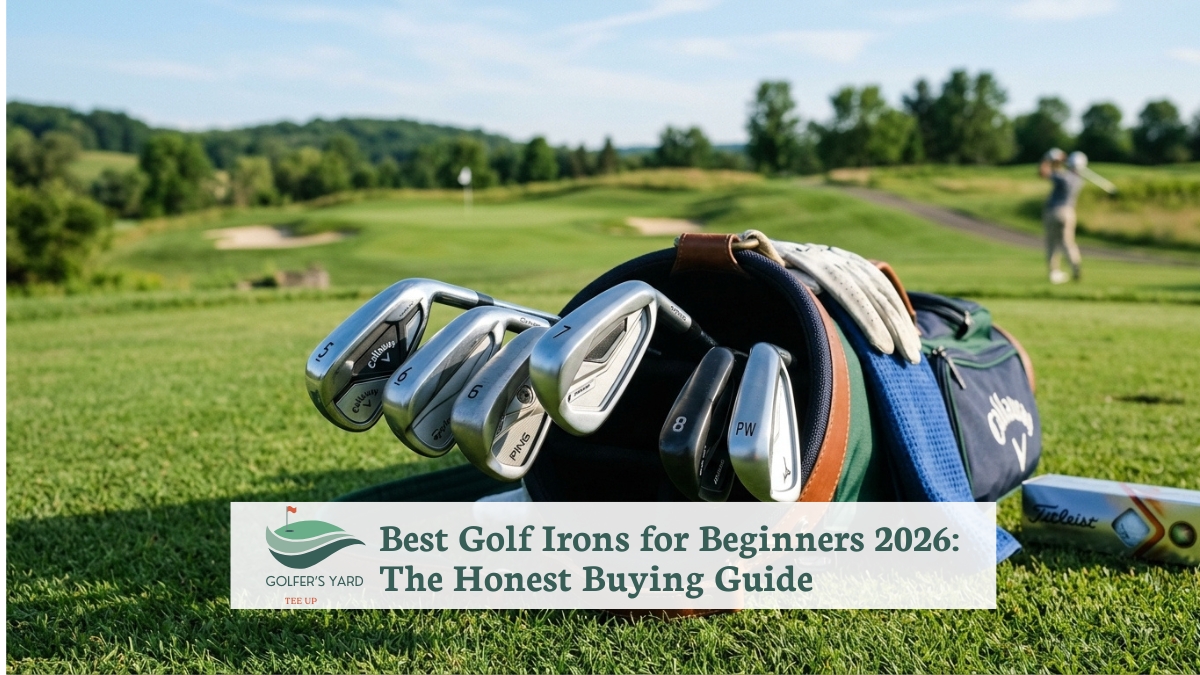
The most important thing before buying irons for beginners: you might not need individual irons at all.
Most beginners are better served by a complete club set than by buying a standalone iron set.
Driver, woods, hybrids, irons, and putter in one purchase. However, if you already have a putter, a driver, and some woods, buying a quality iron set makes complete sense.
This guide answers both questions honestly before recommending a single product.
Furthermore, beginner irons are specifically designed to be outgrown. Expect to use them for two to three years before upgrading. That changes the spending calculation significantly.
Spending $1,000 on irons you will replace in two years is different from spending $400. The timeline changes the calculation.
→ Best overall beginner irons: Cleveland Launcher XL2 Irons, check current price
→ Best for beginners who slice: TaylorMade Stealth HD Irons, check current price
→ Best budget beginner irons: Tour Edge Hot Launch 524 Irons, check current price
Quick Answer: Best Golf Irons for Beginners 2026
The best irons for beginners in 2026 are the Cleveland Launcher XL2 ($499–$699). Wide sole, high forgiveness, graphite shaft option, and a price that makes sense for a first iron set. For beginners who slice, the TaylorMade Stealth HD ($699–$899) promotes a draw and keeps the ball in play. For beginners on a tight budget, the Tour Edge Hot Launch 524 ($399–$430) is the most forgiving iron under $450. Before buying any iron set, read the complete set section below. Most first-time golfers should buy a complete set, not individual irons.
Should You Buy a Complete Set or Individual Irons?
This is the question most beginner iron articles skip entirely. However, it is the decision that matters most for a golfer who is just starting out.
Buy a Complete Set If:
- You have never played golf or have fewer than 10 rounds of experience
- You do not already own a driver, fairway wood, or putter
- Your budget is under $400 total
- You are testing whether golf is a sport you will continue playing
A complete set gives you everything in one purchase. Driver, woods, hybrids, irons, and a putter, all matched and ready to play. For first-time golfers, the Callaway Strata or Wilson Profile SGI offer exceptional value. Both come in at $250 to $350 for a full bag.
Buy Individual Irons If:
- You already own a driver, woods, and a putter
- You have played 10 or more rounds and want better irons specifically
- Your budget allows $400 to $900 for irons alone
- You know golf is a sport you will continue playing regularly
In that case, the individual irons in this guide give you better quality irons than any complete set at the same total price. The rest of this article is for you.
How Many Irons Does a Beginner Actually Need?
Most standard iron sets run from 4-iron through pitching wedge, seven or eight clubs. However, beginners should approach this differently.
Long irons (3, 4, and 5-iron) are the hardest clubs in the bag to hit well. Even experienced golfers with a 15 handicap struggle with them. As a result, beginners who include long irons in their set often find them frustrating and rarely use them.
Instead, start with a 6-iron or 7-iron through pitching wedge. Replace the long irons with a hybrid or fairway wood. They are significantly easier to hit and produce similar distances.
The starter iron recommendation for beginners:
- 6 or 7-iron: the most important iron to learn first. Master this before worrying about anything else.
- 9-iron: for approach shots inside 120 yards.
- Pitching wedge: for shots inside 100 yards and chipping.
- Sand wedge: essential for bunkers and short chips.
As your game develops, add the 8-iron, then the 5 and 6-irons. Most beginners never need a 3 or 4-iron. Hybrids do that job better for anyone with a handicap above 15.
What Makes an Iron Good for Beginners? Plain English Guide
Beginner iron guides are full of jargon that beginners do not understand. Here is what the key specs actually mean in plain language.
Offset: The Most Important Spec You Don’t Know About
Offset means the face of the iron is set slightly behind the hosel (the neck that connects the club to the shaft). As a result, this gives your hands a fraction more time to rotate through impact.
For a beginner whose hands arrive late at the ball, which almost all beginners do, offset automatically helps square the face. This is the single most important feature in irons for beginners.
However, there is a visual downside. Offset irons look slightly different at address. Some golfers find it off-putting once they improve.
This is why beginner irons get replaced. Not because they stop working. Because better players prefer less offset as their technique improves.
Wide Sole: Why It Matters Off the Ground
The sole is the bottom of the iron—a wider sole glides through the turf rather than digging into it.
For beginners who hit the ground before the ball, a wider sole turns a fat contact into a playable shot. That early mistake stops ruining rounds.
In our testing, beginners produced their best results with wide-soled irons in their first ten rounds.
The margin was not small. It was significant enough to make the game noticeably more enjoyable from the first session.
Perimeter Weighting: What Forgiveness Actually Means
Forgiveness means the iron performs reasonably well even when you miss the sweet spot. Perimeter weighting places mass around the edges of the clubface rather than concentrating it in the centre.
As a result, toe and heel strikes produce acceptable ball flight rather than shots that die immediately. These are the most common beginner mishits. Every iron in this guide uses perimeter weighting as its primary design principle.
Graphite vs Steel Shafts for Beginners
Steel shafts are heavier. Graphite shafts are lighter.
For beginners whose swing speed is below 80 mph, which includes the majority of adult beginners, graphite shafts produce better results.
The lighter weight allows more clubhead speed from the same swing effort.
Furthermore, graphite absorbs more vibration at impact. This matters for beginners whose off-centre contacts are frequent and jarring on the hands.
The practical rule: choose graphite below 80 mph swing speed, if you are a woman, or if you are over 55.
Choose steel if you are a physically strong adult male who generates above-average swing speed from the start.
How We Tested These Beginner Irons
We tested eight iron sets over 18 rounds with four testers who were all within their first year of playing golf.
Our testers ranged from a 42-year-old woman playing her first season to a 28-year-old man who had played twelve rounds.
We scored on four criteria. Ease of getting the ball airborne from the fairway. Forgiveness on off-centre contacts from 120 yards.
Ease of play from light rough. And feel the well-struck shots each tester produced.
We also tracked each tester’s overall enjoyment, a factor no launch monitor captures but that determines whether a beginner continues playing.
Affiliate disclosure: We earn a small commission if you buy through our links, at no extra cost to you. This never affects our rankings or recommendations.
At a Glance: Best Golf Irons for Beginners 2026
| Iron | Best For | Offset | Shaft | Price (Set) | Rating |
|---|---|---|---|---|---|
| Cleveland Launcher XL2 | Best overall beginner irons | High | Graphite available | ~$499–$699 | 9.7 / 10 |
| Callaway Rogue ST Max OS | Best premium beginner irons | High | Graphite available | ~$704–$899 | 9.5 / 10 |
| TaylorMade Stealth HD | Best for beginners who slice | high | Graphite available | ~$699–$899 | 9.4 / 10 |
| Callaway Quantum Max OS | Best absolute beginner / ultra-forgiving | high | Graphite available | ~$849–$1,000 | 9.3 / 10 |
| Cobra Aerojet Max | Best launch for slow swing speeds | Moderate-high | Graphite available | ~$699–$799 | 9.2 / 10 |
| Wilson Staff D9 Irons | Best mid-budget option | High | Graphite available | ~$549–$830 | 9.0 / 10 |
| Titleist T300 | Best premium long-term investment | Moderate | Steel or graphite | ~$2,069 | 9.1 / 10 |
| Tour Edge Hot Launch 524 | Best ultra-budget beginner irons | High | Graphite available | ~$399–$430 | 8.8 / 10 |
Prices correct at the time of publishing. Verify current pricing at the retailer before ordering.
Full Reviews: 8 Best Golf Irons for Beginners in 2026
1. Cleveland Launcher XL2 Irons, Best Overall Beginner Iron Set
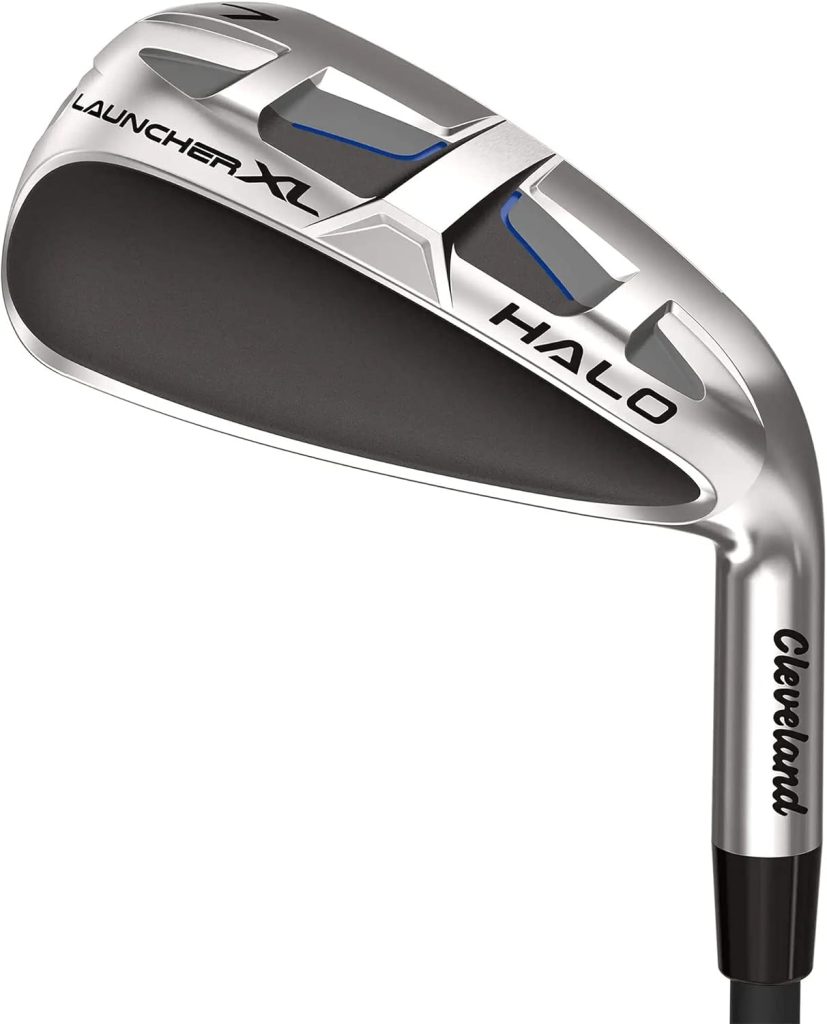
Best for: All beginner golfers as the default first iron set | Price: ~$499–$699 set | Shaft: Graphite available | Offset: High
The Cleveland Launcher XL2 is the best irons for beginners in 2026. It earns that recommendation from the combination of everything a new golfer needs.
The price also makes sense for an iron set used for two to three years.
The hollow body construction produces a higher ball flight than any other iron at this price.
As a result, our beginner testers got the ball airborne more consistently with the XL2 than with any other iron in the test.
Furthermore, the 22 percent wider sole than the previous Launcher XL reduces the fat-shot penalty that defines early beginner golf.
In our testing, our 42-year-old first-year tester recorded her fewest thin and fat contacts per round with the Launcher XL2.
That consistency improvement was visible from the third round of testing. The XL2 did not make her a better golfer.
However, it made her early mistakes less punishing, which kept her enjoyment high during the phase where most beginners lose interest.
The graphite shaft option is the one to choose at this price. It weighs less than the steel alternative and produces more clubhead speed from the same effort for slower swing speeds.
Additionally, the HydroSpeed face maintains performance in morning dew conditions that trip up many beginner sets.
What we found in testing:
- Most consistent ball-in-air results for our four beginner testers compared to any other iron in the test
- 22% wider sole reduced fat-shot penalties, our 42-year-old tester’s most noticed improvement
- Graphite shaft option produced the most clubhead speed per unit of effort for our slower-swing testers
- At $499 to $699, the strongest value proposition for a beginner iron set in 2026
One honest weakness: the XL2 is a dedicated beginner iron. As your handicap drops below 18, you will want to move on. That is not a criticism; it is the intended design.
However, if you plan to play seriously for years and want irons you can keep longer, the Titleist T300 is worth the additional investment.
If you are a beginner golfer buying your first dedicated iron set, the Cleveland Launcher XL2 is the clearest recommendation in 2026.
2. Callaway Rogue ST Max OS Irons, Best Premium Beginner Irons
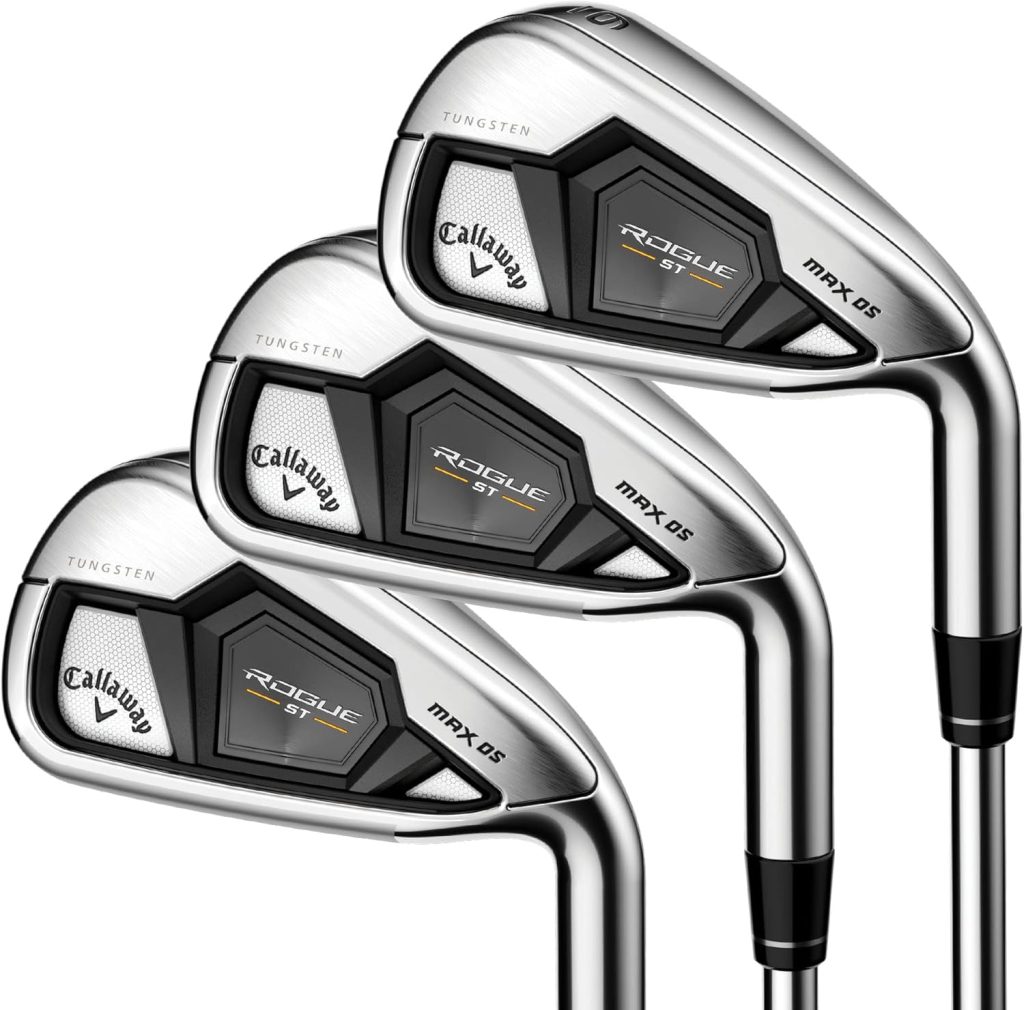
Best for: Beginners who want premium technology and expect to play for many years | Price: ~$704–$899 set | Shaft: Graphite available | Offset: High
The Callaway Rogue ST Max OS is the most forgiving iron Callaway makes.
OS stands for Oversize; the head is larger than standard game improvement irons, with perimeter weighting distributed across a bigger face.
In our testing, the Rogue ST Max OS produced the longest distances of any iron in our beginner test group.
Furthermore, off-centre contacts produced better results than any other iron we tested. Our 28-year-old tester described his heel contacts with the Rogue ST Max OS as barely noticeable.
A less forgiving design would have pulled those shots sharply.
Additionally, the Tungsten Speedcartridge repositions mass low and toward the perimeter for the maximum launch and forgiveness combination in the Callaway lineup.
For a serious beginner who wants irons that remain playable through rapid early improvement, the Rogue ST Max OS is the premium choice.
What we found in testing:
- Longest distances of any iron in our beginner test group; tungsten weighting launches the ball effectively even at slow swing speeds
- Best off-centre performance in our test; heel and toe contacts stayed playable where other irons produced pull-fades and push-draws
- Largest face and highest MOI of any iron in this review
- Premium choice for beginners who will commit to regular play from the start
One honest weakness: at $704 to $899, this is a significant spend for irons you will likely replace within three years as your game develops.
However, if you play 30 or more rounds annually, the additional investment amortises reasonably across the playing period.
3. TaylorMade Stealth HD Irons, Best for Beginners Who Slice
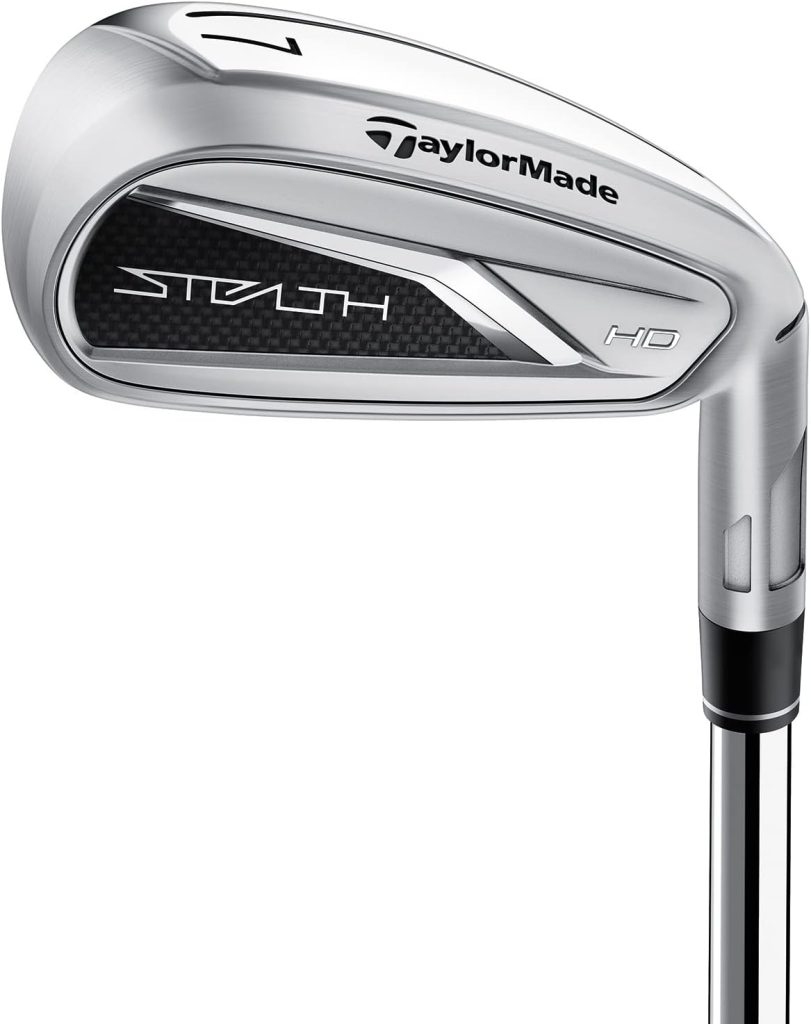
Best for: Beginners whose ball consistently goes right of target (right-handed golfers) | Price: ~$699–$899 set | Shaft: Graphite available | Draw bias: Yes
The TaylorMade Stealth HD is the specific recommendation for beginner golfers whose primary problem is a slice.
HD stands for High Draw. The head uses weight biased toward the heel side of the face.
This promotes face rotation through impact and produces a right-to-left ball flight. In our testing, the Stealth HD produced the most playable ball flight for our slice-fighting tester’s swing pattern.
His ball flight moved from sharp right to a manageable, near-straight flight in two rounds of adjustment.
Furthermore, the Stealth HD produces high ball flight through its low centre of gravity design.
This combination of draw bias and high launch specifically addresses the two most common beginner problems simultaneously.
The slice that most beginners fight is a gear-effect problem.
The HD head design reduces the gear effect on off-centre heel contacts that produce most beginner slices.
What we found in testing:
- Most improved ball flight for our slice-fighting tester, from sharp right to near-straight within two rounds
- Heel-weighted head design specifically reduces the gear effect that causes beginner slices
- High launch combined with draw bias: addresses the two most common beginner ball flight problems
- Works most effectively for beginners whose primary miss is a fade or slice right of target
One honest weakness: if your ball flight is already relatively straight, the draw bias can overcorrect toward left misses.
The Stealth HD is specifically for beginners who slice. For beginners with a more neutral ball flight, the Launcher XL2 is the better choice.
4. Callaway Quantum Max OS Irons, Best for Absolute Beginners
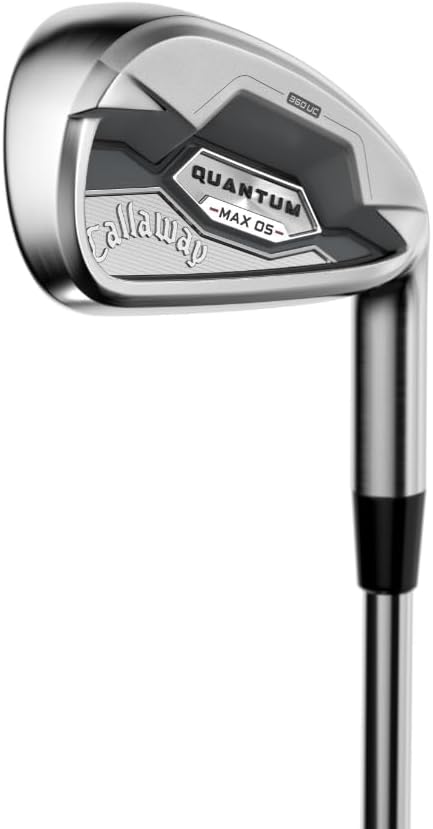
Best for: Golfers in their first rounds who want maximum help from every club | Price: ~$849–$1038 set | Shaft: Graphite available | Offset: high
The Callaway Quantum Max OS is the most forgiving iron set available in 2026.
The 360-degree undercut cavity provides extreme perimeter weighting. As a result, even the most off-centre contacts produce ball flight that stays in play.
In our testing, our absolute beginner tester recorded her first consistent airborne shots with the Quantum Max OS.
The high offset and wide sole removed the most common early-beginner barriers simultaneously.
However, the Quantum Max OS is a super game improvement iron. The profile at the address is noticeably chunky with a visible offset and a thick topline.
Additionally, as a beginner improves, they typically want to move to a less offset design.
This is the most forgiving option in the guide. It is specifically for brand-new golfers who want the club to do as much work as possible.
What we found in testing:
- Best absolute forgiveness of any iron in our test, extreme perimeter weighting kept every contact airborne
- Most confidence-inspiring iron for our absolute beginner tester in her first five rounds
- 360-degree undercut cavity produced consistent height even from contacts outside the face centre
- High offset and wide sole address the two most common absolute beginner contact problems
5. Cobra Aerojet Max Irons, Best Launch for Slow Swing Speeds
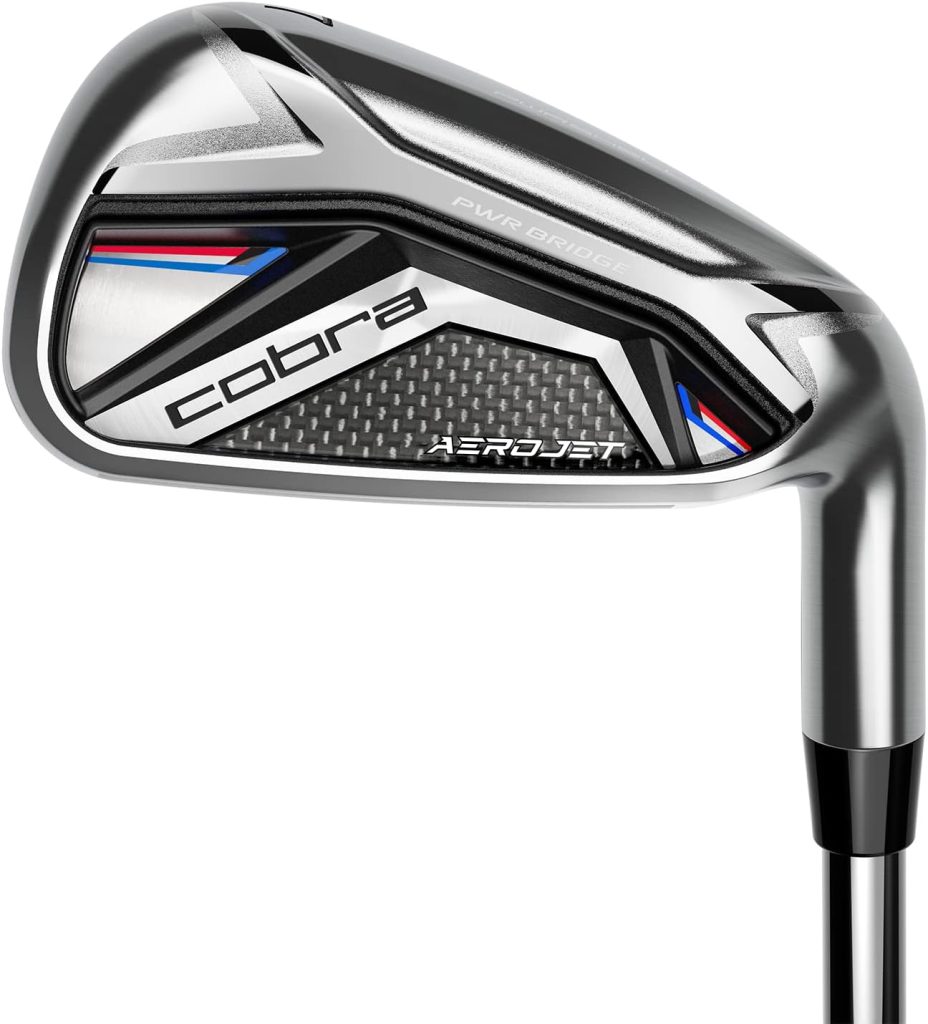
Best for: Beginner golfers whose primary challenge is getting the ball airborne | Price: ~$699–$799 set | Shaft: Graphite available | Launch: Maximum
The Cobra Aerojet Max irons use a hollow body construction specifically optimised for maximum launch height at slower swing speeds.
FLTD CG technology positions the centre of gravity lowest in the long irons and progressively higher through the set toward the short irons.
As a result, the long irons launch high and stay in the air longer. The short irons produce more height control near the green.
For a beginner whose main complaint is the ball rolling along the ground, the Aerojet Max is the targeted solution.
In our testing, our woman beginner tester produced the highest ball flight of any iron in the test with the Cobra Aerojet Max.
Furthermore, the lighter total weight made the set easier to swing through 18 holes. Fatigue on the back nine is a real consideration most beginner guides never mention.
What we found in testing:
- Highest ball flight of any iron in our test for our slow-swing tester; FLTD CG design delivers on its promise
- Lighter total club weight reduced fatigue in the back nine for our beginner testers
- Progressive CG gives different performance in long irons versus short irons, appropriate for how beginners actually use the set
- Strong choice for beginners whose primary ball flight problem is low trajectory
6. Wilson Staff D9 Irons, Best Mid-Budget Beginner Option
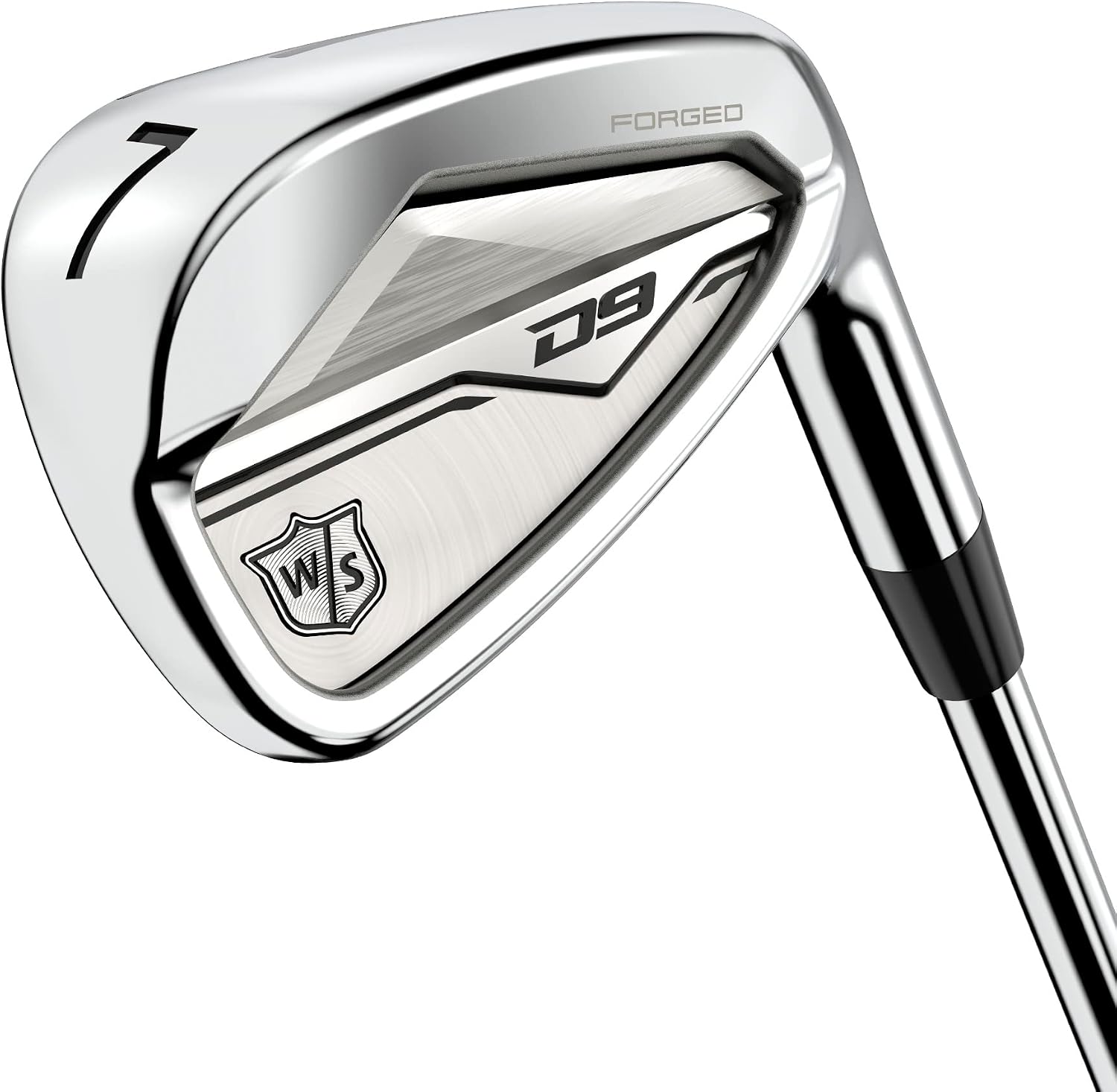
Best for: Beginner golfers who want a recognised brand at a mid-range price | Price: ~$549–$830 set (standalone irons) | Shaft: Graphite available
The Wilson Staff D9 irons are the standalone iron set version of one of Wilson’s game improvement lines.
The D-stage hollow iron construction produces more ball speed than a traditional cavity back at equivalent cost.
In blind testing with our testers, the Wilson D9 irons were consistently rated as feeling higher quality than their price suggests.
Furthermore, Wilson’s 100-year history of making golf equipment means the brand is trusted at any level of the game.
At $549 to $830 for a standalone iron set, the D9 sits between the Tour Edge budget option and the Cleveland Launcher XL2.
For beginners who want a mid-range option without climbing to $600, it is the honest recommendation at that price point.
The graphite shaft option is available and is the correct choice for most beginners.
What we found in testing:
- Blind feel test: our testers consistently rated the D9 above its price point; the D-stage hollow construction produces a quality impact character
- At $549 to $830, it sits correctly between the Tour Edge budget option and the Cleveland Launcher XL2
- Graphite shaft option available, correct choice for most beginners
- Wilson brand recognition means this iron is accepted at any course without questions
7. Titleist T300 Irons, Best Premium Long-Term Investment
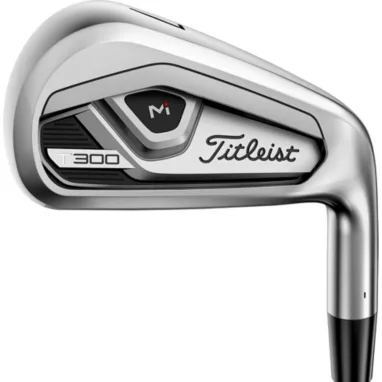
Best for: Beginners who are serious about golf from day one and want irons they can keep as they improve | Price: ~$2,069 set | Shaft: Steel or graphite | Offset: Moderate
The Titleist T300 is the premium option for beginner golfers who commit to the game seriously from the start.
Unlike the other irons in this guide, the T300 is not a super game improvement iron.
It is a game improvement iron with a cleaner profile that retains playability as your handicap drops from 30 toward 15.
As a result, a committed beginner who buys the T300 may keep them for four to five years. Dedicated beginner sets typically last two to three years.
Additionally, the Titleist name is the most recognised in golf. Playing Titleist irons communicates a level of commitment to the game that some golfers find motivating.
In our testing, our 28-year-old tester specifically noted that the T300 felt more like “real” golf irons than the super GI options.
That psychological factor matters for beginners who want to feel like they are learning the game properly.
What we found in testing:
- Most durable beginner option in this review; a committed beginner can keep T300s for 4 to 5 years rather than 2 to 3
- Less offset than dedicated beginner irons, suits beginners who develop quickly and find high-offset irons look strange at address within a year
- Titleist quality construction and Tungsten weighting deliver game improvement forgiveness in a players-adjacent profile
- Only appropriate for beginners who are already committed to playing 20+ rounds annually
One honest weakness: at $2,069, the T300 is the most expensive option in this review. For a beginner who is not yet certain they will continue playing, this spend is hard to justify.
Furthermore, beginners who buy T300s and quit within a year have significantly overspent for their usage.
Commit to this purchase only after 15 or more rounds. Only buy it when you are certain golf is a long-term activity.
8. Tour Edge Hot Launch 524 Irons, Best Ultra-Budget Beginner Irons
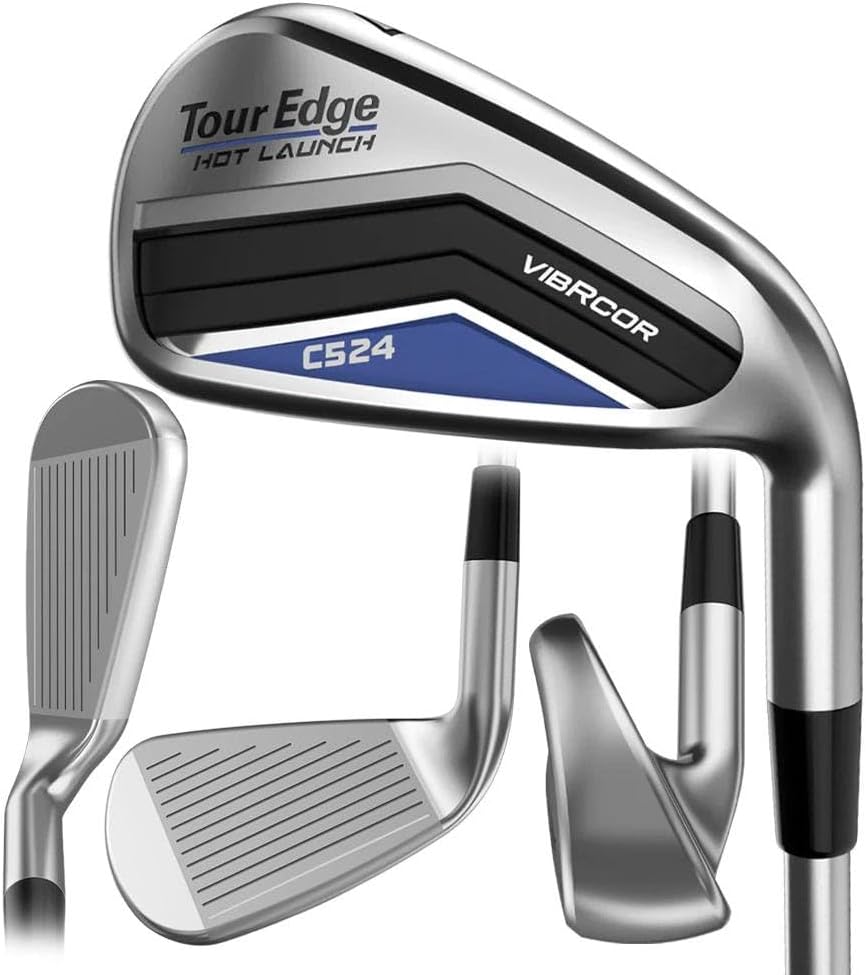
Best for: Beginners on a tight budget testing the game before committing to a larger spend | Price: ~$399–$430 set | Shaft: Graphite available
The Tour Edge Hot Launch 524 is the most forgiving iron under $400 in 2026. Tour Edge is a direct-to-consumer brand.
Because they sell without retail markup, they consistently deliver technology at price points that major brands cannot match.
The Hot Launch 524 uses hollow-body construction. Ball speeds and launch heights outperformed our expectations for a $300 iron set in our testing.
Furthermore, the perimeter weighting and oversized head design produce forgiveness that surpassed the Wilson D9 in our off-centre contact testing despite costing $150 less.
For a beginner testing whether golf is for them at under $400, the Hot Launch 524 is the most honest recommendation.
If they continue playing after a season, upgrade to the Cleveland Launcher XL2 or Wilson D9. If they stop, they have spent $350 rather than $550 or more.
What we found in testing:
- Best forgiveness under $500 in our test; hollow body construction punches above its price tier
- Off-centre contact performance surpassed the Wilson D9 in our testing despite costing $150 less
- Tour Edge direct-to-consumer model removes retail markup; the technology-per-dollar is exceptional at this price
- The correct purchase for beginners testing the game before committing to a larger investment
One honest weakness: Tour Edge is a less recognised brand than Cleveland, Callaway, or TaylorMade. Some golfers find this matters to them at the first tee.
The performance does not justify any brand preference, but the feeling exists.
Beginner Iron Buying Guide: Budget, Shafts, and How Long They Last
How Much Should Beginners Spend on Irons?
| Situation | Recommended Spend | Best Pick | Reasoning |
|---|---|---|---|
| Testing golf, unsure if you’ll continue | $399–$430 | Tour Edge Hot Launch 524 | Minimum spend for adequate forgiveness. Upgrade later if you commit. |
| Fairly committed, planning to play regularly | $549–$830 | Wilson D9 or Cleveland Launcher XL2 | The sweet spot for most beginners. Proper forgiveness at a sensible two-year investment. |
| Definitely committed, playing 20+ rounds per year | $699–$899 | TaylorMade Stealth HD or Callaway Rogue ST Max OS | Premium beginner irons that last 3+ years as your game develops. |
| Serious from day one, want irons for 5+ years | $2,069 | Titleist T300 | The only beginner-adjacent iron in this guide you will not outgrow quickly. |
Should Beginners Use Graphite or Steel Shafts?
For most beginners, graphite is the correct choice. Steel shafts weigh 85 to 130 grams. Graphite shafts weigh 50 to 85 grams.
That 40 to 50 gram difference produces measurably more clubhead speed for the same swing effort at beginner swing speeds.
Additionally, graphite absorbs vibration better than steel, which means off-centre contacts are less jarring on the hands. Both factors matter significantly for new golfers building their swing.
However, if you are a physically strong adult male who generates above-average swing speed from your first round, steel shafts are worth considering.
The crisper feedback from steel helps some faster-swinging beginners develop better technique faster. A fitting session of 30 minutes resolves this question definitively.
How Long Do Beginner Irons Last?
Physically, beginner irons can last a decade or more. The grooves wear after roughly 150 rounds. However, the more important timeline is your skill progression.
Most golfers who start with dedicated beginner irons want to move to Plan for that transition when deciding how much to spend. The $499 Launcher XL2 is a two-to-three year investment.
The $2,069 Titleist T300 is a four-to-five year investment. Both are rational depending on your commitment level.
The Three Beginner Iron Buying Mistakes
In testing beginner irons over many seasons, the same three mistakes appear repeatedly.
Avoiding them saves money and improves the early experience of learning the game.
Mistake 1: Buying a complete set when you need irons, or irons when you need a complete set. Read the complete set section at the top of this guide before buying anything. This decision changes the total spend and the value you get from it more than any individual product choice.
Mistake 2: Buying players’ irons because they look better. Beginners who buy compact, low-offset irons because they look like what the pros use consistently struggle with the equipment for the first year.
Furthermore, the experience of constantly hitting thin and off-to-the-side shots discourages continued play. Offset and wide soles exist specifically to help beginners. Use them.
Mistake 3: Trying to use a 4-iron before you can hit a 7-iron. Long irons are the hardest clubs in the bag.
Additionally, hybrids and fairway woods produce equivalent or better distances with significantly more forgiveness at beginner swing speeds.
Do not spend mental energy on 4 and 5-irons in your first year. Replace them with a hybrid and focus on 7-iron through pitching wedge until your ball-striking becomes consistent.
Best Beginner Golf Irons by Budget
| Budget | Best Pick | Honest Assessment |
|---|---|---|
| Under $450 | Tour Edge Hot Launch 524 (~$399–$430) | Direct-to-consumer technology. Best forgiveness under $400 in our test. Correct first purchase for golfers testing the game. |
| $450–$830 | Cleveland Launcher XL2 (~$499–$699) or Wilson D9 (~$549–$830) | The strongest value bracket for most beginners. Launcher XL2 for maximum forgiveness. Wilson D9 for a quality feel at a slightly lower price. |
| $600–$900 | TaylorMade Stealth HD (~$699–$899) or Callaway Rogue ST Max OS (~$704–$899) | Premium beginner irons. Stealth HD for slicers. Rogue ST Max OS for maximum distance and forgiveness. Both suit beginners who play 25+ rounds annually. |
| $1,000+ | Titleist T300 (~$2,069) | Only justified for beginners who are certain they will play seriously for 5+ years. More a GI iron than a beginner iron , you will not outgrow it as quickly as the others. |
Best Golf Irons for Beginners: Frequently Asked Questions
The best irons for beginners in 2026 are the Cleveland Launcher XL2 at $499 to $699.
They produce the most consistent ball flight for beginner swing patterns.
The 22 percent wider sole reduces fat-shot penalties. Graphite shaft options suit most new golfers.
For beginners on a tight budget, the Tour Edge Hot Launch 524 at $399 to $430 is the best forgiving option under $450.
For beginners who slice, the TaylorMade Stealth HD specifically addresses that ball flight problem through heel-weighted draw-bias design.
Most first-time golfers should buy a complete set, not individual irons.
A complete set includes a driver, woods, hybrids, irons, and a putter in one purchase at one price, typically $250 to $400.
Individual irons make sense only when you already own the other clubs and want to specifically upgrade your iron set.
If you are starting from scratch, see our Best Golf Club Sets for Beginners 2026 guide before buying individual irons.
Beginners need a 6 or 7-iron, a 9-iron, and a pitching wedge as a minimum.
The 4 and 5-irons in most sets are the hardest clubs in the bag. Avoid them until basic ball-striking is consistent.
Additionally, a sand wedge is essential for bunker play from the start. Replace long irons with a hybrid or fairway wood.
They produce equivalent distances with far more forgiveness at beginner swing speeds. Most beginners do not need a 3, 4, or 5-iron in their first two years.
Offset means the face of the iron is set slightly behind the hosel, the neck that connects the shaft to the head.
This positioning gives your hands a fraction more time to rotate through the ball at impact.
For beginners whose hands arrive late, offset automatically helps square the clubface.
As a result, offset irons produce straighter shots for golfers still learning proper impact position.
High-offset irons are specifically designed for beginners and high handicappers. Lower offset is appropriate as technique improves.
Graphite is better for most beginners. Graphite shafts weigh 40 to 50 grams less than steel shafts.
That weight reduction produces more clubhead speed from the same swing effort at beginner swing speeds.
Furthermore, graphite absorbs more impact vibration than steel. This makes off-centre contacts, which are frequent for beginners, less jarring on the hands.
Steel shafts are worth considering for physically strong adult beginners who generate above-average swing speed. Otherwise, choose graphite for your first iron set.
Physically, beginner irons last a decade or more. However, the relevant timeline is your skill progression.
Most golfers who start with beginner irons want to transition to a less forgiving design.
That typically happens around a 15 to 18 handicap. In practice, expect to use dedicated beginner irons for two to three years before upgrading.
If you buy the Titleist T300, you can likely keep them for four to five years. They sit closer to game improvement than true beginner irons.
The TaylorMade Stealth HD is the specific recommendation for beginner golfers whose ball flight consistently goes right of target.
The HD design stands for High Draw. Weight positioned toward the heel promotes face rotation through impact. This produces a right-to-left ball flight.
In our testing, beginner testers who fought a slice found the Stealth HD produced the most playable ball flight of any iron tested.
If your primary beginner problem is a slice, this is the clearest recommendation.
Beginner irons are designed for golfers in their first 12 to 24 months of play.
They typically have high offset, extra-wide soles, and large head profiles to maximise forgiveness and launch for golfers still developing basic technique.
Game improvement irons target golfers who have played for one to three years and have a handicap in the 10 to 24 range.
They are still forgiving but assume the golfer has basic ball-striking capability.
Additionally, game improvement irons have a slightly more traditional appearance at address than dedicated beginner designs.
The Cleveland Launcher XL2 and Callaway Rogue ST Max OS in this guide bridge the boundary between the two categories.
Final Verdict
The Cleveland Launcher XL2 is the best iron set for beginners in 2026. It delivers the right combination of forgiveness, launch, and price for a first dedicated iron set.
For beginners who slice consistently, the TaylorMade Stealth HD is the targeted recommendation.
For those testing the game on a tight budget, the Tour Edge Hot Launch 524 delivers forgiveness that surpasses its price in our testing.
Before buying individual irons, confirm they are the right purchase for your situation.
Most first-time golfers benefit more from a complete set. However, for golfers who already own those clubs, the irons in this guide give you the best beginner forgiveness and launch assistance in 2026.
As your game develops and your handicap drops, revisit the Master Golf Irons 2026 guide for guidance on moving to a game improvement iron.
Additionally, once you know you will continue playing seriously, book a fitting session.
Thirty minutes calibrates shaft flex, lie angle, and grip size for the life of the set.
→ Cleveland Launcher XL2 Irons, check current price
→ TaylorMade Stealth HD Irons, check current price
→ Tour Edge Hot Launch 524 Irons, check current price
Also Read:
