


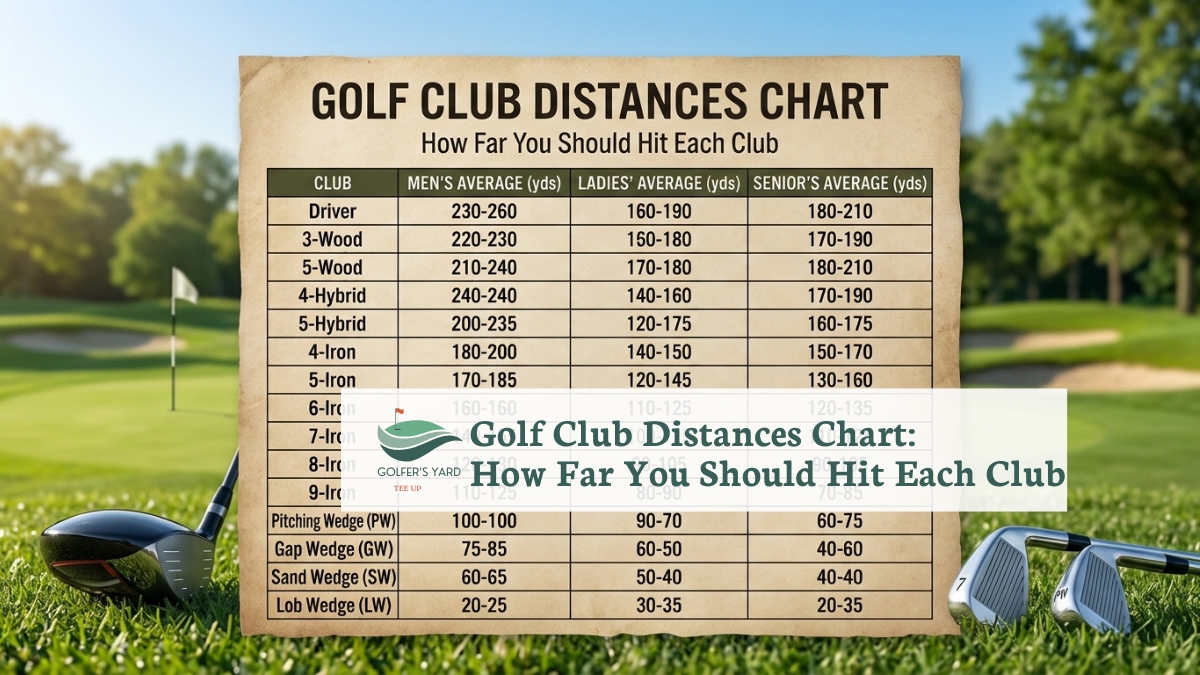
How far should you hit each golf club? Golf club distances depend on your swing speed, your handicap and how solidly you strike the ball.
However, most distance charts show tour numbers that no beginner will ever reach.
Instead, this golf club distances chart shows what real amateurs hit, by handicap, for men and women.
Below, you will also learn how to find your own yardages in one range session. New to the game? Then start with our beginner’s guide to golf.
Quick Answer: Average Golf Club Distances
Average male amateur: about 225 to 240 yards with a driver and 145 to 155 yards with a 7 iron.
Typical female amateur: about 175 to 200 yards with a driver and 110 to 135 yards with a 7 iron.
Beginners: expect the low end of each range, or even slightly below it, at first.
Gaps between irons: usually 10 to 12 yards per club for men, whereas 8 to 10 yards suits women.
Where These Golf Club Distances Come From
First of all, I rounded every range in this chart from large shot-tracking datasets of amateur golfers.
For instance, Shot Scope’s published data covers more than 350 million recorded shots.
On drivers, I also cross-checked the USGA and R&A driving distance report.
That study found sub-6 handicap men averaged about 245 yards, while golfers over 21 averaged about 190.
In short, all numbers are total distance, meaning carry plus roll, on solidly struck shots.
Also, the data filters out mishits, so your average on the course will usually sit a little lower.
Finally, I checked the ranges against my own bag and my playing partners’ numbers. My 7 iron carries about 110 yards at a handicap of 22.
Golf Club Distances Chart for Men
Find your handicap column, then read down the clubs. Meanwhile, beginners without a handicap should use the high handicap column.
| Club | High handicap (21+) | Mid handicap (13 to 20) | Low handicap (0 to 12) |
|---|---|---|---|
| Driver | 205 to 225 | 225 to 240 | 245 to 275 |
| 3 wood | 180 to 200 | 200 to 215 | 220 to 240 |
| 5 wood | 170 to 185 | 185 to 200 | 205 to 225 |
| Hybrid (4H) | 155 to 175 | 175 to 190 | 195 to 215 |
| 4 iron | 150 to 170 | 170 to 185 | 195 to 215 |
| 5 iron | 145 to 160 | 160 to 170 | 185 to 200 |
| 6 iron | 135 to 150 | 150 to 160 | 170 to 185 |
| 7 iron | 130 to 145 | 145 to 155 | 160 to 175 |
| 8 iron | 120 to 135 | 135 to 145 | 150 to 165 |
| 9 iron | 110 to 125 | 125 to 135 | 140 to 155 |
| Pitching wedge | 100 to 115 | 115 to 125 | 125 to 140 |
| Gap wedge (50°) | 85 to 100 | 100 to 110 | 110 to 125 |
| Sand wedge (56°) | 65 to 85 | 85 to 95 | 95 to 110 |
| Lob wedge (60°) | 50 to 70 | 70 to 80 | 80 to 95 |
Golf Club Distances Chart for Women
Of course, women’s distances are shorter mainly because of average swing speed, not technique.
Also, most women carry fewer long irons, so hybrids and woods fill the top of the bag.
| Club | High handicap (21+) | Mid handicap (13 to 20) | Low handicap (0 to 12) |
|---|---|---|---|
| Driver | 165 to 175 | 175 to 200 | 205 to 235 |
| 3 wood | 145 to 160 | 160 to 180 | 180 to 205 |
| 5 wood | 135 to 150 | 150 to 170 | 170 to 190 |
| Hybrid (5H) | 120 to 135 | 135 to 155 | 155 to 175 |
| 5 iron | 115 to 125 | 125 to 150 | 150 to 170 |
| 6 iron | 110 to 120 | 120 to 140 | 140 to 160 |
| 7 iron | 100 to 110 | 110 to 135 | 130 to 150 |
| 8 iron | 95 to 100 | 100 to 125 | 120 to 145 |
| 9 iron | 80 to 90 | 90 to 115 | 110 to 135 |
| Pitching wedge | 65 to 75 | 75 to 100 | 95 to 125 |
| Sand wedge (56°) | 45 to 60 | 60 to 75 | 75 to 95 |
Shopping for clubs that suit these speeds? Then see our guide to the best women’s golf club sets.
How Far Should a Beginner Hit Each Club?
At first, expect the high handicap column or a little less in your first season. That is completely normal, because contact improves long before speed does.
For example, a new male golfer often hits a 7 iron 110 to 130 yards. Meanwhile, a new female golfer often hits it 80 to 100 yards.
In the end, consistency matters more than raw distance. As long as your 7 iron always goes 120 yards, you can plan every approach around that number.
In my first season, my 7 iron went about 90 yards. Later, it gained 20 yards once my contact improved.
Carry Distance vs Total Distance
To begin with, carry is how far the ball flies in the air. Total distance, on the other hand, adds the roll after it lands.
For approach shots, carry matters most, because you need to clear bunkers and water. In contrast, total distance matters more off the tee.
In addition, irons roll 5 to 10 yards on firm fairways and much less in winter. Wedges, however, barely roll at all.
How to Find Your Own Golf Club Distances
Averages are a starting point; however, your own numbers are what win you strokes. In fact, you can find them in a single range session.
- First, warm up. Otherwise, cold muscles cut your numbers short.
- Next, hit 10 balls with each club. Also, use a normal, comfortable swing, not your hardest.
- After that, ignore the best and worst two. Then average the middle six.
- Besides that, measure carry if you can. Either a rangefinder on the landing spot or a launch monitor works best.
- Finally, write it down. Then tape a small card to your bag or save it on your phone.
Indeed, a laser makes this far more accurate than guessing from range flags.
You can also compare options in our guide to the best golf rangefinders.
Want precise carry and spin numbers, too?
In that case, our guide to the best golf launch monitors covers home and range options.
How Big Should the Gaps Between Clubs Be?
Ideally, each iron should go 10 to 12 yards further than the next. For most women, however, 8 to 10 yards is a healthy gap.
In particular, gaps that are too small mean two clubs do the same job.
Conversely, gaps that are too big leave awkward in-between distances.
Notably, the biggest gap usually sits between the pitching wedge and sand wedge.
That is why many golfers add a gap wedge, which our golf wedge guide explains.
Driver Distance by Swing Speed
In general, swing speed is the quickest way to estimate your driver distance.
Either a launch monitor or a cheap speed radar will tell you yours.
| Driver swing speed | Typical total distance | Who swings this fast |
|---|---|---|
| 70 mph | 165 to 180 yards | Many women and senior golfers |
| 80 mph | 190 to 205 yards | Beginners and moderate swingers |
| 90 mph | 215 to 230 yards | The average male amateur |
| 100 mph | 240 to 255 yards | Strong amateurs |
| 110 mph | 265 to 280 yards | Low handicappers and long hitters |
If your distance falls well below your speed’s range, then contact or launch is usually the cause.
In that case, a fitting often helps more than a new driver.
Fairway Wood and Hybrid Distances
Especially early on, most beginners find hybrids and fairway woods easier to hit than long irons.
As a result, many now replace the 3, 4 and 5 irons altogether.
Equally, a 7 wood is a popular middle ground, launching high and landing softly. Additionally, see how far it goes in our guide to 7 wood loft and distance.
Similarly, our guide to the best golf irons for beginners covers forgiving sets with easier long clubs.
What Changes How Far You Hit the Ball?
Swing speed
Above all, swing speed is the biggest single factor. For example, each extra mile per hour of driver speed adds around 2 to 3 yards.
Strike quality
Likewise, off-center hits lose distance quickly, especially with irons. Therefore, improving contact often adds more yards than swinging harder.
Weather and altitude
Cold air and cold balls fly shorter, so expect a few yards less per club in winter. On the other hand, high-altitude courses add distance because the air is thinner.
The golf ball
Also, moderate swing speeds often go further with a softer, low-compression ball. For that reason, see our picks for the best golf balls for high handicappers.
How to Use Your Golf Club Distances on the Course
As soon as you know your numbers, club selection becomes simple.
First, get the yardage to the middle of the green, then pick the club whose carry matches it.
Still unsure which club to pull? Our guide on how to know which golf club to use also walks through common situations.
Also, a GPS watch shows front, middle and back yardages without stopping play. Moreover, our guide to the best golf GPS watches covers the top picks.
Golf Club Distances: Frequently Asked Questions
In general, a beginner man usually hits a 7 iron about 110 to 130 yards.
Meanwhile, a beginner woman usually hits it about 80 to 100 yards.
However, consistent contact matters more than distance in your first season.
On the whole, the average male amateur hits a driver about 225 to 240 yards in total.
In comparison, the average female amateur hits it about 175 to 200 yards.
Of course, beginners typically hit it shorter until their contact improves.
In short, carry is how far the ball flies before it lands.
Total distance, by comparison, adds the roll after landing.
For approach shots, carry matters most, because you must clear hazards in front of the green.
As a rule, each iron should go about 10 to 12 yards further than the next for most men.
For most women, 8 to 10 yards is typical.
Also, check the gap between your pitching wedge and sand wedge, since it is often too big.
Yes, cold weather reduces distance, because cold air is denser and a cold ball is less lively.
Expect a few yards less with every club in winter. Similarly, wet fairways reduce roll.
Final Word: Know Your Own Numbers
To sum up, the average male amateur hits a driver about 225 to 240 yards and a 7 iron about 145 to 155. Similarly, for women, the averages are about 175 to 200 and 110 to 135.
Even so, your own consistent numbers matter far more than any average. So spend one range session measuring them, and every round gets easier.
Also Read:
