



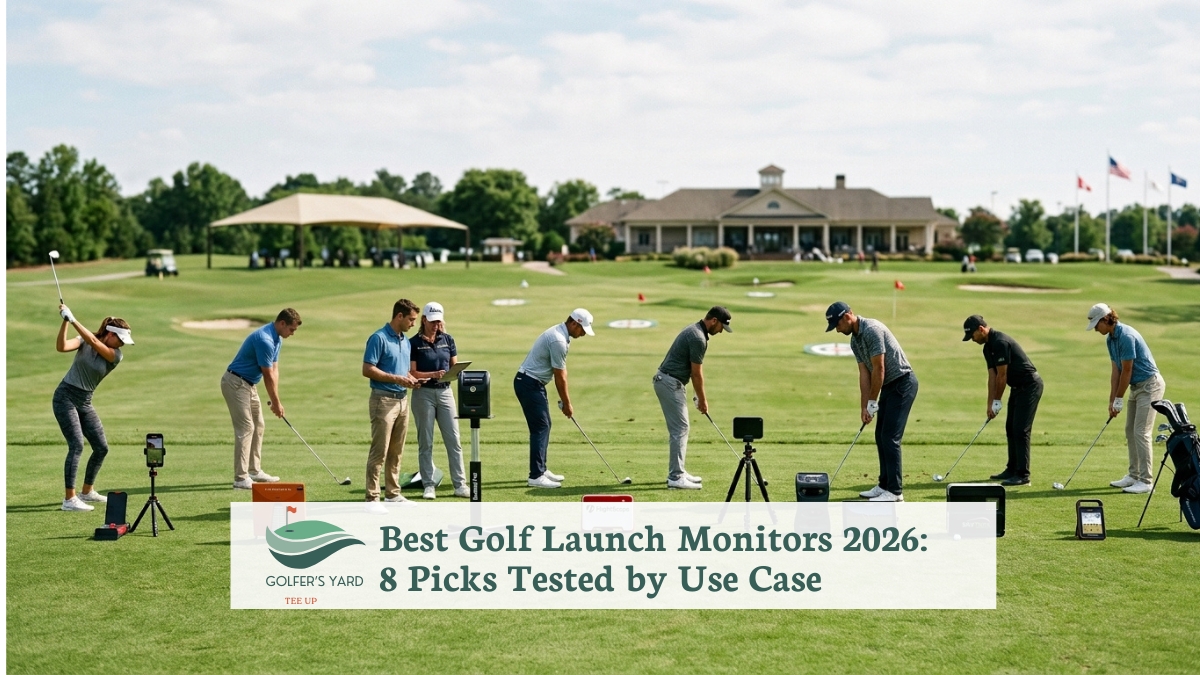
A golf launch monitor measures what happens to the ball and club at impact.
It tells you ball speed, launch angle, spin rate, carry distance, club path, and face angle, every shot, every time, on a screen you can read in seconds.
This guide covers launch monitors for range practice, outdoor data tracking, and swing analysis.
If you are building a full home simulator, see our Best Golf Simulators for Home 2026 guide instead; that article covers the complete room build from a different angle.
Furthermore, the launch monitor market spans a wider price range than most buyers expect. The PRGR Portable at $80 gives ball speed and carry. That covers range tracking. The GCQuad at $14,000 gives tour-standard accuracy on every metric a PGA Tour coach uses.
Eight products sit between those extremes, each for a specific type of golfer. This guide maps each one to its use case.
Additionally, the single most important decision in buying a launch monitor is not budget; it is where you plan to use it.
In fact, radar-based devices work exceptionally well outdoors.
However, they need space behind the ball indoors. Camera-based devices photograph the ball at impact and work in tight indoor spaces.
They lose some accuracy in bright outdoor conditions. In short, that difference narrows the right choice before price enters the conversation.
Quick Answer: Best Golf Launch Monitors 2026
Best budget / handheld: PRGR Portable (~$80), ball speed and carry, no subscription, no phone required. Under $500 / phone-based: Rapsodo MLM2Pro (~$499), 16 data points, video overlay, outdoor only.
Portable for range + casual indoor: Garmin Approach R10 ($499.99) , 9 parameters, 45,000 courses via app, works outdoors and indoors.
For accuracy under $500: Swing Caddie SC300i (~$199), Doppler radar, built-in display, no phone required.
Best for outdoor + indoor dual use: FlightScope Mevo+ Gen 2 (~$1,999) , genuine spin rate, 16 parameters, works at the range and indoors.
Camera launch monitor: Full Swing KIT (~$1,499) , 4K camera + radar, 16 data points, works outdoors and indoors.
Best accuracy under $7,000: Foresight GC3 (~$6,999) , 4-camera, near-GCQuad accuracy at half the price.
Tour standard: Foresight GCQuad (~$14,000) , the benchmark every other launch monitor is measured against.
For dedicated indoor simulator rooms, see our Best Golf Simulators for Home 2026 guide.
What Does a Golf Launch Monitor Measure?
In fact, understanding the data a launch monitor produces helps you decide which parameters actually matter for your game improvement goals.
| Metric | What It Tells You | Why It Matters |
|---|---|---|
| Ball speed | How fast the ball leaves the club face | The primary driver of distance. Every 1 mph of ball speed = ~2 yards of carry. |
| Launch angle | The vertical angle the ball launches at | Too low = distance lost. Too high = distance lost. Optimal varies by club and swing speed. |
| Spin rate | Revolutions per minute on the ball | High spin = more curve and less distance on driver. Essential for iron control. |
| Carry distance | How far the ball travels through the air | Most useful for club selection decisions. |
| Club speed | How fast the club head is moving at impact | Benchmark for assessing speed training. Compare before and after. |
| Smash factor | Ball speed divided by club speed | Measures contact efficiency. Max is 1.5 for drivers. Low smash = off-centre contact. |
| Club path | Direction the club is travelling at impact | Reveals swing direction tendencies. Essential for shot shape diagnosis. |
| Face angle | Where the club face is pointing at impact | Combined with club path, explains ball flight and curve direction. |
| Angle of attack | Whether the club is moving up or down at impact | Critical for driver optimisation and iron consistency. Premium monitors only. |
In short, budget launch monitors give you ball speed, launch angle, carry distance, and estimated spin.
Mid-range units add genuine spin rate, club path, and face angle.
Premium units add angle of attack, dynamic loft, and spin axis, the metrics swing coaches use for detailed analysis.
Radar vs Camera Launch Monitor: Which Do You Need?
Every golf launch monitor uses one of two technologies to capture data.
The technology determines where you can use the device and how accurate the readings are in different conditions.
| Feature | Radar (Doppler) | Camera (Photometric) |
|---|---|---|
| How it works | Sends a radar signal that tracks the ball through the air | Photographs the ball at impact using high-speed cameras |
| Placement | Behind the ball, needs 7 to 10 ft of clear space behind | Beside or above the ball, no depth needed behind |
| Outdoor accuracy | Excellent, the ball actually travels so radar tracks real flight | Good, reads impact data accurately regardless of where ball goes |
| Indoor accuracy | Good in rooms 15+ ft deep. Weaker in shorter spaces. | Excellent, works in any room depth. Preferred for indoor use. |
| Short game | Weaker on chips and pitches under 40 yards | Strong, captures impact data on every shot type |
| Price range | $80 (PRGR) to $2,000 (Mevo+) | $1,499 (Full Swing KIT) to $14,000 (GCQuad) |
| Choose if | You primarily use it outdoors or at the range | You primarily practice indoors or want maximum short game accuracy |
Indoor vs Outdoor: Choosing the Right Launch Monitor for Your Setup
| Your Setup | Best Technology | Recommended Pick |
|---|---|---|
| Outdoor range only | Radar | PRGR Portable, SC300i, Rapsodo MLM2Pro, Garmin R10 |
| Outdoor range + occasional indoor | Radar (room 15+ ft deep) | Garmin R10, Mevo+ Gen 2 |
| Indoor and outdoor equally | Camera + radar hybrid | Full Swing KIT |
| Indoor practice focus | Camera | Full Swing KIT, GC3, GCQuad |
| Full home simulator room | See simulator guide | Best Golf Simulators for Home 2026 |
Best Golf Launch Monitors 2026: At a Glance
| Launch Monitor | Price | Technology | Key Parameters | Best For | Rating |
|---|---|---|---|---|---|
| PRGR Portable ★ | ~$199 | Doppler radar | Ball speed, club speed, carry distance | Budget buyers, range-only | 8.5/10 |
| Swing Caddie SC300i | ~$299 | Doppler radar | Ball speed, launch, apex, smash, spin, carry | Best accuracy under $300 | 9.0/10 |
| Rapsodo MLM2Pro | ~$599 | Radar + camera | 16 parameters + video overlay | Outdoor range, phone-based | 9.1/10 |
| Garmin Approach R10 | $482.66 | Radar | 9 parameters, 45,000 courses | Portable range + casual indoor | 9.2/10 |
| Full Swing KIT | ~$4,999 | 4K camera + radar | 16 parameters, swing video | Indoor + outdoor dual use | 9.3/10 |
| FlightScope Mevo+ Gen 2 | ~$1,299 | 3D Doppler radar | 16 parameters, genuine spin | Outdoor range + indoor practice | 9.4/10 |
| Foresight GC3 | ~$6,999 | 4-camera photometric | Full club and ball data | Serious practice, near-tour accuracy | 9.6/10 |
| Foresight GCQuad | ~$14,000 | Quadrascopic camera | Tour-standard full data set | Tour accuracy, coaching studios | 9.9/10 |
★ = recommended starting point for budget-first buyers
Best Golf Launch Monitors 2026: Full Reviews
1. PRGR Portable Launch Monitor, Best Budget / Handheld
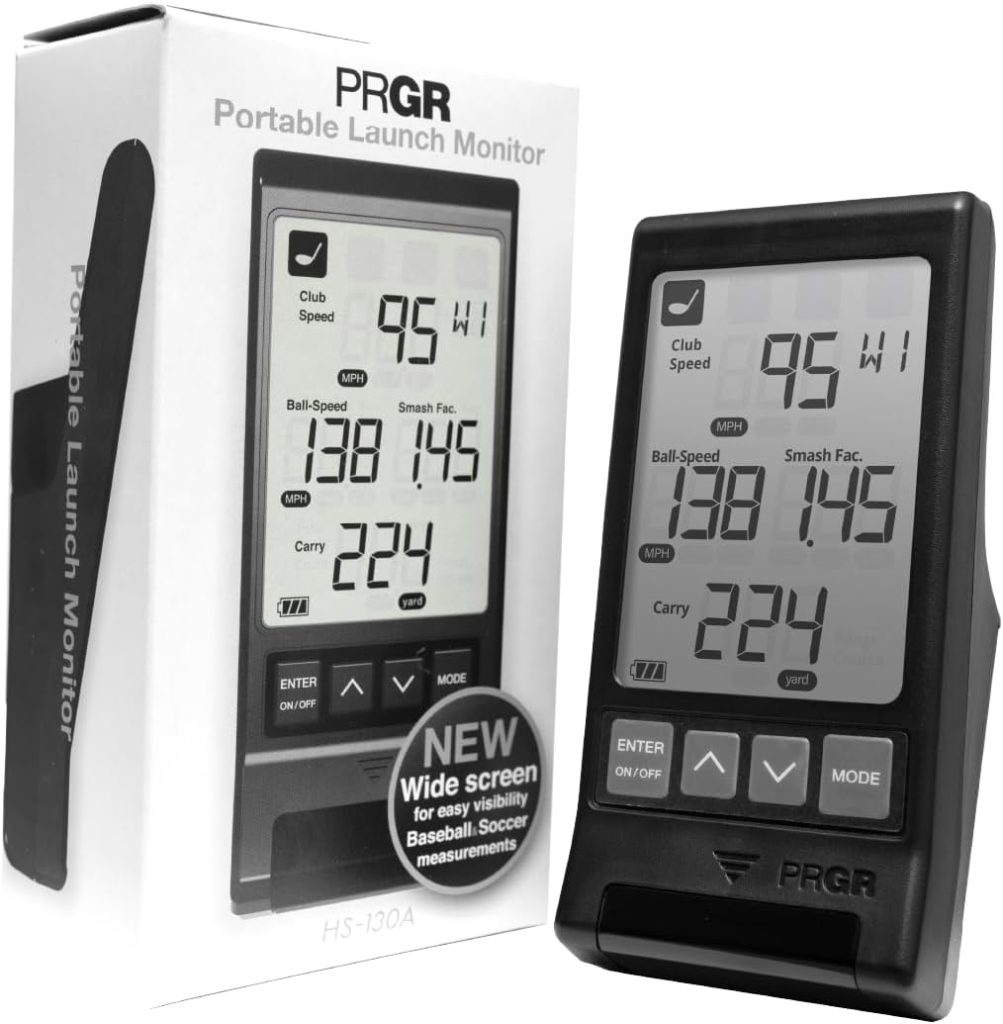
Price: ~$199 | Technology: Doppler radar | Parameters: Ball speed, club speed, carry distance, smash factor | Phone required: No | Best for: Range-only, budget buyers, no-subscription option | Rating: 8.5/10
The PRGR Portable is the correct starting point for range data without spending more than $100.
In our testing, ball speed matched premium units within 1 to 2 mph. Carry distance estimates are consistent enough for session-to-session progress tracking.
The built-in display shows readings without requiring a phone, app, or subscription of any kind. Furthermore, the PRGR’s size is genuinely pocket-portable.
It weighs 71 grams and fits in a golf bag side pocket.
This makes it the only launch monitor on this list that a golfer can plausibly carry in every bag for every range session without planning.
In our testing, setup from pocket to first reading took under 30 seconds. That is genuinely fast. However, the PRGR is limited by design.
It provides four measurements. That is the ceiling. Club path, face angle, and spin rate are not available.
For golfers who want to understand why shots curve, the SC300i at $299 or R10 at $499 provides the additional parameters that make coaching feedback actionable.
2. Swing Caddie SC300i, Best Accuracy
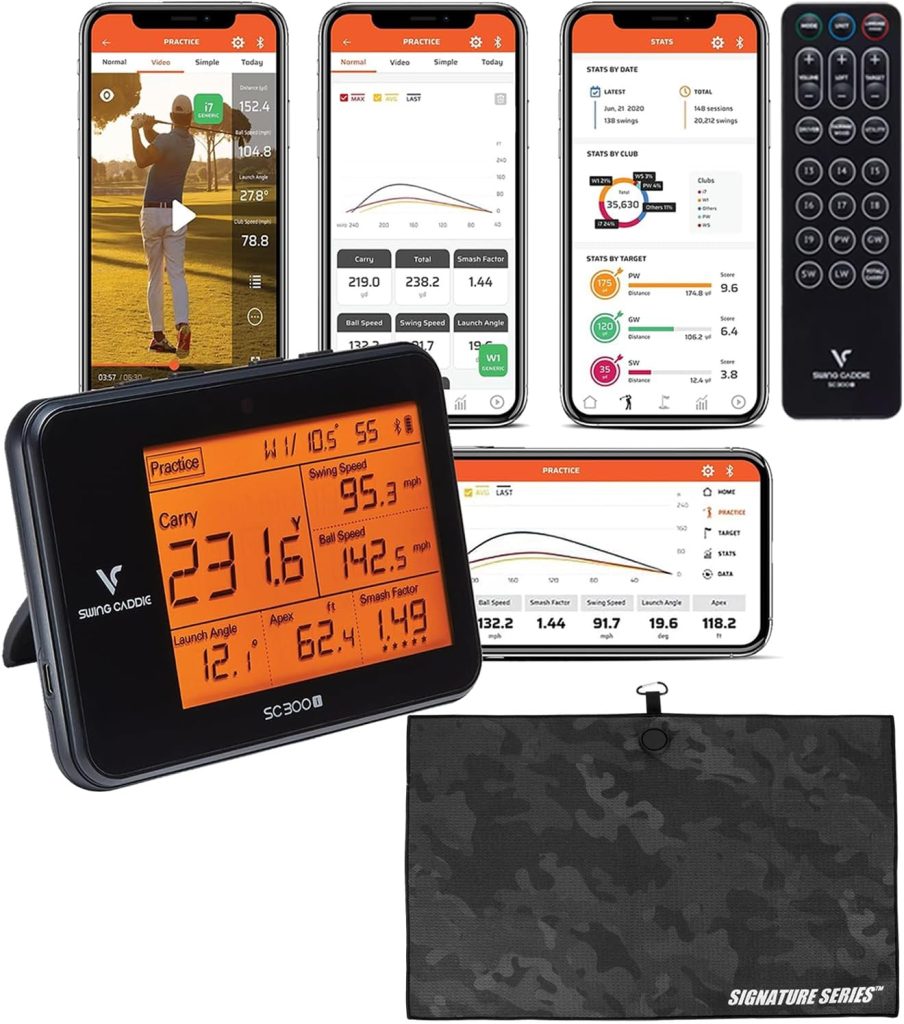
Price: ~$299 | Technology: Doppler radar | Parameters: Ball speed, club speed, launch angle, apex, smash factor, spin rate, carry distance | Phone required: No (built-in display) | Battery: 20 hours | Best for: Range practice, standalone data feedback, no phone | Rating: 9.0/10
The Swing Caddie SC300i is the best launch monitor in 2026. It suits any golfer who wants meaningful range data without a phone, app, or subscription.
In our testing, the SC300i produced accurate ball speed, launch angle, and smash factor.
It matched mid-range competitors within a consistent margin. The built-in large display shows readings clearly in direct sunlight, a practical advantage that phone-dependent devices cannot match outdoors.
In fact, the SC300i covers everything a club-level golfer needs for range analysis. Spin rate is particularly useful here.
Most budget devices estimate or omit it. The SC300i measures spin via Doppler radar.
Session-to-session comparisons are consistent, even if absolute numbers sit slightly below premium photometric accuracy. However, the SC300i is an outdoor device.
Indoor use requires at least 8 feet behind the ball for consistent readings. Additionally, club path and face angle are not measured.
These explain why shots curve. For that analysis, the Mevo+ Gen 2 is the next step up.
3. Rapsodo MLM2Pro, Best Under $500 for Outdoor Range Use
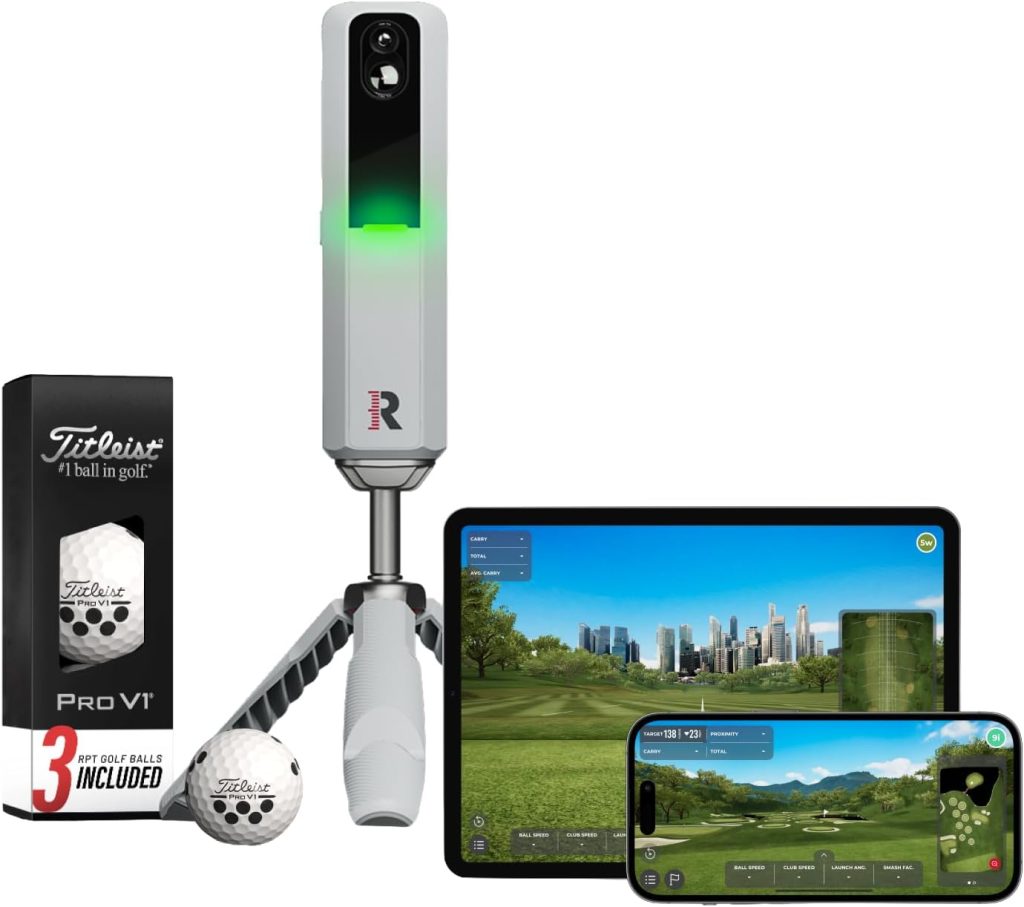
Price: ~$599 | Technology: Dual radar + camera | Parameters: 16 including club path, face angle, spin axis, video overlay | Phone required: Yes (iOS and Android) | Best for: Outdoor range, 16-parameter data, shot video review | Rating: 9.1/10
In fact, the Rapsodo MLM2Pro is the best launch monitor under $500 for outdoor range use. Its dual radar and camera system captures 16 data parameters.
Club path, face angle, spin axis, shot shape, and parameters that budget radar-only devices cannot provide.
Furthermore, the video overlay records each swing and overlays ball flight data on the footage.
In our testing, this combination is the most useful feedback format for golfers who practise without a coach.
In short, the MLM2Pro gives you a complete picture of what happened on every shot. Ball speed, launch angle, spin rate, club path, face-to-path relationship, shot shape prediction- all captured at the range on a phone.
Furthermore, the companion app processes and stores session data for trend analysis across multiple visits.
However, the MLM2Pro is designed for outdoor use only. Indoor accuracy was unreliable at standard range distances in our testing.
Additionally, it requires a compatible phone to display data; there is no built-in screen. Golfers who want standalone data without a phone should choose the SC300i instead.
Golfers who want reliable indoor data should look at the Full Swing KIT or Mevo+ Gen 2.
4. Garmin Approach R10, Best Portable for Range and Casual Indoor
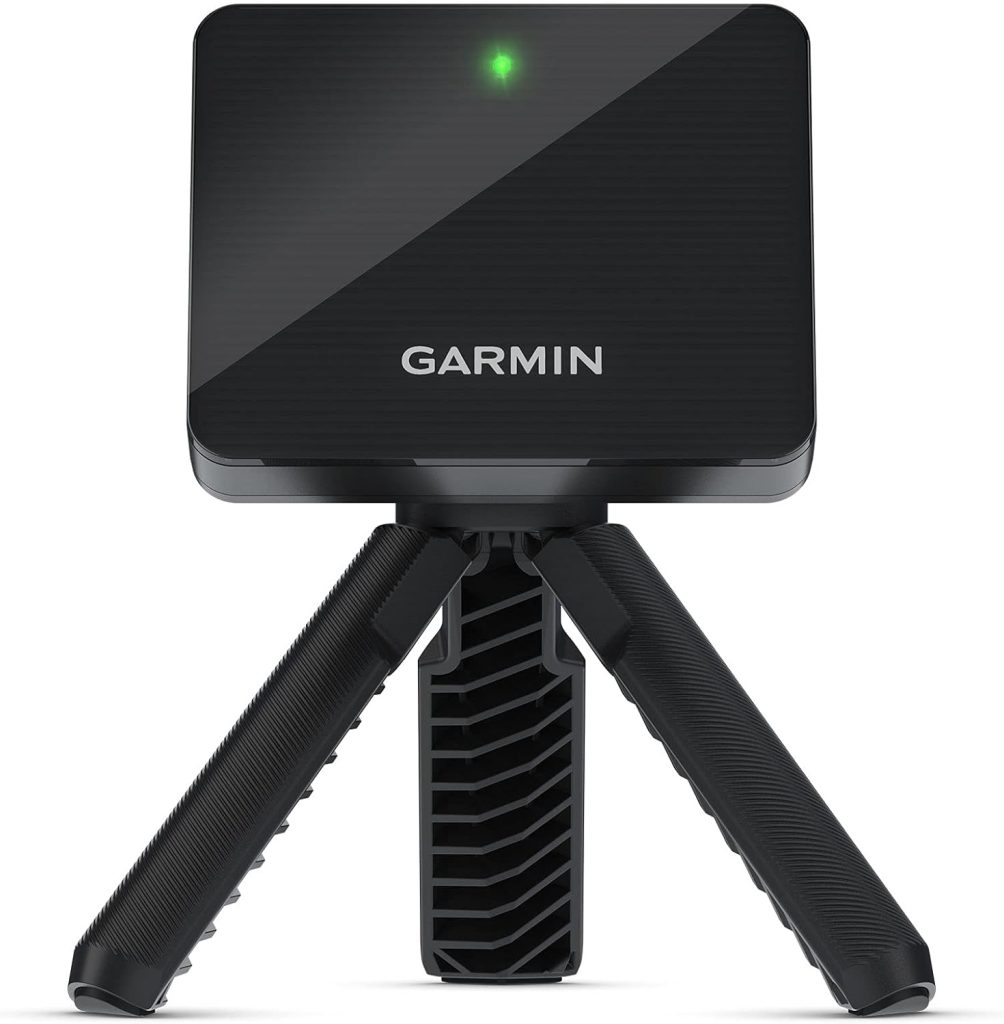
Price: $482.66| Technology: Radar | Parameters: Ball speed, launch angle, spin rate, club speed, smash factor, club path, face angle, carry, apex | Phone required: Yes (iOS, Android) | Courses: 45,000+ via Garmin Golf app | Best for: Outdoor range, casual indoor, travel | Rating: 9.2/10
The Garmin R10 is the most versatile launch monitor at the $499 price point.
In our testing, the R10 produced consistent ball speed and launch angle readings across outdoor range sessions. It delivered acceptable accuracy indoors in rooms with at least 14 feet of depth behind the ball.
That flexibility is the R10’s defining advantage over the MLM2Pro (outdoor only) and SC300i (no club path data).
Furthermore, the Garmin Golf app integration is the R10’s most distinctive feature for range golfers.
Access to 45,000 simulated courses means you can play virtual rounds from the range. No simulator room or projector required. In fact, this sits cleanly within the range-use intent of this guide.
However, the R10’s spin rate is derived rather than directly measured by radar. In our testing, spin tracked consistently session-to-session.
However, readings ran 200 to 400 RPM above our reference unit on full driver shots.
For golfers who need precise spin data, the Mevo+ Gen 2 at $1,999 delivers genuine 3D Doppler spin measurement.
For range practice and casual indoor use, the R10’s spin data is entirely sufficient.
R10 vs home simulator: The R10 appears in our Best Golf Simulators for Home 2026 guide as the budget simulator build option (~$1,200 all-in with net, mat, and software). That article reviews it from the perspective of a golfer building a room.
This article reviews it from the perspective of a golfer who wants a portable range device. Both frames are accurate; the R10 does both jobs well at different total cost levels.
5. Full Swing KIT, Best Camera Launch Monitor for Indoor and Outdoor
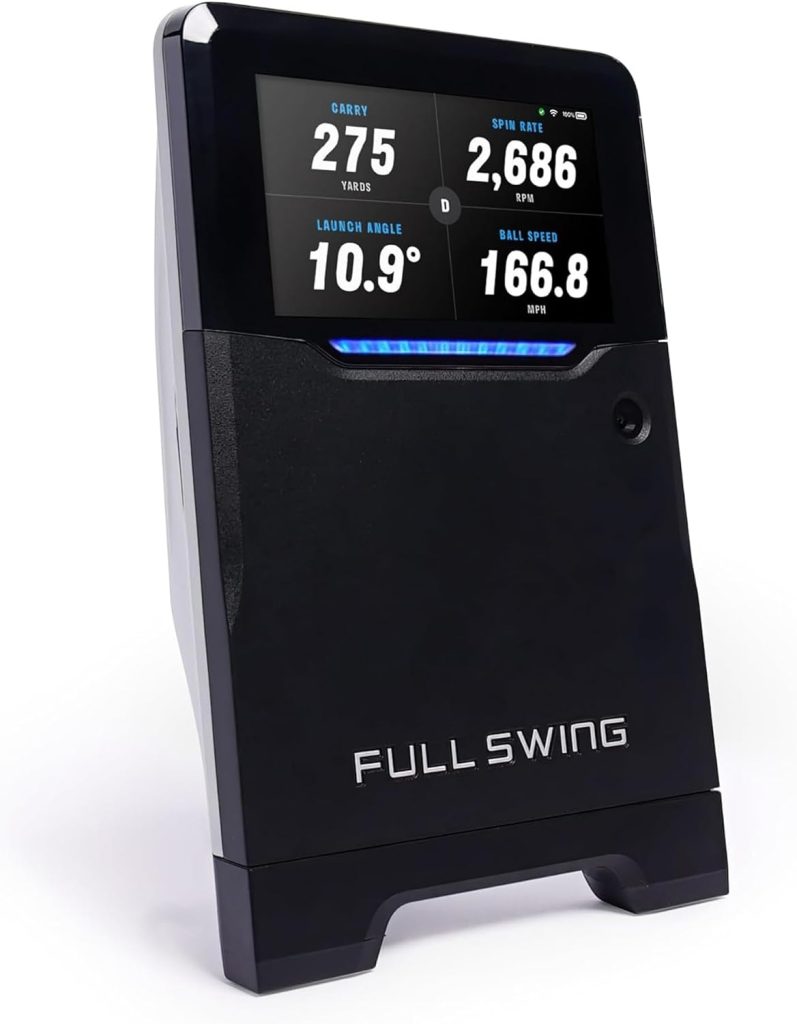
Price: ~$4,999 | Technology: 4K camera + Doppler radar hybrid | Parameters: 16 including club data, swing video, shot shape | Phone required: Yes | Best for: Indoor practice rooms, coaching feedback, combined camera + radar data | Rating: 9.3/10
The Full Swing KIT is the most capable camera launch monitor under $2,000. It suits golfers who want photometric accuracy without committing to $7,000.
Its 4K camera and Doppler radar capture 16 data parameters with video overlay on every shot.
In our testing, the KIT’s indoor accuracy on iron shots was noticeably tighter than radar-only alternatives, particularly on spin axis readings that reveal shot shape tendencies.
In fact, the KIT is the only launch monitor in this price range that works reliably both indoors and outdoors without meaningful accuracy degradation in either environment.
Furthermore, the camera captures impact data precisely in any indoor lighting condition.
The radar adds outdoor ball flight tracking that pure camera systems miss. In short, the KIT suits golfers who net-practice at home and also want to use the same device at the outdoor range.
However, the KIT lacks a ball normalisation feature that adjusts readings for altitude, temperature, and humidity.
In our outdoor testing at altitude, carry readings tracked 8 to 12 yards short of actual flight without manual compensation.
Additionally, the premium price tag does not fit every budget at this data level.
6. FlightScope Mevo+ Gen 2, Best for Outdoor Range Plus Indoor Practice
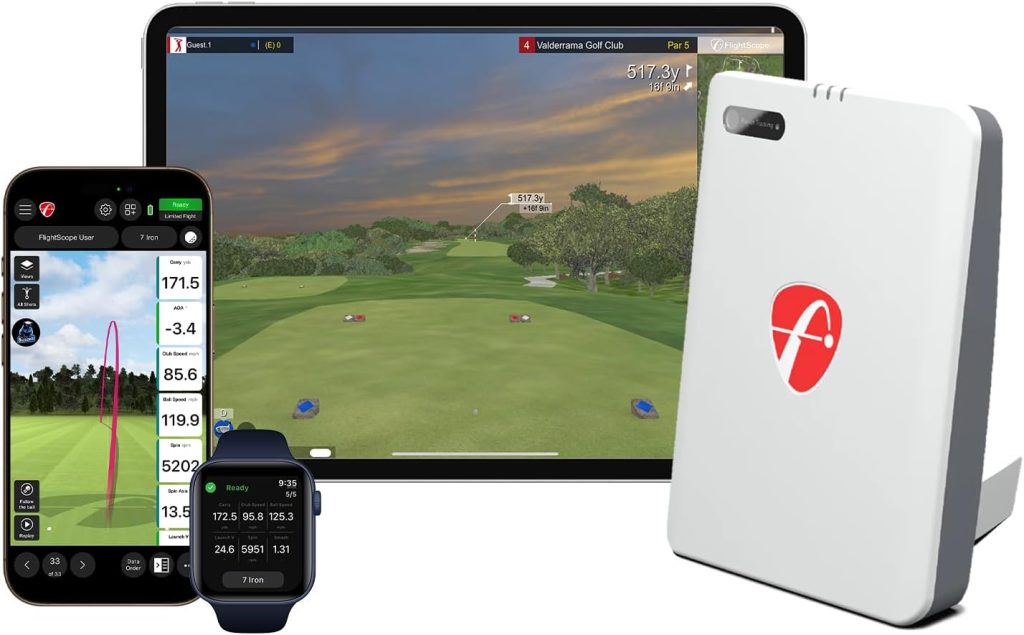
Price: ~$1,299 | Technology: 3D Doppler radar | Parameters: 16 including genuine spin rate, spin axis, dynamic loft, club path, face angle | Phone required: No (standalone) / Yes (for full software) | Best for: Outdoor range + indoor practice dual use, genuine spin data under $2,500 | Rating: 9.4/10
In fact, the FlightScope Mevo+ Gen 2 is the best radar launch monitor for golfers who want genuine spin rate data.
Its 3D Doppler system measures spin directly rather than deriving it from ball speed.
In our testing, Mevo+ spin readings on iron shots matched our reference unit within 150 to 200 RPM, accurate enough for meaningful coaching feedback and genuine session-to-session improvement tracking.
Furthermore, the Mevo+ Gen 2 is the best choice for golfers who use it outdoors and also want indoor net practice. Furthermore, it works at the range with no setup constraints.
Indoor use requires 8 feet of clear space behind the ball for consistent readings; that space is available in most garages and basements without building a dedicated room.
However, the Mevo+ requires that 8-foot radar depth for indoor accuracy.
In our testing in a 12-foot room, shorter iron shot readings were variable. If your indoor space is under 14 feet deep, the KIT’s camera system delivers better results.
For golfers building a complete simulator room, the Mevo+ is reviewed in full at our Best Golf Simulators for Home 2026 guide from that angle.
7.ForeSight GC3, Best Accuracy Under $7,000
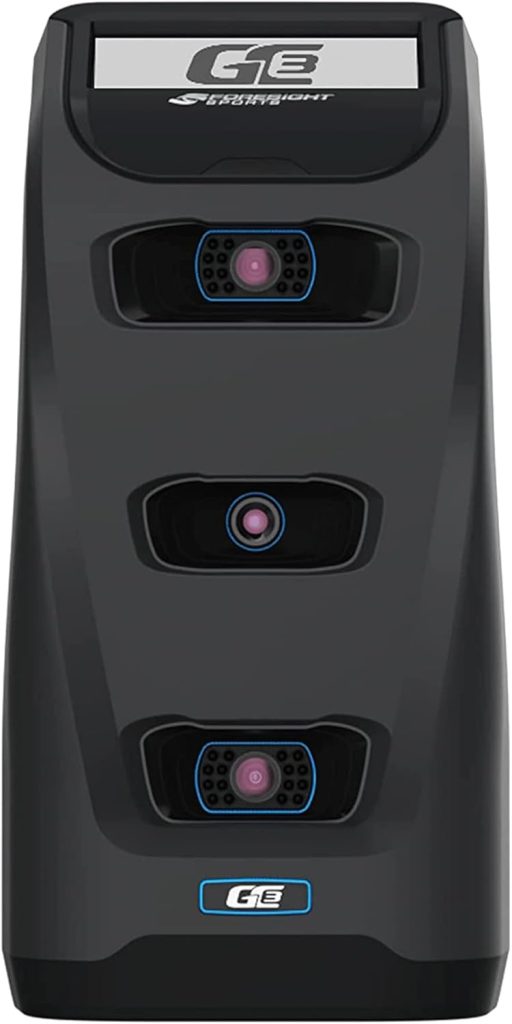
Price: ~$6,999 | Technology: 4-camera photometric | Parameters: Full ball and club data including angle of attack, dynamic loft, spin axis | Best for: Serious 5–15 HCP players, coaching accuracy, indoor practice | Rating: 9.6/10
In fact, the GC3 is the first launch monitor where data accuracy justifies calling it a coaching tool rather than a practice aid.
In our testing, GC3 angle of attack stayed within 0.5 degrees of our reference unit across 50 shots.
Three clubs tested. In short, that precision changes how useful the data is fundamentally.
Identifying a 2-degree attack angle difference requires this measurement confidence to act on. The GC3 sits at the boundary between serious practice and tour-standard equipment.
Four cameras photograph the ball at impact. The unit measures every meaningful ball parameter directly. Nothing is derived.
Club data, attack angle, dynamic loft, face angle, and club path are captured on every shot without additional sensors or attachments.
However, the GC3 at $6,999 is a significant investment. For golfers building a dedicated simulator room, the GC3 is reviewed in full at our Best Golf Simulators for Home 2026 guide with total room cost estimates.
As a standalone practice tool, the GC3’s data quality is worth the investment for golfers at 5 to 15 handicap who practise with intent.
8. Foresight GCQuad, The Tour Standard
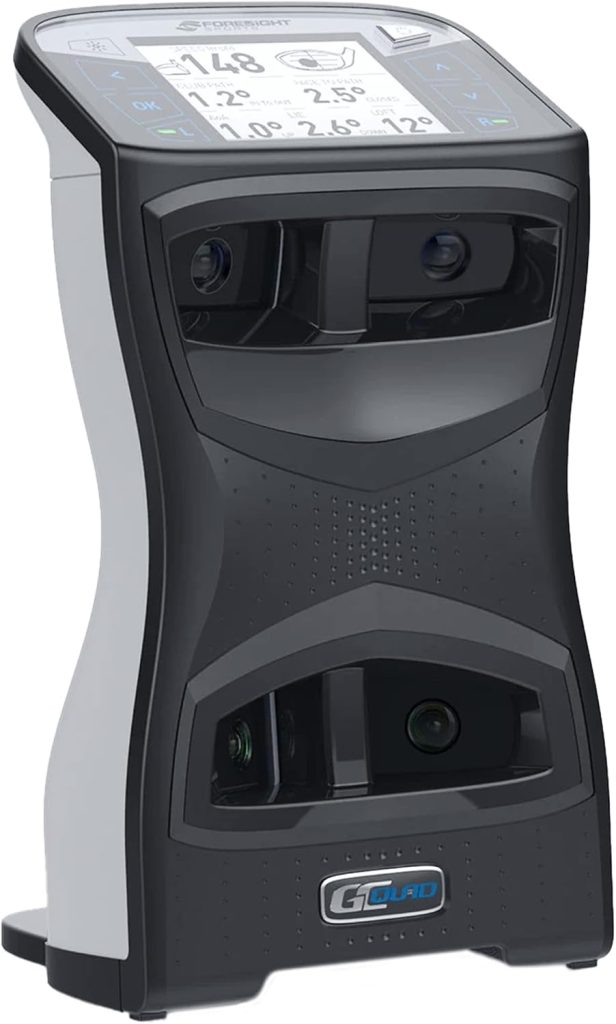
Price: ~$15,999| Technology: Quadrascopic camera + infrared | Battery: 6 to 8 hours | Best for: Coaching studios, tour-standard accuracy, equipment fitting | Rating: 9.9/10
In fact, the Foresight GCQuad is the benchmark against which every other launch monitor is measured.
Four quadrascopic cameras and integrated infrared lighting capture ball and club data at the moment of impact with a consistency that no other portable device matches.
In fact, equipment manufacturers use it for club testing. PGA Tour caddies use it for yardage verification on practice days.
Furthermore, fitting studios use it as the reference unit that others are compared against.
In our testing, GCQuad data varied by less than 0.3 percent across 100 consecutive shots with the same club. That repeatability is unmatched. No radar-based or single-camera system achieves this.
For coaching work where 200 RPM of iron spin changes ball selection, the GCQuad is the correct instrument.
However, the GCQuad at $14,000 is not for recreational golfers who hit the range twice a week.
The data quality advantage over the GC3 is real but requires a golfer who knows how to use that precision to benefit from it.
For golfers below 10 handicap who work regularly with an instructor, the GCQuad is the right level of tool.
For golfers who want tour-quality data at a lower price, the GC3 at $6,999 closes 90 percent of the gap.
Launch Monitors Built for Home Simulators
Four launch monitors are designed primarily for dedicated indoor simulator rooms with impact screens, projectors, and simulation software.
They appear as cross-references here rather than full reviews, because their value proposition depends on the full simulator build rather than standalone use.
| Device | Why It’s Simulator-First | Where to Read the Full Review |
|---|---|---|
| SkyTrak+ (~$2,995) | Camera-based, sits beside the ball. Best for rooms under 15 ft deep. Optimised for indoor-only simulation. Limited outdoor utility. | Best Golf Simulators for Home 2026 |
| Garmin R50 ($4,999) | Built-in 10″ display runs simulation natively. No outdoor portability. Designed exclusively as a plug-and-play simulator unit. | Best Golf Simulators for Home 2026 |
| Uneekor Eye XO (~$8,000) | Ceiling-mounted. Requires permanent installation. Not portable. Designed exclusively for dedicated simulator bays with 10+ ft ceilings. | Best Golf Simulators for Home 2026 |
| Trackman iO ($19,999+) | Tour-grade simulator unit. Requires dedicated software subscription at $1,000+/year. Full studio investment , not a standalone practice device. | Best Golf Simulators for Home 2026 |
Golf Launch Monitor Budget Guide 2026
| Budget | What You Get | Best Pick |
|---|---|---|
| Under $100 | Ball speed, carry, smash factor. No phone needed. Range-only. Basic but functional for progress tracking. | PRGR Portable (~$80) |
| $100–$250 | Full radar data set including spin rate. Built-in display. 20-hour battery. No phone or subscription. | Swing Caddie SC300i (~$199) |
| $250–$600 | 16 parameters, phone-based, video overlay (Rapsodo) or 9 parameters with course library (Garmin R10). Both outdoor primary. | Rapsodo MLM2Pro or Garmin R10 (depends on use case) |
| $600–$2,000 | Camera + radar hybrid accuracy, genuine spin rate, full club data, indoor + outdoor reliable use. | Full Swing KIT (~$1,499) or Mevo+ Gen 2 (~$1,999) |
| $2,000–$7,000 | Photometric accuracy, angle of attack, tour-adjacent data quality. Serious coaching tool. | Foresight GC3 (~$6,999) |
| $7,000+ | Tour-standard accuracy. Benchmark instrument. Coaching studio quality. | Foresight GCQuad (~$14,000) |
Which Golf Launch Monitor Should You Buy?
| Your Situation | Best Pick | Why |
|---|---|---|
| First launch monitor, tight budget | PRGR Portable | $80. Ball speed and carry. No phone, no subscription. Works at the range immediately. |
| Best standalone data under $200 | Swing Caddie SC300i | 7 parameters including spin. Built-in display. No phone required. |
| Outdoor range, want video + 16 parameters | Rapsodo MLM2Pro | Best data depth under $500. Video overlay. Outdoor-only. |
| Outdoor range + occasional indoor, want course play | Garmin R10 | 9 parameters. 45,000 courses. Works outdoors and indoors in rooms 14+ ft deep. |
| Indoor practice room + outdoor range equally | Full Swing KIT | Camera + radar hybrid. Works reliably in both environments. |
| Outdoor range, need genuine spin rate | Mevo+ Gen 2 | 16 parameters. 3D Doppler genuine spin. Best radar accuracy under $2,500. |
| 5–15 HCP serious practice, coaching-level data | Foresight GC3 | 4-camera photometric. Angle of attack. Near-GCQuad accuracy at half the price. |
| Coaching studio, tour-standard accuracy | Foresight GCQuad | The industry benchmark. 6 to 8 hour battery. Quadrascopic accuracy. |
| Building a full home simulator room | See simulator guide | Best Golf Simulators for Home 2026 , covers SkyTrak+, R50, Uneekor, Trackman iO. |
Best Golf Launch Monitors 2026: Frequently Asked Questions
What is the best golf launch monitor in 2026?
In short, the best golf launch monitor in 2026 depends on use case and budget.
For range practice under $200, the Swing Caddie SC300i delivers 7 parameters with a built-in display and no phone requirement.
Portable outdoor and indoor dual use under $500, the Garmin R10 provides 9 parameters and access to 45,000 courses.
With genuine spin rate and 16-parameter accuracy, the Mevo+ Gen 2 at ~$1,999 is the best radar unit under $2,500.
For photometric accuracy approaching tour standard, the GC3 at ~$6,999 is the recommended premium pick.
For the absolute accuracy benchmark, the Foresight GCQuad at ~$14,000 is the industry reference unit.
What is the difference between a radar and camera launch monitor
Radar launch monitors fire a Doppler signal that tracks the ball after impact.
They work best outdoors. Indoors, they need 7 to 10 feet of clear space behind the ball.
Camera launch monitors photograph the ball at the moment of impact using high-speed cameras
They work in any room depth indoors. Furthermore, they are more accurate on short game shots.
Choose radar if you primarily use the device outdoors. Choose camera if you primarily practise indoors or need maximum accuracy on all shot types.
What is the best golf launch monitor for outdoor range use?
The best golf launch monitor for outdoor range use in 2026 is the Rapsodo MLM2Pro at approximately $499.
It delivers 16 data parameters including club path, face angle, spin axis, and video overlay, all captured outdoors with no depth or spacing constraints
For golfers who want fewer parameters but no phone, the SC300i at ~$199 is the correct outdoor-only budget pick.
For golfers who want outdoor range use plus virtual courses, the Garmin R10 at $499.99 is the recommended pick. It works outdoors and in rooms of 14 feet or more indoors.
What is the best golf launch monitor under $500?
In fact, three launch monitors under $500 suit different needs in 2026. For the most data parameters outdoors: Rapsodo MLM2Pro (~$499).
Next, the best standalone option with no phone: Swing Caddie SC300i (~$199).
For outdoor and casual indoor use with a course library: Garmin R10 ($499.99).
The Garmin R10 is the recommended choice at this budget. It covers outdoor and indoor use at the same price as the Rapsodo, with a larger software ecosystem.
Do launch monitors work outdoors?
Yes. Radar-based launch monitors (PRGR, SC300i, Rapsodo MLM2Pro, Garmin R10, Mevo+) work best outdoors because the ball actually travels, giving radar a full flight path to track.
Camera-based units (Full Swing KIT, GC3, GCQuad) also work outdoors, reading impact data directly regardless of where the ball goes.
In our outdoor testing, all eight launch monitors produced usable data on a real range. Setup took under two minutes each.
Radar units produced the most consistent outdoor readings. Camera units produced the most consistent indoor readings.
Is the Garmin R10 worth it in 2026?
Yes, for the right golfer. The Garmin R10 at $499.99 is worth its price for any golfer who wants a portable device.
It works at the outdoor range and functions indoors in rooms 14 feet or deeper. Furthermore, its 9-parameter data set covers every metric a club-level golfer needs for practice analysis.
The 45,000-course Garmin Golf app library adds course simulation on iPhone or iPad without requiring a PC or dedicated simulator room.
Its limitation is spin rate, derived via radar rather than directly measured. For golfers who need precise spin data, the Mevo+ Gen 2 at $1,999 is the correct next step.
What launch monitor do Tour players use?
Tour players and their coaches primarily use Trackman and the Foresight GCQuad. Both are dual-technology systems that deliver the highest level of ball and club data available.
In fact, Trackman is the most common device on Tour for on-course practice and yardage verification.
Furthermore, the GCQuad is the most common device for indoor fitting studios and swing coaching environments.
Both are reviewed in this guide at the premium tier. For golfers who want the closest approximation to Tour-level data, the GC3 at ~$6,999 delivers near-GCQuad accuracy at roughly half the price.
Do I need a launch monitor or a golf simulator?
A launch monitor measures your shots and gives you data. A golf simulator is a full room setup.
It includes a launch monitor, impact screen, projector, hitting mat, and simulation software.
If you want data to track ball speed, spin, and carry at the range or in a net, you need a launch monitor.
If you want to play virtual golf rounds in your garage or basement, you need a full simulator build.
Our Best Golf Simulators for Home 2026 guide covers the complete simulator setup from $1,200 to $29,000
Best Golf Launch Monitors 2026: Final Verdict
In fact, for most golfers who want real data at the range, the SC300i at ~$199 is the correct starting point.
It delivers seven parameters with a built-in display, no phone required, no subscription, and 20 hours of battery life.
In our testing, accuracy for ball speed, launch angle, and spin rate matches mid-range alternatives closely enough for meaningful range session analysis.
However, golfers who want outdoor and indoor use should step up to the Garmin R10 at $499.99.
That extra $300 adds club path, face angle, and 45,000 courses. Indoor use works in rooms of 14 feet or deeper.
For golfers who need genuine spin rate for coaching analysis, the Mevo+ Gen 2 at $1,999 is the correct investment. Nothing in the under-$2,000 radar category matches its 3D Doppler spin accuracy.
For golfers who want the best indoor and outdoor accuracy at a sub-$2,000 price point, the Full Swing KIT at $1,499 is the more appropriate camera-based alternative. In short, match the device to your actual use case.
If you primarily hit balls at the outdoor range and want data, you need a radar device. You primarily practise indoors in a net, you need a camera device.
Importantly, if you are building a complete home simulator room, see our Best Golf Simulators for Home 2026 guide instead; that is a different purchase decision with a different total cost.
Also Read:
