


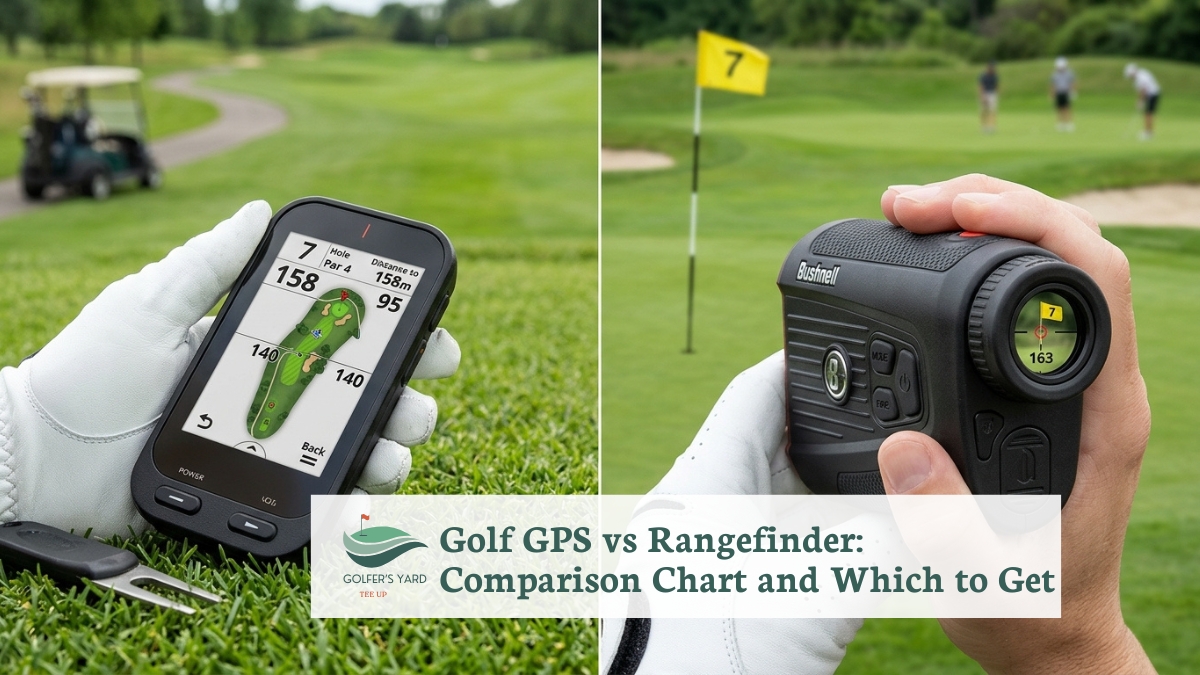
Golf GPS vs rangefinder is one of the first questions golfers ask before buying a distance device. Both tell you how far you have to go. However, they do it in very different ways.
In short, a rangefinder gives you an exact laser distance to the flag. A GPS watch, by contrast, gives you front, middle and back yardages without aiming at anything.
This guide compares them side by side, with a shareable chart and a decision guide by golfer type. For more gear ideas, see our golf tech gadgets guide.
Quick Answer: GPS or Rangefinder?
Choose a rangefinder if you want the exact distance to the pin and you strike the ball consistently. Pick a GPS watch if you want speed, blind-shot yardages and simple numbers.
- Most precise: rangefinder, usually within about one yard of the flag.
- Fastest: GPS watch, because you just glance at your wrist.
- Best for beginners: GPS watch, since front, middle and back numbers are enough.
- Blind shots and hazards: GPS watch.
- Tournament use: both are legal by default, with slope and similar features turned off.
Golf GPS vs Rangefinder: Comparison Chart
First, use this chart to compare the two at a glance. Also, feel free to share or link to it.
| Feature | Laser Rangefinder | GPS Watch |
|---|---|---|
| Accuracy | About 1 yard to the flag | Within a few yards, to fixed points |
| Distance to the pin | Yes, exact | No, front, middle and back of green |
| Blind shots | No, needs line of sight | Yes |
| Hazard distances | Only if visible | Yes, carry and reach numbers |
| Slope adjustment | On many models | On some premium models |
| Speed of use | Aim and lock each shot | Glance at your wrist |
| Shot tracking | No | On many models |
| Battery | Months of rounds on one CR2 | Several rounds per charge |
| Tournament use | Yes, with slope turned off | Yes, with extra features off |
| Typical price | $70 to $500 | $150 to $650 |
| Best for | Consistent ball strikers | Beginners and fast players |
How Does a Golf Rangefinder Work?
A laser rangefinder fires an invisible beam at a target and times how long it takes to bounce back. As a result, it measures the exact distance to whatever you aim at.
Many models add flag lock, which vibrates or beeps when the laser locks onto the pin. Others add slope, which adjusts the number for uphill or downhill shots.
The catch is that you need a clear line of sight. So if the flag sits behind a hill or trees, the laser cannot reach it.
How Does a Golf GPS Watch Work?
A GPS watch uses satellites to find your position on a preloaded course map. Then it calculates the distance to the front, middle and back of the green.
It also shows hazards, such as bunkers and water, even on blind shots. However, it measures to fixed points on the green, not to the actual pin.
How Accurate Are Golf GPS Watches Compared With Rangefinders?
Overall, a rangefinder wins on pure precision. Because it measures to the flag itself, it removes guesswork on pin position.
In contrast, GPS accuracy depends on the satellite signal and the quality of the course map. Generally, expect results within a few yards on a well-mapped course.
That said, the extra precision matters most for consistent ball strikers. For example, if your 7 iron varies by 15 yards, a one-yard difference changes little.
Want to know your real carry numbers first? Our golf club distances chart shows typical yardages by handicap.
Which Is Faster on the Course?
On the other hand, a GPS watch is usually faster. After all, you simply glance at your wrist as you walk up to the ball.
In contrast, a rangefinder means taking it out, aiming and locking on to the flag. With practice, though, that takes only a few seconds.
Which Is Better for Blind Shots and Hazards?
In particular, this is where GPS shines. Since it does not need line of sight, it gives distances on doglegs, blind tee shots and shots over hills.
Moreover, it shows how far you need to carry a bunker or reach the water. A rangefinder can only measure what you can see and hit with the laser.
What Is Slope on a Golf Rangefinder?
Slope adjusts the distance for elevation change. For example, a 150-yard shot that is steeply uphill might play more like 160 yards.
Some premium GPS watches offer a similar feature, often called “plays like” distance. Either way, it helps you pick the right club on hilly courses.
Are Rangefinders and GPS Watches Legal in Tournaments?
Under the Rules of Golf, both devices are legal by default for measuring distance. However, a committee can ban them with a local rule.
Slope and similar features are a different story, because they are not allowed in competition. So for tournament golf, use a rangefinder with a slope switch that turns the feature off.
Either way, always check your event’s local rules first. You can read the official guidance in the USGA’s distance-measuring device FAQs.
Do Pros Use Rangefinders or GPS?
Most tour players still rely on caddies and detailed yardage books during tournaments. However, many use rangefinders in practice rounds to build those books.
Also, some professional events now allow distance-measuring devices. Even so, amateurs benefit far more, because they rarely have a caddie walking the course for them.
Cost: Which Is Better Value?
Budget rangefinders now start around $70, while good GPS watches usually start around $150. However, a watch can also replace your everyday smartwatch.
Also, watches need regular charging, whereas a rangefinder battery lasts for many rounds. As a result, running costs stay low for both.
Some GPS brands charge a subscription for extra features. Therefore, check the long-term cost before you buy.
Is a Golf Rangefinder Worth It?
For consistent ball strikers, yes. Knowing the exact number removes doubt, and doubt causes tentative swings.
For most amateurs, however, a GPS watch covers what you need, and it is faster. Likewise, a free GPS app is enough in your first season.
Golf GPS vs Rangefinder: Which Should You Get?
Ultimately, the right device depends on how you play. So use this guide to match one to your game.
| Golfer type | Best choice | Why |
|---|---|---|
| Beginner | GPS watch | Fast yardages and hazard warnings |
| High handicapper | GPS watch | Green-center numbers are enough |
| Mid handicapper | Either | Pick by budget and speed |
| Low handicapper | Rangefinder | Exact pin distance pays off |
| Tournament player | Rangefinder with slope switch | Legal and precise |
| Blind or hilly course | GPS watch | No line of sight needed |
What I Use and Why
I use a golf watch on the course. I chose it because I’m already wearing it, so there’s nothing to pull out of my bag before a shot.
As an amateur, I’m not chasing the exact yardage to the flag. Instead, front, middle and back of the green tell me enough to pick a club and swing.
For me, the biggest advantage of a watch is speed. I check the distance on the walk to my ball, so I have a club in mind by the time I get there.
It matters most on blind shots. If a green sits over a rise, a rangefinder has no flag to lock onto.
A watch, however, still gives me a number, because it doesn’t need a line of sight.
If I could only keep one device, I would keep the watch. After all, amateurs lose far more shots to poor contact than to being a few yards off.
A rangefinder is more precise, especially for exact pin distances. However, that precision helps most when you can reliably hit a shot that exact distance.
For most of us, a good number on every shot is worth more.
Can You Use Both a GPS Watch and a Rangefinder?
Yes. In fact, many low handicappers settle the golf GPS vs rangefinder debate by using both.
They use the watch off the tee and on blind shots, then the laser for exact approach distances. Some devices, called hybrids, combine a laser with built-in GPS in one unit.
Of course, that means spending more. So for most golfers, one device is plenty.
Where to Compare Models
Ready to choose a device? Our buying guides compare current models in detail.
- Lasers: best golf rangefinders
- Bushnell models: Bushnell golf rangefinder guide
- Watches: best golf GPS watches
- Women’s watches: best women’s golf GPS watches
A GPS watch is usually better for beginners. It gives fast front, middle and back yardages with no aiming. Also, it helps you avoid hazards you cannot see.
Yes, a rangefinder is more precise. It measures the exact distance to the flag, usually within about one yard. In contrast, GPS measures to fixed points on the green.
No, you do not need one to play. However, a rangefinder or GPS device helps you pick the right club. As a result, most regular golfers use one.
Not with slope turned on. Instead, choose a rangefinder with a slope switch, and turn it off for competition. Always check the event’s local rules.
Most work in light rain, and many are water-resistant. However, heavy rain and fog can make it harder to lock on to the flag.
Many popular watches include course maps with no subscription. Still, some brands charge for extra features, so check before you buy.
Final Word: Match the Device to Your Game
To sum up the golf GPS vs rangefinder question, a rangefinder is better for precise approach shots. For speed, simplicity and blind shots, however, a GPS watch wins.
Still undecided? Then start with a GPS watch as a beginner, or a rangefinder if you strike the ball well.
