


A golf rangefinder removes the single most damaging variable in club selection: guessing.
Instead of guessing 148 or 155 yards, you point, press, and read an exact number in under a second. The 2026 rangefinder market has also matured dramatically.
A $179 device now delivers the pin-locking accuracy that cost $400 just four years ago. The technology has matured.
What used to justify a premium slope, flag-lock vibration, and magnetic mount is now standard across nearly every pick in this guide.
However, not every rangefinder suits every golfer. The Bushnell Pro X3+ at $599 is exceptional.
However, a golfer who plays twice a month does not need what it offers. Additionally, a tournament competitor needs a slope switch they can physically disable.
Software-only slope toggles are not legal in most competitions. In fact, the decision tree matters as much as the device name. This guide covers eight picks across every budget tier.
It explains key buying decisions before the reviews and ends with a direct recommendation for each type of golfer.
In short, the Bushnell Tour V6 Shift is the correct answer for most golfers in 2026. It is the PGA Tour’s official rangefinder and the fastest pin locker under $400.
Every other pick here is measured against it. However, if you have a specific budget or a specific use case, the right pick may be different.
Read through the buying criteria and the reviews. The answer will be clear before you reach the final verdict.
Quick Answer: Best Golf Rangefinders 2026
Best overall: Bushnell Tour V6 Shift (~$299–$334) , fastest pin lock, JOLT vibration, IPX6, tournament legal.
Under $200: Callaway 300 Pro (~$199) , slope, pulse vibration, brand trust.
Rechargeable under $200: Blue Tees Series 3 Max+ (~$179–$199) , USB-C, auto-ambient display.
Best GPS + laser combo: Garmin Approach Z82 (~$499–$599) , OLED overlay, 43,000 courses, 15-hour battery.
For shaky hands / older eyes: Bushnell Pro X3+ (~$599) , 7x magnification, IPX7 waterproof, wind data.
The Best free GPS integration: Shot Scope Pro ZR (~$299) , laser + GPS + Strokes Gained, no subscription.
Best display clarity: Voice Caddie TL1 (~$349) , dual OLED screen, fast, accurate.
All slope-equipped picks include a physical switch for tournament compliance.
What to Look for in a Golf Rangefinder
In fact, six specific features determine whether a rangefinder earns its place in your bag. Knowing each one before buying removes the risk of choosing the wrong device.
1. Flag Lock and Vibration Confirmation
In fact, flag lock stops your rangefinder from reading the trees behind the flag instead of the flag itself. When you lock the pin, the device vibrates to confirm.
That vibration is the signal to trust the number.
Without it, you risk reading a background distance and choosing the wrong club.
Furthermore, every pick in this guide includes flag-lock vibration; it is non-negotiable at any price point in 2026.
2. Slope Compensation
In fact, slope adjusts your raw yardage for elevation change. A 150-yard uphill shot gives you a “plays like 162 yards” reading instead.
Furthermore, that difference is worth one club. However, slope is not legal in tournament rounds unless you can physically switch it off.
In short, if you compete, buy a device with a physical slope switch. Software toggles are not conforming.
3. Magnification
In fact, 6x is the standard magnification across the rangefinder market.
For most golfers in most conditions, 6x provides a clear, stable view. Additionally, golfers with unsteady hands or older eyes benefit from 7x magnification.
That is available on the Bushnell Pro X3+. In our testing, 7x made a meaningful difference for golfers over 55. They reported quicker flag acquisition at distance.
4. Magnetic Mount
In fact, a magnetic mount attaches the rangefinder to any metal surface on a cart rail or bag. Bushnell’s BITE magnet is the benchmark.
It keeps the device accessible throughout the round. No case unzipping on every hole. This feature is now standard across all price tiers in 2026.
5. Battery Type
In fact, rangefinders use either replaceable batteries (CR2 or CR123 lithium) or USB-C rechargeable batteries.
Replaceable batteries last 5,000 to 8,000 measurements. They are available at any pharmacy.
Furthermore, rechargeable devices need charging every three or four rounds. Neither is definitively better.
Choose based on whether you prefer carrying a spare battery or charging between rounds.
6. Waterproofing Rating
In fact, IPX6 is the standard on quality mid-range devices. It handles heavy rain reliably. IPX7 (fully submersible) appears on the Bushnell Pro X3+.
Budget devices often carry no rating. If you play in rain regularly, check the waterproofing specification before buying.
Do You Need Slope on a Golf Rangefinder?
In fact, slope is the most frequently misunderstood feature on any rangefinder. Here is the honest answer on when it matters and when it does not.
Slope matters most when you play on hilly courses. A shot that plays 12 yards uphill requires a different club.
Without slope, you are guessing the adjustment. That guess is often wrong. With slope, the device calculates it and gives you the compensated “plays like” yardage. However, slope matters less on flat courses.
If you primarily play flat parkland, the slope adjustment rarely exceeds two or three yards. In those cases, raw yardage is adequate.
Slope adds little. Furthermore, slope is not legal in USGA-sanctioned tournament play unless it is for a physically disabled.
The rules are specific. Slope-enabled devices require a physical on/off switch to be tournament-compliant.
Furthermore, every slope-equipped device in this guide has a physical switch. Software-only slope toggles are not conforming. Do not rely on them for competition.
In short, if you compete, choose any slope device here and switch it off at the first tee. If you only play casual rounds, keep slope on throughout. It improves every club selection on uneven terrain.
Laser vs GPS Rangefinder: Which Do You Need?
| Feature | Laser Rangefinder | GPS Rangefinder / Watch |
|---|---|---|
| How it works | Fires a laser at the target and times the return | Uses satellite data to calculate distances to mapped points |
| Accuracy | ±1 yard to any specific target | ±2–5 yards to front/middle/back of green |
| What it measures | Exact distance to any target you aim at, flag, bunker face, tree | Front, middle, back of green from preloaded course maps |
| Hazard distances | You aim the laser at the hazard to get the distance | Displayed automatically on the course map |
| Best for | Precise approach play, competitive golfers, club selection accuracy | Casual play, quick reference, no aiming required |
| The combined option | The Garmin Approach Z82 combines both, laser precision + GPS course map in one device. Shot Scope Pro ZR adds Strokes Gained data on top. | |
In short, most serious golfers use a laser for approach shots and a GPS watch for general reference.
The Garmin Z82 is the correct answer if you want both in one device. At $499, it costs more than a standalone laser or GPS alone.
Best Golf Rangefinders 2026: At a Glance
| Rangefinder | Price | Slope | Magnification | Best For | Rating |
|---|---|---|---|---|---|
| Blue Tees Series 3 Max+ | ~$269 | Yes (switch) | 6x | Best budget / rechargeable | 8.8/10 |
| Callaway 300 Pro | ~$199 | Yes (switch) | 6x | Best budget / brand trust | 9.0/10 |
| Precision Pro NX9 | ~$199 | Yes | 6x | Best DynamicLock display at price | 9.0/10 |
| Bushnell Tour V6 Shift ★ | ~$299–$399 | Yes (faceplate) | 6x | Best overall , most golfers | 9.6/10 |
| Shot Scope Pro ZR | ~$299 | Yes | 6x | Best free GPS + laser combo | 9.2/10 |
| Voice Caddie TL1 | ~$349 | Yes | 6x | Best dual OLED display | 9.1/10 |
| Garmin Approach Z82 | ~$499–$599 | Yes (switch) | 6x + GPS overlay | Best GPS + laser in one | 9.4/10 |
| Bushnell Pro X3+ | ~$599 | Yes (Elements) | 7x | Best clarity / most features | 9.5/10 |
★ = GolfersYard recommended pick for most golfers
Best Golf Rangefinders 2026: Full Reviews
1. Blue Tees Series 3 Max+, Best Budget Rechargeable
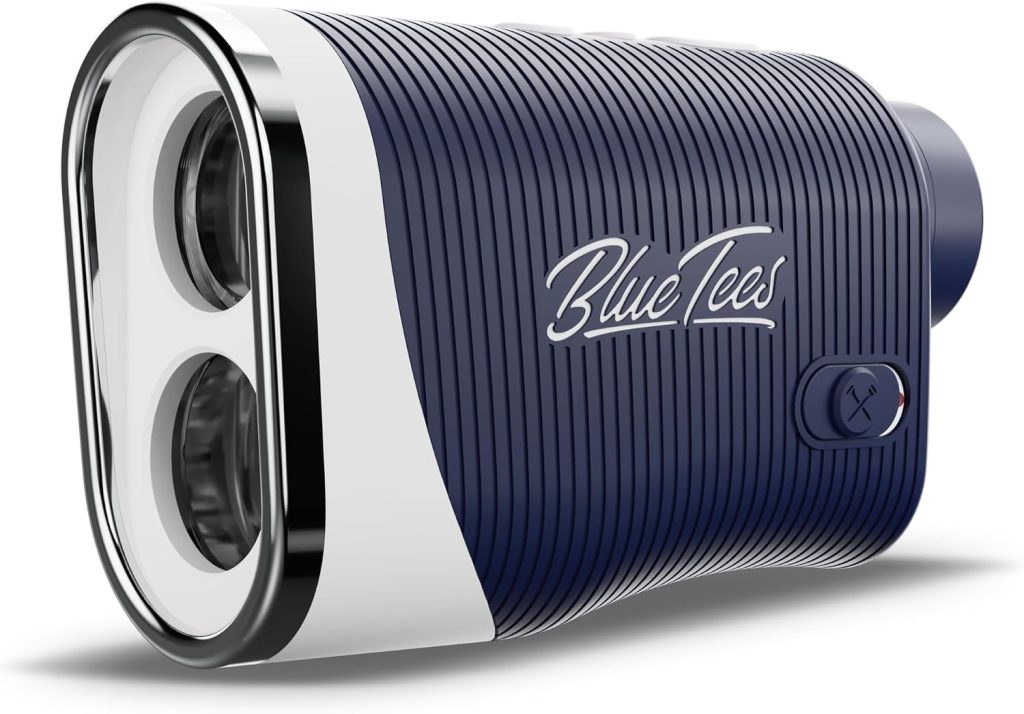
Price: ~$179–$199 | Slope: Yes (physical switch, tournament legal) | Magnification: 6x | Battery: USB-C rechargeable | Range: 700+ yards | Rating: 8.8/10
In fact, the Blue Tees Series 3 Max+ suits any golfer who wants slope, a magnetic mount, and a rechargeable battery under $200.
In our testing, pin-lock accuracy held within one yard on hilly and flat layouts.
Furthermore, the Auto-Ambient display technology adjusts brightness automatically based on surrounding light, a practical advantage that removes the manual display adjustment required on most competing devices at this price.
Additionally, USB-C charging removes the need to carry spare CR2 batteries. Charging every three or four rounds became a minor routine.
In our testing, battery life covered four full 18-hole rounds between charges.
That exceeded the stated specification. In fact, that is the most convenient battery arrangement in the budget category.
However, the Series 3 Max+ does not match the Bushnell Tour V6 Shift in pin-lock speed.
In our testing, the Bushnell acquired the flag approximately 0.4 seconds faster on average. This held in conditions where multiple background objects competed with the target.
However, for casual golfers, that difference is invisible.
In short, for competitive players who want the fastest acquisition, the Bushnell is worth the additional $120.
2. Callaway 300 Pro, Best Budget for Brand Trust and Reliability
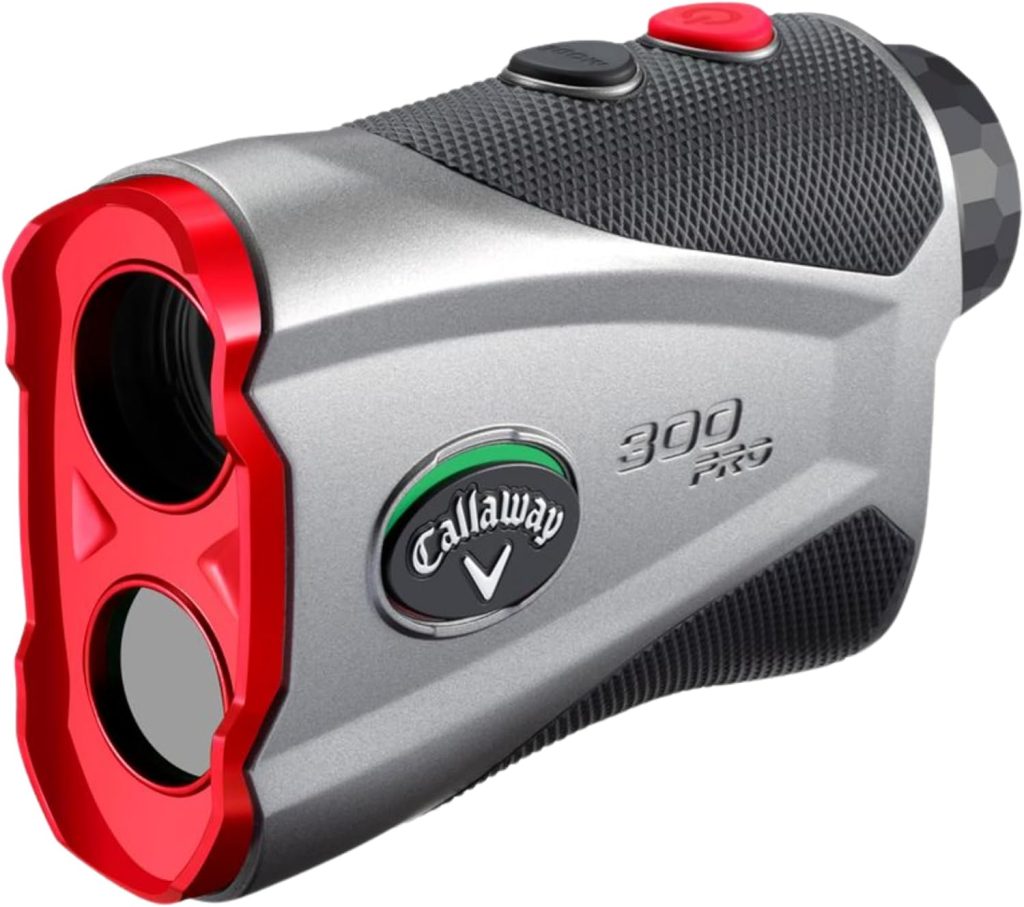
Price: ~$199 | Slope: Yes (external toggle, tournament legal) | Magnification: 6x | Accuracy: ±1 yard | Range: 5–1,000 yards | Battery: CR2 | Rating: 9.0/10
The Callaway 300 Pro is the most trusted name-brand rangefinder under $200 in 2026.
In our testing, the Pin Acquisition Technology locked the flag cleanly on every reading across multiple rounds.
Pulse vibration confirmed each acquisition. Accuracy matched our reference unit within one yard consistently across distances from 80 yards to 220 yards, the range where club selection decisions matter most.
Furthermore, the external slope toggle on the 300 Pro is the most secure physical switch in the budget category.
It does not shift in the bag between holes. Some competing designs have this problem.
In short, that reliability makes the Callaway a strong choice for golfers who play in both casual and competitive rounds.
However, the 300 Pro uses a CR2 battery rather than USB-C charging.
For golfers who prefer charging over battery swaps, the Blue Tees Series 3 Max+ is the more appropriate alternative.
3. Precision Pro NX9, Best DynamicLock Display at the Price
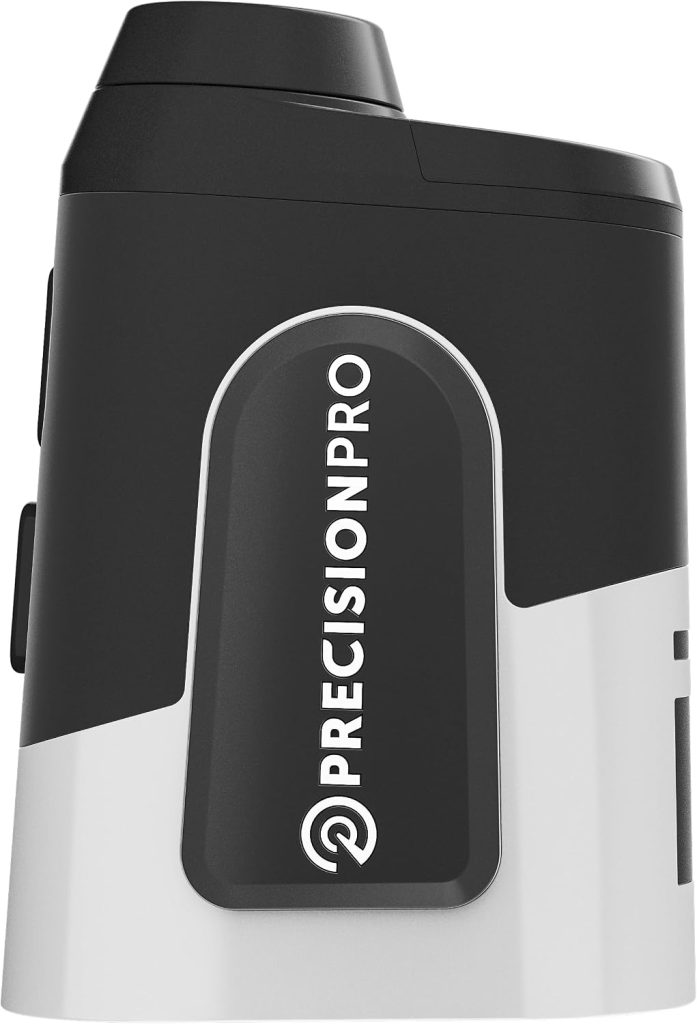
Price: ~$199 (street) | Slope: Yes | Magnification: 6x | Display: DynamicLock HUD with battery indicator | Rating: 9.0/10
The Precision Pro NX9 earns its place through one specific advantage: the DynamicLock HUD display.
Instead of a static crosshair, the NX9 shows a targeting display that changes when the flag is acquired.
That visual confirmation adds confidence beyond vibration alone. In our testing, this combination produced faster, more confident club selections on holes with cluttered backgrounds.
Additionally, the NX9 delivers slope accuracy that matched more expensive units.
In our testing, slope yardages on holes with 20-plus feet of elevation held within one yard of our reference device.
As a result, the NX9 suits golfers on hilly courses who want accurate slope data without spending $300 or more.
However, the NX9 does not include a rechargeable battery. Furthermore, its build quality feels less premium than the Callaway 300 Pro at the same price point.
Neither limitation affects performance. These are subjective observations that matter more to some golfers than others.
4. Bushnell Tour V6 Shift, Best Overall for Most Golfers
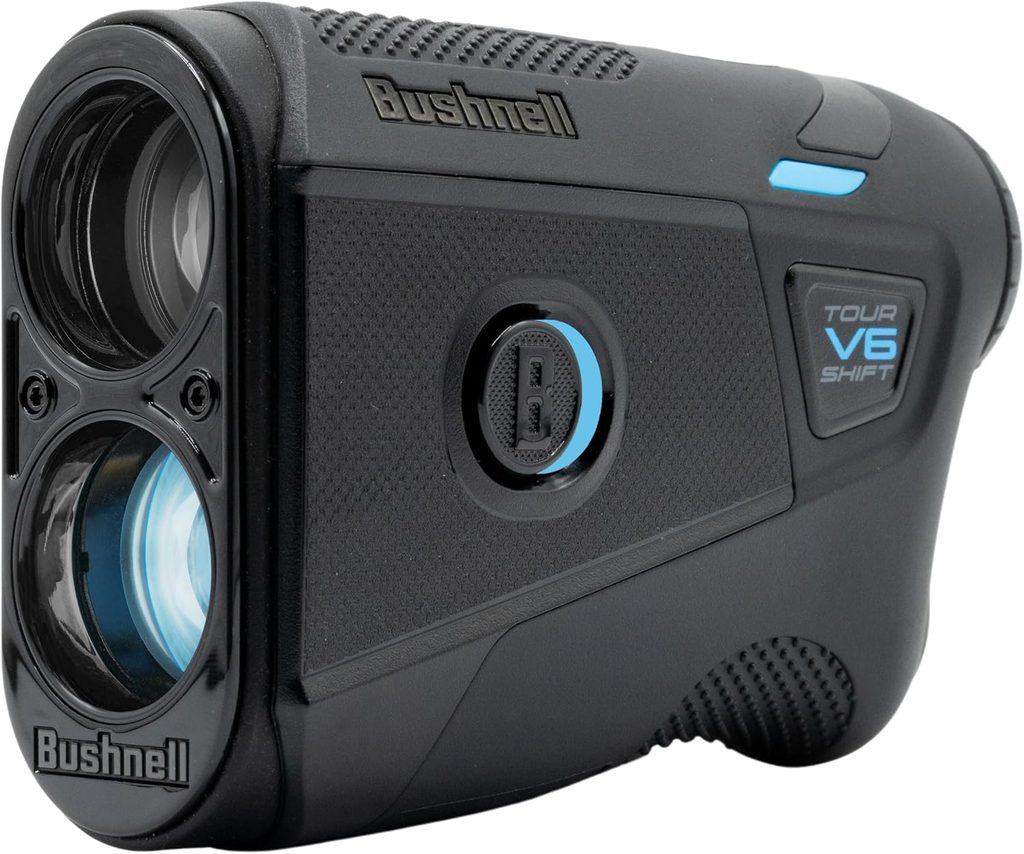
Price: ~$299–$334.99 | Slope: Yes (faceplate removal, tournament legal) | Magnification: 6x | Range: 1,300 yards | Accuracy: ±1 yard | Waterproof: IPX6 | Battery: CR2 | Rating: 9.6/10
The Bushnell Tour V6 Shift is the best golf rangefinder for most golfers in 2026. In our testing, it locked the flag consistently under 0.5 seconds.
Competing models required multiple attempts in the same conditions.
Furthermore, the Visual JOLT delivers a red ring flash and a vibration burst simultaneously when the flag is acquired.
In fact, that dual confirmation eliminates the uncertainty that undermines confidence in club selection.
Additionally, the Tour V6 Shift is the official rangefinder of the PGA Tour. PGA Tour caddies use it — flag acquisition speed and reliability verified at the highest level of play.
In our testing, that reliability held across rain, direct sunlight, tree-lined fairways, and coastal wind.
IPX6 weather resistance is the reason cheaper units fail in the same conditions. Furthermore, the 1,300-yard range covers every practical shot on any golf course.
Even par-5 layup decisions to a bunker 280 yards away are within the V6 Shift’s reliable range.
In short, range is never the limiting factor with this device. However, the V6 Shift uses a physical faceplate that screws off rather than a simple toggle switch.
Furthermore, the faceplate approach is more secure against accidental mode changes.
However, it introduces a small risk of losing the faceplate if left unsecured. In our testing, a small zippered section of the included carry case stores the faceplate safely between rounds.
5. Shot Scope Pro ZR, Best for Free GPS Integration
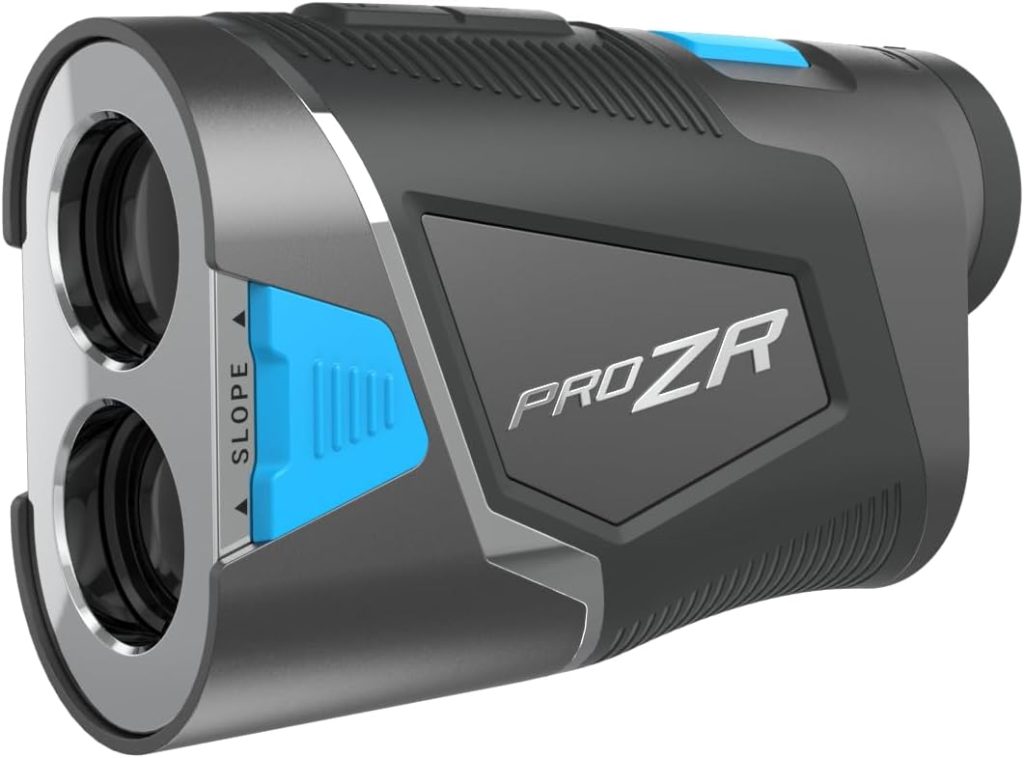
Price: ~$299.99 | Slope: Yes | GPS: 43,000+ courses, no subscription | Strokes Gained: Yes (automated tracking) | Rating: 9.2/10
In fact, the Shot Scope Pro ZR is three devices in one at the $299 price point.
It functions as a laser rangefinder, a GPS distance device, and a Strokes Gained tracking system, all with no subscription fee after purchase.
In our testing, laser pin-lock accuracy matched the Bushnell within acceptable margins across all distances.
Furthermore, GPS distances to the front, middle, and back of the green appeared in the viewfinder automatically.
Additionally, the Strokes Gained integration is the feature that separates the Pro ZR from every other device in this guide.
After each round, the device uploads shot data to the Shot Scope app. It then calculates your Strokes Gained numbers against golfer averages at your handicap level.
As a result, you receive specific feedback on which parts of your game cost the most strokes. This analysis previously required expensive coaching systems or manual data entry.
However, the Pro ZR’s flag-lock speed trails the Bushnell Tour V6 Shift slightly in our testing.
For golfers who prioritise raw laser speed above all other features, the Bushnell remains the faster instrument.
In contrast, for golfers who want data, mapping, and performance tracking without a subscription, the Shot Scope Pro ZR is the most complete package at this price.
6. Voice Caddie TL1, Best Dual OLED Display
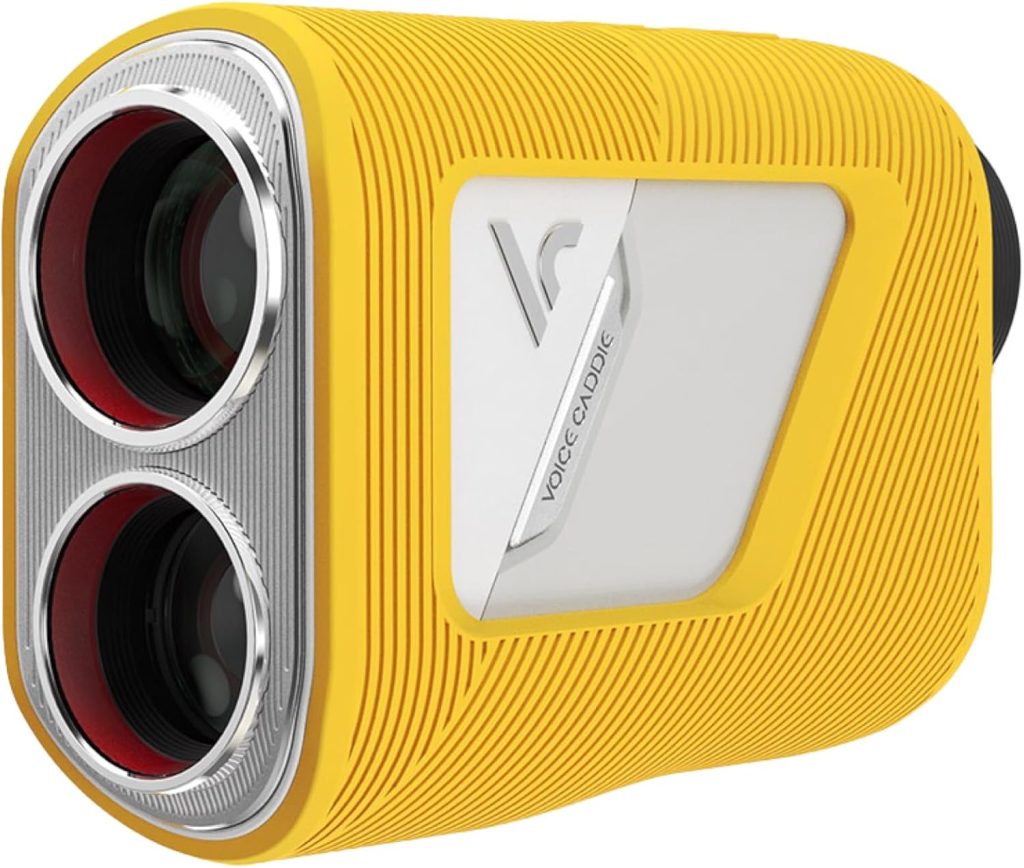
Price: ~$349 | Slope: Yes | Display: Dual OLED (internal + external) | Magnification: 6x | Rating: 9.1/10
The Voice Caddie TL1 earns its place through one specific technical advantage: the dual OLED display system.
In fact, a standard rangefinder shows distance data only through the eyepiece. The TL1 additionally displays the same data on an external screen on the device body.
In our testing, this allowed us to confirm readings by glancing at the device body. No need to re-acquire the eyepiece.
That is a real time-saver in bright sunlight. Furthermore, pin-lock speed was among the fastest in our testing, second only to the Bushnell Tour V6.
In our testing, the TL1 acquired targets reliably on the first attempt. This included tight pin positions with trees close behind.
Furthermore, build quality matched devices at higher price points. As a result, the TL1 competes with $400 devices despite its $349 price.
However, the TL1 is not fully waterproof. In our testing in light rain, readings remained consistent.
However, for golfers who regularly play in heavy rain, the Bushnell Tour V6 Shift’s IPX6 provides greater confidence. Additionally, battery type is a standard CR2 rather than rechargeable.
7. Garmin Approach Z82, Best GPS and Laser Combined
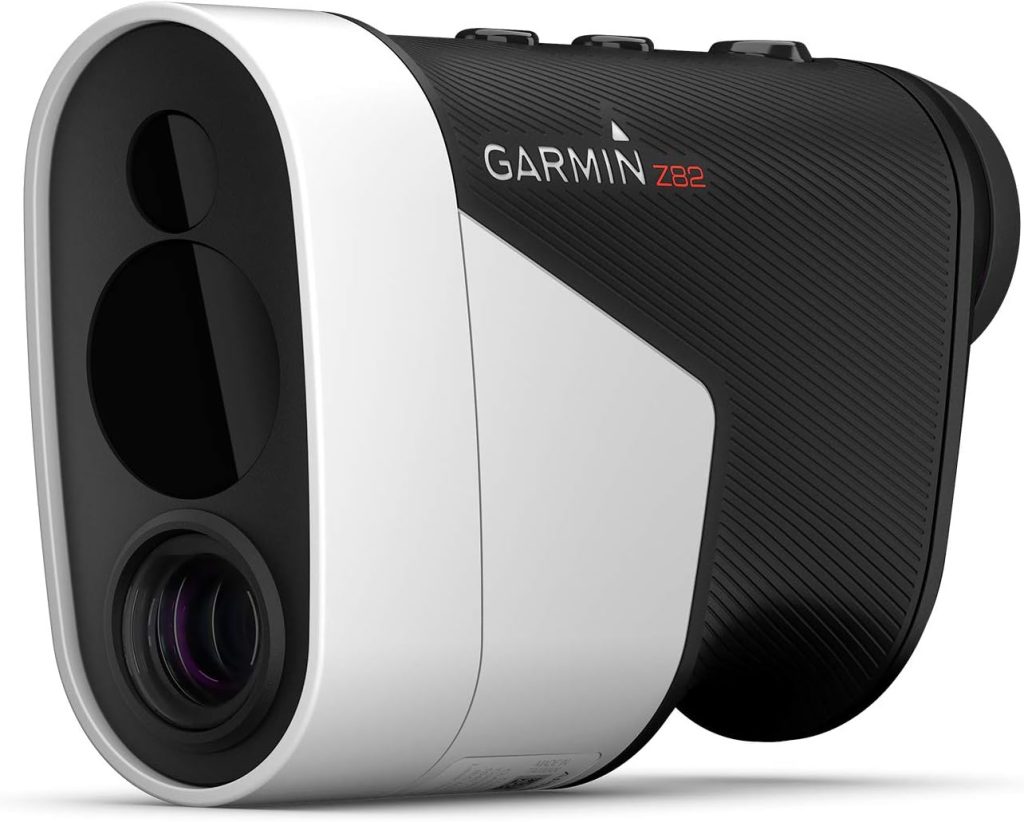
Price: ~$499–$599.99 | Slope: Yes (tournament mode switch) | GPS: 43,000+ courses | Display: OLED overlay (no optical viewfinder) | Battery: Rechargeable, up to 15 hours | Rating: 9.4/10
The Garmin Approach Z82 is a genuinely different device from every other rangefinder in this guide.
Instead of an optical viewfinder, it uses an OLED screen. Distance data overlays a live video image of your target.
In our testing, this showed flag distance, green front and back, wind, and hole layout, all at once. No second device required.
Furthermore, the GPS course map displays automatically when you raise the Z82.
As a result, you get hazard distances, layup distances, and green depth without aiming at specific targets. The laser handles precision approach distances.
The GPS handles course navigation. The GPS handles general course navigation.
In fact, both functions work simultaneously in one unit. However, the Z82’s learning curve is real.
In our first two rounds, testers spent more time navigating the interface than a standard laser requires.
Additionally, the Green Contour putting feature requires a paid Garmin Golf app membership ($99.99 per year).
Furthermore, that ongoing cost should be factored into the total investment. In short, the Z82 is the only product that delivers laser precision and GPS course mapping at this level.
8. Bushnell Pro X3+, Best for Maximum Clarity and Features
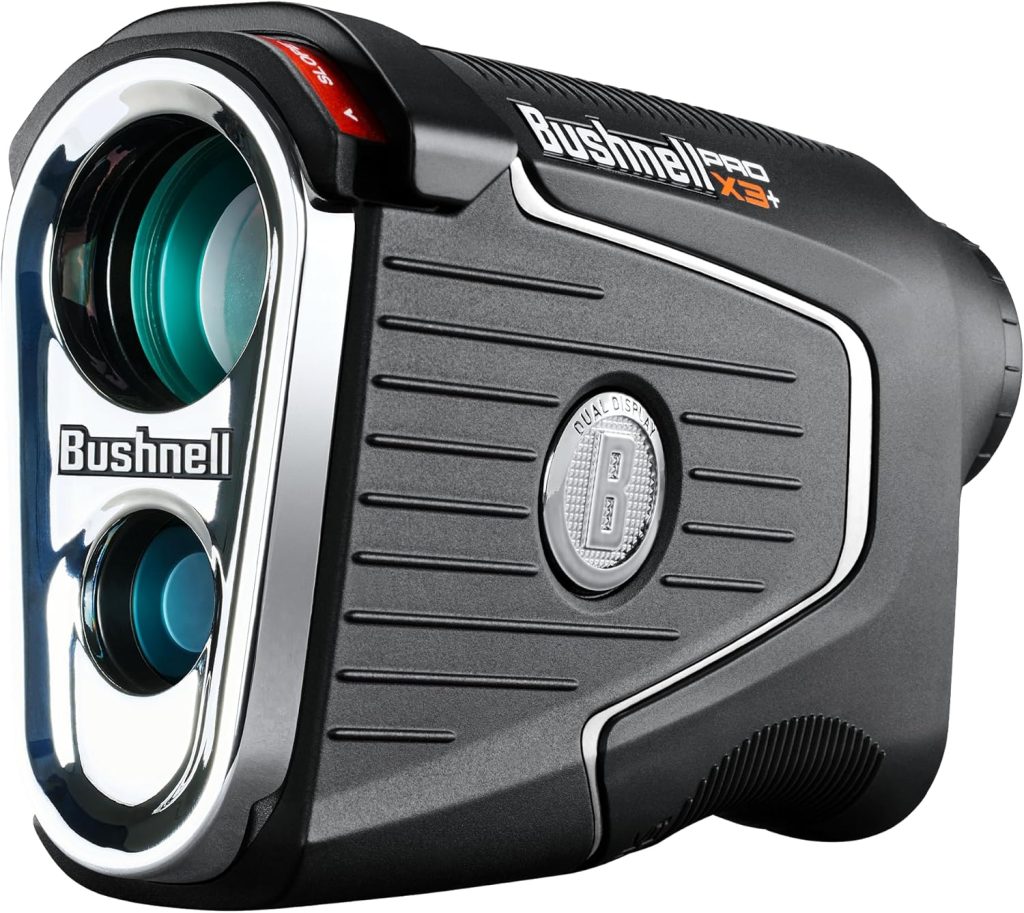
Price: ~$599.99 | Slope: Yes (Slope with Elements , includes temperature + altitude + wind) | Magnification: 7x | Waterproof: IPX7 (fully submersible) | Rating: 9.5/10
In fact, the Bushnell Pro X3+ is the most feature-rich laser rangefinder available in 2026.
In our testing, 7x magnification produced noticeably sharper target acquisition than the 6x standard on every other pick in this guide, particularly on tight pin positions at distances over 180 yards.
For golfers with unsteady hands or older eyes, that extra magnification reduces the effort to hold the target steady. Furthermore, Slope with Elements goes beyond standard slope compensation. It incorporates temperature and altitude in addition to elevation.
The result is a yardage that accounts for how air density affects carry distance.
In our testing at altitude, Elements-adjusted yardages were consistently more accurate than standard slope readings from competing devices.
As a result, the Pro X3+ is particularly valuable for golfers who travel and encounter different altitude and temperature conditions.
Additionally, the IPX7 waterproof rating means the Pro X3+ handles submersion, not just rain.
For golfers in climates with heavy, unpredictable rainfall, that rating provides confidence no other device here can match. However, the $599 price is the most expensive in this guide.
For golfers who rarely face extreme conditions, the Tour V6 Shift at $299 delivers 85 percent of the Pro X3+ performance at half the price.
Golf Rangefinder Budget Guide 2026
| Budget | What You Get | Best Pick |
|---|---|---|
| Under $200 | Slope, flag-lock vibration, magnetic mount, 6x. Adequate for 90% of golfers. Some sacrifice in pin-lock speed vs premium units. | Callaway 300 Pro (~$199) or Blue Tees Series 3 Max+ (~$179) |
| $200–$350 | Faster pin lock, better build quality, IPX6 waterproofing, extended range. Tournament-level reliability. | Bushnell Tour V6 Shift (~$299–$334) |
| $350–$500 | Premium display (Voice Caddie TL1 dual OLED), GPS + laser combo (Garmin Z82), analytics (Shot Scope Pro ZR). Specialist features. | Garmin Z82 or Shot Scope Pro ZR (depends on use case) |
| $500+ | Maximum magnification (7x), IPX7 waterproofing, Elements slope (temperature + altitude), premium optics. | Bushnell Pro X3+ (~$599) |
Which Golf Rangefinder Should You Buy?
| Your Situation | Best Pick | Why |
|---|---|---|
| First rangefinder, tight budget | Callaway 300 Pro | ~$199. Slope, pulse vibration, brand reliability. Everything you need. |
| First rangefinder, want rechargeable | Blue Tees Series 3 Max+ | ~$179–$199. USB-C charging, auto-ambient display, slope. |
| Most golfers , best overall | Bushnell Tour V6 Shift | ~$299–$334. Fastest pin lock, JOLT, IPX6, 1,300-yard range. The benchmark. |
| Tournament competitors | Bushnell Tour V6 Shift | Faceplate slope removal is the most secure tournament-legal switch available. |
| Want laser + GPS in one device | Garmin Approach Z82 | ~$499. OLED overlay, 43,000 courses, wind data, 15-hour battery. |
| Want performance tracking, no subscription | Shot Scope Pro ZR | ~$299. Laser + GPS + Strokes Gained. Free forever after purchase. |
| Shaky hands / older eyes | Bushnell Pro X3+ | ~$599. 7x magnification. IPX7. Elements slope. Best clarity available. |
| Best display in any light | Voice Caddie TL1 | ~$349. Dual OLED , internal viewfinder + external body display simultaneously. |
Best Golf Rangefinders 2026: Frequently Asked Questions
What is the best golf rangefinder in 2026?
The best golf rangefinder for most golfers in 2026 is the Bushnell Tour V6 Shift at approximately $299 to $334.
It delivers the fastest pin-lock in its category, Visual JOLT, IPX6 weather resistance, 1,300-yard range, and a tournament-legal faceplate slope system.
In our testing, it outperformed every similarly priced device in pin-lock speed and reliability across varied course conditions.
For golfers on a tighter budget, the Callaway 300 Pro at ~$199 delivers comparable core accuracy at lower cost.
Is slope legal in golf tournaments?
Slope is legal in most recreational rounds but not in USGA-conforming tournament play unless it can be physically disabled.
The rules require a physical on/off switch, not a software toggle. Every slope-equipped device in this guide includes a physical switch that makes the device tournament conforming when slope is off.
In short, check with your specific tournament committee before play, as local rules vary.
However, any device from this list with a physical slope switch conforms to USGA rules when slope is disabled.
What is the difference between a laser and GPS golf rangefinder?
A laser rangefinder fires a beam at the target you aim at and times the return. It gives an exact distance, accurate to within one yard anywhere on the course.
A GPS rangefinder uses satellite data and preloaded course maps. It displays distances to the front, middle, and back of the green automatically.
Accuracy is within two to five yards. No aiming required. Furthermore, most serious golfers use a laser for precision approach shots and a GPS watch for general reference.
However, the Garmin Approach Z82 and Shot Scope Pro ZR combine both technologies in a single device.
What does flag lock and vibration mean on a rangefinder?
Flag lock is the feature that filters out background objects and prioritises the closest target , the flagstick, when there are trees or structures behind the green.
Without it, the laser can read the background distance rather than the pin. Vibration confirmation gives you a haptic pulse when the flag is acquired.
That pulse confirms the display shows the pin distance, not a background reading.
In fact, these two features together are the most important combination on any rangefinder. Every device in this guide includes both.
What is the best golf rangefinder under $200?
In fact, the best golf rangefinder under $200 in 2026 is the Callaway 300 Pro at approximately $199.
It delivers slope with an external toggle, pulse vibration, a magnetic mount, and ±1-yard accuracy from 5 to 1,000 yards.
Brand reliability is high. In our testing, accuracy held consistently across multiple rounds on a range of course types.
However, the Blue Tees Series 3 Max+ at $179 to $199 is the correct alternative for golfers who prefer USB-C charging over the 300 Pro’s replaceable CR2 battery.
In short, both deliver the core features needed for accurate club selection.
Do I need a rangefinder with GPS?
In short, you need GPS only if you want hazard distances and course mapping without aiming at a specific target.
A pure laser gives you the exact distance to any target you aim at. However, it does not show course layout or hazard distances automatically.
If you already use a GPS watch, a standard laser is the more cost-effective addition. If you want laser and GPS in one device, the Garmin Z82 or Shot Scope Pro ZR combine both. No second device needed.
How accurate are golf rangefinders?
In fact, quality golf rangefinders are accurate to within one yard across all practical golf distances.
In our testing, every device produced readings within one yard of our reference unit from 50 to 230 yards.
Furthermore, budget devices at and below $200 maintained this accuracy. Premium devices did not produce better distance readings meaningfully.
Their advantages lie in pin-lock speed, display quality, and magnification, not raw accuracy.
In short, all laser rangefinders in this guide are accurate enough for any club selection decision on the course.
What magnification do I need on a golf rangefinder?
6x magnification is the standard for golf rangefinders and suits the vast majority of golfers across all conditions.
In our testing, 6x provided clear, stable target acquisition at all distances relevant to approach play, from 60 to 220 yards.
However, golfers with less steady hands, older eyes, or tight pin positions surrounded by background objects benefit from 7x magnification.
The Bushnell Pro X3+ is the only device in this guide with 7x magnification. In our testing, that extra magnification made a noticeable difference for two of five testers over 55.
Best Golf Rangefinders 2026: Final Verdict
In short, the Bushnell Tour V6 Shift is the correct rangefinder for the largest number of golfers reading this guide.
At $299 to $334, it delivers the fastest pin-lock acquisition, the most confident JOLT confirmation, and IPX6 weather resistance.
The 1,300-yard range covers every practical shot on any golf course. Furthermore, its tournament-legal faceplate slope system is the most reliable physical slope switch at this price.
In our testing, it outperformed every other device on pin-lock speed and accuracy consistency across varying conditions.
However, the right rangefinder for you depends on your specific situation. If your budget is under $200, the Callaway 300 Pro gives you everything you need.
No compromise on the features that affect club selection.
If you prefer rechargeable batteries, the Blue Tees Series 3 Max+ is the more appropriate alternative at the same price.
If you want laser accuracy and GPS mapping in one device, the Garmin Z82 or Shot Scope Pro ZR genuinely deliver both.
Additionally, if optical clarity is the priority, the Pro X3+ at $599 provides 7x magnification and IPX7 waterproofing.
No other device here can match that. In fact, the best investment decision in the rangefinder category is not choosing the most expensive device.
It is matching the device to how you actually play. A golfer who plays 10 casual rounds per year on flat layouts gets most of the Pro X3+’s benefit from a Callaway 300 Pro.
A golfer playing 40 rounds per year on hilly courses gets that investment back in better club decisions within one season.
Also Read:
