



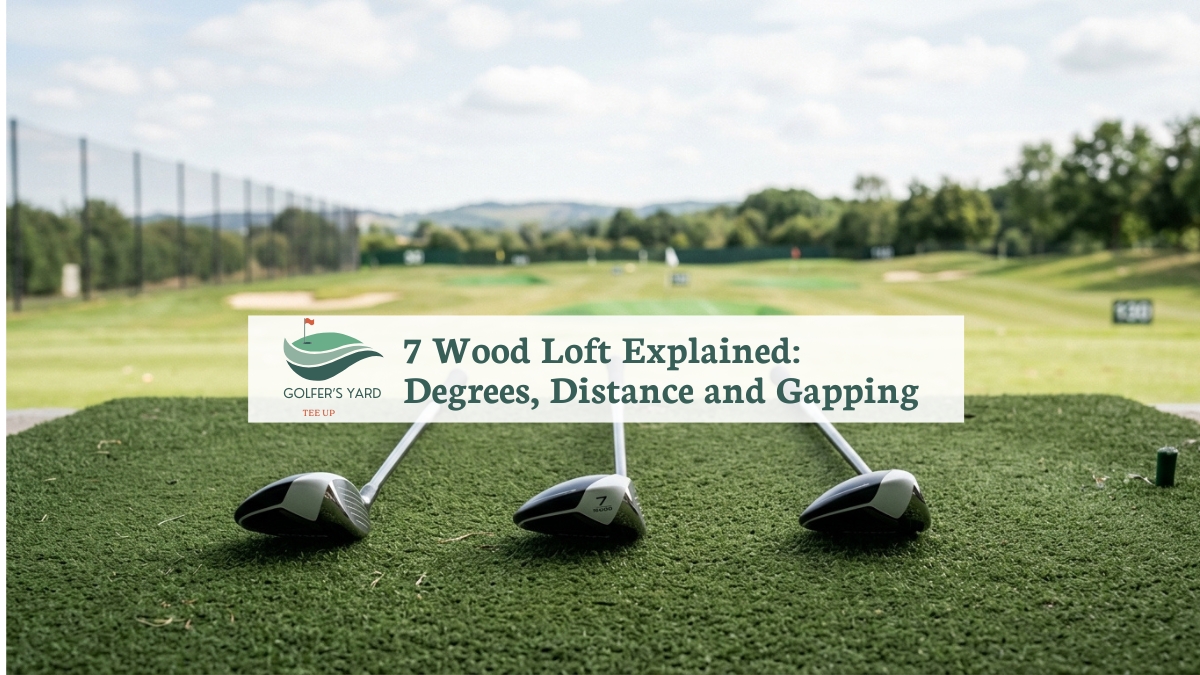
The 7 wood loft sits at approximately 21 to 24 degrees, higher than a 5-wood (18–19°) and lower than most hybrids (22–28°).
That position in the loft range is precise and intentional. Notably, 21 degrees is the most common 7 wood loft across all major manufacturers.
That range makes the 7-wood one of the most precisely placed clubs in the bag.
It fills the gap between fairway wood height and hybrid versatility at a distance most golfers struggle to cover with long irons.
Evidently, the 7 wood loft has become one of the most searched specifications in golf equipment in 2026; a direct result of Tour professionals putting the club back into mainstream conversation.
Dustin Johnson, Xander Schauffele, and, at the 2026 Masters, Tommy Fleetwood with a 9-wood, have all demonstrated that high-lofted fairway woods are not a compromise. They are a precision tool.
This guide covers the exact degree range by manufacturer, the distance it produces by swing speed, how it gaps against a 5-wood, a hybrid, and a long iron, and when to use it on the course.
For the question of whether a 7-wood belongs in your specific bag, see our dedicated guide: The Rise of the 7 Wood: Is It For You?
Quick Answer — 7 Wood Loft
Standard 7 wood loft: 21–22 degrees (21° is the most common across all major manufacturers).
Range across manufacturers: 20° (low end, Titleist GT2) to 25° (high end, adjustable Callaway models).
Average distance: 180–200 yards for most recreational golfers. Scratch golfers typically carry 215–225 yards.
Equivalent to: A 3-iron or 3-hybrid in loft angle — but with a larger head, lower centre of gravity, and easier launch.
Shaft length: Approximately 42 to 42.5 inches — shorter than a 5-wood, longer than most hybrids.
Who it suits: Every handicap level. Most commonly used as a replacement for a 4-iron, 5-iron, or 3-4 hybrid.
What Loft Is a 7 Wood? Degrees Explained
Specifically, the standard 7 wood loft is 21 degrees, though manufacturers produce models ranging from 20 to 25 degrees depending on the intended player profile.
That 5-degree range reflects a genuine design philosophy difference: lower-lofted 7-woods (20–21°) suit faster swing speeds who want a penetrating ball flight, while higher-lofted 7-woods (23–25°) are built for slower swing speeds and maximum launch.
Notably, there is no universal industry standard for 7 wood loft. Each manufacturer sets their own specification.
Unlike iron lofts, where “a 7-iron” implies a rough degree range, fairway wood lofts vary meaningfully between brands and between model tiers within the same brand.
Consequently, always check the manufacturer specification for the specific model you are considering rather than assuming a standard loft applies.
7 Wood Loft by Manufacturer (2026)
| Manufacturer | Model | 7-Wood Loft | Adjustable? | Notes |
|---|---|---|---|---|
| Callaway | Elyte 7-Wood | 21° (std) / up to 25° adjustable | Yes (OptiFit ±2°) | Widest adjustability range — suits players who want to fine-tune loft |
| TaylorMade | Qi35 7-Wood | 22° | Yes (±1.5°) | Slightly stronger loft than Ping or Cleveland — lower, more penetrating flight |
| Ping | G440 Max 7-Wood | 21° | No | Fixed loft — precision engineered for the widest sole design in the category |
| Titleist | GT2 7-Wood | 20° | Yes (SureFit) | Lowest standard loft — faster ball flight, suits higher swing speeds |
| Cobra | Darkspeed Adapt Max 7-Wood | 22.5° | Yes | Higher loft than most — maximum launch for slower swing speeds |
| Cleveland | Launcher Halo XL 7-Wood | 21° | No | Fixed loft — wide sole design optimised for ease of launch |
| Srixon | ZX Mk II 7-Wood | 21° | No | Standard 21° — value-tier fixed loft, consistent ball flight |
Key point on adjustable lofts: Several manufacturers offer ±1° to ±2° hosel adjustability on their 7-woods.
Consequently, a “21-degree” 7-wood with a ±2° hosel can be played at 19° (approaching 5-wood territory) or at 23° (approaching 9-wood territory).
This matters for gapping: before buying, check whether the model is fixed-loft or adjustable, and which loft setting best fills the gap in your existing bag.
7 Wood Loft Chart: Full Fairway Wood and Hybrid Comparison
Understanding where the 7 wood loft sits in the full progression from driver to iron helps explain why golfers choose it over the alternatives.
Specifically, the 7 wood occupies the same loft range as a 3-iron or 3-hybrid, but with a completely different head design that makes it easier to launch from the fairway.
| Club | Typical Loft Range | Typical Carry Distance (85 mph) | Best From |
|---|---|---|---|
| Driver | 8–12° | 220–240 yards | Tee only |
| 3-Wood | 15–16° | 195–215 yards | Tee, tight fairway lies |
| 5-Wood | 18–20° | 185–205 yards | Fairway, light rough, tee |
| 7-Wood | 21–24° | 175–195 yards | Fairway, rough, tight lies, tee |
| 9-Wood | 24–26° | 165–185 yards | Fairway, rough — growing in Tour usage (2026) |
| 3-Hybrid | 19–21° | 175–195 yards | Fairway, rough, approach shots |
| 4-Hybrid | 22–25° | 165–185 yards | Fairway, rough, approach shots |
| 3-Iron | 20–23° | 175–190 yards | Fairway — requires fast swing and consistent strike |
| 4-Iron | 23–26° | 165–180 yards | Fairway — long iron, high skill requirement |
Notably, the 7 wood loft at 21–24° covers exactly the same degree range as the 3-hybrid and 4-hybrid.
The key difference is not loft but design. The wider, shallower head of the 7-wood produces a higher peak trajectory and softer landing than a hybrid at the same loft angle.
Furthermore, the 7-wood’s longer shaft (approximately 42 inches versus 40 inches for a typical 4-hybrid) generates more clubhead speed and marginally more carry distance.
7 Wood Distance: How Far Does a 7 Wood Go?
Specifically, average 7 wood distance varies significantly by swing speed.
Shot Scope data from millions of tracked rounds provides the most reliable benchmarks for recreational golfer distances:
| Player Profile | Driver Swing Speed | Typical 7-Wood Carry | Total Distance (carry + roll) |
|---|---|---|---|
| Scratch (0 HCP) | 100–110 mph | 215–225 yards | 225–240 yards |
| 5 handicap | 90–100 mph | 200–210 yards | 210–225 yards |
| 15 handicap | 80–90 mph | 180–195 yards | 190–210 yards |
| 25 handicap | 70–80 mph | 165–180 yards | 175–195 yards |
| Senior / slower swing | Under 70 mph | 145–165 yards | 155–180 yards |
Accordingly, how far a 7 wood goes depends more on the golfer’s swing speed than on any equipment variable.
A golfer at 70 mph carrying the exact same club as a 100 mph player will produce approximately 60 to 70 yards less carry.
Consequently, the loft specification alone does not predict distance; swing speed and strike quality together determine the actual number.
Furthermore, the 7 wood’s height advantage means the ball stops faster on the green than a hybrid or long iron at the same carry distance.
Evidently, a ball landing at a steeper angle from a high-trajectory 7 wood stops closer to the landing point than a lower-trajectory hybrid at the same distance.
That difference is genuinely meaningful for approach shots where accuracy and stopping power matter more than raw distance.
7 Wood vs 5 Wood Distance Gap
Generally, the average distance gap between a 5-wood and a 7-wood is 10 to 15 yards for most recreational golfers.
That gap is smaller than many golfers expect, and smaller than the gap between a 3-wood and 5-wood (also 10–15 yards).
Consequently, a golfer considering carrying both a 5-wood and a 7-wood should confirm that the actual carry distance difference in their own bag justifies the additional club slot.
Additionally, the 7-wood’s steeper descent angle makes it more useful on approach shots than the 5-wood, even at similar carry distances.
Golfers who primarily use fairway woods from the tee may not notice the trajectory difference.
Golfers who rely on fairway woods for long approaches to guarded greens will notice the stopping power advantage significantly.
7 Wood vs Hybrid: What Is the Difference?
The most common 7 wood loft question is how it compares to an equivalent hybrid. Both clubs cover similar loft ranges and carry distances.
However, the comparison matters for three specific reasons: head design, trajectory, and versatility from different lies.
| Factor | 7-Wood (~21°) | 3-Hybrid (~20°) / 4-Hybrid (~23°) |
|---|---|---|
| Head design | Larger, wider, shallower — fairway wood profile | Smaller, more compact — sits between wood and iron |
| Trajectory | Higher peak height, steeper descent angle, softer landing | Mid-trajectory, less height but more penetrating |
| Fairway lies | Excellent — shallow sole sweeps easily | Good — but requires a more descending strike than most golfers expect |
| Rough | Very good — larger head glides through light rough effectively | Excellent from thicker rough — smaller head cuts through more easily |
| Tight lies | Good — requires sweeping motion | Better — more versatile on tight summer turf |
| Shaft length | ~42–42.5 inches | ~39–40.5 inches |
| Distance (same loft) | Slightly more carry — longer shaft generates more speed | Slightly less carry — shorter shaft, slower head speed |
| Off the tee | Very good — wider head inspires confidence | Good — less head profile at address |
Notably, neither the 7-wood nor the hybrid is universally superior. The 7-wood wins in trajectory and fairway performance.
The hybrid wins from thick rough and on tight lies where precision trumps height.
Accordingly, many golfers carry one of each: a 7-wood for fairway and tee-shot applications and a hybrid for versatility from difficult lies.
For the full discussion of whether to choose a 7-wood or hybrid for your bag, see our guide: The Rise of the 7 Wood: Is It For You?
7 Wood vs 5 Wood Loft: Key Comparison
The 5-wood sits at 18 to 20 degrees, compared to the 7-wood at 21 to 24 degrees. Markedly, that 3-to-4 degree difference produces three measurable differences in ball flight and performance:
Launch angle: The 7-wood launches higher than the 5-wood. For golfers who struggle to get the ball airborne with a 5-wood, the additional loft of the 7-wood makes a meaningful difference in launch consistency.
Evidently, that is why the 7-wood has become the recommended entry point for high-handicap and senior golfers replacing long irons.
Carry distance: The 5-wood typically carries 10 to 15 yards further than the 7-wood for the same golfer.
Overall, the choice between a 5-wood and a 7-wood usually comes down to which club fills the gap in the bag more precisely, not which one goes further.
Landing angle: The 7-wood’s higher trajectory produces a steeper descent angle, which means the ball stops more quickly after landing.
For approach shots into guarded greens, that stopping power advantage can be significant.
Additionally, a 7-wood approach shot sits closer to where it lands than the same-distance shot hit with a 5-wood or hybrid.
7 Wood vs 4 Iron and 5 Iron: The Replacement Question
The most practical application of the 7 wood loft question is this: does the 7-wood replace the 4-iron or 5-iron in your bag?
Evidently, a standard 4-iron carries a loft of approximately 23 to 26 degrees, directly overlapping with the upper range of 7-wood loft specifications.
A standard 5-iron typically sits at 26 to 30 degrees.
| Club | Typical Loft | Launch Difficulty | Carry (85 mph swing) | Who Should Use It |
|---|---|---|---|---|
| 4-Iron | 23–26° | High — small sweet spot, low launch | 175–185 yards | Single-digit handicappers, fast swing speeds |
| 7-Wood | 21–24° | Low — large head, high launch | 175–195 yards | All handicap levels — particularly 12+ who struggle with long irons |
| 5-Iron | 26–30° | Medium — varies significantly by iron model | 165–180 yards | Mid-handicap players who hit their irons consistently |
| 4-Hybrid | 22–25° | Low-medium | 165–185 yards | Players who want iron-like versatility at long-iron distances |
However, the 7-wood is not a perfect replacement for the 4-iron or 5-iron in every situation.
The 7-wood excels from the fairway and off the tee where its wider head and higher launch are advantages.
From tight lies on firm ground, it requires a sweeping motion that not every golfer finds intuitive.
From the rough, it performs well in light rough but loses some effectiveness in thicker conditions where a hybrid’s smaller head cuts through more cleanly.
Consequently, the practical recommendation for golfers considering replacing a long iron is to carry the 7-wood alongside a hybrid rather than choosing one over the other.
A 7-wood covers the fairway and tee-shot application. A 4-hybrid covers rough, tight lies, and punching shots under trees.
Together, they eliminate the need for long irons that most recreational golfers cannot use effectively.
7 Wood Loft and When to Use It on the Course
Understanding the loft helps clarify exactly when to pull the 7-wood. Specifically, the 7-wood loft makes it the ideal club in four on-course situations:
1. Long Par-3 Approach Shots
Furthermore, the 7-wood’s high launch and soft landing make it particularly effective on long par-3 holes where the distance required (170–200 yards for most recreational golfers) matches the 7-wood’s range and where the green demands a high, stopping approach.
Notably, it outperforms a long iron in this situation because the higher landing angle holds the green better than a lower-trajectory iron shot.
2. Second Shots on Long Par-4 and Par-5 Holes
Specifically, on par-4 holes where the approach is 170 to 200 yards from the fairway, the 7-wood provides the distance and trajectory combination that most golfers cannot replicate with a long iron.
Additionally, on par-5s where a layup to a precise yardage is required, the 7-wood’s consistent carry distance makes it a reliable positioning club.
3. Off the Tee on Short Par-4 Holes
Evidently, many golfers default to driver on par-4 holes that do not require full driver distance.
The 7-wood off the tee produces a controlled, high-trajectory tee shot that places the ball in the fairway with good positioning for the approach.
Particularly on tight driving holes where accuracy matters more than maximum distance, the 7-wood is often the smarter tee-club choice.
4. From Light Rough
Notably, the 7-wood’s wide sole allows it to glide through light rough more effectively than a long iron or hybrid from the same lie.
However, it is less effective in thick rough where a hybrid’s smaller head cuts through more cleanly.
Therefore, the 7-wood is the right choice from lies where the grass is long but not thick, the typical condition found in the first cut at most recreational courses.
7 Wood Shaft Length: What You Need to Know
Furthermore, the standard 7-wood shaft length is approximately 42 to 42.5 inches, roughly 0.5 to 1 inch shorter than a standard 5-wood (43–43.5 inches) and 1.5 to 2 inches longer than a typical 3-4 hybrid (40–40.5 inches).
That shaft length is one of the key reasons the 7-wood produces more carry than an equivalent hybrid: the longer lever generates more clubhead speed at the same swing effort.
Notably, shaft weight and flex matter as much as length for 7-wood performance.
Slower swing speeds (under 80 mph) benefit from lighter, more flexible shafts that allow the clubhead to square naturally.
Faster swing speeds (above 95 mph) need stiffer, heavier shafts to prevent the head from overtaking the hands through impact.
The 9-Wood: The Logical Extension of the 7-Wood Trend
Notably, the 9-wood loft typically sits between 24 and 26 degrees — approximately 3 degrees more than a standard 7-wood.
The 9-wood has historically been considered a senior or beginner club, but Tommy Fleetwood’s decision to carry a 9-wood at the 2026 Masters at Augusta National changed that perception significantly.
Fleetwood described Augusta as “a perfect 9-wood golf course” because the high, soft-landing ball flight suits the firm, fast greens where approach shots need to stop quickly.
Evidently, the same principle that makes the 7-wood loft attractive for golfers replacing long irons applies even more strongly to the 9-wood for golfers replacing 5-irons and 6-irons.
Further information on whether high-loft fairway woods fit your game is available at The Rise of the 7 Wood: Is It For You?
7 Wood Gapping Guide: Building It Into Your Bag
Essentially, gapping refers to the yardage spacing between clubs.
Essentially, a well-gapped bag has approximately 10 to 15 yards between each club from pitching wedge to 3-wood, with no awkward in-between gaps.
Furthermore, the 7-wood loft makes it the ideal gap-filler in two specific bag configurations:
| Bag Setup | Without 7-Wood | With 7-Wood | Gap Filled |
|---|---|---|---|
| Standard setup (3w + 4h) | 3-wood at ~210 yards, 4-hybrid at ~185 yards — 25-yard gap | 3-wood + 7-wood at ~195 yards + 4-hybrid — 15-yard gaps | Fills the long-range gap between 3-wood and hybrid |
| Iron-focused setup (4i + 5i) | 5-wood at ~200 yards, 4-iron at ~175 yards — 25-yard gap | 5-wood + 7-wood at ~190 yards — 10-yard gap | Replaces long iron with a higher-launch alternative |
| Senior / high-handicap setup | 3-wood + 5-wood + 4-hybrid — often too close together | 5-wood + 7-wood, no 3-wood — better spacing, easier to hit | Removes the hardest clubs to hit, improves coverage |
Accordingly, the right approach to gapping a 7-wood is to take a launch monitor session and confirm your actual carry distances with your 5-wood, 7-wood, and highest hybrid or longest iron.
Consequently, the yardage gap between those clubs in your own bag not the theoretical chart above, determines whether the 7-wood fills a genuine gap or creates redundancy.
7 Wood Loft: Frequently Asked Questions
Specifically, a standard 7 wood loft is 21 degrees, though the range across manufacturers spans from 20 degrees (Titleist GT2) to 22.5 degrees (Cobra Darkspeed Adapt Max) at fixed loft.
Several brands offer adjustable hosels that extend the range to 25 degrees with optional settings.
Notably, 21 degrees is the most common specification across Ping, Cleveland, and Srixon.
Always check the specific model’s published specification rather than assuming a universal standard applies.
Average 7 wood distance varies significantly by swing speed.
Evidently, Shot Scope data shows: scratch golfers carry 215 to 225 yards, 5-handicap golfers carry 200 to 210 yards, 15-handicap golfers carry 180 to 195 yards, and 25-handicap golfers carry 165 to 180 yards.
Seniors and golfers with swing speeds under 70 mph typically carry 145 to 165 yards. These figures assume a well-struck shot with a modern 7-wood design.
A standard 5-wood loft is 18 to 20 degrees, compared to the 7-wood at 21 to 24 degrees.
Consequently, the 7-wood launches higher, lands more steeply, and stops more quickly than a 5-wood at the same carry distance.
The 5-wood typically carries 10 to 15 yards further than the 7-wood for the same golfer.
Both suit fairway and tee-shot applications, but the 7-wood is easier to launch for golfers with slower swing speeds or steep angles of attack.
Specifically, a 7-wood typically replaces a 4-iron, 5-iron, 3-hybrid, or 4-hybrid.
The 7-wood loft at 21 to 24 degrees overlaps directly with the 4-iron (23–26°) and 3-hybrid (19–21°) loft ranges.
For most golfers above 12 handicap, the 7-wood is significantly easier to hit from the fairway than a 4-iron, with a wider sole, larger sweet spot, and lower centre of gravity.
Club fitters frequently recommend replacing the longest iron in the bag with a 7-wood as the first equipment change for golfers who struggle with long-iron consistency.
Evidently, from the fairway, yes, the 7-wood is generally easier to hit than an equivalent hybrid for most golfers.
The wider, shallower sole of the 7-wood promotes the sweeping, low-angle-of-attack strike that fairway lies require.
However, from thick rough and tight lies on firm ground, the smaller head of a hybrid typically performs more consistently than a 7-wood.
Additionally, from under trees where a low trajectory is needed, the hybrid’s punch-shot capability makes it more versatile.
Overall, the 7-wood wins from clean fairway lies; the hybrid wins from difficult lies.
Specifically, yes, the 7-wood is one of the most effective clubs for senior golfers.
The higher loft (21–24°) compensates for the reduced swing speed that comes with age by making the ball easier to launch.
A senior golfer who previously carried a 3-wood may find that a 5-wood and 7-wood combination provides more consistent performance and better yardage coverage than any long iron.
Additionally, several manufacturers produce 7-woods with lighter graphite shafts and higher-lofted heads (23–25°) specifically calibrated for slower swing speeds.
Cobra’s Darkspeed Adapt Max at 22.5° is one commonly recommended option for slower-swing seniors.
Notably, a standard 7-wood at 21 degrees has the same loft as a traditional 3-iron.
However, the practical performance differs substantially: the 7-wood produces a much higher ball flight, a softer landing, and more consistent distance on off-centre strikes than a 3-iron, because the larger head and lower centre of gravity make the club dramatically more forgiving.
At 22 to 24 degrees, the 7-wood overlaps with a 4-iron (23–26°) in loft but again produces a higher, softer shot that most golfers find easier to use on approach shots to guarded greens.
Specifically, a 9-wood loft typically sits between 24 and 26 degrees, approximately 3 to 4 degrees more than a standard 7-wood.
Consequently, a 9-wood produces an even higher trajectory and a softer landing than a 7-wood, at the cost of approximately 15 to 20 yards of carry distance.
The 9-wood has historically been a senior and beginner club, but gained significant mainstream attention when Tommy Fleetwood carried one at the 2026 Masters at Augusta National, noting that its high, soft-landing ball flight was ideal for Augusta National’s fast, firm greens.
7 Wood Loft: Summary and Next Steps
In short, the 7 wood loft at 21 to 24 degrees makes it the club that fills the gap between fairway wood distance and long-iron precision with the ease of launch that most golfers cannot reliably produce from a 3-iron, 4-iron, or even a 3-hybrid.
Evidently, the degree range is consistent enough across manufacturers that any 7-wood will perform within a predictable loft band, but the precise specification matters when fitting it into a specific bag configuration.
Furthermore, the 7-wood’s high launch, soft landing, and consistent carry distance make it effective in four on-course situations: long par-3 approaches, second shots on long holes, tee shots on tight par-4s, and from light rough.
It is not the optimal club from thick rough or tight lies, but for its primary applications, no club in the same loft range matches its trajectory and stopping power.
Also Read:
