



Golf has a reputation problem. Walk into most pro shops, and the women’s section is a small rack in the corner.
Most instruction assumes you swing like a man. And the first time you show up at a course as a beginner, you can feel every experienced golfer’s eyes on you.
That experience puts more women off golf than anything else, not the difficulty of the game, but the feeling of not belonging. It is worth noting because it is real.
And it is also worth telling you that it gets better fast, that there are more women golfers now than at any point in history, and that the communities built specifically for women beginners are genuinely welcoming in ways that make the early weeks much easier than going it alone.
We have played and tested golf equipment across hundreds of rounds. We have walked into courses as the only woman in a group and as one of four.
This guide gives you everything we wish someone had told us before we started: equipment, lessons, your first round, what to wear, how much it costs, and where to find other women to play with.
Quick Answer , Women’s Beginner Golf Guide
To start playing golf as a woman in 2026: buy a women’s starter set ($220 to $600), book one lesson before hitting range balls, and spend three sessions at the driving range before stepping onto a course. Do not use men’s clubs , they are too long, too heavy, and built for a different swing speed. Total cost for your first month: around $350 to $600. The fastest way to enjoy golf from day one is to find a women’s league or beginner clinic in your area before you buy anything.
→ Best women’s starter set under $500: Callaway Strata Women’s Complete Set, check current price
→ Best budget option under $499: Wilson Women’s Profile SGI Set, check current price
Why Women Are Taking Up Golf in 2026
Female participation in golf has grown by more than 30% over the past decade. The number of women golfers in the US now exceeds 6 million.
Nelly Korda and Lydia Ko are mainstream sports stars. LPGA events are sold out.
Many courses now run women-only clinics and beginner sessions designed specifically to lower the barrier to entry.
The equipment has also changed. Brands that once treated women’s clubs as an afterthought now run dedicated R&D programmes for women’s swing characteristics.
The instruction community has shifted alongside it; there are more certified female teaching professionals than ever, and more clinics designed around the way women actually learn.
Golf is also one of the few sports you can play seriously well into your 60s, 70s, and beyond. It is a sport for life.
If you start at 35, you have four or five decades of competitive and social play ahead of you. That is an unusual proposition for any sport.
Step-by-Step: How to Start Playing Golf as a Woman
Step 1: Do Not Use Men’s Clubs
This is the most important thing in this guide. If you have a husband, partner, or friend offering to lend you their clubs so you can “just try it,” decline politely.
We understand the appeal; it saves money before you know whether golf will stick.
But men’s clubs are built for swing speeds of 85 mph and above. Most women beginners swing between 60 and 75 mph.
Using men’s clubs means you are fighting the equipment on every single shot.
Men’s shafts are stiffer than you need. They are also an inch longer than women’s standard, which throws off your posture and your swing path from the first ball you hit.
The clubheads are heavier, which further reduces your swing speed.
Every bad shot you hit with men’s clubs reinforces a swing fault you would not have developed with the right equipment. It makes learning harder and slower.
Women’s clubs are built around your actual swing: lighter shafts, almost always graphite throughout the bag. More flex in the shaft, labelled Ladies or L flex. Lighter clubheads. Shorter overall length.
These features help you generate distance and proper ball flight without needing to swing harder.
One exception worth knowing: if you are taller than 5’9″, standard women’s clubs may actually be too short for you.
At that height, standard women’s shaft length is calibrated for an average female height and can put you in an awkward posture.
A quick visit to a pro shop for a fitting assessment, most do these for free, will tell you whether you need standard women’s clubs, extended women’s clubs, or whether men’s senior-flex clubs might suit your swing speed and height better.
Step 2: Buy a Women’s Starter Set (Not Individual Clubs)
The right first purchase is a complete women’s starter set, not individual clubs.
A starter set gives you everything in one box, typically a driver, a fairway wood or hybrid, a set of irons, a wedge, and a putter, matched in shaft weight and flex.
The clubs in a set are designed to work together. Buying individual clubs from different brands at different specs is a recipe for inconsistency when you are still developing your swing.
You do not need 14 clubs. Beginners improve faster with fewer clubs because they make decisions faster and develop their feel more quickly.
Most women’s starter sets include 9 to 11 clubs. That is the right number for your first season.
You do not need to spend more than $600 for a set that will serve you well for your first full season. Here are the three sets we recommend at different price points, all tested on course:
Best Women’s Starter Sets 2026
1. Top Pick: Callaway Strata Women’s Complete Set (~$599)
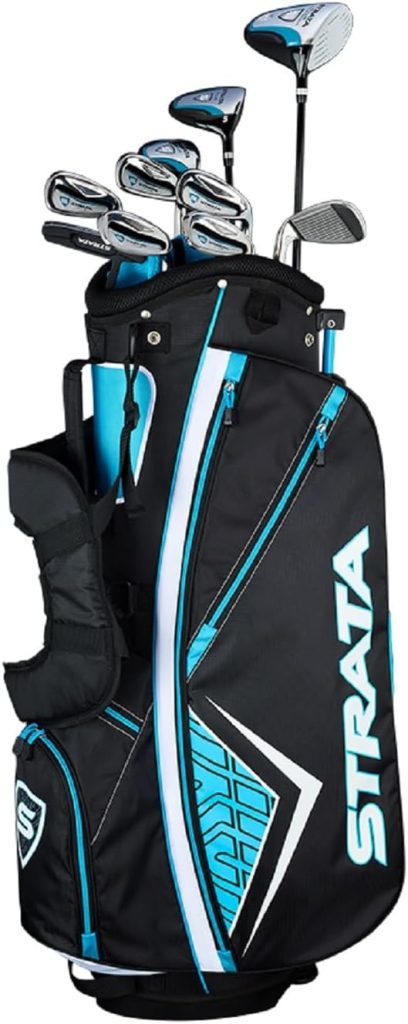
We have put the Strata Women’s set through multiple Women’s Golf Beginner Guide rounds. It is consistently the best starter set for women at any price.
The driver is forgiving with a high launch angle that gets the ball airborne even on off-centre hits.
The hybrid replaces the hard-to-hit long irons that most beginners struggle with. The irons have wide soles that reduce the penalty for fat shots , the most common beginner miss.
The putter is balanced and easy to align.
The Strata comes with a lightweight stand bag that has enough pockets for everything you need in a round.
At $599, you are getting a set that will carry you through your first season and into your second without needing to replace anything.
If you are worried about spending $599 before you know you will stick with golf, consider that a single round at most public courses costs $40 to $60.
This set costs the same as ten rounds.
If you play five rounds and enjoy it, the set has paid for itself in the sense that you have found a sport worth investing in.
If this set was built for women who want to enjoy golf from the first round without fighting their equipment, that is exactly what it delivers.
2. Budget Pick: Wilson Women’s Profile SGI Set (~$370)
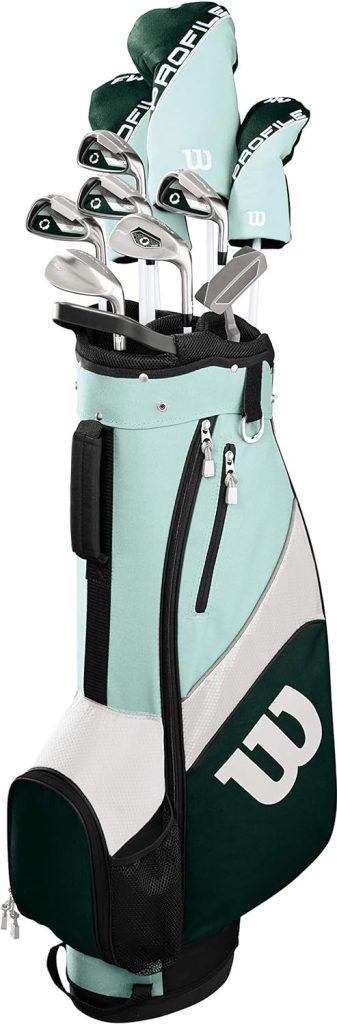
The Wilson Profile SGI is the right choice if your priority is spending the minimum before committing for Women’s Golf Beginner Guide.
At $370, it delivers a functional beginner set with cavity-back irons that are forgiving on mishits and a driver designed for high launch at slower swing speeds.
We tested this set across three rounds and found it performs better than its price suggests. The bag included is lighter and has fewer pockets than the Strata, but it does the job for carrying 18 holes.
The putter is functional rather than refined , you may want to upgrade it within your first year. The irons are the strongest part of this set.
If the only thing stopping you from starting golf is the cost of the initial investment, the Wilson Profile SGI removes that barrier.
3. Mid-Tier Pick: Cobra Women’s Fly XL Set (~$999)
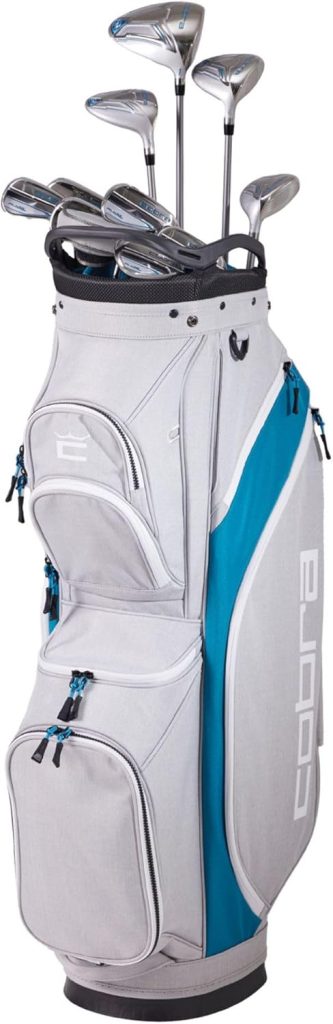
The Cobra Fly XL Women’s set is for beginners who are confident they will stick with golf and want a set that holds up well into their second and third season.
The driver has a larger face than the Strata, which increases forgiveness on heel and toe hits.
The irons are slightly more refined at impact. The hybrid is the easiest to hit of the three sets we tested.
We recommend this set for women who have tried golf before, at a driving range, at a lesson, or at a Topgolf session , and already know they enjoy it.
If this is truly your first exposure to the sport, start with the Strata or Wilson.
If you have already decided golf is your sport and you want a set that grows with you through your first few years, the Cobra Fly XL is worth the extra money over the Strata.
For a full review of every women’s starter set at every price point, see our Best Women’s Golf Club Sets 2026 guide.
Step 3: Add Three Essentials Before You Go Anywhere
Once you have your clubs, you need three things before your first range session. Everything else can wait.
Golf balls. Buy a low-compression ball. Low compression means the ball deforms more on impact, which generates distance for swing speeds under 80 mph.
At a higher compression, slower swing speeds lose distance and control.
The Callaway Supersoft, Titleist TruFeel, and Srixon Soft Feel are all excellent choices. A dozen costs $20 to $30. Buy two dozen , you will lose some in your early rounds.
A glove. A golf glove goes on your lead hand , your left hand if you are right-handed, your right if you are left-handed.
It improves your grip, protects against blisters in your first weeks, and helps you grip the club consistently.
Women’s golf gloves are sized differently from men’s. See our Best Women’s Golf Gloves 2026 guide for specific recommendations under $25.
Footwear. You do not need golf shoes for your first range sessions. Flat-soled trainers or walking shoes work at the range.
However, once you step onto a course, most facilities require soft-spike or spikeless golf shoes.
Spikeless golf shoes are the right choice for beginners , they work on and off the course, require no break-in period, and the best options cost $80 to $110.
See our Best Women’s Golf Shoes 2026 guide for picks at every price point.
Step 4: Book One Lesson Before You Hit Range Balls
The most common beginner mistake is going straight to the driving range and hitting a bucket of balls without any instruction.
It feels productive. It is not. You are ingraining whatever movement pattern your body defaults to, and those patterns are almost never correct.
Fixing ingrained bad habits later is harder and slower than learning correctly from the start.
One 45-minute lesson with a PGA teaching professional costs $50 to $80 at most public facilities.
In that session, a good instructor sets your grip, your stance, and your posture , the three fundamentals that determine 80% of what happens in every swing for years afterward.
With those three things correct, every range session that follows is building something useful.
Look specifically for a teaching professional who works with women beginners.
Many clubs offer women’s group lessons and beginner clinics at lower cost than private lessons , typically $20 to $35 per person for a 60 to 90-minute group session.
These are also a natural way to meet other women at the same stage of the game. Search the PGA of America’s instructor finder at pga.com for certified professionals near you. Most will specify if they run women’s programmes.
Step 5: Spend Three Sessions at the Driving Range First
Before you play a full course, spend three separate range sessions building basic contact. A bucket of 60 balls costs $10 to $15 at most public facilities.
Use those sessions to do one thing: work on making consistent contact with your 7-iron and your pitching wedge.
Those are the two shortest full-swing clubs in your bag. They require the least swing length to hit well and they teach you the fundamentals of contact faster than any other club.
Every professional teaching a beginner starts with the short irons. There is a reason for that.
In those three sessions, you are not working on distance. You are not comparing yourself to anyone else at the range. You are building the motor pattern for a repeatable swing.
Three sessions of focused practice with a short iron does more for your first round than ten sessions of wild driving practice.
Step 6: Start With 9 Holes, Not 18
Your first round on a real course should be 9 holes, not 18. Even better: start on a par-3 course. Par-3 courses are shorter, less formal, and less intimidating. Every hole is a short iron or hybrid distance.
There are no long fairways where beginners feel exposed. Many cities have par-3 courses specifically designed as entry points for new golfers, and many welcome beginners without a handicap.
On your first round, follow these three rules and nothing else will matter:
Pick up after six shots on any hole. If you have hit the ball six times and you are still not on the green, pick it up, mark a score of double-bogey on your card, and move to the next hole.
No one benefits from watching a beginner hit eight shots from the same bunker. Pace of play matters on a golf course. Picking up is not giving up , it is the correct thing to do.
Play from the forward tees. Every course has multiple sets of tees at different distances. Beginners play from the forward tees regardless of gender. Forward tees are there for a reason.
Playing from the back tees as a beginner makes every hole harder and every round less enjoyable. There is no virtue in making the game unnecessarily difficult in your first month.
Focus on the experience, not the scorecard. Your first round score means nothing. You will three-putt. Then, you will hit the ball sideways.
You will lose balls in places that seem impossible to lose them. All of this is part of the process. The only goal of your first round is to finish 9 holes and enjoy being on a golf course.
What to Wear Playing Golf as a Woman
Golf has a dress code. The strictness varies considerably by venue. Public municipal courses are generally relaxed, a collared shirt or golf polo with shorts, skorts, or trousers and you are fine.
Private clubs are stricter. Before any round, check the club’s dress code on their website or call the pro shop.
Here is what works at almost every course:
Top: A golf polo or collared shirt. Many women’s golf tops now come without a collar but with a clean, non-logo neckline that most courses accept.
Athletic tops and tank tops are typically not accepted at private courses. When in doubt, a women’s golf polo is never wrong.
Bottom: Golf skorts, shorts, or trousers. Skorts are the most popular choice among women golfers , they give you full range of motion, no riding up through the swing, and they look right on the course. Shorts should reach mid-thigh at minimum. Denim of any kind is not accepted on most courses.
Footwear: Spikeless golf shoes for the course. Trainers at the driving range. Flip flops and open-toe shoes are never appropriate on a golf course.
Weather layers: Golf is played in all conditions. A lightweight waterproof jacket and a fleece mid-layer cover most scenarios.
Women’s golf outerwear has improved significantly , brands like Puma, adidas, and Callaway make performance golf jackets that are actually flattering and functional.
For everything from gloves to shoes to outerwear, our Women’s Golf Hub covers the full women’s apparel cluster.
How Much Does Golf Cost for a Woman Beginner?
Nobody gives honest numbers on this. Here are the real costs for your first year as a woman beginner golfer.
| Item | Cost | Notes |
|---|---|---|
| Women’s starter set | $220–$300 | One-time purchase. Lasts 2–3 seasons minimum. |
| Golf balls (2 dozen) | $45–$60 | Low-compression beginner balls. You will lose some. |
| Golf glove | $15–$25 | Replace every 20–30 rounds or when grip degrades. |
| Spikeless golf shoes | $80–$110 | Not needed for range. Required on most courses. |
| 1–2 lessons | $100–$160 | The most important spend. Book before the range. |
| 3 range sessions | $30–$45 | $10–$15 per bucket of 60 balls. |
| First 9-hole round | $20–$40 | Par-3 or municipal course. Avoid private clubs initially. |
| Total , Month 1 | $510–$740 | Equipment is the one-off cost. Everything else is ongoing at much lower cost. |
| Ongoing , per round (public course) | $25–$60 | Green fees vary enormously by course and time of day. Morning weekday rates are almost always cheapest. |
The honest picture: month one costs $500 to $700 if you buy everything. From month two onwards, the only regular cost is green fees and occasional ball replacement.
A golfer who plays twice a month at a public course spends $600 to $1,400 a year on the game after the initial setup.
That is the realistic ongoing cost of a recreational golf habit. You can reduce the first-month cost by borrowing clubs for your first lessons, most teaching professionals have loaners , and by buying a used starter set.
Used women’s sets in good condition are available on eBay and Facebook Marketplace for $80 to $150.
This is a completely reasonable approach for someone who wants to confirm they enjoy golf before spending $370 on new clubs.
Golf Swing Basics for Women Beginners
Most golf instruction is written for men with faster swing speeds. These three fundamentals are specific to what we observe in women beginners and are rarely covered in generic beginner guides.
Grip Pressure , Lighter Than You Think
The most common swing fault we see in women beginners is gripping the club too tightly. A tight grip restricts your wrist hinge, reduces clubhead speed, and causes the club to twist at impact.
We describe the correct grip pressure as holding a tube of toothpaste firmly enough to control it but not so tightly that you squeeze any out.
Your grip should be firm but your forearms should feel completely relaxed. If your forearms are tense at address, loosen your grip.
You Do Not Need to Hit Hard
Clubhead speed comes from a free-swinging motion and correct sequencing , not from muscling the club through impact.
Women beginners who try to hit the ball hard almost always swing too fast on the way back, lose their sequencing, and make worse contact than when they swing freely at 80% effort.
Trust the club. The loft and shaft flex are doing the work for you.
Your job is to make clean contact with a balanced, unhurried swing. The simplest swing thought for a beginner: swing to a balanced finish and hold it for three seconds.
A balanced finish is only possible if the swing was controlled. Chase the finish, not the distance.
The Slice , What It Is and Why It Happens
The slice , the ball curving sharply from left to right for right-handed players , is the most universal beginner problem across both men and women.
It happens because the clubface is open to the swing path at impact.
Almost always this comes from a weak grip and an over-the-top downswing. The fix is simple in concept: strengthen your grip by rotating both hands slightly to the right on the handle, and feel the clubhead drop inside on the downswing rather than coming over the top.
Your teaching professional will show you this in your first lesson. It is the most important technical correction any beginner makes.
Finding Your Women’s Golf Community
The fastest way to improve as a beginner is to play regularly with other golfers at a similar stage. For women, there are now more dedicated options for this than at any previous point.
Women’s Leagues at Local Courses
Most public and semi-private courses run a women’s league that plays one morning per week.
These leagues welcome beginners , the handicap system means golfers of different abilities can play together competitively.
Walk into the pro shop at your local course and ask about their women’s league. This is the single best thing you can do in your first month to accelerate your progress and enjoy the game.
LPGA Women’s Network
The LPGA runs a national network of clinics, events, and leagues specifically for women beginners and recreational players. Search lpga.com for programmes in your area.
Many are free or low cost. The LPGA Amateur Golf Association (LPGA-AMGA) is the most structured option , they run leagues and events in most major metropolitan areas.
Facebook Groups
Search “women’s golf” plus your city or region in Facebook Groups. There are hundreds of active women’s golf groups across the country, many with thousands of members.
These groups organise social rounds, beginner sessions, and equipment swap events. They are informal and genuinely welcoming to beginners.
Women’s Golf Apps and Communities
The 18Birdies app has a large women’s golf community feature. Golfshot also has social features that connect you with local players. Both apps also handle GPS yardage and scoring for your rounds.
Women’s Beginner Golf: The Sequential Buying Guide
No other guide maps out when to buy what. This is the order that makes financial sense and supports how your game actually develops.
Day 1: Buy These
- Women’s starter set ($220 to $300)
- Two dozen low-compression golf balls ($45 to $60)
- One women’s golf glove ($15 to $25)
After Your First 3 Rounds: Consider These
- Spikeless golf shoes ($80 to $110) , once you are playing regular course rounds
- A second lesson to address the specific faults your first rounds revealed
- A putting mat for home practice ($40 to $80) , putting is where beginners drop the most shots
After Your First 15 Rounds: Consider These
- A club fitting , by this point you know your swing well enough to be fitted properly
- A GPS watch or rangefinder , yardage becomes important once you can control the ball
- Joining a women’s league , the subscription or joining fee is worth it at this stage
Do Not Buy These as a Beginner
- A full 14-club set , you do not need or benefit from 14 clubs in your first season
- Premium tour-level golf balls , high-compression balls designed for fast swing speeds actively hurt distance for beginners
- A rangefinder , learn to feel distances first. A rangefinder adds a step to every shot before you have the swing consistency to use the information
- Custom-fitted premium irons , wait until you have played 20 rounds and know your swing tendencies
For the complete women’s equipment picture, visit our Women’s Golf Hub which covers every category from clubs to apparel to tech.
Women’s Beginner Golf: Frequently Asked Questions
Buy a women’s starter set ($220 to $300), book one lesson with a PGA teaching professional before hitting range balls, spend three sessions at a driving range, then play your first 9-hole round on a par-3 or municipal course.
Do not use men’s clubs. Join a women’s league or beginner clinic as early as possible, it accelerates improvement and makes the early weeks more enjoyable.
Yes, women’s clubs are built for swing speeds of 60 to 75 mph. Men’s clubs are built for 85 mph and above.
Using men’s clubs as a woman beginner results in poor distance, poor ball flight, and swing faults that are harder to correct later.
The one exception: women taller than 5’9″ may need custom-length clubs rather than standard women’s clubs, a free fitting assessment at a pro shop confirms this.
The first month costs $510 to $740 including a starter set, balls, glove, shoes, one or two lessons, and your first few rounds.
After the initial equipment purchase, ongoing costs are primarily green fees at $25 to $60 per round at public courses.
A golfer who plays twice a month spends roughly $600 to $1,400 per year on the game after setup.
A golf polo or collared shirt, golf skort or trousers, and spikeless golf shoes covers most courses.
Private clubs have stricter dress codes, check before you go.
Denim, athletic leggings, and open-toe shoes are not accepted at most golf facilities.
When in doubt, a women’s golf polo and skort combination is never wrong.
Three reliable routes: ask the pro shop at your local course about their women’s league (most courses run one), search “women’s golf” plus your city in Facebook Groups, or visit lpga.com to find LPGA Women’s Network events and clinics in your area.
Women’s leagues welcome beginners , you do not need to be good before you join.
The 7-iron is the easiest club to learn with. It has enough loft to get the ball in the air at a beginner swing speed, enough length to produce a satisfying shot, and enough weight to give you feedback on where you are making contact.
All beginner instruction starts with the 7-iron for these reasons.
Your pitching wedge is the second-easiest and teaches you the same fundamentals.
Most women beginners can play a full 18-hole round without embarrassing themselves after 8 to 12 weeks of consistent practice , roughly one lesson, three range sessions, and five or six course rounds.
Breaking 100 (a common first milestone) typically takes three to six months of regular play.
The improvement curve in year one is dramatic for players who take at least one lesson and practice with purpose rather than just hitting balls.
Final Verdict
The Callaway Strata Women’s Complete Set is the right first purchase for most women beginners.
It is forgiving where beginners need forgiveness, complete enough to cover every shot on the course, and priced to let you commit to golf without overcommitting financially before you know you love it.
Buy the set, book one lesson before you touch a range ball, spend three sessions building basic contact with your 7-iron, and play your first round on a par-3 course with someone patient.
That sequence gives you the best possible start in the game. Everything else , shoes, gloves, GPS tech, better irons , comes after you know the game is yours.
The culture concern is real, and it gets better. The fastest way through the uncomfortable early weeks is to find a women’s league or beginner group before your first course round. You will not regret it.
→ Callaway Strata Women’s Complete Set, check current price
→ Wilson Women’s Profile SGI Set (budget pick) , check current price
Also Read:

