



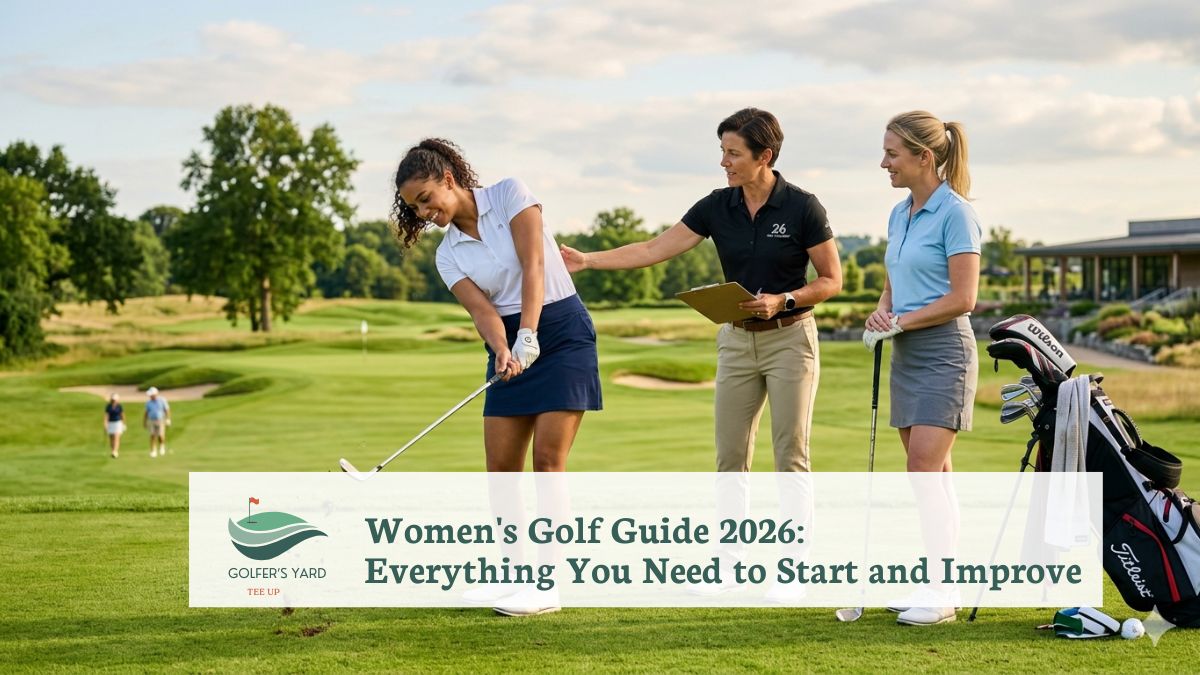
Women’s golf is growing faster than any other segment of the sport.
According to the National Golf Foundation, women now represent 37% of all new US golfers, a figure that has more than doubled in a decade.
Better equipment designed specifically for women’s swing speeds has helped.
Additionally, more welcoming club cultures and a far wider range of on-course apparel have removed most of the old barriers to entry.
However, information available to new women golfers is still scattered across dozens of sites, each covering only a narrow slice of the picture.
Consequently, this guide pulls everything together.
Whether you are picking up a club for the first time, or working toward a single-digit handicap, every answer is here or linked from here.
Quick Answer
To start women’s golf in 2026, buy a beginner club set ($280-$450), book two lessons before your first round, and wear a moisture-wicking polo, golf skort or trousers, and proper golf shoes.
A full starter kit costs around $600-$700. Expect your first handicap within 8-12 rounds. Sections below cover equipment by level, what to wear, shoes, apps, practice drills, and where to find other women golfers.
Equipment: What to Buy at Every Level
Women’s golf clubs differ from men’s in four meaningful ways: lighter overall weight, narrower grip circumference, higher lofts, and more flexible shafts.
Specifically, these differences are matched to the average women’s swing speed of 65-80 mph.
Consequently, buying men’s clubs at this swing speed makes the game noticeably harder without any offsetting benefit.
Additionally, the quality gap between beginner, mid-level, and premium tiers is significant enough to matter.
Below is a clear equipment path from your first round to committed golfer.
Stage A: First-Round Equipment ($280-$650 total)
For your first season, a complete women’s beginner set is the correct purchase.
Individual clubs bought one at a time cost more overall and give you mismatched lofts and shaft weights.
Overall, the three sets we have tested are the Callaway Strata 11-Piece ($280), the Wilson Profile SGI ($300), and the Cobra Fly XL ($450). Each delivers everything you need to start.
Each includes a driver, fairway wood, hybrid, irons (6-9 plus pitching wedge), putter, and bag.
Furthermore, each set is designed around a slower swing speed, so the ball gets airborne more easily.
Overall, distance is not sacrificed the way it is with stiffer men’s shafts.
Beyond the clubs, your first-round kit needs three more items: golf shoes (see the shoes section below), a golf glove ($12-$18), and a sleeve of golf balls.
For balls, buy the cheapest you can find. Callaway Supersoft 12-pack or Srixon Soft Feel Lady work well.
Since you will lose several per round at this stage, spending more on balls is not productive.
Also, do not buy at this stage: individual clubs, a rangefinder, premium balls, or a GPS watch.
None of these make financial sense until Stage B or later.
Stage B: Development (25-18 Handicap, $150-$300 incremental)
Once you are scoring consistently in the 90s and have played 20+ rounds, two upgrades make a real difference.
First, replace your beginner fairway wood or hybrid with a women’s specific model.
In our testing, the TaylorMade Kalea Premier Rescue and Callaway Paradym Ai Smoke Ladies Hybrid are both forgiving at this stage.
Second, consider adding a dedicated sand wedge (56 degrees) if your beginner set does not include one.
Additionally, a sand wedge is one of the most-used clubs around the green.
Specifically, the short game gap between beginner and mid-handicap golfers is almost entirely about wedge play.
Adding a proper lofted wedge at this stage will drop more strokes than any other single purchase.
Stage C: Committed Player (18-12 Handicap, $800-$1,800 incremental)
When you reach 18 handicap or below and play at least twice monthly, individual club fitting is worth the investment.
A proper fitting session at a major retailer or club costs $50-$150. It ensures shaft flex, lie angle, and grip size are all matched to your specific swing.
Women’s game-improvement irons – TaylorMade Kalea Premier, Callaway Paradym, Ping G Le3 – deliver noticeably more distance and forgiveness than beginner sets.
Furthermore, a golf GPS watch or rangefinder becomes worthwhile at Stage C, since distance control starts to matter once you can hit the ball reasonably straight.
Our detailed GPS watch and rangefinder guides are linked in the articles section below.
Stage D: Performance (Below 12 Handicap, $1,500+ incremental)
Below 12 handicap, your equipment needs become highly individual.
Club fitting is non-negotiable, shaft specifications matter significantly, and players’ irons become a realistic option for strong ball strikers.
Consequently, equipment decisions should be made in the context of a professional fitting session rather than any general guide.
| Stage | Handicap range | Key purchase | Approx cost | Do not buy yet |
|---|---|---|---|---|
| A – First round | New (no HCP) | Complete beginner set | $280-$450 | GPS watch, premium balls, individual clubs |
| B – Development | 25-18 | Hybrid upgrade + wedge | $150-$300 | Full set replacement, players irons |
| C – Committed | 18-12 | Full fitting + game-improvement irons | $800-$1,800 | Players irons before fitting |
| D – Performance | Below 12 | Custom fitted set | $1,500+ | Anything without a fitting |
Golf Shoes: What to Look for and When to Upgrade
Golf shoes are not optional. Trainers and running shoes lack the lateral stability needed for a golf swing.
On wet grass, they provide almost no grip, which is dangerous as well as performance-limiting.
Even a basic pair of golf shoes makes a meaningful difference from your first round.
Women’s golf shoes split into two main categories: spikeless and spiked.
For most women golfers, spikeless shoes are the better starting choice.
Spikeless options are lighter, more comfortable for long walks, easier to drive in, and entirely course-legal at 99% of clubs.
However, spiked shoes offer marginally better grip in wet conditions and steep lies, and are preferred by lower-handicap players who play frequently in wet climates.
In our testing across six shoe models, three factors separated the best from the rest: insole cushioning quality, available width fit options, and waterproofing membrane breathability.
A shoe feeling fine at hole 1 but compressing by hole 10 is a common problem in budget models.
For full reviews, read our dedicated guide: Best Women’s Golf Shoes 2026.
Specifically, it covers our top pick for comfort, best spiked option, best for wide feet, and best lightweight model.
What to Look for in Women’s Golf Shoes
Waterproofing: A two-year waterproof warranty (FootJoy standard) is the benchmark.
Shoes without a warranty can still be waterproof initially but may degrade after 18-24 months of regular play.
Subsequently, you may find wet socks on a drizzly autumn morning.
Width options: Many women have narrower feet than the standard D width assumed by men’s shoe manufacturers.
Women-specific lasts (the foot-shaped mold a shoe is built on) make a significant difference in comfort and stability throughout the swing.
Furthermore, a shoe that fits correctly from the heel reduces fatigue over 18 holes.
Sole design: Spikeless soles vary enormously in their grip pattern. A flat rubber sole provides almost no traction.
Instead, look for a multi-directional tread pattern with raised grip zones at the heel and forefoot – the areas carrying the most load through a golf swing.
Weight: For a standard 18-hole round, you walk approximately 5 miles.
Specifically, shoes under 12 oz per shoe (women’s sizing) are noticeably more comfortable over a full round than heavier alternatives.
Golf Apparel: What to Wear on Any Course
Golf apparel rules vary by club. Three items are required everywhere: a collared top, proper golf bottoms (trousers, shorts, or skort – not denim or leggings), and golf shoes.
Most public courses are lenient; most private clubs are strict. When in doubt, call ahead.
Beyond the dress code basics, the practical requirements for golf apparel differ from most sports.
Specifically, you need full range of motion through the shoulders and hips, sun protection for up to 5 hours outdoors, and temperature management across varying conditions.
Additionally, enough pockets for two balls, a tee, a pitchfork, and a ball marker is more useful than it sounds.
Women’s Golf Tops
Women’s golf polos are the safest choice for any club. Look for 4-way stretch fabrics, UPF 30+ sun protection woven into the fabric (not a coating that washes out), and a collar that stays flat after washing.
Brands we have tested extensively include adidas, Nike, PUMA, and J.Lindeberg.
Each approaches fabric technology differently, and our dedicated tops guide ranks them by performance category.
Women’s Golf Skorts
Golf skorts – skirts with a built-in shorts liner – have replaced dedicated golf skirts as the dominant women’s on-course bottom.
Moreover, the shorts liner provides modesty and coverage through a full swing, while the skirt exterior satisfies dress codes that ban athletic shorts.
Length typically runs 15-18 inches, with 16 inches being the sweet spot between coverage and freedom of movement.
In our testing of eight women’s golf skorts, fabric quality and shorts liner length were the two factors most affecting real-world comfort.
A liner ending at mid-thigh eliminates chafing on walking holes.
However, a liner extending only 3-4 inches from the waistband does not provide enough coverage.
For our full ranked guide, including adidas, Nike, Lululemon, and budget picks, read: Best Women’s Golf Skorts 2026.
Women’s Golf Trousers and Shorts
For cooler conditions, women’s golf trousers from PUMA, adidas, and Callaway Golf Apparel offer 4-way stretch, tapered fits, and packable insulation in some models.
Golf shorts work well in warmer conditions at courses that permit them.
However, check the specific club’s dress code first, since some private clubs restrict shorts or require a minimum length of 18 inches.
Layering for Cold and Wet Weather
A women’s golf rain jacket is one of the highest-value apparel investments for players in temperate climates.
Good waterproof layers need to allow a full shoulder turn without riding up – this is where generic outdoor waterproofs consistently fail.
Specifically, golf-specific designs have articulated shoulders and extended backs to prevent the jacket from pulling across the chest at the top of the backswing.
In our wet-weather testing, FootJoy HydroLite and Galvin Green consistently perform best.
| Item | Required? | Notes |
|---|---|---|
| Collared polo or mock-neck top | Yes – all courses | Moisture-wicking, UPF preferred |
| Golf skort, shorts, or trousers | Yes – no denim/leggings | Check length rules at private clubs |
| Golf shoes | Yes – all courses | Spikeless fine for most clubs |
| Golf glove (left hand for right-handed player) | Recommended | Improves grip in heat and wet |
| Sun protection (cap, sunscreen, arm sleeves) | Strongly recommended | 5 hours in direct sun is significant UV exposure |
| Waterproof layer | Situational | Essential in UK, Pacific NW, and SE Asia |
Getting Started: Six Steps That Actually Work
Two mistakes derail most new women golfers before they establish a routine.
First, buying equipment before having a lesson.
Second, playing a full 18-hole round before being ready.
Both create unnecessarily frustrating early experiences.
Consequently, following the six steps below avoids both.
Step A: Book Two Lessons First
Before you buy equipment, book two 45-minute lessons with a PGA professional. Doing so achieves three things.
First, it builds a repeatable swing foundation. Second, it gives the pro a chance to assess which equipment specifications suit you.
Third, it makes your first range session productive rather than bewildering.
Expect to pay $45-$80 per lesson at a public course, or $80-$150 at a private club.
Step B: Buy a Starter Set
Following the lessons, buy a complete women’s beginner set in the $280-$450 range (see the equipment section above).
Avoid buying second-hand clubs unless a pro has confirmed they are appropriate for your swing speed and height.
Specifically, mismatched lofts or the wrong shaft flex can make learning significantly harder without the player ever knowing why.
Step C: Three Driving Range Sessions
Before your first course round, spend three sessions at a driving range.
Focus entirely on consistent contact – not distance, not direction. Specifically, consistency of strike is the only thing that matters at this stage.
Each session should last 45-60 minutes and include a mix of irons and woods practice.
Step D: Play Nine Holes, Unscored
Your first course round should be nine holes, played without keeping score.
Scoring before you have a consistent ball strike creates anxiety that slows learning.
Furthermore, playing nine holes first limits the physical fatigue that makes a full 18-hole debut frustrating for beginners.
Eventually, you will be ready for 18 holes – but there is no need to rush it.
Step E: Register for a Handicap
Once you have played five scorecards on a registered course, you can register for an official handicap.
In the US, the USGA Handicap System is free through most golf clubs or via the GHIN app.
Registered bodies include England Golf, Scotland Golf, Golf Ireland, and Golf Australia for non-US players.
Indeed, a handicap is essential for joining leagues, playing in competitions, and accurately tracking improvement over time.
Step F: Join a Women’s Group or League
Joining a structured women’s league or society is the single best thing you can do for your game after your first few months.
Playing regularly with golfers of similar ability creates a consistent practice structure.
Moreover, it removes the pace-of-play pressure that makes beginners anxious and builds the social side of the game that keeps most women engaged long-term.
Most public courses have a women’s Tuesday or Wednesday morning group.
Specifically, call the pro shop and ask almost all welcome new members.
How the Handicap System Works for Women
Since 2020, the World Handicap System (WHS) has standardised golf handicaps globally.
Consequently, a 15 handicap in the US represents the same ability level as a 15 handicap in Australia or the UK.
Before WHS, national systems varied significantly, making cross-country comparisons unreliable.
What a Handicap Is
A golf handicap is a numerical representation of your potential ability, calculated from your best recent scores.
Specifically, the system takes the best 8 of your last 20 score differentials, averages them, and multiplies by 0.96.
A score differential accounts for the difficulty of the course played – its course rating and slope.
Therefore, a round on a harder course contributes differently to your handicap than the same gross score on an easier course.
What Your First Handicap Will Be
Most new women golfers receive an initial handicap between 28 and 36.
A maximum of 54 is the WHS ceiling for women. As you improve, your handicap falls.
Reaching 18 handicap is generally considered the transition from beginner to intermediate.
Subsequently, reaching single figures (below 10) puts you in roughly the top 10-15% of women golfers by measured ability.
How Net Scoring Works in Competition
In most club competitions, women play off their full handicap on a net basis. Your net score is your gross score minus your handicap.
In Stableford – the most common format in UK club golf – you score points per hole based on how you perform against your handicap-adjusted par.
Overall, most beginners find Stableford less stressful than stroke play, since a single bad hole does not compound into a runaway total.
Registering for Your Handicap
US players should register with a club affiliated with the USGA and submit five 18-hole scorecards through the GHIN app or at the club.
An initial handicap is calculated automatically within 24 hours.
Similarly, UK players register through England Golf, Scotland Golf, or their national governing body at a registered club.
Swing Fundamentals Specific to Women Golfers
Women’s golf instruction has historically defaulted to men’s swing models with minor modifications.
However, more recent coaching research has established that women’s swing biomechanics have some meaningfully different characteristics.
Specifically, these differences arise not because women are less athletic, but because of differences in average hip-to-shoulder width ratio, hip flexibility ranges, and grip strength distribution.
Hip Flexibility as an Advantage
Women golfers typically have greater hip flexibility than male golfers, allowing a fuller hip turn in the backswing.
However, this advantage is often wasted by under-rotating.
In our experience on the course, women who consciously turn the left hip fully behind the ball in the backswing generate noticeably more clubhead speed.
Notably, this happens without any additional physical effort.
Lead-Wrist Position at the Top
Among all technical checkpoints in a golf swing, the position of the lead wrist at the top of the backswing matters most for consistent ball striking.
Specifically, a cupped (bent-back) lead wrist opens the clubface and produces slices and weak fades.
However, a flat or slightly bowed lead wrist squares the face more naturally through impact.
Working on this position with a qualified instructor, or using a training aid like the HackMotion, creates faster improvement than almost any other single technical focus.
Grip Pressure
Over-gripping is the most common fault in women new to golf.
On a scale of 1-10, most club golfers grip at 7-8 when 4-5 is sufficient.
Specifically, excess grip pressure tightens the forearms and restricts the natural release of the club through impact.
In our testing, players who consciously reduced grip pressure saw immediate improvements in both distance and ball contact.
Shaft Flex
At swing speeds below 75 mph, a regular-flex shaft will be too stiff.
Most women’s beginner club sets come with ladies-flex (L-flex) shafts, appropriate for swing speeds of 55-75 mph.
At 75-85 mph, a senior or regular flex may produce better results.
Fortunately, swing speed can be measured at any major retailer’s launch monitor for free – worth knowing before any equipment purchase from Stage B onward.
Practice: Drills That Actually Improve Your Game
Most golfers practice by hitting full shots until they run out of balls or time.
This is the least efficient form of practice available.
Specifically, structured practice – drills targeting specific faults – produces improvement 3-4 times faster than undirected hitting, according to motor learning research.
The 60/30/10 Practice Split
For beginner and intermediate women golfers, the most productive practice split is 60% short game, 30% iron and approach shots, and 10% driver.
Short game means putting, chipping, and pitching within 50 yards.
This allocation is counterintuitive for most new golfers.
Nevertheless, scoring data is clear: more than 65% of shots in a typical 90+ round occur within 100 yards of the hole.
Putting Drills That Work
Gate drill: place two tees just wider than your putter head, 12 inches in front of the ball on your putting line.
Roll the ball through the gate 20 consecutive times before moving to full-distance putts.
Overall, this drill builds a square face at impact faster than almost any other method.
In our experience working through it consistently, three-putt frequency drops markedly within two or three sessions.
Distance control drill: place 5 balls at 10-foot intervals from 10 to 50 feet.
Stop each ball within 18 inches of the hole.
Distance control accounts for the majority of three-putts in club golf.
Specifically, leaving a 40-foot putt 8 feet short is a more common cause than missing the line, and this drill addresses exactly that.
Chipping Drills That Work
Ladder drill: place six targets at 10, 20, 30, 40, 50, and 60 feet from your chip landing zone.
Hit one chip to each target in sequence, landing within 3 feet of each.
Overall, this drill builds the feel for different swing lengths that creates consistent short-game distance control.
Furthermore, it replicates the variety of chip distances encountered in a real round far better than hitting 30 chips to the same target.
Full Swing Practice
For full swing practice, alternating between a wedge and a mid-iron on every other shot is more productive than hitting 30 balls with the same club.
This replicates on-course conditions where every shot requires a mental reset.
Additionally, always aim at a specific target a yardage marker, a flag, or a towel rather than into open space.
Best Golf Apps for Women in 2026
Golf apps have matured significantly in the past three years.
In 2026, the best options offer GPS yardages to the front, center, and back of the green.
Additionally, shot tracking tied to a wearable, handicap management, and social features for booking tees and posting scores are now standard in the leading apps.
Below is an honest assessment of the five most relevant to women golfers.
Golfshot Plus
Golfshot remains the most comprehensive women-friendly GPS app in 2026.
Course coverage exceeds 45,000 courses worldwide, and GPS accuracy is consistently within 2-3 yards in our testing.
Additionally, the Apple Watch integration allows full score-keeping without pulling your phone out.
Furthermore, women’s leaderboard and league features make it particularly useful for club golfers tracking performance within a playing group.
Cost: $29.99/year for Plus, $39.99 for GPS Pro.
18Birdies
18Birdies is the strongest app for women new to the game.
Its shot-by-shot tutorial feature walks beginners through club selection and course management decisions in real time.
Consequently, it reduces the cognitive load of early course rounds significantly.
Additionally, an optional social feed connects players with other 18Birdies users at the same course, making it easier to find playing partners.
Cost: Free for basic, $9.99/month for Premium.
GHIN App (US Only)
For US golfers, the GHIN app is non-optional once you have a USGA handicap.
It is the official interface for posting scores, checking your handicap index, and viewing score history.
Straightforward and reliable, it does one thing well.
However, it does not offer GPS or round tracking. Therefore, most golfers use it alongside one of the other apps above.
Cost: Free.
Golf GameBook
Golf GameBook is the strongest app for club competitions and group play.
Its live scoring and leaderboard features make it the go-to choice for society days and women’s league rounds.
Many UK and European women’s golf societies use it as their official scoring platform.
Furthermore, statistics tracking (greens in regulation, fairways hit, putts per round) provides more actionable data than any other free app.
Overall, it is a strong choice for competitive club golfers.
Cost: Free for basic, €3.99/month for Premium.
Hole19
Hole19 is particularly strong on course maps and aerial photography, making it useful for golfers playing unfamiliar courses.
Its 3D course flyover feature shows hazard locations, bunker layouts, and green contours in enough detail to inform real course management decisions.
Specifically, in our testing on unfamiliar courses, Hole19’s hazard mapping reduced penalty shots by a meaningful margin compared to playing without GPS.
Cost: Free for basic, $19.99/year for Premium.
Also Read: Best Golf Apps for iPhone 2026: GPS, Scoring and More
Real Costs of Women’s Golf in 2026
Golf has a reputation for being expensive, and it is not entirely unfounded.
However, actual cost depends enormously on how, where, and how often you play.
For example, a beginner playing public courses 15 times per year will spend far less than someone who joins a private club and plays 50 rounds.
Below is an honest breakdown.
First-Month Costs
| Item | Budget | Mid-range | Notes |
|---|---|---|---|
| Lessons x2 | $90 | $160 | PGA pro, 45 minutes each |
| Complete beginner set | $280 | $450 | Callaway Strata / Cobra Fly XL |
| Golf shoes | $65 | $130 | Spikeless, women’s fit |
| Glove, balls, tees | $35 | $50 | 12 balls, 1 glove, tees |
| Polo or shirt x2 | $50 | $90 | Moisture-wicking, collared |
| Skort or trousers x1 | $45 | $90 | Golf-specific fit |
| Range sessions x3 | $30 | $45 | $10-$15 per bucket |
| First 9-hole round | $20 | $45 | Public course, walking |
| Total | $615 | $1,060 |
Ongoing Monthly Costs
| Item | Budget (x1-2 rounds/month) | Active (x4 rounds/month) |
|---|---|---|
| Green fees (walking, public) | $30-$60 | $120-$200 |
| Driving range | $10-$20 | $30-$50 |
| Balls (lost + replenished) | $15-$25 | $25-$40 |
| Lessons (monthly) | $0-$75 | $75-$150 |
| Total | $55-$180 | $250-$440 |
Private club membership costs range from $2,000 to $15,000+ per year depending on location and club prestige.
However, most women’s groups and leagues at public courses charge $50-$200 per season, which is excellent value compared to booking individual tee times.
Golf Etiquette: Unwritten Rules That Matter
Golf etiquette is not optional, and violations cause far more friction with other players than most beginners expect.
Indeed, a breach of etiquette can overshadow a good round in the memory of your playing partners.
Below are the situations new women golfers most commonly encounter.
Pace of Play
Slow play is the single most common criticism leveled at new golfers by experienced players.
On a course, aim to maintain the same gap to the group ahead of you as the gap behind you.
If you fall a hole behind the group ahead, pick up your ball and move to the next hole.
Specifically, do not finish a hole your group is holding up. At first, this feels wrong, but it is correct golf etiquette and widely practiced in beginner groups.
Additionally, keep your pre-shot routine short. One practice swing maximum before each full shot is a good rule for beginners.
A two-minute waggle and re-grip sequence while others wait is considered poor form at every level of the game.
Green Etiquette
Three rules apply universally on any green.
First, do not walk across another player’s putting line.
Second, repair your pitch mark with a divot repair tool.
Third, tend the flagstick for other players when asked and hold it well away from the hole while they putt.
Additionally, mark your ball with a coin if another player’s line passes near yours.
Silence During a Shot
Stop talking, stop moving, and position yourself out of the player’s peripheral vision before they start their swing.
Even minor movement in the periphery can distract at the moment of impact.
Furthermore, this rule applies equally on the tee, in the fairway, and on the green.
Post-Round Customs
Post-round drinks at the clubhouse (traditionally called the 19th hole) are one of the most enjoyable aspects of club golf.
By convention, the player who won buys the first round, or the group splits evenly if no bet was played.
Participating briefly builds goodwill quickly and is considered standard in most club environments.
Overall, the 19th hole is where lasting golf friendships are formed.
Finding Your Women’s Golf Community
Growth in women’s golf has produced a genuinely welcoming range of entry points.
Indeed, finding the right community is as important as finding the right equipment for long-term enjoyment of the game.
Women’s Golf Societies
Most golf clubs in the US and UK have a women’s society organising weekly competitions, monthly social rounds, and annual events.
Joining is free or included in club membership in most cases.
Specifically, societies often play Stableford rather than stroke play, which is a more forgiving format for beginners since bad holes are capped rather than compounding a score.
LPGA and National Programmes
Besides club-level societies, the LPGA-USGA Girls Golf programme is the largest girls’ and women’s golf development initiative in the US.
It has chapters at courses and clubs across all 50 states. Women’s Golf Day (womensgolfday.com) runs a single global participation day each June that has brought over 500,000 women to courses for the first time.
Both programmes are actively beginner-friendly.
Online Communities
Several online communities have strong women’s golf memberships. r/WomensGolf on Reddit is active, practical, and consistently welcoming to new players.
Similarly, Ladies Golf Hub on Facebook has over 40,000 members and a particularly strong advice thread for beginners.
Instagram’s women’s golf community – searchable via #WomensGolf – is more visual and style-forward but also surfaces equipment and apparel recommendations regularly.
Corporate Golf
Corporate golf – business rounds, client entertainment, and charity golf days – has opened substantially to women in the past decade.
A basic level of golf competence (able to play a round without significantly slowing the group) is a genuine professional asset.
Furthermore, many employers contribute to lessons or club membership for employees who participate in corporate golf events. It is worth asking directly.
Every Women’s Golf Article on GolfersYard
Below are all the women’s golf articles on this site. Each is written and tested to the same standard as this guide.
Equipment Guides
Read: Best Women’s Golf Club Sets 2026 – our ranked guide to the best women’s complete sets from beginner to performance level.
Also: Best Golf Balls for Women 2026 – compression, cover type, and which balls suit which swing speeds.
Apparel Guides
Read: Best Women’s Golf Skorts 2026 – eight skorts tested across fabric, liner length, and on-course comfort. adidas, Nike, Lululemon, and budget picks included.
Shoe Guides
See: Best Women’s Golf Shoes 2026
Tech and App Guides
Also: Best Golf Apps for Apple Watch 2026 – GPS, scoring, and stats apps ranked for Apple Watch compatibility.
Frequently Asked Questions
Book two lessons before anything else.
Following the lessons, buy a complete women’s beginner set in the $280-$450 range, spend three sessions at a driving range, then play nine holes without keeping score.
Subsequently, once you have played five full scorecards at a registered course, you can apply for an official handicap.
Yes, for most beginner and intermediate players.
Women’s clubs are lighter, have narrower grips, higher lofts, and more flexible shafts matched to the average women’s swing speed of 65-80 mph.
Using men’s clubs at this swing speed produces lower ball flight and less carry distance.
In fact, the effort required for the same result increases noticeably.
However, the equipment gap narrows at higher swing speeds.
Specifically, some women who swing above 90 mph play regular-flex men’s shafts after a fitting.
Wear a collared polo or mock-neck top, a golf skort or trousers (not denim, leggings, or regular athletic shorts), and golf shoes.
A glove is strongly recommended. Additionally, sun protection – cap, sunscreen, and UV arm sleeves – is important for a round lasting 3-5 hours outdoors.
If the weather may turn, a packable golf rain jacket in your bag is worth carrying.
In the US, five 18-hole scorecards submitted to a USGA-affiliated club are required.
Given one to two rounds per week, most new players have their first handicap within 4-8 weeks of starting.
Similarly, UK players submit five cards to England Golf.
Subsequently, the GHIN app (US) processes submissions within 24 hours of posting.
First-month costs (equipment, lessons, apparel, first rounds) run $615-$1,060 depending on how much you spend on clubs and clothing.
Ongoing monthly costs for someone playing 1-2 rounds per month at a public course run $55-$180.
However, private club membership adds $2,000-$15,000+ per year but typically eliminates most round-by-round green fee costs for frequent players.
Golf has a steeper initial learning curve than most sports because the ball is stationary, eliminating the natural timing instinct that helps in ball sports.
However, women often have biomechanical advantages – particularly hip flexibility and a natural tendency toward a smooth rather than aggressive swing.
These advantages help longer-term development.
Overall, most women play their first comfortable round within 8-12 range sessions and 5-8 course visits.
No single brand leads across all categories.
For clubs, Callaway (Paradym, Kalea Premier), TaylorMade (Kalea), and Ping (G Le3) lead in women’s equipment.
For shoes, FootJoy sets the benchmark with the widest range of women’s-specific lasts.
Similarly, for apparel, adidas, Nike, and Lululemon each lead on performance, value, and style respectively.
Budget picks across all categories are covered in our dedicated guides linked above.
Final Word
Women’s golf in 2026 is more accessible, better equipped, and better supported than at any previous point in the game’s history.
Clubs are genuinely designed for women’s swing mechanics rather than being shortened versions of men’s equipment.
Apparel is functional and stylish rather than a compromise between sport and formality.
Furthermore, communities – online, at club level, and through national programmes – are welcoming to beginners in a way that was not reliably true a decade ago.
Getting started does not require a large investment or a high level of athletic ability.
Two lessons, a beginner set, and a pair of golf shoes will get you onto a course.
Moreover, the game rewards patience and consistent practice more than raw athleticism.
This makes it unusual among sports and explains why most people who commit to it stay with it for life.
Use the linked articles in the hub above to go deeper on whichever section matters most to you right now.
Each was written and tested by the GolfersYard team to the same standard as this guide.
Start with the equipment stage that matches where you are, and build from there.
