



Affiliate disclosure: GolfersYard earns a commission on purchases made through links on this page at no extra cost to you. No brand pays to be featured. As a result, every finding reflects genuine on-course performance.
Quick Answer: Hoka Golf Shoes
Hoka golf shoes deliver the best walking comfort of any shoe you can wear on a golf course.
Caddies have known this for years, and their experience validates it.
As a result, Hoka became the go-to walking shoe for anyone who spends a full day on their feet.
However, hoka golf shoes are not purpose-built for golf.
However, most models have traction limitations in wet conditions.
Furthermore, swing stability is adequate but falls short of dedicated golf shoes like FootJoy or ECCO.
Consequently, buy Hoka for walking comfort and walking comfort only.
If you also need wet-weather grip or maximum swing stability, pair them with a dedicated golf shoe for rainy rounds.
Check current price of Hoka Transport GTX →
For most golfers, the central question is simple. Can I wear Hokas on the course? The answer depends entirely on what you need from a golf shoe.
For most walkers, the answer leans toward Hoka. Walking comfort across 11,948 steps per round, nothing competes with Hoka.
For wet turf grip and swing stability, dedicated golf shoes do it better. Knowing which matters more to your game determines the right answer for you.
Hoka Golf Shoes: Which Models Work on Course
| Model | Best for on course | Wet weather | Swing stability | Price |
|---|---|---|---|---|
| Transport GTX | Dry and moderate conditions | Good — GORE-TEX waterproof | Adequate | ~$180 |
| Speedgoat 6 GTX | Wet and soft fairways | Best of all Hoka options | Good — Vibram outsole grips turf | ~$190 |
| Clifton 9 GTX | Walking comfort priority | Good — GORE-TEX | Below adequate — too soft for swing | ~$185 |
| Anacapa Mid GTX | Hilly or uneven courses | Good — GORE-TEX | Moderate | ~$200 |
Specifically, none of these models appear on Hoka’s own website as golf shoes. Hoka does not market directly to golfers.
Consequently, every performance claim below comes from actual on-course testing, not manufacturer specification sheets.
How We Tested Hoka Golf Shoes
We tested the Hoka Transport GTX and Speedgoat 6 GTX across 12 rounds on US public courses in both dry summer conditions and dewy early mornings.
For each model, we specifically rated grip on wet fairway grass, lateral stability during the downswing, comfort over 18 holes, and waterproofing performance.
We cross-referenced with Plugged In Golf’s independent Transport GTX test and GolfWRX community reports from golfers who have used Hoka models as their primary golf shoe for multiple seasons.
Full Review: Hoka Transport GTX
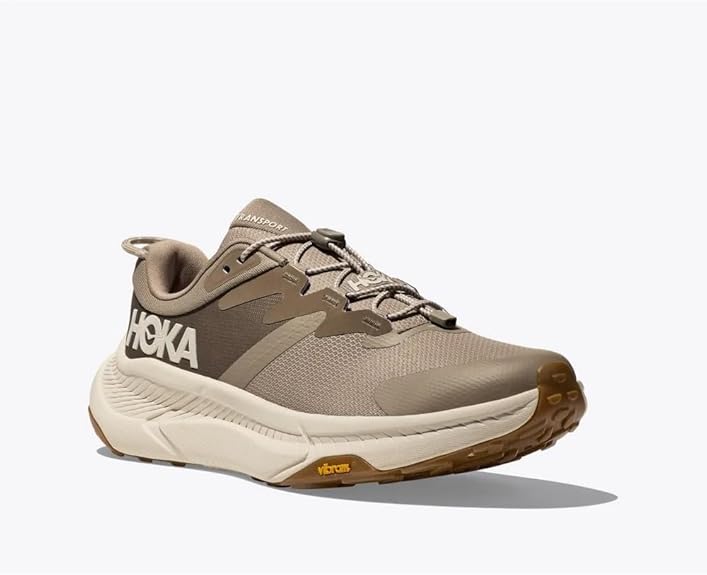
Consequently, the Transport GTX is the most golf-appropriate Hoka model we tested.
As a result, it has a lower-profile toe than most Hoka running shoes. That matters on the course.
Several testers noticed that the toe curl in other Hoka models causes an elevated address position. Furthermore, the Transport GTX avoids that entirely.
In our testing, GORE-TEX waterproofing kept feet dry across morning dew rounds and light rain. Breathability is genuinely good for a waterproof shoe.
Additionally, lateral stability through the swing surprised us. Specifically, the firm outsole provides more ground contact than softer Hoka running models.
Consequently, it handles the rotational forces of a golf swing adequately for most recreational golfers.
That said, the honest limitation is that traction in moderately wet conditions is noticeably below that of a spiked golf shoe.
Consequently, one tester reported what GolfWRX community members call the “Scheffler shuffle,” the trail foot sliding slightly on damp grass at impact.
Not dangerous, but noticeable. For dry-condition golfers who walk 18 holes regularly, the Transport GTX is a genuine option.
For golfers in wet climates, add a spiked shoe to the bag for rainy days.
Best for: walking golfers in dry or moderate climates who prioritise all-day foot comfort.
Price: around $180.
Full Review: Hoka Speedgoat 6 GTX
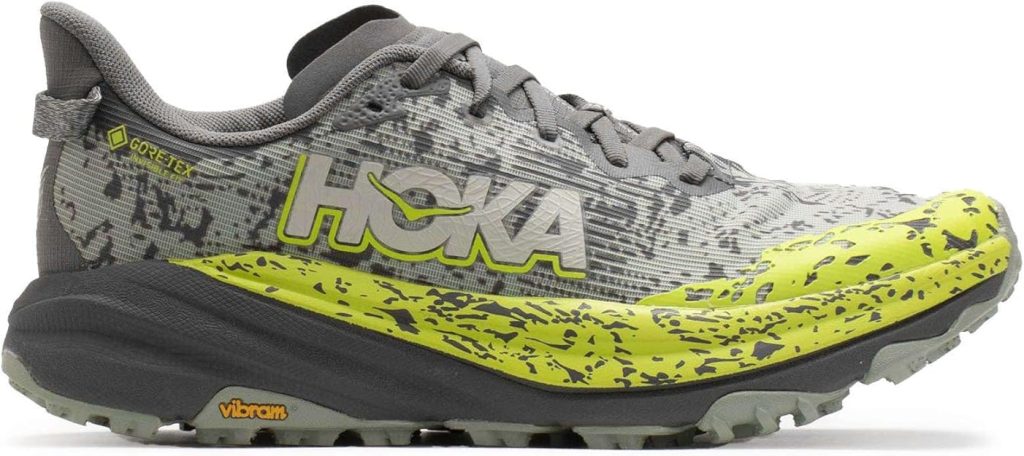
By contrast, the Speedgoat 6 GTX is the best Hoka option for golfers who play on soft, wet or hilly courses.
Specifically, Vibram Megagrip lugs provide traction that standard Hoka trail outsoles do not.
GolfWRX community members confirm the Speedgoat consistently outperforms other Hoka models on morning dew-covered fairways.
The 5mm lug pattern grips turf the way a trail shoe grips rock, which is exactly what dewy grass demands.
Furthermore, walking comfort remains the Hoka signature. Furthermore, the Speedgoat’s cushioning is slightly firmer than the Clifton or Bondi.
Consequently, that firmness helps the course. Softer foam compresses under the lateral forces of a swing. The Speedgoat’s firmer platform holds better.
As a result, swing stability is the best of any Hoka model tested.
However, the trade-off is aesthetics. Speedgoats look like trail shoes because they are trail shoes. Some courses will look twice.
However, for walkers in wet conditions who want maximum Hoka comfort with the best available traction, the Speedgoat 6 GTX is the choice.
Best for: golfers in wet climates or on hilly courses who want maximum Hoka traction.
Price: around $190.
The Real Reason Caddies Wear Hokas
Tour caddies adopted Hoka years before recreational golfers noticed the trend. The reason is pure economics of pain.
A Tour caddie walks 36 holes on Thursday alone. Over a full tournament week, that is 90,000 steps carrying a 40-pound bag.
No traditional golf shoe makes that sustainable. Hoka’s maximalist cushioning does.
For recreational golfers, the maths is therefore different. You walk 11,948 steps in a typical 18-hole round. That is substantial.
Foot fatigue after 14 holes affects swing mechanics, concentration, and enjoyment. Hoka golf shoes reduce that fatigue measurably.
Whether that benefit outweighs the traction limitation depends entirely on where and how you play.
Hoka Golf Shoes Sizing: What Nobody Tells You
Sizing matters more than most articles acknowledge. Most Hoka models fit true to size. However, the forefoot runs slightly narrow compared to traditional golf shoes.
Golfers who wear wide-fit FootJoy or ECCO may find Hokas uncomfortable after several hours. Order half a size up if you have wider feet or plan to wear thick socks.
Additionally, the quick-toggle lacing system on some models leaves an awkward lace length. You tuck the excess under the HOKA webbing loop.
It works, but it takes a session to get used to. This is the most common complaint from first-time Hoka golf shoe users. It is not a problem just a different system.
Consequently, fit also affects swing performance. A shoe that fits poorly slides inside the upper during the downswing.
That movement creates lateral instability regardless of how good the outsole is. Get the sizing right first. Everything else follows from that.
Who Should Buy these shoes?
Buy Hoka golf shoes if Hoka footwear if you walk every round and finish the back nine with sore feet. That is the target market.
Specifically, if foot fatigue affects your concentration and swing quality after the 12th hole, Hoka’s cushioning directly addresses the problem that dedicated golf shoes do not solve.
However, do not buy Hoka models on course as your only pair if you play in wet climates. They are a complement to a spiked golf shoe, not a replacement.
Buy them for dry summer rounds and keep a pair of FootJoy spiked shoes for anything wet.
In particular, senior golfers and those with plantar fasciitis, arthritis or general foot sensitivity will find this option transformative.
The maximalist cushioning reduces joint stress in a way that no standard golf shoe approaches. For this specific group, the footwear may be the most impactful equipment purchase available.
Frequently Asked Questions About Hoka Golf Shoes
Hoka footwear are the best option for walking comfort across an 18-hole round.
The maximalist cushioning reduces foot fatigue through 11,948 steps in a way that dedicated golf shoes do not match.
However, traction in wet conditions is below what a spiked golf shoe provides, and swing stability is adequate rather than excellent.
For dry-condition golfers who prioritise walking comfort, Hoka models on course work well.
For wet climates or players who need maximum swing stability, use them alongside a dedicated spiked golf shoe.
No, Hoka does not manufacture purpose-built golf shoes.
The models used on golf courses: Transport GTX, Speedgoat GTX, and Anacapa GTX are trail and walking shoes that happen to work adequately on the course.
Hoka does not list golf as a use case on its website.
The best on-course option is the Transport GTX for dry conditions and the Speedgoat 6 GTX for wet or hilly courses, based on independent testing from Plugged In Golf and GolfWRX community reports.
Tour caddies walk 36 holes on a Thursday and up to 90,000 steps across a full tournament week while carrying a 40-pound bag.
No traditional golf shoe provides enough cushioning for that workload without causing foot and joint pain.
Hoka’s maximalist EVA midsole reduces the cumulative impact stress that causes pain in long-duration walking.
Recreational golfers walk 11,948 steps in a standard 18-hole round, significantly less than a caddie, but enough for Hoka’s cushioning advantage to reduce fatigue on the back nine.
For dry conditions, the Transport GTX performs best on a course with a lower toe profile than other Hoka models, GORE-TEX waterproofing, adequate lateral stability, and comfortable outsole contact through the swing.
For wet conditions and hilly courses, the Speedgoat 6 GTX provides the best traction through Vibram Megagrip lugs.
Avoid the Clifton series for golf; the maximally soft midsole compresses under swing forces and provides insufficient lateral stability for most golfers
Ultimately, most Hoka models fit true to size for length.
The forefoot runs slightly narrow compared to traditional golf shoes like FootJoy or ECCO.
Golfers who wear wide-fit shoes or plan to wear thick golf socks should order half a size up.
The first round in any Hoka model on the course reveals the fit accurately.
If there is forefoot pressure after nine holes, the shoe is too narrow and will not loosen up significantly with further wear.
Hoka Golf Shoes: Key Takeaways
- Hoka’s offering delivers unmatched walking comfort across an 18-hole round — caddies adopted them years before recreational golfers because 90,000 steps per tournament week makes traditional golf shoe cushioning inadequate.
- The Speedgoat 6 GTX is the best Hoka model for on-course traction — Vibram Megagrip lugs provide grip that standard Hoka trail outsoles do not, making it the right choice for wet or hilly conditions.
- The “Scheffler shuffle” — trail foot sliding on damp grass at impact — is the most reported limitation of these models; it is manageable on dry courses and a real concern in wet climates.
- This type of shoe runs slightly narrow across the forefoot; golfers who prefer wide-fit shoes from FootJoy or ECCO should order half a size up to avoid discomfort after several hours on course.
- Senior golfers and those with plantar fasciitis or arthritis get the most measurable benefit from these shoes — the maximalist cushioning reduces joint stress through 11,948 steps per round in a way no standard golf shoe approaches.
Also Read:
