


This article contains affiliate links. If you buy through them, we may earn a small commission at no extra cost to you. As an Amazon Associate, we earn from qualifying purchases. Read our affiliate disclosure.
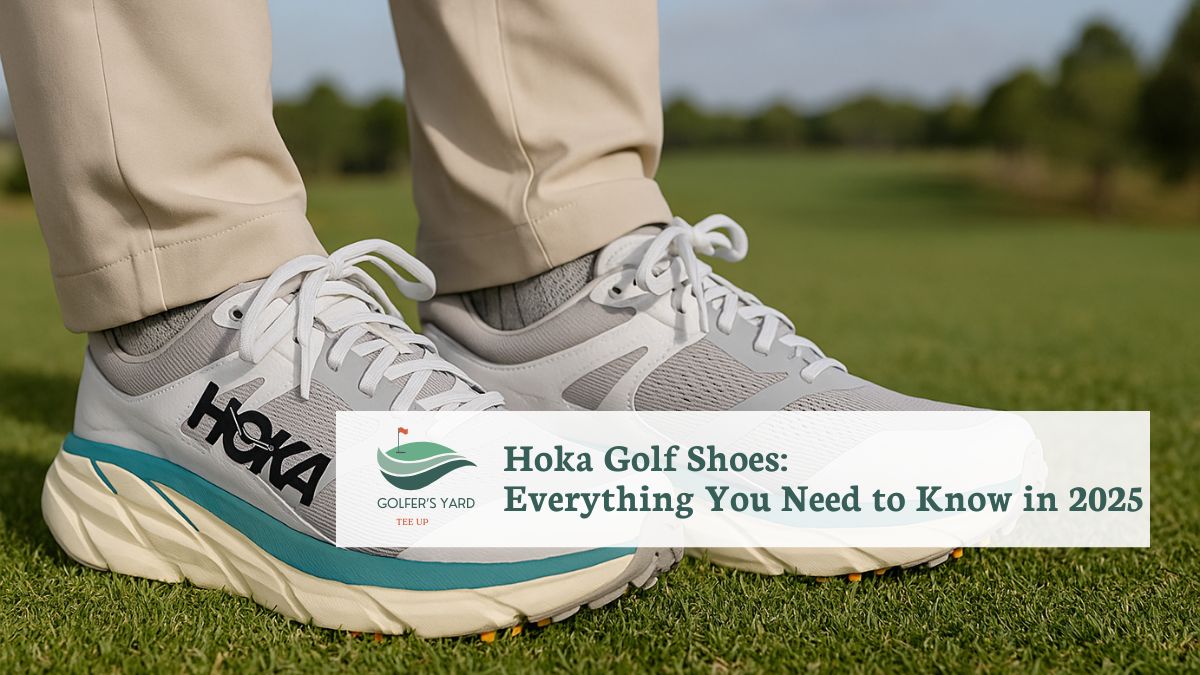
Looking for Hoka golf shoes because your feet ache by the 15th? Walk 18 in the Hoka Transport GTX (~$140 to $170, flat Vibram sole).
In fact, Hoka (formerly Hoka One One) makes no golf shoe. Still, this waterproof men’s walker is our pick for walked rounds on dry courses.
Because its sole sits flatter and lower than Hoka’s running shoes, you stay balanced at address. Meanwhile, its Gore-Tex lining kept our socks dry on dewy mornings.
When fairways stay damp and soft, the Speedgoat 6 Mid GTX (~$135 to $160) grips better with deeper lugs.
Women whose heels slip in men’s sizes should try the Women’s Transport GTX (~$160). Also, steep courses suit the Anacapa 2 Mid GTX (~$200), with its ankle support.
Overall, we wore two pairs over 12 walked rounds and judged three more on specs. All five prices date from 17 November 2026.
Want a shoe built for golf from the sole up? Then start with our best golf shoes guide.
Quick Answer: Which Hoka Shoe Is Best for Golf?
You walk dry, firm courses (men’s pick): the Hoka Transport GTX (~$140 to $170) has the flattest sole and lowest toe of the five.
You walk soft, damp courses with climbs: because its Vibram Megagrip lugs dig in, the Hoka Speedgoat 6 Mid GTX (~$135 to $160) is our wet-turf pick.
Your course is steep or your ankles roll: for side-hill lies, the Hoka Anacapa 2 Mid GTX (~$200) adds a high, supportive collar.
Your heel slips in men’s sizes: try the Hoka Women’s Transport GTX (~$160), made on a narrower women’s last.
You already own Cliftons: walk in the Clifton 9 GTX but never swing in it, since its soft foam rolls.
You play in steady rain: then a spiked shoe from our best golf shoes guide grips far better.
Does Hoka Make Golf Shoes?
No, Hoka makes no golf shoe, so walking golfers borrow its Transport GTX instead. As of November 2026, we could find no Hoka golf shoe, golf sponsorship or golf collaboration.
In fact, every Hoka you see on a course is a running, trail or hiking shoe worn off-label. The brand began in Annecy, France, in 2009, and Deckers has owned it since 2013.
That matters for two reasons. For one thing, none of these shoes has a golf outsole, so wet-grass grip falls short.
In addition, a few private clubs still require golf shoes. So check the dress code before your first round.
In short, Hoka is superb for dry walking rounds and a gamble on wet grass.
Are Hoka Golf Shoes Waterproof?
The GTX models are, because a Gore-Tex membrane lines the upper. During our testing, the Transport GTX and Speedgoat kept our socks dry through dewy early rounds.
However, waterproof does not mean grippy, since the outsoles still slide on wet grass. By comparison, standard versions without GTX in the name, such as the regular Clifton 9, let water in.
If you need waterproof golf shoes with real spikes, then our best golf shoes guide covers those.
Why Walking Golfers Switch to Hoka
Walking 18 holes typically means about 5 to 7 miles and 11,000 to 16,700 steps. That range comes from a 2017 BMJ Open review of golf studies.
As a result, your heels and the balls of your feet take a beating by the back nine. Hoka designs its thick, rockered midsoles for exactly that kind of long walk.
For this reason, many amateur walkers report wearing Hoka or similar cushioned trail shoes on course. Caddies, who walk every hole under a heavy bag, face the same problem on a bigger scale.
Former Masters and PGA champion Vijay Singh has worn Hoka trail shoes in competition, including at the Masters. Also, he has said they are the only shoes he can play in without foot pain.
At a 2022 PNC Championship press conference, he said they feel better than golf shoes. Reports name his pair as Hoka’s Tecton X 2 trail shoe (reported).
Even so, we found no sign of a sponsorship deal, so treat this as a player’s choice.
Footwear researchers suggest that personal comfort is the best guide when choosing a shoe. Likewise, many walkers find max-cushion shoes more comfortable over long distances.
The catch? Still, independent on-course tests of Hoka trail and hiking models keep finding the same trade-off.
Generally, walking comfort is excellent, but wet-grass grip and swing stability trail a spikeless golf shoe.
Already Own Cliftons? Walk in Them, Don’t Swing in Them
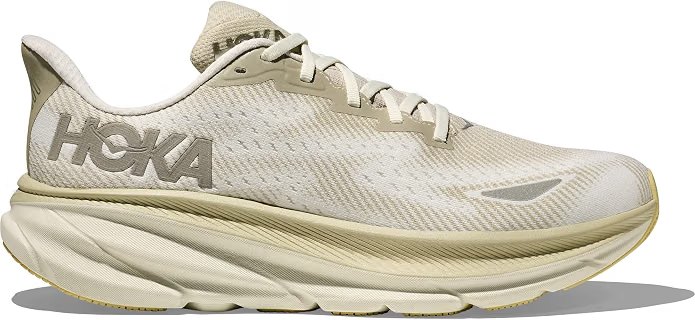
The Clifton 9 GTX (~$165) is a superb walking shoe, and buyers often say it eases foot pain. However, its soft, high-stack foam looks likely to roll when you turn hard through the ball.
We judged it on specs and buyer feedback, not on course. Besides, some buyers report soles coming apart, and some find it narrow.
So wear Cliftons for the walk to the first tee, the putting green and the day after a round. Instead, for the swing itself, the Transport GTX costs about the same and sits far steadier.
Similarly, Hoka’s newer Clifton 11 GTX (about $203) brings the same trade-off for golfers.
How We Tested Hoka Shoes on the Course
We wore two Hokas for golf: the Transport GTX and the Speedgoat 6 GTX
Across the two pairs we played 12 rounds, six in each. Because a cart would hide the very problem we wanted to test, we walked all 12.
Our rounds were on US public courses, in dry summer conditions and on dewy early mornings. Above all, the dawn tee times mattered, since wet grass is where a trail shoe gives way.
During every round, we rated four things a walking golfer actually feels.
Specifically, we scored wet-grass grip at impact and lateral stability in the downswing.
Equally, we scored comfort on holes 16 to 18, plus dry socks after a dewy front nine.
Unlike those two pairs, we judged the Anacapa 2, Women’s Transport and Clifton 9 on specs and buyer feedback.
None of those three went on course with us, and their write-ups say so.
Our scores out of 5 weigh grip and stability ahead of cushioning. After all, a soft shoe that slips costs you strokes.
Hoka Golf Shoes Compared: Which Model Suits Your Walk
| Model | Best for | Wet grass | Swing stability | Cut | Worn on course | Price |
|---|---|---|---|---|---|---|
| Transport GTX | Walking dry, firm courses | Fair | Good | Low | Yes | ~$140 to $170 |
| Women’s Transport GTX | Women whose heels slip in men’s sizes | Fair | Good | Low | No, specs only | ~$160 |
| Speedgoat 6 Mid GTX | Soft, damp courses with climbs | Best of the five | Good | Mid | Yes | ~$135 to $160 |
| Anacapa 2 Mid GTX | Steep courses, weak ankles | Good | Fair | Mid | No, specs only | ~$200 |
| Clifton 9 GTX | Walking only, not swinging | Fair | Poor | Low | No, specs only | ~$165 |
Read the swing stability column first, because a shoe that rolls at impact costs you strikes. After that, match the wet grass column to how dewy your usual tee time is.
1. Hoka Transport GTX: Best Hoka Golf Shoe for Walking Dry Courses
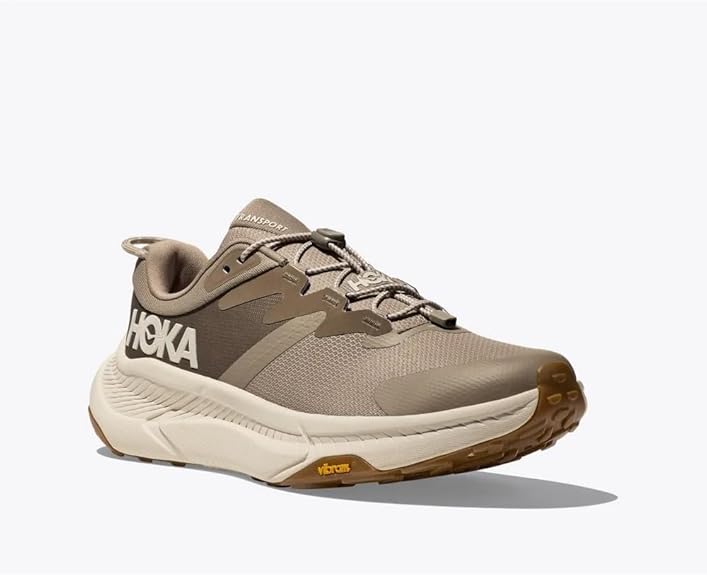
Price: ~$140 to $170 | Type: Gore-Tex walking shoe | Cut: low | Outsole: Vibram rubber, shallow lugs | Weight: about 11.6 oz per shoe, men’s size 9 | Tested: 6 walked rounds | Our score: 4.3/5
Is your forefoot burning by the 14th on a firm parkland course? In that case, this is the Hoka golf shoe we would hand you first.
It suits men who walk dry, flat courses and want comfort without a golf brand’s stiff sole. Specifically, the walker problem it fixes is aching heels and forefeet over five miles of firm fairway.
Compared to Hoka’s running shoes, the Transport sits flatter and lower to the ground. As a result, your weight stays centred at address rather than rocking back onto your heels.
How It Grips, and Where It Slips
During our rounds, the wide sole held firm on dry turf through full driver swings. On the other hand, the shallow lugs let our trail foot slide on dewy early mornings.
Independent on-course tests found the same weakness. So treat it as a dry-weather shoe, and keep a spiked pair in the car for dawn tee times.
Comfort, Fit and Waterproofing
On the positive side, our feet felt far fresher on holes 16 to 18 than in our usual golf shoes. In addition, the Gore-Tex lining kept our socks dry through dewy front nines.
It runs true to length, but the forefoot felt snug next to a FootJoy in the same size.Likewise, buyers with wide feet report a snug fit, so try it with golf socks before your first round.
Each pair ships with standard laces and a removable insole, and Hoka covers manufacturing defects for one year.
Against the Speedgoat 6 Mid GTX, it costs about $5 to $10 more. Still, you get a steadier base and a dressier look for the money.
Skip if: you tee off at dawn on soaked grass, have wide feet, or play a club that requires golf shoes.
Newer version: Hoka now also sells the Transport 2 GTX at about $210. Until the first model sells out, though, the original remains the better value for golf.
Pros
- Flattest, lowest sole of any Hoka here
- Gore-Tex kept our socks dry on dewy mornings
- Passes for a casual shoe in the clubhouse
Cons
- Shallow lugs slide on wet grass
- Narrow forefoot for wide feet
2. Hoka Speedgoat 6 Mid GTX: Best Hoka for Wet, Hilly Public Courses
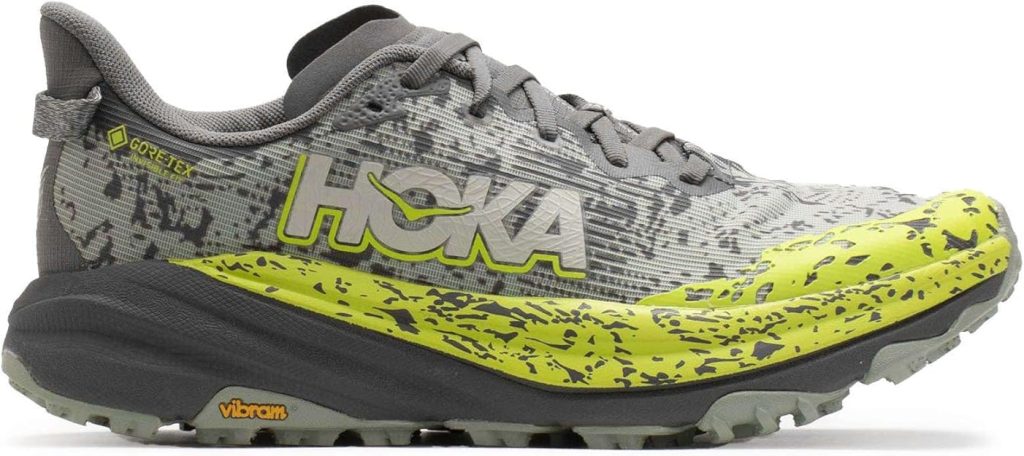
Price: ~$135 to $160 | Type: Gore-Tex trail shoe, mid cut | Outsole: Vibram Megagrip, 5 mm lugs | Weight: about 12.3 oz per shoe, men’s size 9 | Tested: 6 walked rounds | Our score: 4.1/5
A Speedgoat for golf makes the most sense on soft, damp public courses with a few climbs. In particular, it suits the walker who slips on wet banks and reaches the 9th with soaked socks.
Because its Vibram Megagrip lugs dig into turf, it holds damp ground far better than the Transport.
Indeed, in our testing it stayed planted on dewy tee boxes where the Transport slid.
Even so, it gave a little under hard rotation in the downswing. After all, trail lugs share one size and lack the outriggers of a golf sole.
The Trade-Offs for Walkers
For one thing, it looks like a trail shoe, because it is one. On a dressier course, that can earn a second look.
Another catch is sizing, since it ran about half a size small for us. Similarly, buyers report small sizing, along with soles that wear early on hard cart paths.
Hoka adds a gusseted tongue to keep grit out, and the same one-year defect cover applies.
In fact, at $5 to $10 less than the Transport, it is the cheaper of our two tested pairs.
Skip if: your club has a strict dress code, or you walk mostly on cart paths.
Newer version: the Speedgoat 7 arrived in 2026 at about $175. Still, the Speedgoat 6 Mid GTX keeps the waterproof upper for less money, which matters more for golf.
Pros
- Best grip on wet grass of any Hoka
- Firmer foam than the Clifton steadies the swing
- Waterproof mid-cut upper
Cons
- Runs small, so size up
- Looks like a hiking shoe on course
3. Hoka Anacapa 2 Mid GTX: Best Hoka for Steep Courses and Weak Ankles
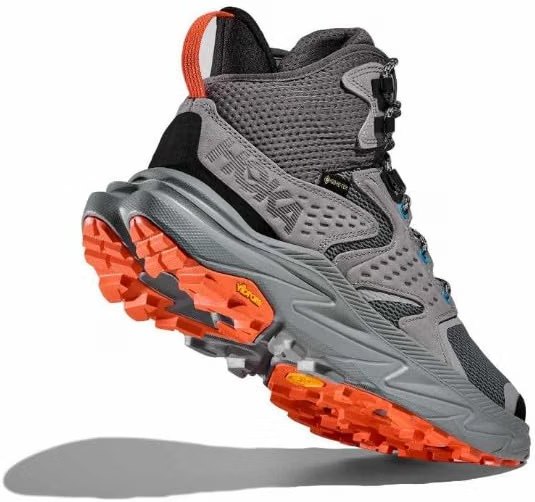
Price: ~$200 | Type: Gore-Tex hiking boot, mid-cut | Outsole: Vibram Megagrip | Weight: about 15.5 oz per shoe, men’s size 9 | Tested: specs and buyer feedback, not worn on course | Our score: 3.9/5
Play a course full of side-hill lies, or have ankles that roll on slopes? Then the Anacapa’s higher collar is the reason to look here.
It suits walkers on steep or mountain courses, and anyone who keeps playing through the cold months. We judged it on specs and buyer feedback, and we did not wear it on course.
Given that it uses Megagrip rubber, it should handle wet banks and cart-path edges well. However, it is the heaviest shoe here and the warmest in summer.
Also, a mid-cut boot can restrict hip turn for golfers with a full, flexible backswing. Expect to pay about $40 to $65 more than the Speedgoat for that extra ankle support.
Likewise, it carries Hoka’s one-year defect warranty. Overall, we see it as a shoulder-season or hilly-course pick, not an everyday golf shoe.
Skip if: you play in summer heat or rely on a big, free hip turn.
Pros
- Ankle support on slopes
- Grippy Vibram outsole
Cons
- Heaviest and hottest of the five
- Mid-cut boot can restrict hip turn for some
Hoka Golf Shoes for Women: Women’s Transport GTX
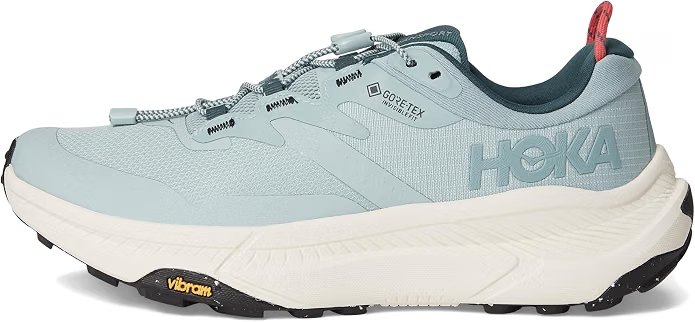
Price: ~$160 | Type: Gore-Tex walking shoe, women’s last | Cut: low | Outsole: Vibram rubber, shallow lugs | Weight: about 9.7 oz per shoe, women’s size 6| Tested: specs and buyer feedback, not worn on course | Our score: 4.2/5
Hoka makes no women’s golf shoe either, so women walkers face the same borrowing question. Instead, our answer is the Women’s Transport GTX, for anyone whose heel lifts in a smaller men’s size.
It sits on a women’s last, with a narrower heel and lower volume than the men’s shoe. As a result, it should hold the foot better through the swing than a downsized men’s pair.
Unlike the men’s pair, we assessed it on specs and buyer feedback rather than on course. Expect the same split as the men’s Transport: steady on dry turf, slippery on dew.
At the same time, its ~$160 price sits inside the men’s band, so the better fit costs nothing extra. When your course stays damp, Hoka also makes the Speedgoat in women’s sizes.
Want spiked or spikeless shoes made only for women? Then our best women’s golf shoes guide covers them.
Skip if: you play early tee times on wet grass, or want a shoe made only for golf.
Pros
- Women’s last holds the heel better than a small men’s size
- Gore-Tex upper for dewy mornings
- Same price band as the men’s version
Cons
- Shallow lugs slide on wet grass
- Not worn on course by our testers
Hoka Golf Shoes for Men: Which Pair to Walk 18 In
Does Hoka make golf shoes for men? No, but men get the widest choice of Hokas that work on a course.
So start with your course and your feet, rather than the colourway. If you walk a firm parkland course every Saturday, then the men’s Transport GTX is our first choice.
When your local course stays soft into June, the Speedgoat 6 Mid GTX earns its place instead. Meanwhile, hilly layouts suit the Anacapa 2 Mid GTX and its higher collar.
Men with wide feet have the hardest time, because both tested pairs felt snug across the forefoot. Also, watch for a sale on the original Transport GTX as the Transport 2 GTX takes over.
- Dry, flat parkland: Transport GTX, for the flattest and most stable sole.
- Soft, wet or links-style turf: Speedgoat 6 Mid GTX, for the deepest grip.
- Hilly or mountain courses: Anacapa 2 Mid GTX, for ankle support.
- Wide feet: half a size up, or a wide-fit golf shoe instead.
Hoka vs Spikeless Golf Shoes for Walkers
A spikeless golf shoe wins on grip and stability, while a Hoka wins on walking comfort. That is because golf outsoles mix lug sizes and angles, whereas most trail shoes repeat one lug shape.
Besides, golf shoes add a wider base and a stiffer midsection, so the foot stays put at impact. By contrast, Hoka builds for miles, with deep foam and a rocker that rolls you forward.
So for dry rounds where comfort comes first, a Hoka is a fair swap. When grass is wet, or you want one pair for every round, buy a spikeless golf shoe instead.
Our best golf shoes guide ranks the spikeless pairs worth a walker’s money.
Hoka Sizing for Golf: How It Compares With FootJoy
To begin with, both Hokas we wore ran true to length but felt narrower in the forefoot than FootJoy.
In particular, the Speedgoat ran about half a size small, so we went up a half size.
Buyers report the same pattern, especially golfers moving from wide FootJoy or ECCO fits. Since thick golf socks make it tighter still, size up across every model if you wear them.
Before you walk 18, wear a new pair for a full nine holes. If the forefoot presses by the 9th, then the shoe will not stretch enough to fix it.
For truly wide feet, a wide-fit golf shoe from our best golf shoes guide is the safer buy.
Should a Walking Golfer Buy Hokas?
Yes, if you walk most rounds on dry courses and finish with sore feet. One of our testers has plantar fasciitis and found the Transport GTX kept heel pain down through 18 holes.
That is one golfer’s experience, not medical advice, so see a podiatrist about ongoing pain. Also, several Hoka models carry the APMA Seal of Acceptance from US podiatrists, so check your model’s page.
No, if you play in rain or at a strict private club. In that case, a spikeless golf shoe gives you comfort and real grip in one pair.
Many walkers end up owning both: a Hoka for dry summer rounds, and a golf shoe for wet months.
Hoka Golf Shoes FAQ
Yes, on most public courses, and the Transport GTX is the pair we would start with.
However, check the dress code first, since some private clubs require golf shoes.
The Hoka Transport GTX is the best Hoka for golf on dry courses, at about $140 to $170.
On the other hand, the Speedgoat 6 Mid GTX grips better on wet ones.
Yes, indeed, the Transport GTX kept our feet fresher over a walked 18 than our usual golf shoes.
That matters, since a walked round covers about 5 to 7 miles.
The Speedgoat 6 Mid GTX copes with light rain best, thanks to deep lugs and Gore-Tex. In contrast, a spiked golf shoe grips soaked fairways far better in steady rain.
The Transport GTX fits true to length but narrow in the forefoot. Meanwhile, the Speedgoat runs about half a size small, so size up.
No, as of November 2026, we could find no Hoka golf clubs, golf clothing, or golf sponsorships.
Instead, Hoka sells running, trail, and hiking gear, which golfers borrow for walking rounds.
Final Verdict: Are Hoka Golf Shoes Worth It?
For walking golfers on dry courses, yes, and the Hoka Transport GTX is the pair to buy. It gave us the steadiest sole in the range and the freshest feet on the 18th green.
If your course stays damp, then choose the Speedgoat 6 Mid GTX instead. Women should start with the Women’s Transport GTX, while steep courses suit the Anacapa 2 Mid GTX.
Since Hoka still makes no golf shoe, keep a spiked pair for rain and strict clubs. As a next step, wear your new Hokas for nine holes on a dry morning before you commit to 18.
Keep reading
- Golf apparel and gear guide: what to wear and pack for every round, from shoes to rain gear.
- Best golf shoes: our full ranking of spiked and spikeless golf shoes for every course.
- FootJoy golf shoes: the fit most Hoka switchers measure against.
- Adidas golf shoes: sneaker-style pairs with proper golf outsoles.
- Under Armour golf shoes: cushioned golf shoes for walkers who want real grip.
- Best women’s golf shoes: golf-built picks on women’s lasts.
