




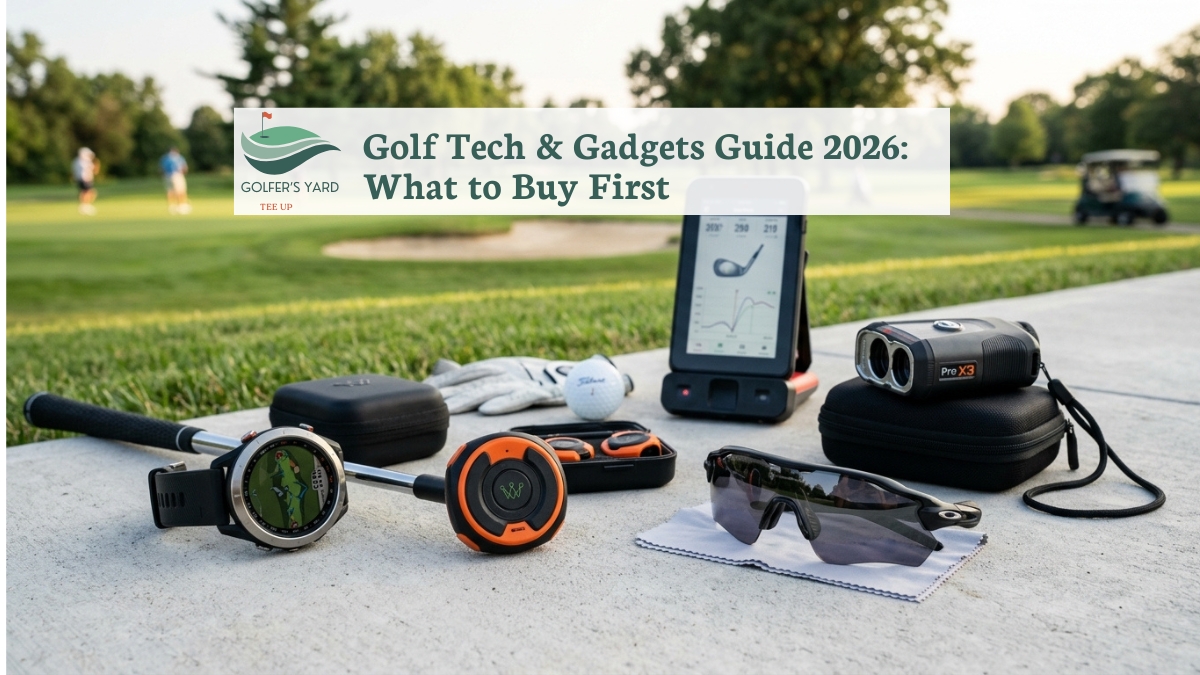
Remarkably, golf technology has never been more capable or more confusing to navigate.
The market in 2026 offers GPS watches under $200, rangefinders with built-in AI slope, launch monitors that fit in a shirt pocket, and home simulators starting at $400.
Notably, the problem is not a shortage of options. The problem is knowing which device genuinely lowers your score, which sits unused after three rounds, and which to buy first when you cannot justify buying everything at once.
Consequently, this guide does not list every piece of golf tech available in 2026. Instead, it answers the question every golfer actually asks: what should I buy first, and what can wait?
Accordingly, each category below links to our full tested review. Overall, the goal is to give you a clear decision framework before you spend a single dollar on golf technology.
Quick Answer: What Golf Tech to Buy First
Step 1 (any handicap, under $200): A GPS watch or laser rangefinder. Knowing your exact yardage is the highest-impact, lowest-cost improvement available. Start here before anything else.
Step 2 (12–24 handicap, $200–$600): A swing analyzer or entry-level launch monitor. Once you know your yardages, you need to understand why your ball goes where it does. These tools turn vague feedback into specific data.
Step 3 (serious golfers, $400–$3,000+): A home practice net or golf simulator. These are for golfers who want to practise at home. A net costs $70 to $400. A full simulator starts at $1,500 and scales to $15,000.
What you can skip: Any gadget that cannot answer “how did this help my score?” is novelty, not technology. Smart balls, sensor insoles, and most training apps fall into this category for most golfers.
The Golf Tech Buying Order: A Framework for Every Level
Notably, the single most common golf tech mistake is buying a launch monitor before owning a reliable yardage device.
Specifically, a launch monitor tells you how far you hit a 7-iron on the range. Furthermore, a GPS watch tells you how far you need to carry it to the flag on the 14th hole.
Both pieces of information genuinely matter to your score.
However, on-course yardage comes first because it immediately changes how you play every shot in every round.
The range data from a launch monitor improves your practice. That benefit takes weeks or months to show up in your scores.
Accordingly, the three-step framework below reflects the order in which golf technology produces the fastest return on your investment.
The sequence holds regardless of handicap. It simply changes which specific products suit you at each step.
| Step | Category | What It Does | Budget Range | Improvement Timeline |
|---|---|---|---|---|
| 1 | GPS Watch or Rangefinder | Gives exact yardage to the pin. Eliminates the most common club selection error in recreational golf. | $80–$550 | Immediate. First round you use it. |
| 2 | Swing Analyzer or Launch Monitor | Measures what your swing actually produces. Turns feel-based practice into data-driven practice. | $150–$2,000 | 4–8 weeks of consistent use. |
| 3 | Practice Net or Home Simulator | Allows practice at home between rounds. More swings per week accelerates improvement. | $70–$15,000 | Depends entirely on how consistently you use it. |
| + | Golf Apps | Shot tracking, stats analysis, course GPS, and handicap management. Supplements hardware — does not replace it. | Free–$100/yr | Immediate insight, improvement varies. |
Step 1: GPS Watch vs Rangefinder — Which Should You Buy First?
Specifically, this is the most commonly asked question in golf technology.
The short answer: both give you yardage, but they work differently and suit different playing styles.
Evidently, a rangefinder gives precise laser-measured distance to a specific target.
A GPS watch gives pre-loaded distances to the front, middle, and back of the green without you stopping to aim at anything.
When to Choose a GPS Watch
Consequently, a GPS watch is the better first purchase if you walk the course regularly, play quickly, or find it disruptive to stop and aim a rangefinder before every shot.
Modern GPS watches from Garmin and Shot Scope come preloaded with 40,000 or more courses.
They provide yardages instantly from your wrist without removing a device from your bag.
Furthermore, the better 2026 models automatically track your shots, calculate strokes gained data, and update your handicap after each round without manual input.
Additionally, GPS watches are the only yardage device legal for all forms of competition play in 2026.
Rangefinders with active slope function are prohibited in most stroke play competitions. A GPS watch removes that complication entirely.
Notably, the most tested and recommended GPS watch in 2026 is the Garmin Approach S70.
At $499, it provides automatic shot tracking, full-colour course maps, and health metrics that work both on and off the course.
For golfers who want distance tracking without the Garmin price point, Shot Scope offers a subscription-free alternative that includes automatic shot tracking across 40,000 courses for under $200.
Our full guide: Best Golf GPS Watches 2026: Tested and Ranked
When to Choose a Rangefinder
Conversely, a rangefinder is the better first purchase if you play in competitions, prefer the precision of laser-measured distance over GPS approximation, or regularly encounter situations where front/middle/back distances are not enough (for example, carrying a bunker exactly, or hitting to a specific section of a wide green).
Moreover, rangefinders are faster to aim than most people expect and dramatically reduce second-guessing on approach shots.
In our testing, the Bushnell Tour V6 Shift remains the most trusted rangefinder in recreational golf in 2026, used by more tour caddies than any other model.
The PinSeeker technology locks onto the flagstick rather than trees or background objects behind it.
The slope function adjusts the displayed yardage for elevation change, giving the distance the ball needs to carry rather than the raw laser measurement.
Importantly, the slope can be switched off for competition rounds where it is prohibited.
For golfers starting who want rangefinder accuracy at a lower entry price, the Bushnell Phantom 3 at $149 delivers reliable measurements at approximately one-third the price of the premium models. Our full guides:
- Best Golf Rangefinders 2026: Laser and GPS Compared
- Best Golf Rangefinder for Beginners 2026
- Bushnell Golf Rangefinder Review 2026
GPS Watch vs Rangefinder: The Honest Comparison
| Factor | GPS Watch | Rangefinder |
|---|---|---|
| Distance accuracy | Within 1–5 yards (GPS signal dependent) | Within 0.5–1 yard (laser measurement) |
| Speed of use | Instant — glance at wrist | 5–15 seconds to aim and lock |
| Slope adjustment | Yes (better models) | Yes (most models above $150) |
| Competition legal | Always yes | Yes — only with slope switched off |
| Shot tracking | Yes (automatic on premium models) | No |
| Subscription cost | Free (Shot Scope) to $10/mo (Garmin Connect) | None |
| Entry price | ~$80 (basic) to $499 (premium) | ~$149 (basic) to $450 (premium) |
| Best for | Walking golfers, fast players, stat trackers | Precise players, competition golfers, course management focus |
Step 2: Swing Analyzers and Launch Monitors
Evidently, once you know your yardages, the next improvement comes from understanding why your ball goes where it goes.
Specifically, this is what swing analyzers and launch monitors both address. They are not the same tool, and choosing between them depends on where you practise and what data matters to you.
Golf Swing Analyzers: For the Range and the Course
Specifically, a swing analyzer attaches to a club or your glove and measures the mechanics of your swing.
Tempo, club path, face angle at impact, and wrist hinge are the primary outputs.
The data connects to an app on your phone and shows you patterns across multiple swings rather than measurements for individual shots.
Accordingly, swing analyzers suit golfers who want to understand their swing tendencies rather than their ball flight numbers.
A golfer who consistently pulls their irons left, for example, benefits more from knowing their club path angle at impact than from knowing their ball speed.
The Arccos Caddie Smart Sensors are the most widely used swing analysis system in 2026, fitting to the grip end of all 14 clubs and tracking every shot automatically across a round.
The annual subscription of $99 includes an AI-caddie function that recommends club selection based on your actual historical shot distances rather than assumed distances.
Furthermore, Shot Scope provides an alternative with no subscription fee, using a GPS watch and tagged clubs to build a statistical profile of your game over time.
Golfers who resist subscription costs consistently choose Shot Scope. Golfers who want the AI club recommendation feature consistently prefer Arccos.
Our full guide: Best Golf Swing Analyzers 2026: Tested by Handicap
Golf Launch Monitors: For the Range and Home Practice
Conversely, a launch monitor measures what the ball does after you hit it: speed, launch angle, spin rate, carry distance, and shot shape.
It does not tell you why your swing produced those numbers. Instead, it gives you the output data that reveals which parts of your ball flight need improvement.
Notably, launch monitors have dropped significantly in price since 2020.
The Garmin Approach R50 at $600 provides radar-based launch monitor accuracy in a portable device that also functions as a GPS unit.
The Rapsodo MLM2PRO at $500 uses camera and radar technology to produce data comparable to a Trackman at a fraction of the cost, including a ball flight video of each shot.
At the entry level, the Shot Scope LM1 at around $200 delivers ball speed, carry distance, and launch angle. Those three metrics are the most actionable for recreational golfers.
Additionally, full-size launch monitors (Trackman, Foresight GCQuad) used in professional fittings remain prohibitively expensive for home use at $15,000 to $25,000.
Consequently, the consumer market has converged on the $200 to $800 range as the sweet spot for reliable recreational performance.
Our full guide: Best Golf Launch Monitors 2026: Every Budget Covered
Launch Monitor vs Simulator: What Is the Difference?
Importantly, a launch monitor is a measurement device. A simulator is a launch monitor plus a projector, screen, enclosure, and software that displays a virtual course in front of you.
Practically, a simulator turns launch monitor data into a playable round of golf indoors.
Evidently, a launch monitor alone is used for range practice and club fitting. A simulator is used for playing virtual rounds at home.
Consequently, the right sequence is always launch monitor before simulator. Once you own a launch monitor, adding a home simulator is simply a software and hardware extension.
Starting with a simulator before owning a launch monitor means buying both simultaneously, which significantly increases cost and complexity.
For golfers who want to practice at home rather than play virtual rounds, a launch monitor paired with a practice net is frequently the better choice and costs considerably less than a full simulator setup.
Our full guide: Best Golf Simulators for Home 2026: All Budgets
Step 3: Practice Nets and Home Simulators
Particularly for golfers who cannot get to the range between rounds, practising at home is the single highest-leverage way to increase weekly swing repetitions.
Evidently, more swings per week produces faster improvement than any device.
A practice net costing $70 to $400 turns a garage or garden into a valid practice space. A full simulator turns it into a virtual golf course.
Golf Practice Nets
Remarkably, the gap between a $70 practice net and a $400 practice net is not about quality.
It is about stability, portability, and what happens when a shot goes slightly offline.
Budget nets catch well-struck shots but collapse or move on heavy drives.
Premium nets like the Spornia SPG-8 ($280) stay fixed, include a ball-return chute, and handle full-driver speed without moving.
For golfers who hit driver regularly at home, the additional investment in a stable net repays itself in the third session when a budget net has tipped over twice already.
Notably, a practice net works best alongside a launch monitor. Without a launch monitor, you see the ball disappear into the net and guess at the outcome.
With a launch monitor, every swing produces carry distance, ball speed, and shot shape data. That data converts net sessions from vague repetition into specific, measurable practice.
Our full guide: Best Golf Practice Nets 2026: Backyard and Garage Picks
Home Golf Simulators
At the entry level, a home golf simulator requires four components: a launch monitor ($300 to $600), simulation software ($300 to $800 per year), a projector or screen ($300 to $1,500), and an impact screen or hitting net ($300 to $1,500).
The total for a functional entry-level setup starts at approximately $1,500 and rises quickly with better components.
At the premium end, full enclosures with turf flooring, custom screens, and commercial-grade projectors run $10,000 to $30,000.
Accordingly, for most recreational golfers, the question is not “should I buy a simulator?” but “which launch monitor and software combination fits my space and budget?”
The GSPro and E6 Connect simulation platforms are the most popular software choices in 2026 because they offer realistic course libraries and pair with a wide range of launch monitors from $300 upward.
Our full guide covers every tier: Best Golf Simulators for Home 2026
Golf Apps: The Tech You Already Have
Evidently, the smartphone in your pocket is already a functional golf GPS device, a scorecard, a handicap calculator, and a statistical tracking tool.
Golf apps do not replace hardware devices at the high end, but they meaningfully extend what your hardware already does.
Furthermore, several golf apps in 2026 provide value that no hardware device can match. AI-powered club recommendation and historical shot data are the two standout areas.
What Golf Apps Do Well
Notably, golf apps excel at three things hardware devices cannot do alone.
First, course GPS coverage: the best golf apps cover more than 40,000 courses worldwide with hole layouts, hazard mapping, and green contour data.
Second, statistical analysis: apps like Arccos and Shot Scope build a database of every shot you hit across every round and identify the specific weaknesses costing you the most strokes.
Third, AI caddying: Arccos Caddie uses your historical distances and the wind and elevation data for each specific shot to recommend the club most likely to produce the desired outcome, not the club you think goes that distance.
Additionally, the Golfshot app integrates GPS distances, automatic scoring, and swing analytics for golfers who want a single app covering all three functions.
Notably, Golfshot’s Auto Strokes Gained feature is the most accessible implementation of strokes gained analysis available to recreational golfers in 2026.
Our full review: Golfshot App Review 2026: Is It Worth the Subscription?
Which Golf Tech for Which Handicap?
Evidently, different technology produces different returns depending on where your game currently sits.
The table below matches the most impactful tech purchase to each handicap range based on where the most strokes are typically being lost.
| Handicap | Where Strokes Are Lost | Highest-Impact Tech Purchase | What to Skip for Now |
|---|---|---|---|
| 28+ (beginner) | Wrong club selection, poor contact, lost balls | GPS watch (~$150). Knowing the yardage does not fix a poor swing, but it removes the club selection error that adds 3–5 strokes per round before the swing is even an issue. | Launch monitor, simulator. The data is not actionable until ball-striking is more consistent. |
| 18–28 (high handicap) | Inconsistent distances, three-putting, short game errors | Rangefinder or GPS watch plus a swing analyzer. The rangefinder solves club selection. The swing analyzer identifies the one or two swing tendencies producing the most offline shots. | Full home simulator. Practising your current swing more at home without swing data just reinforces existing errors. |
| 10–18 (mid handicap) | Distance control, approach shot dispersion, wedge game | Entry-level launch monitor ($200–$600) plus a practice net. At this level, your swing is repeatable enough that launch data reveals specific adjustments worth making. | Full Trackman fitting (overkill for this level). Casual GPS watch (you already have the yardages — what you need is data on why shots disperse). |
| 6–10 (low handicap) | Wedge precision, putting, specific shot shapes | Mid-range launch monitor ($600–$1,500) plus Arccos stat tracking. At this level, the data from Arccos strokes gained analysis identifies the specific shot type costing the most strokes with statistical precision. | Entry-level swing analyzers (too limited for the precision you need). |
| Scratch to 6 (single figure) | Putting, specific wedge distances, mental game | Premium launch monitor plus golf simulator for year-round practice maintenance. Putting mat with green speed measurement. | Beginner-tier GPS watches and entry launch monitors. The data precision matters at this level. |
Total Cost of Golf Technology: 3-Year Ownership Guide
Notably, the advertised price of most golf technology devices does not reflect the total cost of ownership.
Subscriptions, software updates, replacement accessories, and course data fees add meaningful cost over time.
Consequently, this table shows the true cost of each tech category over three years, including all known ongoing fees as of September 2026.
| Category | Device Cost | Year 1 Total | Year 2 Total | Year 3 Total | Subscription? |
|---|---|---|---|---|---|
| GPS Watch (Shot Scope) | ~$180 | ~$180 | ~$0 | ~$0 | No subscription fee |
| GPS Watch (Garmin S70) | ~$499 | ~$619 (inc $120 Garmin Connect Premium) | ~$120 | ~$120 | $9.99/mo optional premium |
| Rangefinder (Bushnell Tour V6) | ~$450 | ~$450 | ~$0 | ~$0 | No subscription |
| Swing Analyzer (Arccos) | ~$230 (sensors) | ~$329 (inc $99/yr subscription) | ~$99 | ~$99 | $99/yr required for AI caddie |
| Swing Analyzer (Shot Scope) | ~$180 (watch + tags) | ~$180 | ~$0 | ~$0 | No subscription fee |
| Launch Monitor (Rapsodo MLM2PRO) | ~$500 | ~$700 (inc $200/yr software) | ~$200 | ~$200 | $200/yr for full simulation features |
| Launch Monitor (Garmin R50) | ~$600 | ~$600 | ~$0 | ~$0 | No mandatory subscription |
| Practice Net (Spornia SPG-8) | ~$280 | ~$280 | ~$0 | ~$0 | None |
| Golf Simulator (Entry Level) | ~$1,500–$3,000 setup | ~$2,000–$3,800 (inc software subscription) | ~$300–$800 | ~$300–$800 | $300–$800/yr simulation software |
| Golf App (Golfshot) | Free download | ~$39.99/yr | ~$39.99 | ~$39.99 | Annual subscription |
Rules of Golf: What Tech Is Legal on the Course?
Under the Rules of Golf (USGA and R&A), distance measuring devices are permitted in most competitions unless the committee has specifically prohibited them in the local rules.
However, the rules distinguish between basic distance measurement and additional features that are always prohibited during competition rounds.
| Device | Legal in Competition? | Conditions |
|---|---|---|
| GPS Watch (distance only) | Yes | Always legal — no conditions unless committee specifically bans DMDs |
| GPS Watch (slope/wind features) | No | Slope, wind, and “plays like” adjustments are prohibited during rounds even if the device offers them |
| Laser Rangefinder (no slope) | Yes | Legal when slope function is switched off |
| Laser Rangefinder (active slope) | No | Slope function must be disabled for competition rounds |
| Swing Analyzer (on course) | No | Devices that give advice during a round (including swing analysis) are prohibited |
| Launch Monitor (on course) | No | Not for use during a round — practice facility only |
| Golf Apps (GPS/scoring only) | Yes | Apps that only provide GPS distances and scoring are legal |
| AI Caddie Apps (club recommendation) | No | Any feature that gives advice on club selection or game strategy is prohibited |
Consequently, for golfers who play in club competitions or formal stroke play events, the practical recommendation is to own a slope-capable rangefinder with a clearly labelled slope-off button, and a GPS watch.
Both provide legal yardages in competition. Both provide additional non-legal features (slope, AI caddie) for casual rounds and practice.
Golf Tech That Actually Lowers Your Score vs Golf Tech That Does Not
Remarkably, no other golf technology guide makes this distinction directly.
Evidently, the market is full of devices that impress in product demos but do nothing measurable for your score after three months of use. This section is the honest assessment.
Tech That Measurably Lowers Scores
Remarkably, four categories of golf technology produce documented, measurable score improvement:
Yardage devices (GPS and rangefinder): Research consistently shows that club selection errors account for 3 to 7 shots per round for golfers above a 15 handicap.
The cause is uncertain yardage before the shot. A GPS watch at $150 addresses all of them immediately.
Shot tracking (Arccos, Shot Scope): Arccos published data in 2025 showing golfers using their AI caddie averaged 2.3 fewer strokes per round within 10 rounds of consistent use.
Specifically, the mechanism is removing optimistic distance assumptions. Most golfers systematically overestimate their carry distances by 10 to 15 yards.
Launch monitors for range practice: Golfers who receive specific carry distance and launch angle feedback during range sessions show measurably faster improvement in distance control than those who practice without data.
The specific number varies by handicap and practice frequency, but the directional improvement is consistent across available studies.
Putting mats and home practice nets: Neither device improves your technique on its own.
However, both dramatically increase the number of quality repetitions a golfer gets per week between rounds.
More quality swings and strokes per week is the most reliable predictor of improvement available in golf.
Tech That Rarely Improves Scores
Evidently, some popular golf gadgets do not produce measurable score improvement for most recreational golfers:
Smart golf balls: Sensor-embedded balls that track spin and flight data are not yet available in legal tournament specifications.
The data they produce requires sophisticated interpretation that most recreational golfers cannot act on without coaching support.
Swing training aids (mirror, alignment board, sensor insoles): These work when used consistently alongside coaching.
Used independently without professional feedback, they rarely produce lasting change.
Notably, the sensor insole category produces data that is genuinely useful for scratch players and coaches but rarely actionable for golfers above 10 handicap without a coach to interpret it.
Club head speed training devices: Overspeed training protocols genuinely increase swing speed when followed correctly.
However, most golfers who purchase these devices do not follow the structured protocol required to see results and abandon them within 6 weeks.
Golf Tech and Gadgets Guide 2026: Frequently Asked Questions
Specifically, for most golfers above a 15 handicap, a GPS watch or laser rangefinder produces the fastest score improvement.
Knowing your exact yardage to the pin eliminates the most common club selection error in recreational golf.
For golfers with a 10 to 15 handicap, an entry-level launch monitor turns vague range practice into data-driven practice with carry distance and launch angle feedback on every shot.
Start with yardage first, practice data second.
Evidently, both are useful but for different reasons. A rangefinder gives precise laser-measured distance to a specific target.
Specifically, it is more accurate but slower to use. A GPS watch gives instant distances from your wrist.
Furthermore, it is faster, always legal, and includes shot tracking on premium models.
Golfers who play in competitions should own a rangefinder with a slope-off function. Golfers who prioritise speed of play and round statistics should choose a GPS watch.
Notably, yes. Consistent use is the key requirement.
A launch monitor turns feel-based range sessions into data-driven practice by showing carry distance, ball speed, launch angle, and spin rate on every shot.
Notably, the improvement comes from identifying specific patterns over multiple sessions, not from a single use.
Golfers who use a launch monitor for 30 minutes per week consistently for 8 weeks show measurably faster improvement in distance control than those who practice without data.
Specifically, a launch monitor is a measurement device.
A simulator is a launch monitor plus a screen, projector, and software that displays a virtual course in front of you.
A launch monitor alone is used for range practice and fitting. A simulator allows you to play virtual rounds of golf indoors.
Consequently, always buy the launch monitor first. Adding simulator software and hardware to an existing launch monitor is significantly cheaper than buying a complete simulator setup from scratch.
Tour professionals use TrackMan or Foresight GCQuad launch monitors during practice. These cost $15,000 to $25,000.
During competition rounds, caddies carry laser rangefinders without slope function. Bushnell and Leupold are the most common on Tour.
Many Tour players also use Arccos sensors to build statistical databases of their ball-striking patterns during practice rounds.
Garmin GPS watches are worn by Tour players primarily for pace-of-play management and health tracking rather than yardage, as caddies typically step off distances from course markers.
Specifically, golf swing analyzers produce genuine value when used consistently alongside even occasional lessons.
Arccos Caddie is the best-evidenced system: their 2025 data showed users averaged 2.3 fewer strokes per round within 10 rounds through AI club selection recommendations alone.
Standalone swing sensors (wrist-mounted or club-mounted) produce useful tempo and path data but require coaching context to act on effectively.
Consequently, swing analyzers deliver more value to golfers who take at least occasional lessons than to those who use them independently.
For GPS distances and scoring, Golfshot is the highest-rated golf app on iPhone in 2026.
It covers 45,000 courses, provides automatic scoring, and includes Auto Strokes Gained analysis.
For AI-powered club recommendations based on your personal shot history, Arccos Caddie is the most evidence-backed option.
For free GPS distances without a subscription, the Golf GPS app by Hole19 provides reliable front, middle, and back yardages on 43,000 courses at no cost.
See our full review: Golfshot App Review 2026
Specifically, the USGA and R&A permit distance measuring devices that measure distance only. GPS watches are always legal.
Laser rangefinders are legal only with slope switched off. A committee may permit slope for casual competitions by local rule.
Any feature providing advice during a round is prohibited: this includes AI caddie recommendations, wind adjustment features, and swing analysis during a round.
Consequently, own a rangefinder with a clearly labelled slope-off button and a GPS watch for competition play, and use all premium features freely in casual rounds only.
Golf Tech Articles on GolfersYard: Complete Guide Index
Specifically, every tech category reviewed and tested on GolfersYard links from this hub page. Additionally, gap articles in production are noted below so you can return when they are live.
GPS Watches and Rangefinders
- Best Golf GPS Watches 2026: Tested and Ranked — Garmin vs Shot Scope vs Bushnell, all budgets
- Best Women’s Golf GPS Watch 2026 — tested picks for women golfers specifically
- Best Golf Rangefinders 2026 — laser vs GPS, slope vs non-slope, every budget
- Best Golf Rangefinder for Beginners 2026 — under $200, easy to use
- Bushnell Golf Rangefinder Review 2026 — the Tour standard reviewed in full
Launch Monitors and Simulators
- Best Golf Launch Monitors 2026 — from $200 entry-level to premium setups
- Best Golf Simulators for Home 2026 — complete setup guides, all budgets
Swing Analyzers and Training
- Best Golf Swing Analyzers 2026 — Arccos vs Shot Scope vs standalone sensors
- Best Golf Practice Nets 2026 — backyard and garage nets, $70 to $400
Golf Apps
- Golfshot App Review 2026 — the most tested GPS and scoring app for iPhone and Android

