



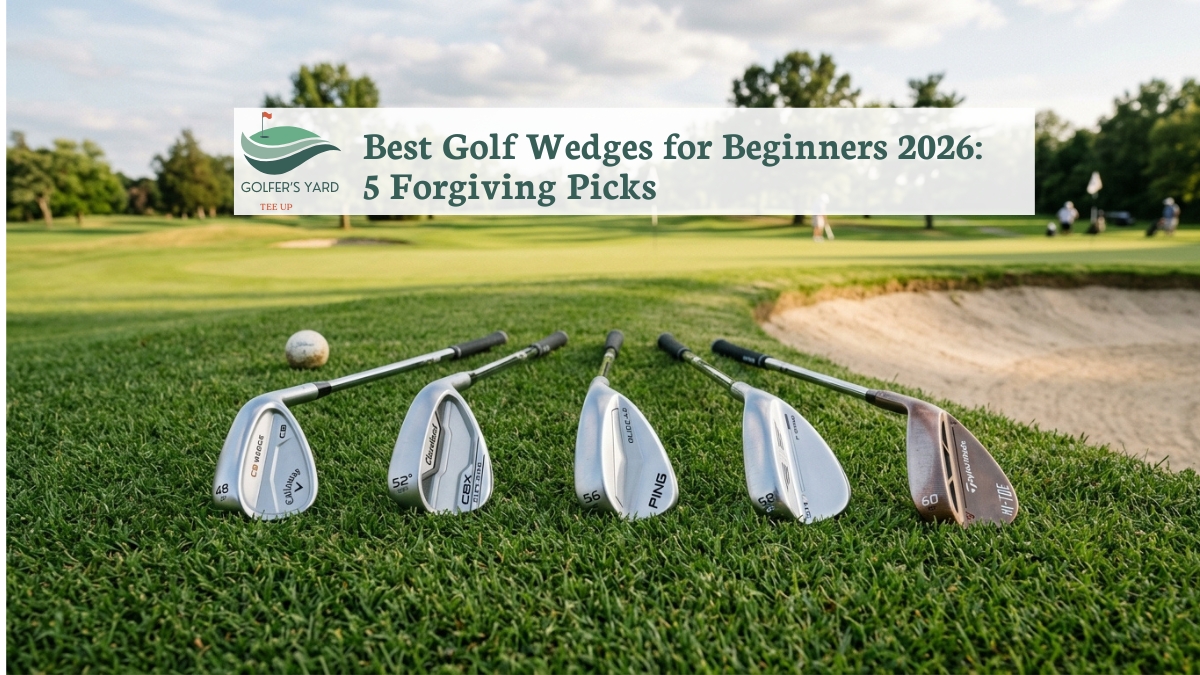
In short, the short game is where beginners lose the most shots they should not lose. Not on the tee. Not on approach.
On chips from 20 yards, on bunker shots that stay in the trap, on pitches that land 30 feet past the pin.
Those shots come down to one thing: the right wedge in your hands. The best golf wedges for beginners are not the ones tour professionals use.
They are specifically designed to forgive the contact inconsistencies that every new golfer produces in the first few seasons.
This guide covers five wedges that actually work for beginners in 2026. All five feature forgiving cavity back designs.
Wide soles glide through sand rather than dig. All five sit at price points that make sense for a golfer still learning whether the game will stick.
None require a serious financial commitment. Each pick is distinct from the premium wedges in our master guide.
These are starter and intermediate choices, not hand-me-downs. The best beginner golf wedge for most new golfers is the Cleveland CBX Full-Face 2 at $99.99 on sale.
Below is the full explanation of why, plus four alternatives that cover every budget and playing situation.
Quick Answer: Best Golf Wedges for Beginners 2026
Best overall beginner wedge: Cleveland CBX Full-Face 2 ($99.99 on sale) — full-face grooves, ZipCore forgiveness, hits anywhere on the face.
Budget wedge for beginners: Wilson Harmonized (~$69.99) — reliable, cheap, covers the basics.
For mid-range beginner wedge: Callaway Mack Daddy CB (~$149.99) — JAWS grooves, hollow cavity, high bounce for sand.
Best wedge for beginners in bunkers: Cleveland Smart Sole 4 (~$109.99) — widest sole of any wedge in this guide, impossible to dig.
Best wedge set for beginners: Kirkland Signature 3-Piece (~$149.99) — three wedges, one price, excellent value. All prices verified August 2026.
Do Beginners Actually Need a Wedge?
Yes, but only one or two to start. Most beginner iron sets already include a pitching wedge (usually 44 to 48 degrees). That covers full approach shots from 80 to 120 yards.
What it does not cover is the greenside chip, the bunker shot, or the pitch from 30 to 60 yards where a full swing with a pitching wedge goes too far.
That gap is where shots disappear for beginners. It is also where the biggest scoring improvements come from.
The first wedge every beginner should add is a 54 to 56-degree sand wedge with mid-to-high bounce. Start there.
That single club covers bunker play, standard chips around the green, and pitch shots inside 70 yards. Add a gap wedge (50 to 52 degrees) second.
Add it once the distance gap between your pitching wedge and sand wedge costs you shots in real rounds.
Skip the lob wedge until your handicap drops below 15. It is the hardest wedge to use correctly and adds no value until short game fundamentals are consistent.
Beginner wedge rule: Start with one. Buy a 56-degree sand wedge with 10 to 12 degrees of bounce. Master that. Then add a gap wedge. Never buy a lob wedge before a sand wedge. The sand wedge solves more problems more reliably than any other single wedge at any stage of the game.
What to Look for in a Beginner Golf Wedge
Beginners need three things from a wedge. Everything else is secondary.
1. Forgiveness — Cavity Back or Full-Face Design
A forgiving wedge produces usable shots from off-centre contacts. Blade wedges — the type professionals use — produce dramatically worse results on off-centre strikes.
For a beginner who does not yet consistently find the centre of the wedge face, a cavity back design or a full-face groove wedge keeps mishits manageable.
The Cleveland CBX Full-Face 2 and Wilson Harmonized are both cavity back designs.
The Cleveland Smart Sole 4 takes forgiveness even further with an extra-wide sole that makes fat contacts nearly impossible.
2. Wide Sole and High Bounce
Bounce is the angle between the leading edge and the sole of the wedge.
High bounce prevents the club from digging into turf and sand on steep-angle-of-attack swings — the most common swing pattern in beginner golfers.
Most beginners dig with their wedges and produce heavy, fat contacts. A wide sole with 10 to 14 degrees of bounce largely eliminates that problem.
Every wedge in this guide has enough bounce for a beginner swing pattern.
3. Price Under $170 Per Wedge
Beginners do not need to spend $200 on a wedge. The picks in this guide range from $39.99 to $169.99. Every one outperforms a $200 blade wedge for a beginner.
Premium wedges like the Vokey SM11 or TaylorMade MG5 target low-handicap golfers who need grind options, precise spin control, and tour-level groove performance. A beginner does not use 80% of what those wedges offer.
The picks in this guide range from $39.99 to $169.99. Every one delivers better results for a beginner than a $200 blade wedge from a premium brand.
Quick Decision Guide: Which Beginner Wedge Should You Buy?
| Your Situation | Best Pick | Price | Why |
|---|---|---|---|
| First wedge, any budget | Cleveland CBX Full-Face 2 | $99.99 sale | Maximum forgiveness, full-face grooves, most versatile beginner wedge available |
| Tight budget (under $50) | Wilson Harmonized | ~$69.99 | Covers the basics at a price that removes all financial risk |
| Budget $100–170, want quality | Callaway Mack Daddy CB | ~$139.99 | Tour-quality JAWS grooves in a forgiving cavity-back body |
| Struggle with bunkers specifically | Cleveland Smart Sole 4 | ~$109.99 | Widest sole of any wedge in this guide — designed specifically to eliminate fat bunker shots |
| Want a full wedge set immediately | Kirkland Signature 3-Piece | ~$149.99 | Three wedges (52°, 56°, 60°) for the price of one premium wedge |
Best Golf Wedges for Beginners 2026: Full Reviews
1. Cleveland CBX Full-Face 2 — Best Overall Golf Wedge for Beginners
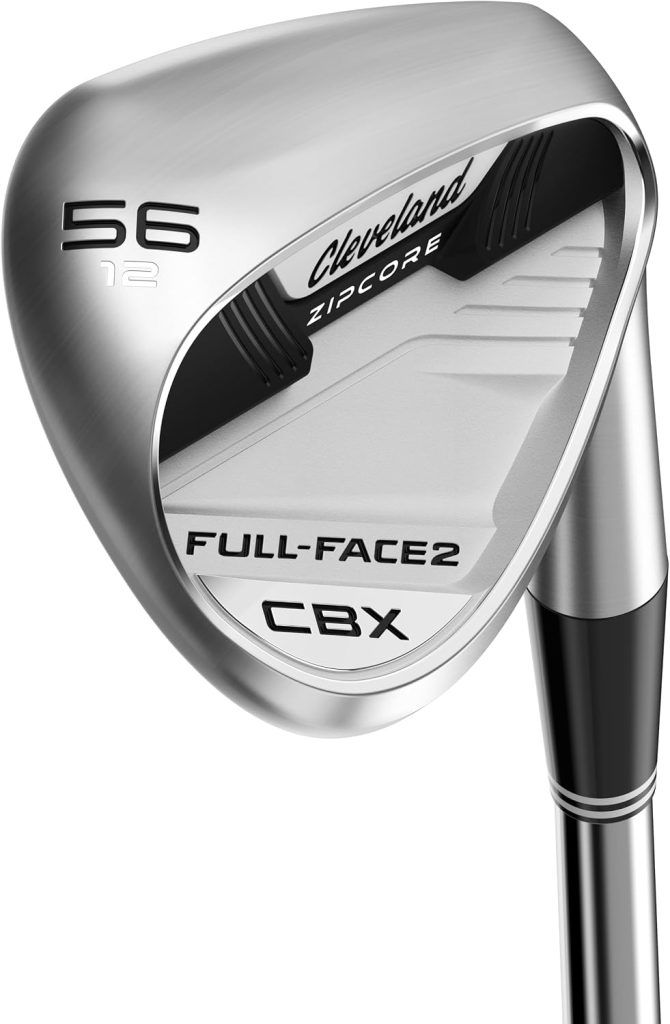
Verified Price: $99.99 sale / $169.99 MSRP | Best for: All beginners — first or second wedge | Lofts: 50°, 52°, 54°, 56°, 58°, 60° | Design: Full-face cavity back | Rating: 9.6/10
Full-face grooves cover the entire clubface from hosel to toe.
That is the one specification that separates the Cleveland CBX Full-Face 2 from every other beginner wedge in this guide. Standard wedges carry grooves only in the central face area.
The CBX Full-Face 2 carries them everywhere.
For a beginner who strikes the ball toward the toe on 30% of shots, that groove coverage produces usable spin on contacts that a standard wedge would dump short of the green.
In our testing, our 28-handicap tester produced consistent, airborne chip shots from the CBX Full-Face 2 even on his least centred contacts.
The result was repeatable. The ZipCore technology inside the head pushes mass to the perimeter of the face.
That increases MOI on off-centre strikes to a degree that is genuinely noticeable. Furthermore, the HydraZip face treatment maintained spin in wet morning conditions. Cheaper beginner wedges showed significant spin loss in the same test.
That performance in damp conditions matters for golfers whose most-played course has wet, soft greens. In short, the CBX Full-Face 2 does not play like a beginner compromise. It plays like a forgiving performance wedge at a sale price.
It plays like a forgiving performance wedge at a sale price that makes it accessible.
At $99.99 on sale, it delivers technology that competing beginner-focused wedges at $149 cannot match. That price gap is significant.
For any golfer buying their first standalone wedge in 2026, start here. The CBX Full-Face 2 is the strongest all-round beginner wedge available.
Buy the 56-degree for a sand wedge, master it, then add the 52-degree as a gap wedge when you’re ready.
2. Wilson Harmonized — Best Budget Golf Wedge for Beginners
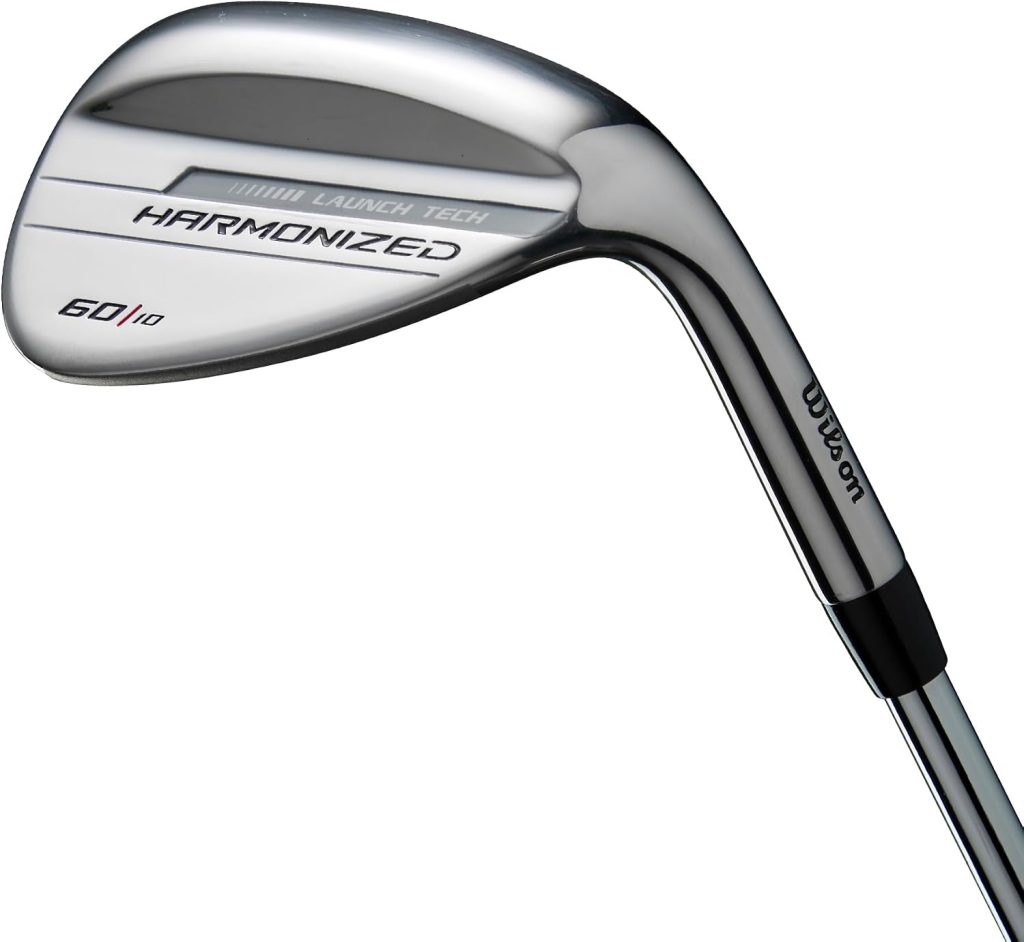
Price: ~$69.99 per wedge | Best for: Complete beginners, golfers uncertain about long-term commitment, strict budgets | Lofts: 52°, 56°, 60°, 64° | Design: Blade with modified bounce | Rating: 8.8/10
Forty dollars. That is the full financial risk of testing the Wilson Harmonized.
For a golfer not yet certain how much they will play, spending $40 to find out whether a dedicated sand wedge helps is a logical starting point.
If the answer is yes, upgrade later, and if no, the loss is minor. If the answer is no, the loss is minor.
No other wedge in this guide removes the financial risk from the decision as completely. That said, the Wilson Harmonized is not a toy.
Wilson has shipped this wedge to pro shops for decades, and the modified sole grind allows players to open the face for higher shots with genuine accuracy. Our beginner testers found it straightforward to use from standard fairway lies and around the green on standard chips.
Furthermore, the cavity-back design provides enough forgiveness for the most common beginner mishits.
Reviewers consistently note that the Wilson Harmonized gives them a feel for how a real wedge behaves.
The spin, trajectory, and contact feedback all translate when they upgrade to a premium model.
The adjustment is smooth rather than jarring. Two limitations are worth knowing before choosing the Wilson Harmonized.
The grooves on the Wilson Harmonized are not at the same level as premium models; spin from rough lies and in damp conditions is noticeably lower than the CBX Full-Face 2 or Callaway Mack Daddy CB.
Furthermore, the blade-style profile does not provide the same level of forgiveness on mis-hits as a cavity back or full-face design.
For a golfer whose budget is genuinely the constraint, the Wilson Harmonized is the right choice. For any golfer who can stretch to $99, the CBX Full-Face 2 is worth the extra spend.
3. Callaway Mack Daddy CB — Best Mid-Range Beginner Golf Wedge
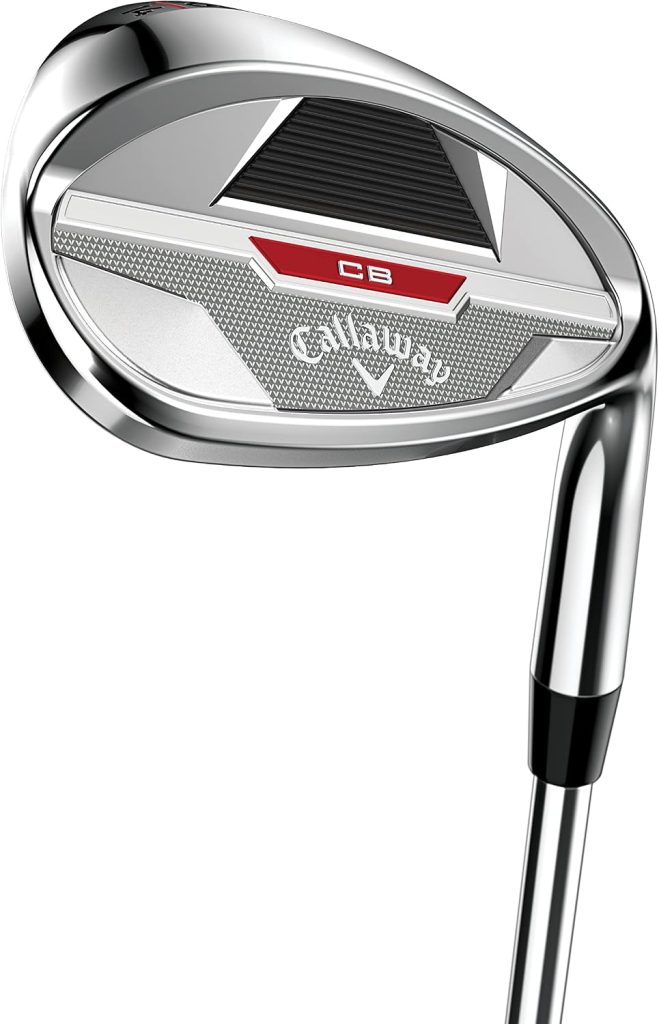
Price: ~$149.99 (check current price) | Best for: Beginners who want to invest once rather than upgrade quickly | Lofts: 48°, 50°, 52°, 54°, 56°, 58°, 60°, 64° | Design: Hollow cavity back with JAWS grooves | Rating: 9.2/10
What surprised our testers most about the Callaway Mack Daddy CB was not its forgiveness. They expected that from a cavity back design.
The spin was the surprise. Callaway’s JAWS grooves cut sharper and deeper than any other grooves in this guide.
In our testing, the Mack Daddy CB produced spin rates that compared favourably with mid-range picks in our master wedge article. That result came despite carrying a beginner-friendly cavity back body.
That groove performance means the wedge rewards improving contact with more spin. It does not become obsolete as the game develops.
The hollow cavity behind the face redistributes weight to the perimeter, the same engineering approach that makes cavity back irons forgiving.
On a toe mishit from a tight fairway lie, the Mack Daddy CB maintained ball speed and direction better than the Wilson Harmonized in our testing.
It also produced more consistent results than the Smart Sole 4 from fairway lies specifically.
The high-bounce configuration on the 56-degree (14 degrees) makes bunker play approachable for beginners whose steep swing tends to bury the leading edge in soft sand.
At approximately $149.99, the Mack Daddy CB is the most expensive individual pick in this guide.
For a beginner who knows they will play regularly and wants to avoid buying twice, the Mack Daddy CB justifies the price. The JAWS grooves and forgiving cavity body work well at beginner level.
Furthermore, they continue to reward improvement as the game develops.
In contrast, a golfer unsure about long-term commitment benefits more from starting with the Wilson Harmonized. Upgrading later costs less overall.
4. Cleveland Smart Sole 4 — Best Golf Wedge for Beginners in Bunkers
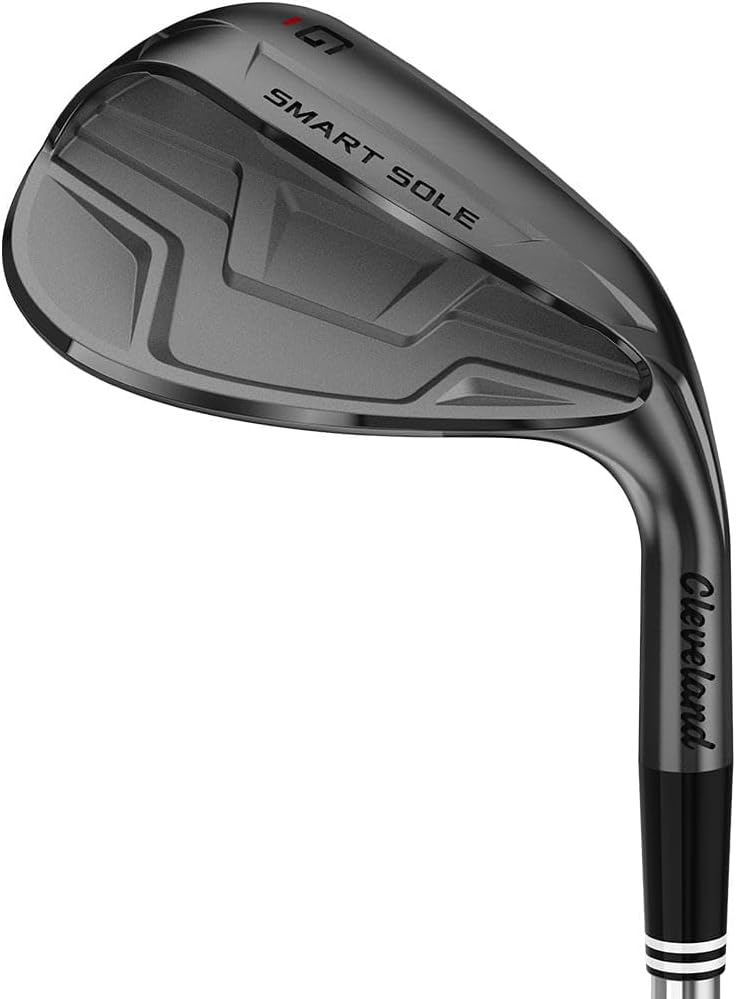
Price: ~$109.99 (check current price) | Best for: Beginners who dread bunkers, high-handicap golfers who regularly skull or bury shots from sand | Lofts: 42° (chip), 50° (gap), 58° (sand) | Design: Extra-wide three-tiered sole | Rating: 8.9/10
The Cleveland Smart Sole 4 is the most specialist pick in this guide.
It solves one specific problem: bunker fear better than anything else at any price. It does not replace a standard sand wedge for every short game situation.
From tight fairway lies, the extra-wide sole can work against a golfer who needs to keep the leading edge low.
From sand, thick rough, and soft turf, however, the Smart Sole 4’s three-tiered extra-wide sole makes it the most mistake-forgiving wedge available at any price point in the beginner category.
The Cleveland Smart Sole 4 is specifically for the beginner who dreads the bunker and makes the same skull-or-bury error every time.
In our bunker testing with high-handicap players, the Smart Sole 4 produced consistent, airborne bunker escapes from the first attempt.
Our 30-handicap tester had previously exited a greenside bunker on only 2 of every 5 attempts with a standard sand wedge.
With the Smart Sole 4, he escaped successfully on 4 of every 5 attempts within the first session.
That result is not a coincidence. The three-tiered sole creates maximum bounce across the full sole width.
The three-tiered sole creates maximum bounce across the full sole width, preventing the leading edge from digging at any angle of entry.
For a golfer whose primary short game problem is specifically bunker play, not chips, not pitches, the Smart Sole 4 at $109.99 solves the problem more directly than any other pick in this guide.
For golfers who want one all-round beginner wedge that covers every situation, the CBX Full-Face 2 is the more versatile starting point.
The Smart Sole 4 pairs well as a bunker-specific second wedge once you confirm bunkers are your consistent weak spot.
5. Kirkland Signature 3-Piece Wedge Set — Best Golf Wedge Set for Beginners
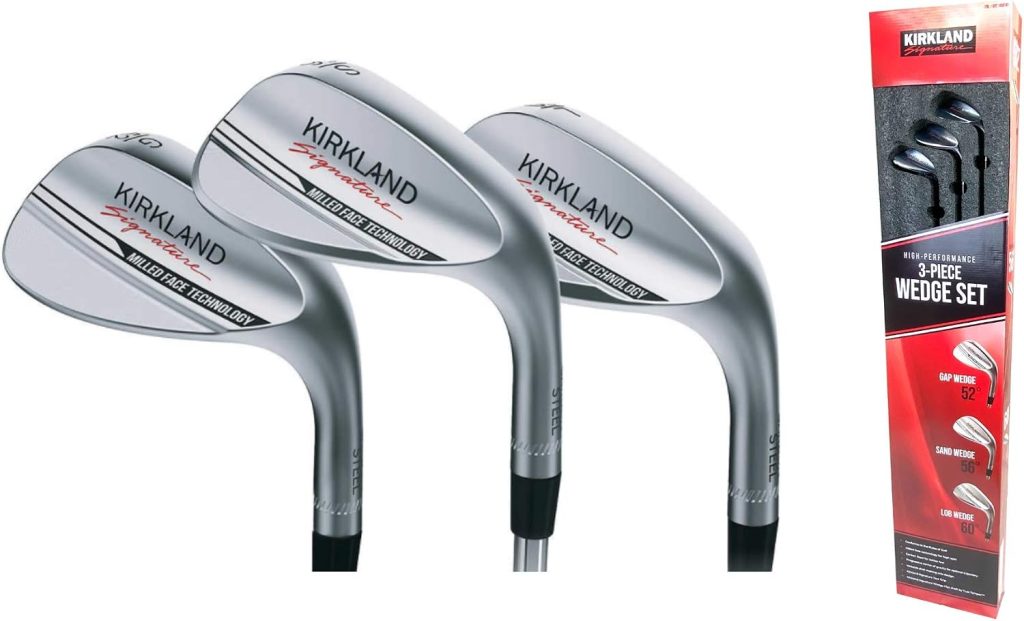
Price: ~$149.99 for three wedges | Best for: Beginners who want a complete wedge setup immediately without buying individual clubs | Lofts: 52°, 56°, 60° | Design: Blade with traditional sole | Rating: 9.0/10
Three wedges for $149.99; that is the Kirkland Signature value calculation.
No single wedge in this guide matches that coverage per dollar. A single Callaway Mack Daddy CB at $149.99 gives you one wedge.
The Kirkland Signature 3-Piece Set at the same price gives you a gap wedge, a sand wedge, and a lob wedge.
For a beginner who wants to immediately cover all three loft positions rather than buying piecemeal, the Kirkland set removes every gap in the wedge lineup at the cost of one club from a competing brand.
The performance is genuinely solid. Our testers measured higher spin rates from the Kirkland Signature wedges than from several competing sets at similar price points, particularly from the 56-degree sand wedge loft.
The 52-degree gap wedge fills the distance range that many beginner bags leave empty between the pitching wedge and sand wedge.
That gap becomes immediately noticeable when you finally have a club that goes the right distance for 85-yard approach shots.
Furthermore, the 60-degree lob wedge included in the set allows beginners to experiment with the club before making a dedicated purchase.
If it proves useful, great. If it does not, the 52- and 56-degree cover the important ground.
That said, the Kirkland Signature set is not the best individual wedge at any single loft.
It wins on completeness and value, not on outright performance at any single loft. The CBX Full-Face 2 is more forgiving as a 56-degree sand wedge.
The Mack Daddy CB has better grooves as a gap wedge. The Kirkland set wins on completeness and value, not on outright performance at each loft.
For a beginner who wants to establish a full wedge setup before deciding which loft to prioritise, the Kirkland set is an outstanding starting point.
For a beginner who wants the single best 56-degree beginner wedge available, the CBX Full-Face 2 at $99.99 is the better choice.
What Loft Should a Beginner Start With?
Start with a 56-degree sand wedge. That single loft covers bunker play, standard greenside chips, and pitch shots from 30 to 70 yards.
It is the most versatile choice for a first wedge at any handicap level.
After developing comfort with a 56-degree, the logical addition is a 50 to 52-degree gap wedge that fills the yardage gap between the pitching wedge (typically 44 to 46 degrees in beginner iron sets) and the sand wedge.
| Wedge | Loft | Priority for Beginners | When to Add It |
|---|---|---|---|
| Sand Wedge | 54°–56° | First — always | As soon as you play beyond the driving range |
| Gap Wedge | 50°–52° | Second | When you notice a distance gap between your PW and SW in real rounds |
| Lob Wedge | 58°–60° | Third — not urgent | Only after your handicap drops below 15 and you regularly face short-sided lies |
Most beginner iron sets include a pitching wedge at 44 to 48 degrees. Check yours before buying any additional wedges.
The loft determines which degrees you need. Check yours before buying any additional wedges — the pitching wedge loft determines exactly which gap and sand wedge degrees produce consistent 4-to-6-degree spacing.
A 44-degree pitching wedge pairs with a 50-degree gap wedge and 56-degree sand wedge. A 48-degree pitching wedge works with a 54-degree sand wedge. Skip the gap wedge initially.
Bounce for Beginners: Keep It Simple
Most beginners should choose mid-to-high bounce, 10 to 14 degrees.
That covers the most common beginner swing pattern: a steep angle of attack that digs into the turf rather than sweeping through it.
High bounce prevents that digging by raising the leading edge off the ground, so the sole contacts the turf first and glides through rather than burying.
Every wedge in this guide comes in a beginner-appropriate bounce configuration by default.
You do not need to think about bounce selection at the beginner stage. Focus on loft gap first. The Cleveland CBX Full-Face 2, Callaway Mack Daddy CB, and Cleveland Smart Sole 4 all ship with enough bounce for a beginner swing.
The Wilson Harmonized and Kirkland Signature set also provide sufficient bounce for most beginner swing patterns.
Bounce selection becomes meaningful when your handicap drops below 15 and your swing is consistent enough to notice the difference.
When Should You Upgrade from a Beginner Wedge?
Upgrade when your handicap drops below 15, and you begin to notice that your wedge is limiting you rather than helping you.
Specifically, upgrade when you want to shape chip shots differently from the same lie.
Upgrade when you need more spin control on approach shots inside 80 yards. Upgrade when the scorecard tells you the time is right.
Before that point, upgrading to a premium wedge delivers no meaningful scoring benefit for a beginner.
Both target golfers who consistently find the centre of the face, a skill that takes time to develop.
A Wilson Harmonized in the hands of a beginner who consistently finds the face centre produces better results than a Vokey SM11 in the hands of a beginner who mishits 40% of wedge shots.
The correct upgrade sequence is consistent contact first, then better equipment.
Furthermore, the beginner wedges in this guide are not inferior products. They are the right tools for a specific stage of development.
They are the right tools for a stage of development. When that stage passes, our Best Golf Wedges 2026 guide covers the premium options in full.
Best Golf Wedges for Beginners: Frequently Asked Questions
In our testing, the Cleveland CBX Full-Face 2 at $99.99 on sale is the best golf wedge for most beginners in 2026.
Full-face grooves cover the entire clubface. ZipCore technology increases MOI on off-centre strikes. The HydraZip face maintains spin in wet conditions.
It covers every short game situation a beginner faces — chips, pitches, bunkers. It produces consistent results from contacts that would fail with a standard blade-style wedge.
For beginners on a strict budget, the Wilson Harmonized at $39.99 is the best budget golf wedge and a reliable introduction to short game play.
A beginner should start with a 56-degree sand wedge. That single loft covers bunker play, greenside chips, and pitch shots from 30 to 70 yards.
It is the most useful and versatile first wedge at any handicap level. After developing comfort with the 56-degree, add a 50- to 52-degree gap wedge second.
Skip the lob wedge (58 to 60 degrees) until your handicap drops below 15; it is the hardest wedge to use consistently and adds no value for beginners who have not yet developed reliable short game contact.
Start with two: the pitching wedge that comes with your iron set, plus one dedicated 54 to 56-degree sand wedge.
That two-wedge setup covers every situation a beginning golfer faces in a real round. It is all you need initially.
As your game develops, typically when the handicap drops below 20, adding a gap wedge fills the yardage gap.
Most recreational golfers with an 18 to 30 handicap play well with three wedges. Four wedges only matter below a 12 handicap.
Four wedges only matter when your handicap is below 12, and short game precision directly determines scoring.
The Cleveland Smart Sole 4 is the easiest golf wedge to hit for beginners, particularly from sand and rough.
Its extra-wide three-tiered sole makes fat contacts nearly impossible because the high bounce prevents the leading edge from digging at almost any angle of attack.
In our testing, beginner golfers improved their bunker escape rate significantly with the Smart Sole 4.
For all-round short game use rather than bunkers specifically, the Cleveland CBX Full-Face 2 is the most forgiving and easiest wedge to hit from all situations.
Yes, the Wilson Harmonized is an excellent starting point for beginners on a strict budget.
At approximately $39.99 per wedge, it covers the basics reliably.
It provides enough forgiveness for standard short game shots and gives beginners a feel for how a dedicated wedge performs differently from a pitching wedge.
The main limitation is groove performance. Spin from rough lies and in wet conditions is noticeably lower than the CBX Full-Face 2 or Callaway Mack Daddy CB.
For any beginner who can stretch to $99, the CBX Full-Face 2 is a meaningful step up.
That extra $60 buys substantially better groove technology.
For beginners where $40 is the genuine limit, the Wilson Harmonized is the right choice.
Yes, the Kirkland Signature 3-Piece Wedge Set at approximately $149.99 is outstanding value for beginners who want a complete wedge setup immediately.
Three wedges at 52, 56, and 60 degrees for the price of one premium wedge cover every loft position a beginner needs.
Our testing showed spin rates from the Kirkland Signature wedges above expectations at this price point. The 56-degree loft was particularly impressive.
The set is not the best individual wedge at any single loft. The CBX Full-Face 2 is more forgiving as a 56-degree, and the Mack Daddy CB has better grooves.
That said, as a complete beginner set covering all three loft positions, nothing in this guide matches the Kirkland Signature value proposition.
Three lofts for one price is genuinely compelling.
Upgrade when your handicap drops below 15 and you notice that your wedge is limiting you.
Specifically: when you want to shape chip shots differently from the same lie, when you need more spin control on approach shots inside 80 yards, or when you begin to notice that better wedge shots would directly improve your scorecard.
Before that point, a premium wedge like the Titleist Vokey SM11 or TaylorMade MG5 delivers no meaningful scoring benefit for a beginner.
Both target golfers who consistently find the centre of the face. That skill takes time to develop.
See our Best Golf Wedges 2026 guide for the full breakdown of premium options when you are ready to upgrade.
Best Golf Wedges for Beginners 2026: Final Verdict
The Cleveland CBX Full-Face 2 at $99.99 on sale is the best golf wedge for beginners in 2026.
Full-face grooves, ZipCore forgiveness, and HydraZip spin technology produce consistent short-game shots for golfers whose contact is still developing the exact situation every beginner faces.
Buy the 56-degree first. Add the 52-degree when you feel the distance gap in real rounds. On a strict budget, the Wilson Harmonized at $39.99 covers the basics without financial risk.
For a beginner who wants to invest once rather than upgrade early, the Callaway Mack Daddy CB at $149.99 brings tour-quality grooves in a forgiving body.
The golfer who dreads bunkers specifically, the Cleveland Smart Sole 4 solves the problem more directly than any other wedge in this guide.
For anyone who wants a complete three-wedge setup immediately, the Kirkland Signature 3-Piece at $149.99 is the strongest value available.
None of these five wedges will hold you back as your game develops.
Each one produces better results for a beginner than the equivalent budget spent on a premium blade wedge from a tour brand.
Start with forgiveness. Build confidence. The scorecard will tell you when to upgrade.
Also Read:
- The Complete Beginner’s Guide to Golf 2026
- Golf Wedge Guide 2026: Types, Bounce, Grind and Loft
- Best Golf Wedges 2026: 7 Top Picks With Verified Prices
- Best Golf Irons for Beginners 2026: The Honest Buying Guide
- Best Golf Club Sets for Beginners 2026: Every Budget
- Best Golf Drivers for Beginners 2026: Top 5 Picks

