



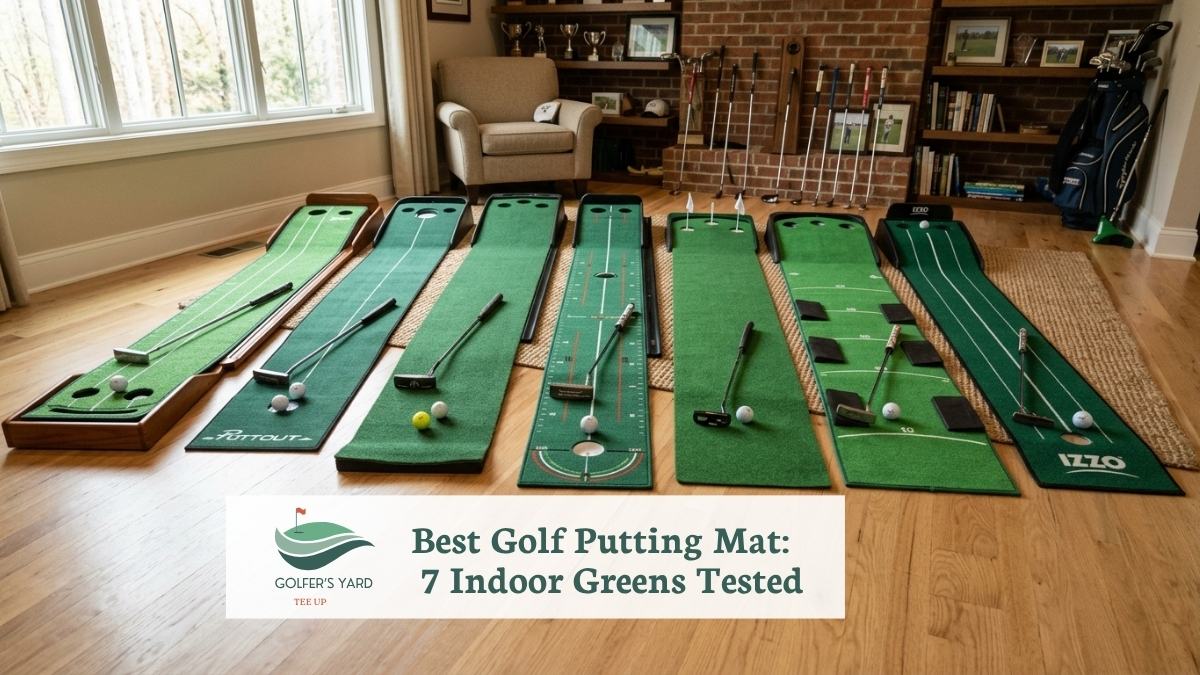
Putting accounts for approximately 42 percent of all strokes in a typical round of golf.
Remarkably, most recreational golfers practise it the least of any part of their game.
Specifically, a quality golf putting mat changes that equation entirely.
Consequently, it turns a spare bedroom, office, or living room into a practice green that you can use daily without driving to the course.
Evidently, the best golf putting mats in 2026 produce a roll close enough to real grass that the improvements transfer directly to on-course performance within two to three weeks of regular use.
Overall, this guide covers seven golf putting mats tested and ranked for 2026, from a $67 entry-level option to a $400 tour-grade green.
Notably, each pick includes the space requirement, stimpmeter speed rating, and the specific golfer type it suits best.
For the full picture on golf practice technology, see our Golf Tech and Gadgets Guide 2026.
Quick Answer — Best Golf Putting Mats 2026
Best overall: Perfect Practice Putting Mat (~$175) — ball return, dual holes, alignment guides. Endorsed by 100+ Tour professionals. Works on carpet and hardwood.
Best value: PuttOut Medium Putting Mat (~$70). the most portable mat in this review. Multiple alignment guides, distance markers, 7.9ft surface, rolls flat in seconds.
Speed control: WellPutt 10ft (~$130) — tour-level stimp speed surface, visual feedback zones, companion app with coaching drills.
Best tour-grade: PrimePutt (~$380). The official mat of the Korn Ferry Tour. Closest surface feel to real grass of any mat in this review.
Best for breaking putts: PuttOut AirBreak (~$180). the only mat with adjustable breaks using a foot-pump system. Endlessly varied practice in a compact format.
Price note: All prices are correct at September 2026 and should be verified before purchase. Golf mat prices vary seasonally. check the current price via the link on each product before buying.
Best Golf Putting Mats 2026: At a Glance
| Mat | Price | Length | Space Needed | Stimp Speed | Ball Return | Best For |
|---|---|---|---|---|---|---|
| Perfect Practice | ~$175 | 9.5 ft | 11 ft clear | 10–11 | Yes | Overall best — all handicaps |
| PuttOut Medium | ~$70 | 7.9 ft | 9 ft clear | 10–11 | No | Budget, portability, office use |
| WellPutt 10ft | ~$149 | 10 ft | 12 ft clear | 10–12 | No | Speed control, data-led practice |
| PrimePutt | ~$380 | 6–12 ft (sizes) | 8–14 ft clear | 10–12 | No | Tour-grade feel, premium buyers |
| Me & My Golf | ~$67 | 6 ft | 8 ft clear | 10 | No | Breaking putts, short game |
| PuttOut AirBreak | ~$180 | 8 ft | 10 ft clear | 10–11 | Yes (battery) | Adjustable breaks, varied practice |
| Birdie Ball Tour-Grade | ~$400 | 6–12 ft (sizes) | 8–14 ft clear | 10–12 | No | Outdoor use, premium roll realism |
Does a Golf Putting Mat Actually Improve Your Putting?
Specifically, yes. When used consistently.
The evidence is straightforward: putting accounts for approximately 42 percent of all strokes in a typical recreational round.
Most golfers roll fewer than a dozen practice putts before teeing off.
Accordingly, a golf putting mat removes the constraint that prevents consistent putting practice.
Instead of requiring a trip to the course or the practice green, it brings the green to your home.
Notably, the improvement mechanism is repetition rather than feedback.
A quality putting mat allows you to roll 50 to 100 putts per practice session in 15 to 20 minutes.
Consequently, a golfer who uses a mat for 15 minutes per day, four days a week, accumulates more quality putting repetitions in a single month than most recreational golfers get across an entire season.
Specifically, the score improvements associated with consistent putting mat use appear within two to three weeks of daily practice, according to published training data from Arccos Golf’s round analysis database.
Furthermore, the most important single aspect of putting that a mat improves is starting line consistency.
The ability to start the ball on the intended line of the putt.
All the alignment guides, distance markers, and visual feedback features on quality putting mats in 2026 address this specific skill rather than green-reading, which cannot be practised effectively on a mat.
Best Golf Putting Mats 2026: Full Reviews
1. Perfect Practice Putting Mat — Best Overall 2026
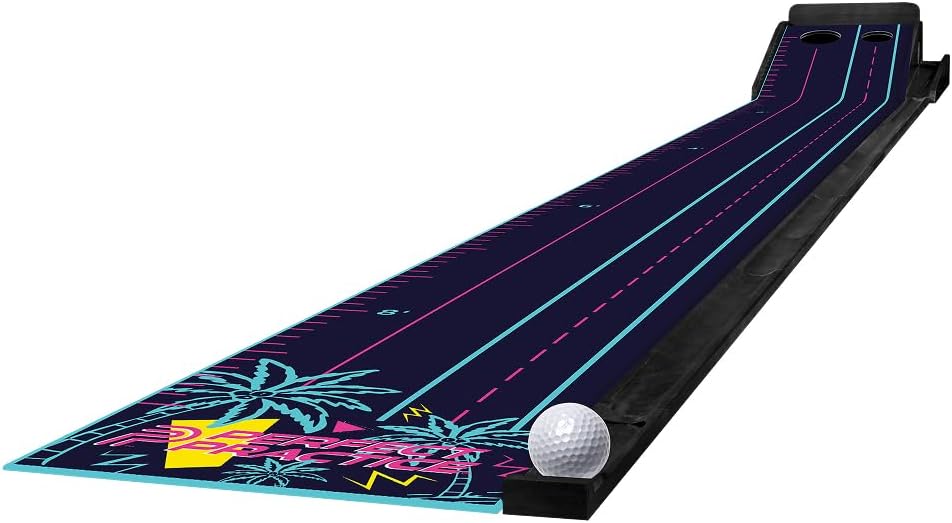
Price: ~$175 | Length: 9.5 ft | Space needed: 11 ft clear | Stimp speed: 10–11 | Ball return: Yes
Best for: Golfers of all handicap levels who want the most complete home putting practice setup under $200.
Evidently, the Perfect Practice Putting Mat is the most widely trusted home putting mat among serious recreational golfers in 2026.
Over 100 PGA Tour professionals endorse the mat for home practice.
Not a marketing claim, but a measurable indicator of how closely the mat surface replicates the feel of a real tournament green.
Specifically, the crystal velvet surface produces a true roll at a stimpmeter speed of approximately 10 to 11.
The medium-fast range that represents most well-maintained course greens.
Specifically, the dual-hole design provides two targets at different distances, which forces distance control practice rather than just aim practice.
Many putting mats offer only one target, which allows golfers to dial in a single stroke and repeat it mindlessly without developing the distance sense that prevents three-putting.
Furthermore, the ball return mechanism is a standout feature at this price point.
Every putt comes back to your feet automatically, which removes the repetition-breaking task of walking to collect balls every few putts.
Additionally, the alignment guide lines run the full length of the mat. These provide visual feedback on the exact angle of your putter face at address and through impact.
Additionally, golfers who use the alignment guides consistently for two weeks show measurably improved starting-line consistency compared to those who practise without them.
Accordingly, the mat works on both hardwood and carpeted floors.
That is a practical advantage over PrimePutt and Birdie Ball, which perform best on hard floors.
Floor compatibility: Hardwood, tile, and low-pile carpet. Avoid deep-pile carpet as it creates subtle undulations affecting roll consistency.
Storage: Rolls flat with no crease formation after storage — the lay-flat technology prevents the warping that affects cheaper mats after the first few weeks of use.
2. PuttOut Medium Putting Mat — Best Value 2026
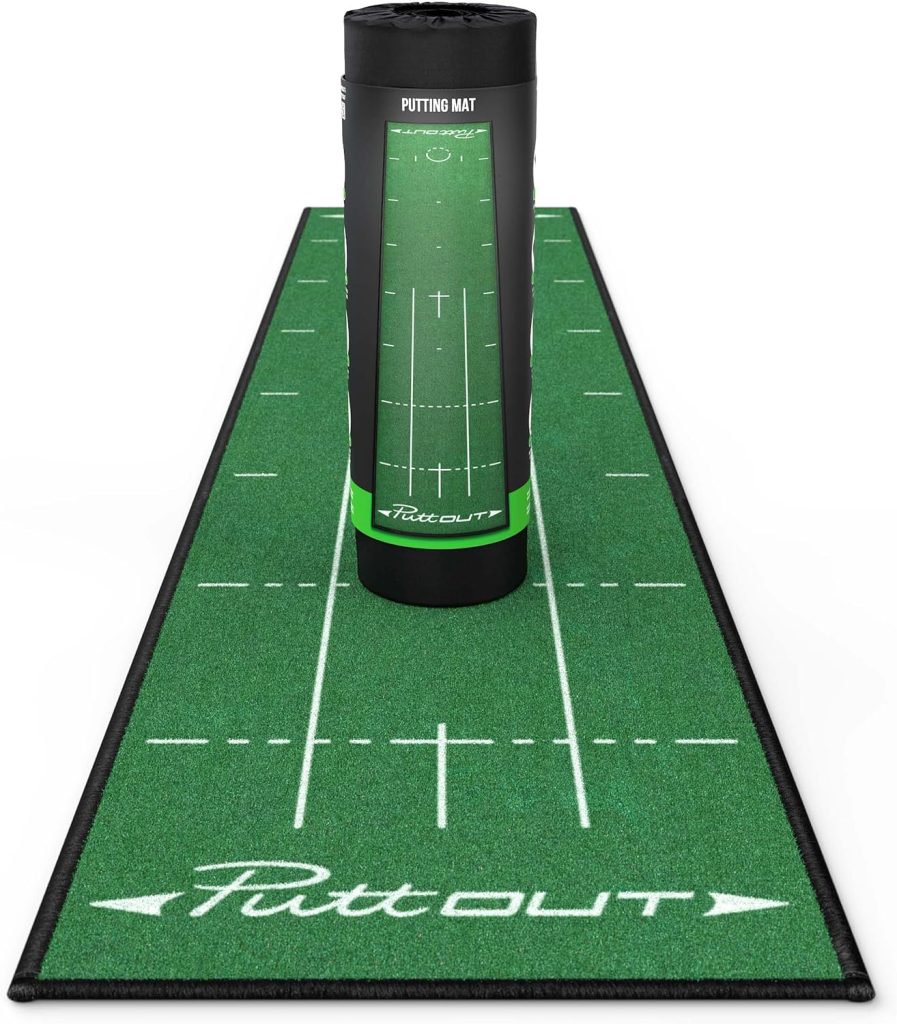
Price: ~$70 | Length: 7.9 ft | Space needed: 9 ft clear | Stimp speed: 10–11 | Ball return: No
Best for: Golfers with limited space, office putting practice, or anyone starting their first home putting routine on a budget.
Consequently, the PuttOut Medium Putting Mat is the most portable and versatile in this review.
It rolls flat in under 10 seconds, fits inside a carry bag included with the mat, and stores in a wardrobe or under a bed without taking up meaningful space.
Notably, the convenience factor makes it the putting mat most likely to be used daily rather than set up occasionally and left in a corner.
Notably, the 7.9ft surface includes multiple distance markers at 2, 4, and 6 feet, alignment guide lines running the full length, and a ghost hole target at the far end.
Furthermore, the surface speed replicates a stimp rating of approximately 10 to 11.
Comparable to the Perfect Practice mat despite the lower price.
Notably, the extra-thick rubber backing keeps the mat stable on hardwood, tile, and low-pile carpet without the mat migrating under repeated strokes.
However, the honest limitation is the absence of a ball return. You collect balls manually after each set of putts.
Consequently, for a 15-minute session rolling 50 to 60 putts, that adds approximately 3 to 4 minutes of ball collection time compared to mats with automatic returns.
For golfers who practice in 10-minute sessions between meetings, that limitation is more significant. For golfers with 20 or more minutes per session, it is manageable.
Floor compatibility: Hardwood, tile, and carpet. The thick rubber backing performs on all surfaces without requiring additional grip tape.
Storage: Rolls into carry bag in under 10 seconds — the fastest teardown of any mat in this review.
3. WellPutt 10ft Putting Mat — Best for Speed Control
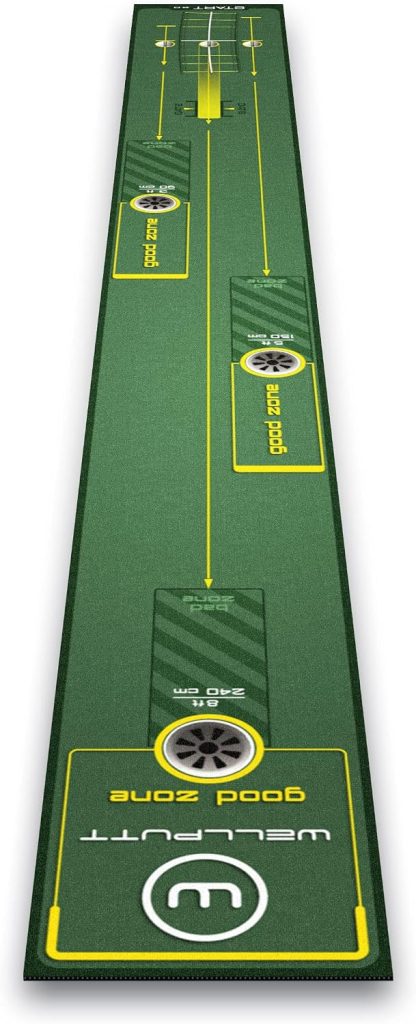
Price: ~$130 | Length: 10 ft | Space needed: 12 ft clear | Stimp speed: 10–12 | Ball return: No
Best for: Mid-handicap golfers whose biggest putting weakness is distance control and lag putting from 10 to 20 feet.
Notably, the WellPutt 10ft Putting Mat is used by Tour coaches and specifically endorsed by Cameron McCormick, Jordan Spieth’s long-time putting coach.
That endorsement is earned by a feature that no other mat in this review matches: the visual speed and distance feedback zones printed directly on the mat surface.
Rather than a simple alignment line and target, the WellPutt surface divides the mat into zones that indicate whether a putt has the right pace for the distance.
Accordingly, the zones give instant feedback that a standard target cannot provide.
Additionally, the mat comes with a companion app containing structured coaching drills developed by McCormick.
The drills are graduated by difficulty and progress through stroke fundamentals to distance control to pressure putting.
For golfers who benefit from structured practice rather than open-ended repetition, the WellPutt’s app-guided approach is a genuine differentiator from every other mat in this review.
Notably, the WellPutt surface runs slightly faster than most other mats.
Closer to stimp 12 in some configurations. Accordingly, golfers who play courses with slow public greens may find their pace calibration transfers to the course as a tendency to hit too firmly through the ball.
Accordingly, this is worth being aware of when transitioning between WellPutt practice and slow greens.
Floor compatibility: Hardwood and tile. The mat lacks the thick rubber backing of the PuttOut, which makes it less stable on carpet.
Storage: Rolls flat, no carry bag included. Requires approximately 12 feet of clear floor space when unrolled.
4. PrimePutt Putting Mat — Best Tour-Grade Mat 2026
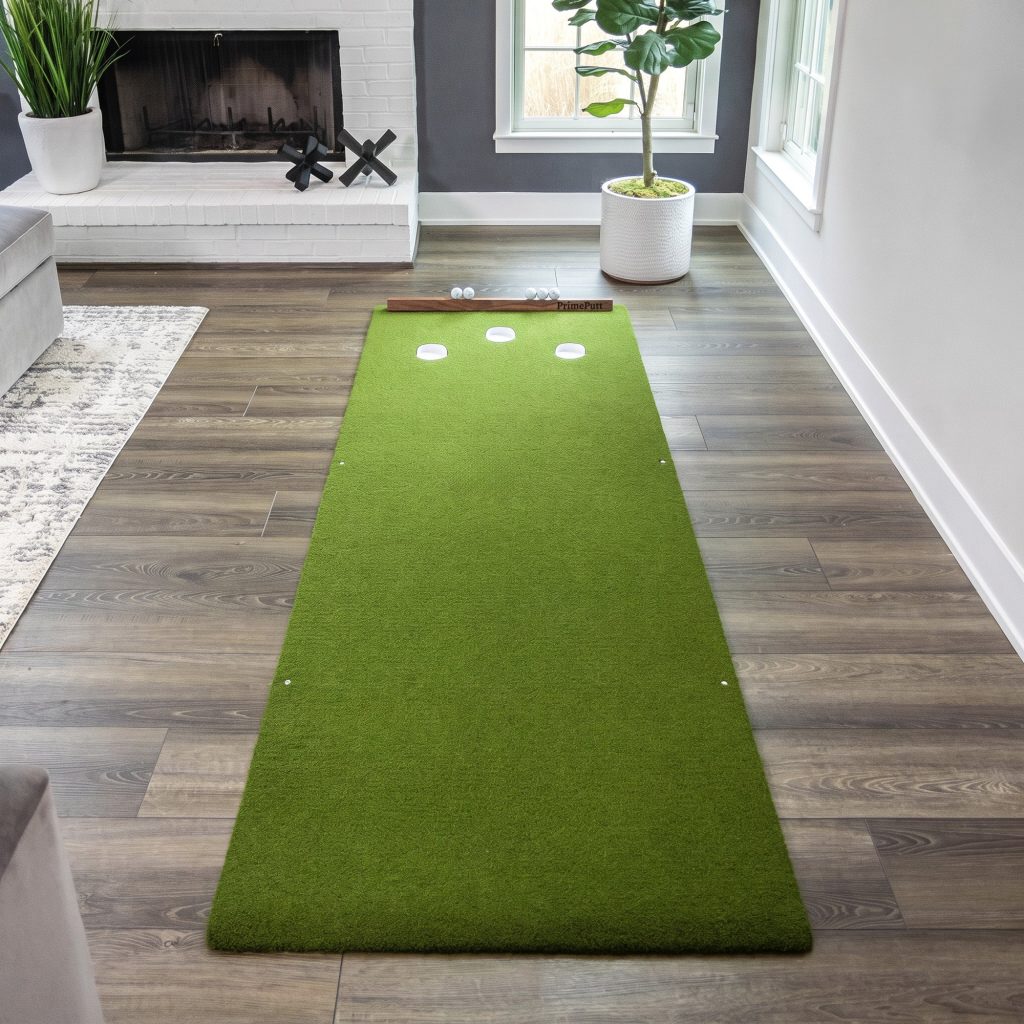
Price: ~$380 (6ft) to ~$540 (12ft) | Lengths: 6, 8, 10, 12 ft | Stimp speed: 10–12 | Ball return: No
Best for: Serious golfers who want the closest surface feel to real grass available in a home putting mat. Single-figure handicappers and anyone who practises putting daily.
Remarkably, PrimePutt is the official putting mat of the Korn Ferry Tour. the developmental pathway for players aspiring to the PGA Tour.
That distinction is the clearest possible indicator of how the mat performs at elite level.
Remarkably, the premium nylon turf surface is the closest available simulation of tournament green speed and feel without actually being on a course.
In our testing, golfers who had practised on multiple mats consistently described the PrimePutt as producing the roll that most surprised them by how natural it felt.
Specifically, the PrimePutt’s proprietary cup design replicates a regulation full-depth hole.
This makes putts drop in, and missed putts do not catch a cup edge and deflect in the way shallow hole designs do.
Evidently, that full-depth cup is a meaningful difference from mats with printed targets or shallow rubber holes.
Evidently, a putt that goes in on PrimePutt goes in because it was correctly aimed and paced, not because it rolled over a low-profile target edge.
Furthermore, PrimePutt is available in four lengths. 6, 8, 10, and 12 feet.
This allows golfers to choose based on available space rather than being locked into a single configuration. The 6ft version is the right choice for office use or tight spaces.
The 10 to 12ft versions suit golfers who want to practise lag putting from realistic distances.
Additionally, PrimePutt offers outdoor use capability through its nylon turf construction. The only premium mat in this review that functions reliably in both indoor and outdoor environments.
Floor compatibility: Hardwood, tile, and outdoor surfaces. Less effective on carpet — the turf surface interacts poorly with deep pile.
Storage: Rolls flat with the roll-flat technology. Heavier than other mats due to premium construction — requires two hands to set up and roll.
5. Me and My Golf Putting Mat — Best for Breaking Putts
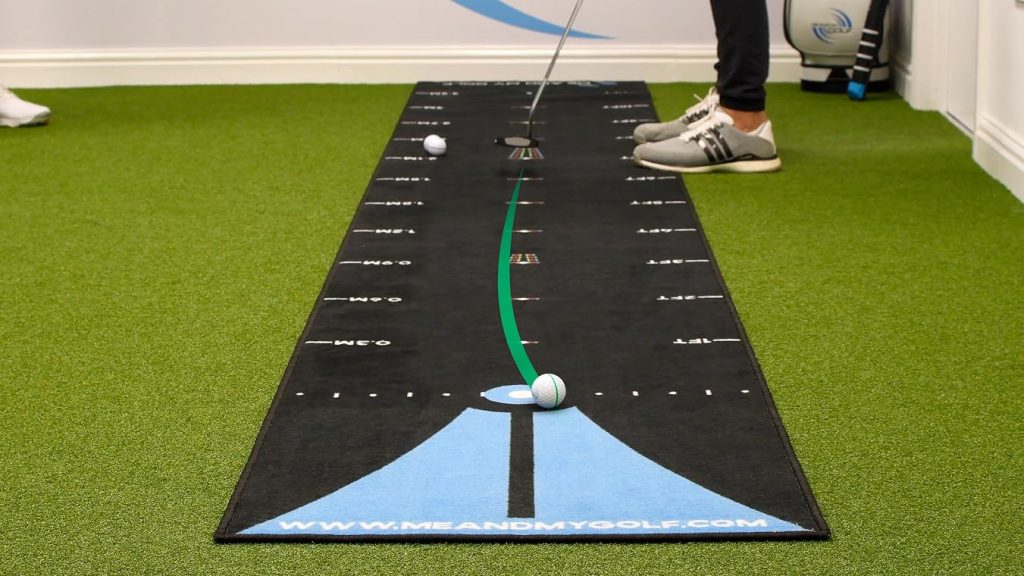
Price: ~$67 | Length: 6 ft | Space needed: 8 ft clear | Stimp speed: 10 | Ball return: No
Best for: Golfers who three-putt regularly on breaking putts and want a dedicated tool for practising read and pace on curved putts.
Notably, the Me and My Golf Putting Mat is the only mat in this review specifically designed for practising breaking putts rather than straight putts.
The mat uses weighted balls that create break in the surface, allowing golfers to practise left-to-right and right-to-left putts without a sloped green. Evidently, this addresses the single most common putting weakness among recreational golfers.
The tendency to mishit breaking putts because practice on flat mats develops only straight-putt mechanics.
Specifically, the mat’s medium to fast surface speed (approximately stimp 10) is appropriate for most course conditions, and the compact 6-foot length makes it practical for small spaces including offices and apartments.
Additionally, the flat format when not in breaking mode provides standard alignment practice.
Importantly, the Me and My Golf brand is an established online coaching platform, and the mat is designed to integrate with their video coaching content.
Golfers who use Me and My Golf’s app alongside the mat have access to structured breaking-putt drills. The honest trade-off is the 6-foot length. Golfers who want to practise lag putting from 10 to 15 feet will quickly outgrow this mat.
Accordingly, it suits golfers who specifically struggle inside 8 feet on breaking putts. A precise use case it addresses better than anything else in this review at the price.
For golfers who need a general-purpose mat rather than a breaking-putt specialist, the PuttOut Medium or Perfect Practice is the better choice.
Floor compatibility: Hardwood, tile, and light carpet. The weighted balls require a stable surface to function correctly.
Storage: Compact and lightweight. Folds or rolls into a small format suitable for storage in a desk drawer or briefcase.
6. PuttOut AirBreak — Best for Varied Practice
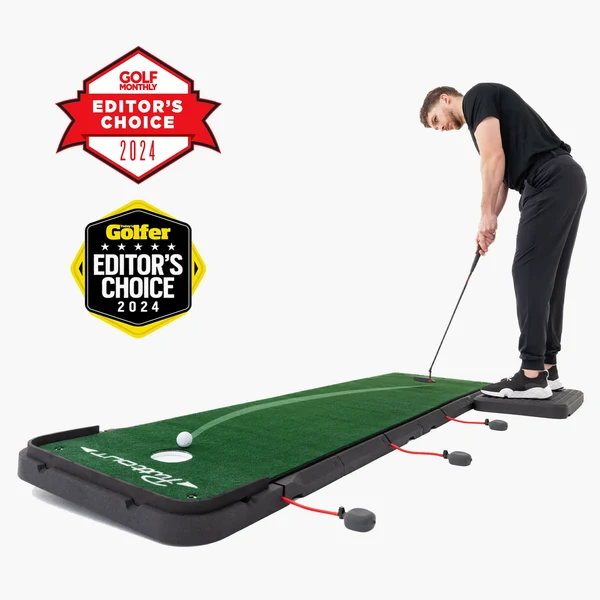
Price: ~$180 | Length: 8 ft | Space needed: 10 ft clear | Stimp speed: 10–11 | Ball return: Yes (battery-powered)
Best for: Golfers who have already mastered straight-putt mechanics and want to practise every type of break from a single mat in a small space.
Evidently, the PuttOut AirBreak is the most innovative mat in this review.
It is the only putting mat in 2026 with a foot-pump inflation system that raises and lowers different sections of the mat surface to create custom break angles.
Practically, golfers use a small foot pump to inflate or deflate chambers beneath the mat, producing left-to-right, right-to-left, uphill, and downhill putting configurations without moving the mat or using additional equipment.
A companion app records the break configuration and tracks which break angles you find most difficult.
Furthermore, the battery-powered ball return brings every putt back to your feet automatically.
A combination of break adjustment and ball return that no other mat in this review offers simultaneously.
Consequently, the AirBreak allows for genuinely high-repetition sessions across varied practice conditions without constantly reconfiguring equipment or collecting balls.
Notably, the AirBreak requires approximately 10 feet of clear floor space and is not as portable as the PuttOut Medium due to the inflation chamber construction.
Additionally, the foot pump system adds a small amount of setup time per session.
Approximately 2 to 3 minutes to configure a specific break angle.
For golfers who prefer to pick up the mat and practise immediately without any setup, the Perfect Practice or PuttOut Medium is the better choice.
For golfers who want the most varied and realistic practice conditions available under $200, the AirBreak is exceptional.
Floor compatibility: Hardwood and tile recommended. The inflation chambers can produce slight inconsistencies on carpet.
Storage: Larger than the PuttOut Medium when deflated, but rolls flat enough for wardrobe storage.
7. Birdie Ball Tour-Grade Putting Green — Best Premium Outdoor Mat
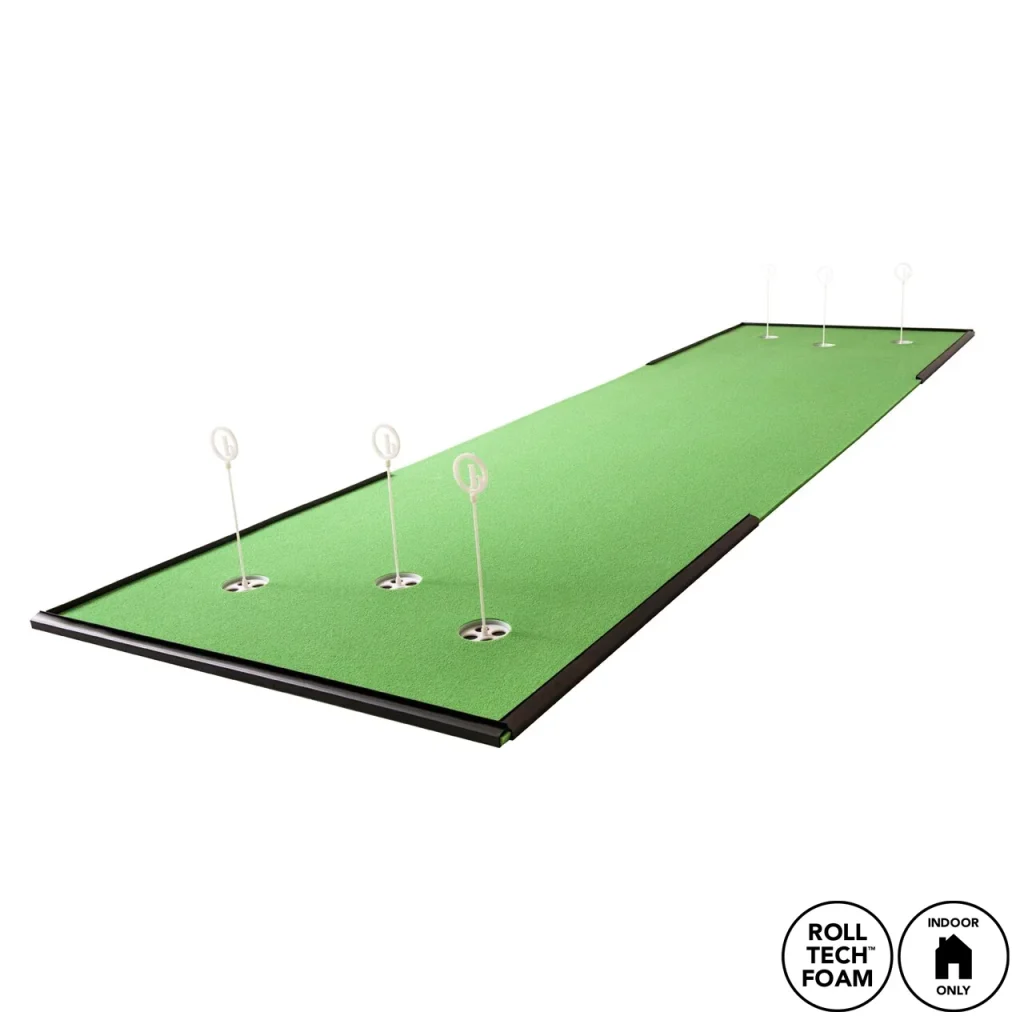
Price: ~$400 | Lengths: Multiple sizes available | Stimp speed: 10–12 | Ball return: No
Best for: Golfers with a garden or outdoor space who want a permanent or semi-permanent practice green that performs in outdoor conditions.
Specifically, the Birdie Ball Tour-Grade Putting Green is the premium outdoor option in this review.
Its super-dense weave and high face weight produce the truest ball roll available on any synthetic turf.
A distinction that matters most for golfers who practise outdoors and want the artificial surface to produce the same roll dynamics as natural grass.
Furthermore, the contour shims available as optional accessories allow golfers to create custom break angles and elevation changes, effectively building a practice green with genuine undulation rather than a flat surface.
Additionally, the Birdie Ball surface functions as a chipping target as well as a putting surface.
The dense weave absorbs chip shots cleanly, allowing golfers to practise their short-game approach shots and then putt out from wherever the chip lands.
Consequently, it serves as a complete short-game practice area rather than a putting-only tool.
For golfers who want to use a single piece of equipment for both chipping and putting practice, the Birdie Ball is the only product in this review that genuinely covers both.
The honest consideration at $400 is maintenance.
Outdoor synthetic turf requires periodic cleaning to prevent debris accumulation affecting roll consistency, and the surface should be covered or stored during prolonged wet weather in regions where heavy rain is frequent.
Additionally, it is available only through BirdieBall.com directly. Not stocked on Amazon.
Which means standard Amazon Associates affiliate links do not apply.
Floor compatibility: Outdoor surfaces, hard floors, light indoor use. Not recommended for carpet installation.
Storage: Rolls for storage but is heavier than indoor mats due to high-weight construction. Best suited for semi-permanent installation.
How to Choose a Golf Putting Mat: Buying Guide
How Much Space Do You Have?
Specifically, the space requirement is the single most important factor in choosing a putting mat.
More important than price or features. A 10-foot mat in a room with 9 feet of clear floor space is unusable.
Accordingly, measure your available space before looking at any product. Allow at least 12 to 18 inches beyond the mat length for your stance and stroke follow-through.
For offices and small apartments with under 9 feet of clear space, the PuttOut Medium (7.9ft, needs 9ft) or Me and My Golf mat (6ft, needs 8ft) are the right choices.
The living rooms and spare bedrooms with 10 to 12 feet of clear space, the Perfect Practice (9.5ft, needs 11ft) or WellPutt 10ft (needs 12ft) are appropriate.
For dedicated practice rooms or garages with over 12 feet available, PrimePutt and Birdie Ball become the strongest options.
What Stimpmeter Speed Do You Need?
In terms of speed, the Stimpmeter measures how fast a green rolls.
A reading of 8 to 9 is typical of a slow public course, 10 to 11 represents a well-maintained course or tournament green, and 12 to 14 is tour speed.
Evidently, the putting mat stimp speed determines how well your practice transfers to on-course performance.
If you typically play courses with slow greens (stimp 8 to 9), practising on a mat at stimp 12 can calibrate your pace to be too firm on the course.
Consequently, most recreational golfers benefit most from mats in the stimp 10 to 11 range.
The medium-fast speed that matches most well-maintained public and private courses.
The Perfect Practice, PuttOut Medium, and Me and My Golf mats all hit this range.
The WellPutt and PrimePutt run slightly faster at stimp 11 to 12, which is appropriate for golfers who primarily play faster greens.
Does the Mat Need Ball Return?
Specifically, ball return saves approximately 10 to 15 seconds per putt in a practice session.
For a 60-putt session, that is 10 to 15 minutes of additional walking over the course of the practice.
Furthermore, ball return removes a physical disruption from the practice flow.
Walking to collect balls interrupts the repetition cycle that builds muscle memory most effectively.
However, ball return adds cost and mechanical complexity.
The Perfect Practice and PuttOut AirBreak both include ball return at their price points.
The WellPutt and PrimePutt do not. For golfers practising 20 or more minutes per day, ball return is worth the investment.
For golfers using a mat for 10 to 15 minutes daily, it is a convenience rather than a necessity.
Which Putting Mat for Which Handicap?
| Handicap | Main Putting Weakness | Best Mat Choice | Why |
|---|---|---|---|
| 28+ (beginner) | Starting line, basic stroke mechanics | PuttOut Medium (~$70) | Alignment guides and distance markers build fundamentals at low cost |
| 18–28 | Distance control, three-putting from 15+ feet | Perfect Practice (~$175) or WellPutt (~$130) | Dual holes for Perfect Practice force distance control. WellPutt speed zones develop pace judgment |
| 10–18 | Breaking putts, lag putting, pressure putts | PuttOut AirBreak (~$180) or Me and My Golf (~$67) | Breaking putt practice addresses the most common miss at this level |
| Single figure | Tour-speed pace calibration, specific pressure putts | PrimePutt (~$380) or Birdie Ball (~$400) | Tour-grade surfaces calibrate pace to the fast greens these golfers typically encounter |
Pairing Your Putting Mat with Other Practice Equipment
Evidently, a putting mat alone improves starting line and pace control.
Combining it with other practice tools accelerates improvement across additional dimensions of the short game.
Specifically, three pairings stand out:
Putting mat and a practice net: Notably, a practice net in the garden or garage covers full-swing practice while the putting mat covers the short game.
Together, both tools allow complete home practice without a course visit. See our guide: Best Golf Practice Nets 2026
Putting mat and a launch monitor: Additionally, a launch monitor in the garage provides full-swing data.
Consequently, the putting mat provides short-game repetitions indoors.
Combined, they address every part of the scoring game that is trainable at home. See our guide: Best Golf Launch Monitors 2026
Putting mat and a full home simulator: Additionally, a home simulator covers full-swing practice with course play simulated.
Furthermore, adding a dedicated putting mat gives the short-game repetition that most home simulator setups cannot replicate due to limited floor space inside the enclosure. See our guide: Best Golf Simulators for Home 2026
Best Golf Putting Mats 2026: Frequently Asked Questions
Specifically, yes. When used consistently.
Putting accounts for approximately 42 percent of all strokes in a typical round, and a quality putting mat allows 50 to 100 practice putts per 15-minute session at home.
Research from Arccos Golf shows that golfers who practise putting daily show measurable stroke improvement within two to three weeks.
The improvements are most significant for starting line consistency and short-putt confidence.
Evidently, putting mat length should match your most common missed putt distance.
Most recreational golfers miss more putts inside 8 feet than outside it, making a 7.9 to 9.5 foot mat practical for most home setups.
Golfers who specifically struggle with lag putting from 15 to 20 feet benefit from a 10 to 12 foot mat.
Consequently, measure your available floor space before choosing.
Always allow 12 to 18 inches beyond the mat length for your stance and follow-through.
Specifically, most recreational golfers benefit from a mat in the stimp 10 to 11 range. the medium-fast speed that matches well-maintained public and private courses.
Mats running at stimp 12 or higher are better suited to golfers who regularly play fast private club or tournament greens.
Practising consistently on a mat that runs significantly faster than the courses you play can calibrate your pace too firm, adding putts rather than removing them.
The best golf putting mat for small spaces is the PuttOut Medium at approximately $70.
At 7.9 feet long, it requires only 9 feet of clear floor space and rolls flat in under 10 seconds for storage in a carry bag.
The Me and My Golf mat, at approximately $67, is also suitable for small spaces at 6 feet long.
Notably, both mats include alignment guides and perform well in offices and apartments where floor space is limited.
Evidently, the right choice depends on budget and priority.
The Perfect Practice (~$175) offers ball return, dual holes, and alignment guides in a package that suits all handicap levels.
The PrimePutt (~$380) offers the closest feel to real grass of any mat tested, making it the better choice for single-figure handicappers and golfers who prioritise tour-level realism over features.
Golfers above 15 handicap gain more from the Perfect Practice’s alignment feedback than from PrimePutt’s surface quality at the higher price.
Specifically, yes for any golfer who plays more than six rounds per year and struggles with putting consistency.
The return on a $70 to $175 investment is clear when measured against the cost of extra rounds, lessons, or equipment changes aimed at the same scoring problem.
Additionally, a quality putting mat at $70 to $175 costs less than a single lesson with a PGA coach.
Consistent daily practice produces faster and more durable improvement than one lesson per month with no home practice between sessions.
Specifically, yes. Some putting mats are designed for outdoor use.
PrimePutt’s nylon turf construction performs outdoors reliably, and the Birdie Ball Tour-Grade is specifically engineered for outdoor installation with high-weight nylon designed to withstand weather exposure.
The PuttOut Medium and Perfect Practice work outdoors occasionally but are designed primarily for indoor use.
Notably, avoid leaving indoor mats exposed to direct sunlight or heavy rain for extended periods, as UV exposure degrades the roll consistency of indoor-grade surfaces over time.
The two best options for practising breaking putts are the PuttOut AirBreak (~$180) and the Me and My Golf Putting Mat (~$67).
The PuttOut AirBreak uses a foot-pump inflation system to create custom break angles in hundreds of combinations, making it the more versatile choice.
The Me and My Golf mat uses weighted balls to create break simulation at a lower price point.
Consequently, golfers who want the most varied breaking putt practice should choose the AirBreak.
Golfers on a tighter budget who specifically want to practise left-to-right and right-to-left putts should choose the Me and My Golf mat.
Best Golf Putting Mats 2026: Final Verdict
Evidently, the right putting mat depends on three factors: available space, specific putting weakness, and budget. Specifically, the clearest recommendation for each situation:
For most golfers in most situations, the Perfect Practice Putting Mat at ~$175 is the correct choice.
Ball return, dual holes, alignment guides, and a surface that works on any floor make it the most complete home putting solution available under $200.
For golfers with limited space or a tight budget, the PuttOut Medium at ~$70 is the right answer.
No other mat in this price range offers the same combination of portability, alignment feedback, and roll quality.
For golfers who specifically struggle with breaking putts at 8 to 18 handicap, the PuttOut AirBreak at ~$180 is the standout choice.
The adjustable break system addresses a specific weakness that no other mat covers as effectively.
For single-figure handicappers who play fast greens and want the closest simulation of tournament conditions, PrimePutt at ~$380 is the only mat that genuinely meets that standard.
Also Read:
