



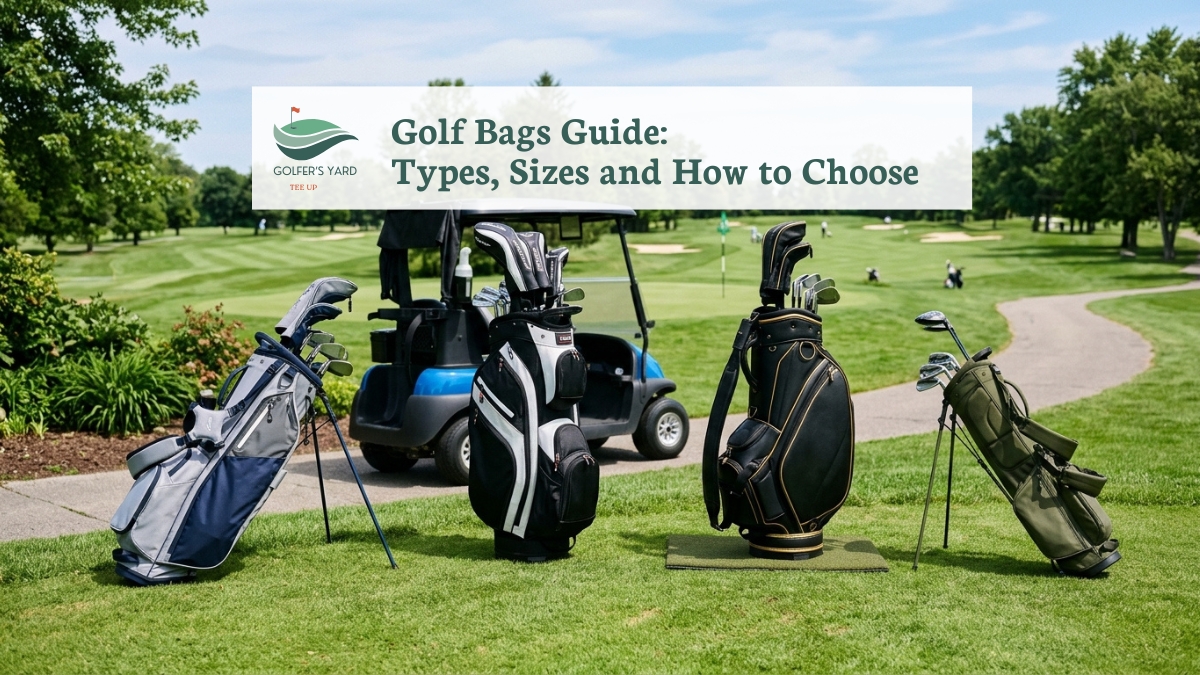
A golf bag holds your clubs, but the right one also shapes how your round feels. The best bag for you depends on whether you walk, push or ride.
Below, this guide explains every type of golf bag, how they differ and how to pick one. In addition, it shows you how to set up, organize and carry your bag properly.
Quick Answer: Which Golf Bag Do You Need?
You walk and carry: a stand bag, ideally under 5 lbs with a dual strap. See our best golf stand bags.
You ride a cart or use a push cart: a cart bag with a 14-way top and cart-friendly pockets. See our best golf cart bags.
You play quick nines or the range: choose a carry or Sunday bag that weighs about 2 to 3 lbs.
You do a bit of everything: a hybrid stand bag with a flat base and full-length dividers.
You are a woman choosing your first bag: start with our best women’s golf bags, which covers fit and weight.
The 6 Types of Golf Bags Explained
The six main types of golf bags are stand, cart, carry, hybrid, tour and travel bags. However, each one suits a different way of playing.
| Type | Typical weight | Top dividers | Best for |
|---|---|---|---|
| Stand bag | 2.9 to 6 lbs | 4 to 14-way | Walkers and push cart users |
| Cart bag | 5.5 to 8 lbs | 14 to 15-way | Golfers who ride or push |
| Carry or Sunday bag | 1.5 to 3 lbs | 1 to 4-way | Short rounds, par 3s and the range |
| Hybrid bag | 4 to 6 lbs | 14-way | Golfers who walk some days and ride others |
| Tour or staff bag | 10 lbs and up | 5 to 6-way | Caddies and tour professionals |
| Travel bag | 7 to 18 lbs | None | Flying with your clubs |
Stand Bags
A stand bag has two legs that flip out when you set it down. As a result, it stays upright on the fairway and keeps your grips off wet grass.
Most stand bags weigh between 3 and 5.5 lbs. In addition, they come with a dual strap that spreads the weight across both shoulders like a backpack.
Stand bags suit golfers who walk most rounds. However, many also sit well on a push cart or riding cart.
For tested picks, read our full guide to the best golf stand bags.
Cart Bags
A cart bag has no legs and a flat, stable base. Instead, it straps onto a riding cart or push cart.
Because weight matters less on a cart, these bags offer more storage. Typically, you get a 14-way or 15-way top, 9 to 14 pockets and an insulated cooler pocket.
The trade-off is weight and bulk. For that reason, a cart bag is awkward to carry for more than a few holes.
To compare models, see our best golf cart bags guide.
Carry and Sunday Bags
A carry bag, often called a Sunday or pencil bag, is the lightest option. Generally, it holds 6 to 8 clubs and weighs about 2 lbs.
These bags have one strap and few pockets. So they suit quick nine-hole rounds and range sessions rather than full 18-hole rounds.
In fact, a carry bag is the classic par 3 golf bag and golf range bag. It holds just the clubs you need for short holes.
Hybrid Bags
A hybrid bag mixes a stand bag’s legs with a cart bag’s organization. Specifically, most have a 14-way top, a flat base that sits flush on a cart and a dual strap.
On the negative side, hybrids weigh a little more than pure stand bags. Still, they are the most flexible choice if you walk on weekends and ride during the week.
Tour and Staff Bags
A golf staff bag, also called a tour bag, is the large bag you see on professional tours. Overall, it is heavy, roomy and made for caddies.
Typically, a staff bag weighs 10 lbs or more and has a 5 or 6-way top. It also carries the player’s name or brand logo.
For most amateurs, a staff bag is too heavy to walk with. On the other hand, it works on a cart if you want maximum storage and a classic look.
Travel Bags
A golf travel bag protects your clubs on flights. While soft cases are lighter and fold away, a hard case golf travel bag offers more protection.
Also, most golf travel bags now come with wheels. Look for a padded top, a stiff spine and room for shoes and a few layers.
Most US airlines count a golf travel bag as one checked bag, usually with a 50 lb limit. Therefore, weigh your bag before you pack extra gear inside.
Stand Bag vs Cart Bag: The Key Differences
A stand bag has fold-out legs and dual straps for walking. In contrast, a cart bag has a flat base and more pockets for riding.
| Feature | Stand bag | Cart bag |
|---|---|---|
| Legs | Yes, fold out when set down | No |
| Weight | 2.9 to 6 lbs | 5.5 to 8 lbs |
| Straps | Dual backpack strap | Single handle or strap |
| Top | Usually 4 to 14-way | Usually 14 to 15-way |
| Pockets | 6 to 11 | 8 to 14 |
| Works on a push cart | Yes, if the base is flat | Yes, built for it |
| Comfortable to carry 18 holes | Yes | No |
If you carry even half your rounds, buy a stand bag. Otherwise, a cart bag gives you more storage and easier pocket access from the seat.
How to Choose a Golf Bag: 7 Questions to Ask
Choosing a golf bag gets easier when you answer a few simple questions first. Then, work through them in order.
1. Do You Walk, Push or Ride?
Above all, this decides the type. Walkers need a stand or carry bag, riders need a cart bag, and push cart users can choose either.
2. How Much Weight Can You Comfortably Carry?
For walkers, an empty bag under 4 lbs feels light over 18 holes. Once you add 14 clubs, balls and water, most bags weigh 18 to 30 lbs.
Every extra pound of bag weight adds up over four or five miles of walking. That is why lightweight golf bags are popular with walkers and seniors.
3. Do You Need a 4-Way or 14-Way Top?
A 14-way top gives every club its own slot. In contrast, a 4-way top groups clubs together and keeps the bag lighter.
Later, the dividers section explains this fully.
4. Will It Sit Securely on a Push Cart?
Look for a flat, molded base and a cart strap pass-through. Without these, the bag twists on the cart and blocks the bottom pockets.
5. How Many Pockets Do You Really Use?
Most golfers use five or six pockets every round. Beyond that, extra pockets add weight unless you ride and want a cooler pocket.
6. How Much Rain Do You Play In?
Waterproof bags use sealed seams and zippers. By comparison, water-resistant golf bags shed light showers but soak through in steady rain.
Either way, a good rain hood helps. Most bags include one, and you can buy a separate golf bag rain cover if yours is lost.
7. What Is Your Budget?
Good stand and cart bags start around $140. Meanwhile, premium models with lighter fabrics and better straps cost $250 to $350, and luxury bags go higher.
Golf Bag Dividers: 4-Way vs 14-Way vs 15-Way
The top of a golf bag is split into sections called dividers. As a result, they protect your shafts and stop grips from tangling.
- 4-way or 5-way top: clubs share sections, usually woods, mid irons, short irons and wedges. It is lighter and quicker to pull clubs from.
- 8-way top: a middle option that separates more clubs without much extra weight.
- 14-way top: one slot per club. Also, it makes a missing club obvious at a glance.
- 15-way top: 14 slots plus a dedicated putter well, common on cart bags.
Full-length dividers matter as much as the number. Specifically, they run the full length of the bag, so grips never snag on each other.
Be aware that many full-length dividers stop an inch or two above the base. So grips can still touch at the very bottom.
If you carry a full set of 14 clubs, a 14-way top keeps things tidy. However, if you walk and want the lightest bag, a 4-way top is the better trade.
Golf Bag Materials: Nylon, Polyester and Leather
Most golf bags use nylon or polyester. Both are light, tough and shed light rain.
- Nylon: strong and abrasion resistant, common on stand bags.
- Polyester: cheaper and holds color well, common on budget and cart bags.
- Waterproof fabrics: coated fabrics with sealed seams, used on rain-ready bags.
- Leather and synthetic leather: premium and classic, but heavier and higher maintenance.
For walking, choose nylon or polyester to keep weight down. On the other hand, leather suits riders who want a classic look.
Golf Bag Sizes and Dimensions
Most golf bags stand between 34 and 36 inches tall. Meanwhile, the top opening usually measures 8 to 10 inches across.
| Bag type | Height | Top opening | Empty weight |
|---|---|---|---|
| Carry or Sunday bag | 31 to 34 in | 4 to 6 in | 1.5 to 3 lbs |
| Stand bag | 34 to 36 in | 7 to 9 in | 2.9 to 6 lbs |
| Cart bag | 35 to 36 in | 9 to 10 in | 5.5 to 8 lbs |
| Tour or staff bag | 36 to 38 in | 9 to 11 in | 10 lbs and up |
Bag size matters if you drive a small car or store your bag in a locker. Also check that your driver fits, since some long drivers sit high in short carry bags.
How Many Clubs Can You Carry in a Golf Bag?
The Rules of Golf allow a maximum of 14 clubs in your bag during a round. You can carry fewer, but never more.
That limit is why 14-way tops exist. For a full breakdown, read our guide to how many golf clubs are in a golf bag.
How Much Does a Golf Bag Weigh?
Most empty golf bags weigh 3 to 8 lbs. Loaded with 14 clubs, they weigh 18 to 30 lbs.
The type of bag makes the biggest difference.
| Bag type | Empty weight | Loaded with 14 clubs |
|---|---|---|
| Carry or Sunday bag | 1.5 to 3 lbs | 10 to 15 lbs (6 to 8 clubs) |
| Lightweight stand bag | 2.9 to 4 lbs | 18 to 24 lbs |
| Standard stand bag | 4 to 6 lbs | 20 to 26 lbs |
| Cart bag | 5.5 to 8 lbs | 22 to 30 lbs |
| Tour or staff bag | 10 lbs and up | 30 lbs and up |
Clubs alone weigh about 10 to 14 lbs for a full set. Therefore, balls, water and layers often add more weight than the bag itself.
How to Set Up and Organize a Golf Bag
A well-organized golf bag saves time on every shot. Equally important, it protects your clubs and stops you leaving a wedge behind.
How to Arrange Clubs in a 14-Way Golf Bag
On a 14-way bag, the top row sits nearest the strap handle and holds your longest clubs. Follow this order:
- Top row: driver, fairway woods and hybrids.
- Middle rows: long irons on one side and mid irons on the other.
- Bottom row: short irons and wedges, closest to you as you face the bag.
- Putter well: your putter, in its own full-length slot.
In other words, the clubs get shorter as you move to the row closest to you. As a result, every grip stays visible and easy to reach.
How to Arrange Clubs in a 4-Way Golf Bag
On a 4-way top, use one section for each group of clubs:
- Top section: driver, woods and hybrids.
- Left middle: long and mid irons.
- Right middle: short irons.
- Bottom section: wedges and putter.
For instance, keeping wedges together in the bottom section means you grab them quickly around the green.
How to Set Up a 5, 6, 7 or 8-Way Golf Bag
The same rule applies to any divider count: longest clubs at the top, shortest nearest you. For example, here is how to fill each layout:
- 5-way: woods and hybrids, long irons, mid irons, short irons, then wedges and putter.
- 6-way: add a separate putter slot to the 5-way layout.
- 7-way: give the driver its own slot, then follow the 6-way layout.
- 8-way: split wedges from short irons, and keep a full-length putter well.
Golf Bag Organizers
A golf bag organizer is a divider insert that adds slots to a 4-way or 5-way bag. It costs far less than a new bag.
Also, it stops grips tangling in older bags with worn dividers. Just check the insert matches your bag’s top diameter before you buy.
How to Organize Your Golf Bag Pockets
Pockets work best when every item has one home. For example, most golfers can follow this simple layout:
- Ball pocket: a dozen balls and a ball marker.
- Valuables pocket: phone, keys and wallet, ideally velour-lined.
- Rangefinder pocket: your rangefinder or GPS, near the top for quick access.
- Apparel pocket: a rain jacket and a spare layer.
- Accessory pocket: tees, divot tool, spare glove and sunscreen.
Similarly, clear out old scorecards, broken tees and extra balls every month. An overloaded bag quickly adds three or four pounds.
How to Put a Golf Bag on a Push Cart or Riding Cart
First, place the bag on the cart with the top facing you as you push. Then, secure the bottom strap through the bag’s cart strap pass-through.
Next, tighten the top strap around the bag’s upper cuff. After that, check that the bottom pockets still open, then adjust the umbrella holder if you use one.
Generally, a stand bag sits best on a push cart when its legs lock closed and its base is flat. For more on carts themselves, see our guide to the best golf push carts.
On a riding cart, rest the bag on the rear platform with the club faces toward you. Then, loop the cart strap through the bag’s pass-through and buckle it tight.
Finally, check you can open the pockets you need from the seat. If the strap blocks them, slide it higher on the bag.
How to Carry a Golf Bag Properly
To begin with, wear a dual-strap stand bag like a backpack, with both straps at the same length. In fact, uneven straps are the most common cause of shoulder pain after a walking round.
- Shorten the straps so the bag sits high on your back, not low by your hips.
- Keep the bag’s top tilted slightly forward so clubs do not fall out.
- Use the hip pad, if your bag has one, to rest the weight on your hip.
- Lift with your legs when you pick up the bag, not with your back.
If your golf bag strap wears out, most brands sell replacement single and double straps. Likewise, replacement legs are available for many stand bags.
How to Clean a Golf Bag
Cleaning a golf bag takes about 20 minutes and makes it last longer. To begin with, empty every pocket and remove the clubs.
Next, vacuum out sand and grass from the pockets and the bottom of the bag. Then, wipe the outside with warm water and mild soap, using a soft brush on stains.
Finally, let the bag dry upright in the shade with every pocket open. However, avoid direct sun, since it fades fabric and weakens waterproof coatings.
How Long Does a Golf Bag Last?
A good golf bag lasts five to ten years with regular use. Usually, the straps, legs and zippers wear out before the fabric does.
Eventually, signs of a worn-out bag include broken stand legs, torn dividers and zips that no longer close. On the other hand, a worn strap alone is usually cheap to replace.
How Much Does a Golf Bag Cost?
Most quality golf bags cost $150 to $250 in 2026, and premium bags cost $250 to $350. In general, expect these prices:
| Price range | What you get |
|---|---|
| Under $150 | Basic stand or carry bags, 4-way tops, fewer pockets |
| $150 to $250 | Most quality stand and cart bags, 14-way tops on cart bags, dual straps |
| $250 to $350 | Premium fabrics, lighter weights, better straps and waterproofing |
| $350 and up | Luxury and tour-style bags with leather trim and personalization |
For most golfers, the $150 to $250 range offers the best value. Above that, you mostly pay for lighter weight and premium finishes.
Where to Compare Golf Bags by Type
We test and rank bags in depth on separate pages. In short, use the guide that matches how you play:
| If you… | Read this guide |
|---|---|
| Walk or use a push cart | Best golf stand bags |
| Ride a cart most rounds | Best golf cart bags |
| Want a bag built for women | Best women’s golf bags |
| Want our top pick in every category | Best golf bags |
How We Put This Guide Together
This guide draws on years of walking, pushing and riding with different golf bags. Over five years, our team has used more than 30 bags, from Sunday bags to cart bags.
In addition, we measured the bags we own and compared brand specifications. Prices reflect amazon.com listings checked on 10 November 2026.
Golf Bags: Frequently Asked Questions
The six main types are stand, cart, carry or Sunday, hybrid, tour and travel bags.
Stand bags suit walkers, while cart bags suit golfers who ride.
A stand bag has fold-out legs and dual straps for carrying.
In contrast, a cart bag has no legs, a flat base and more pockets for riding.
A 14-way golf bag is worth it if you carry a full set of clubs.
It gives each club its own slot, which protects shafts and stops grips tangling.
Put your driver, woods and hybrids at the top, nearest the handle.
Then place long and mid irons in the middle, and short irons and wedges at the bottom.
A standard golf bag is 34 to 36 inches tall with an 8 to 10 inch top opening.
Generally, stand bags are slimmer, while cart bags are wider.
Yes, most modern stand bags fit a push cart.
Even so, choose one with a flat base and a cart strap pass-through, so it does not twist.
Final Word: Choose the Type First, Then the Bag
Choose your golf bag type first, based on how you get round the course. While walkers should start with a light stand bag, riders get more from a cart bag.
Once you know your type, compare our tested picks for stand bags, cart bags and women’s golf bags. For the rest of your kit, explore our golf apparel and gear guide.
Also Read:

