



Walking is the best way to play. You read the course better, and your scores hold steadier.
Your body stays in the round rather than 40 yards off line on a cart path.
A good push cart, though, is what makes all of that sustainable across 18 holes.
Without a reliable cart, most players eventually revert to riding rather than walking.
The eight picks here also represent the best balance of price and performance currently available.
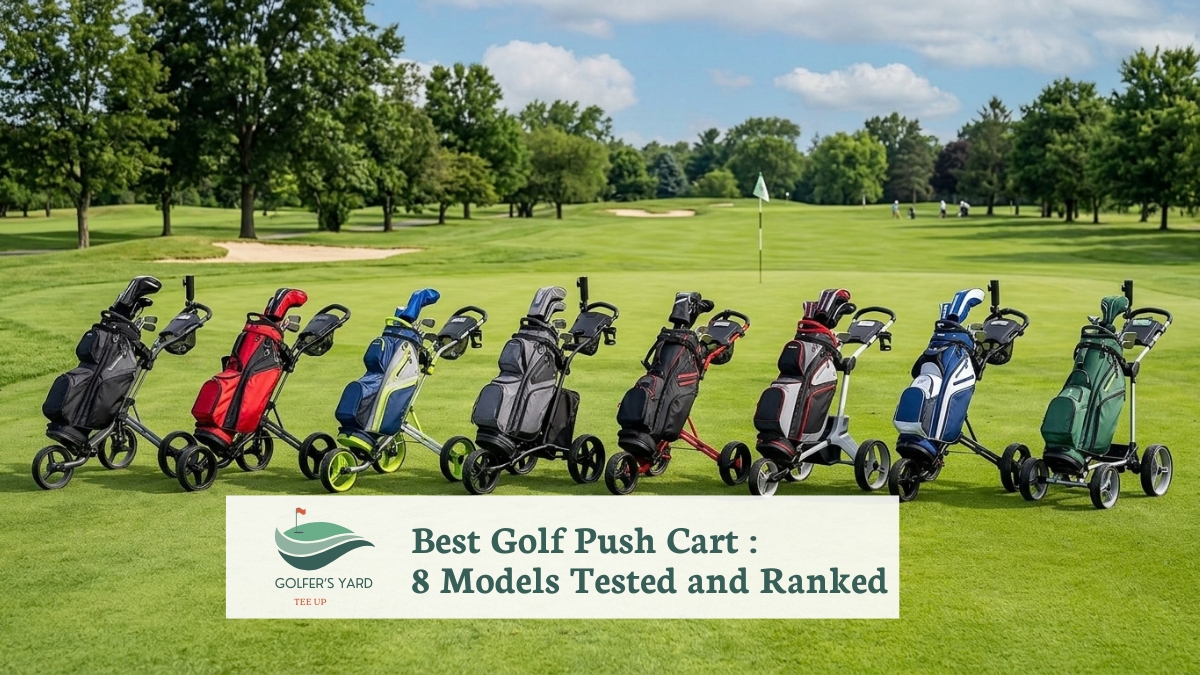
We tested eight models across hilly parkland, tight links layouts, and flat courses.
The assessment covered stability on side slopes, fold speed, mid-round storage access, and brake quality.
The differences between carts are, notably, more significant than the price gaps suggest.
Some carts in the same price bracket perform substantially better on specific course types.
Additionally, testing over multiple rounds revealed failures that a single-session test would miss entirely.
The eight picks below are worth your money in 2026. Each has been assessed across multiple rounds rather than a single session.
The conclusions here hold up in varied conditions, not just ideal ones.
We’ve also noted which cart suits which player type. The best overall pick isn’t necessarily the best for your course specifically.
Quick Answer: Best Golf Push Carts
The Clicgear Model 4.5 is the best golf push cart for most players in 2026.
At $339, it combines a rock-solid build, a fast single-step fold, and generous storage. Budget pick: CaddyTek EZ V8 at $149.
Premium choice: Stewart R1-S at $369 for those who want the best materials at a non-motorised price.
Quick Comparison: Best Golf Push Carts 2026
| Cart | Price | Weight | Wheels | Best For | Rating |
|---|---|---|---|---|---|
| Clicgear Model 4.5 | $339 | 18.5 lbs | 3-wheel | Best overall | 9.4/10 |
| CaddyTek EZ V8 | $149 | 15.9 lbs | 3-wheel | Best under $200 | 8.6/10 |
| Bag Boy Nitron | $279.95 | 14.7 lbs | 3-wheel | Lightest 3-wheel | 8.8/10 |
| Motocaddy QB2 | $199 | 15.2 lbs | 3-wheel | Most compact fold | 8.5/10 |
| Sun Mountain Speed Cart X | $299.99 | 17.8 lbs | 3-wheel | Best storage | 8.9/10 |
| Clicgear Rovic RV1S | $279 | 17.1 lbs | 3-wheel | Hilly courses | 8.7/10 |
| Big Max Autofold FF | $399 | 20.1 lbs | 4-wheel | Best 4-wheel | 8.9/10 |
| Stewart R1-S | $369 | 16.8 lbs | 3-wheel | Premium build | 9.1/10 |
Best Golf Push Carts 2026: Full Reviews
1. Clicgear Model 4.5, Best Overall Golf Push Cart

Verified Price: $339 at Amazon | Best For: All-round walking play | Weight: 18.5 lbs | Rating: 9.4/10
Ten-inch front wheels and 12-inch rear wheels give the Clicgear 4.5 a notably stable, wide platform. It tracks straight on flat fairways and holds firm on side slopes without fuss.
Frame rigidity also holds up well across uneven ground, which separates it from cheaper alternatives at this price level.
In testing, the one-step folding mechanism operated cleanly every time.
Push resistance was also low throughout, and the adjustable handle locked precisely at each height setting.
The handle range, furthermore, covers 34 to 44 inches, which accommodates shorter players and those over six feet alike.
Storage capacity is similarly strong. A central basket, cup holder, umbrella mount, and four accessory attachment points cover most setups without compromise.
What separates it from competitors is consistency.
Push carts at this price often compromise somewhere: a loose brake, a flimsy handle, or a bag strap that slips.
The Model 4.5, however, tightens every detail. That quality shows consistently across a full season of use.
It’s also, specifically, a cart that holds its resale value better than most competitors. At 18.5 lbs, lifting it into a boot with a full bag requires real effort.
Players with back concerns or a smaller vehicle should therefore compare it with the Bag Boy Nitron before committing.
That said, for most players on most courses, the Model 4.5 remains the most complete push cart at any price.
2. CaddyTek EZ V8, Best Golf Push Cart Under $200

Verified Price: $149 at Amazon | Best For: Budget-conscious walking play | Weight: 15.9 lbs | Rating: 8.6/10
At 15.9 lbs and $149, the CaddyTek EZ V8 is the lightest cart on this list. It’s also the lowest-priced.
For regular walkers who don’t want to spend $300 or more, nothing at this price point comes close.
The value proposition is, consequently, very strong. For anyone who walks between 10 and 25 rounds per year, it’s arguably the smartest buy in this group.
Testing showed solid performance across flat to moderately rolling terrain.
The one-touch folding system is also faster than the manual mechanisms on many carts in the $200 to $250 range.
Storage is minimal, however: a small front basket and a single cup holder. Players who carry a rangefinder case, extra drinks, and accessories will feel that limitation quickly.
Its strongest differentiator is weight combined with price.
Walking 18 holes with a lighter cart reduces cumulative fatigue in a way that’s noticeable over a full round.
The EZ V8 delivers that advantage, specifically, without the premium spend.
For occasional walkers, that trade-off is particularly strong value. Build quality reflects the price, however.
The frame feels less rigid than Clicgear equivalents, and the brake requires more deliberate engagement on steep downhill sections.
For casual players who walk five to ten times per year, though, the EZ V8 is sufficient.
Serious walkers who play three or four rounds per week should therefore invest more.
3. Bag Boy Nitron, Lightest 3-Wheel Golf Push Cart

Verified Price: $279.95 | Best For: Players prioritising weight | Weight: 14.7 lbs | Rating: 8.8/10
At 14.7 lbs, the Bag Boy Nitron is the lightest three-wheel push cart tested across this entire group.
Bag Boy achieved that through revised frame geometry and lighter alloy tubing.
It still retained the features that matter most on-course, notably the brake quality and storage capacity.
Performance in testing was strong on flat and moderately hilly terrain. The Nitron Air handle adjusts smoothly and holds position firmly.
The integrated foot brake is also responsive. Storage is above average for a lightweight cart.
A large lower basket, a padded phone pocket, and a scorecard holder are all features.
Where it earns its ranking is the combination of weight and usability. Most carts under 15 lbs sacrifice storage, brake quality, or stability somewhere.
The Nitron, however, gives up almost nothing. Players who travel frequently or have physical restrictions will consequently find this the best balance available under $300.
It’s also, specifically, the pick for anyone who’s dismissed lightweight carts based on earlier, flimsier designs.
The Nitron changed what’s achievable at this weight. Wheel size is smaller than the Clicgear 4.5, however.
On rough or wet terrain, that creates more resistance and more push effort.
On manicured courses, the difference is negligible, and on rougher layouts, though, it’s worth factoring in before buying. Players on links courses with coarse turf will notice it more than those on parkland.
4. Motocaddy QB2, Most Compact Golf Push Cart

Verified Price: $199 | Best For: Small boot storage, travel | Weight: 15.2 lbs | Rating: 8.5/10
Motocaddy designed the QB2 around a single constraint: fold it as small as possible without sacrificing on-course stability.
The result folds to 21 inches in height, making it the most compact push cart tested.
It’s also, notably, one of the few that fits comfortably in a small hatchback alongside a bag. On course, the QB2 handles competently.
The three-point wheel design tracks straight, and the foot brake engages securely.
Push resistance is slightly higher than the Bag Boy Nitron at similar weight, however. Smaller wheel diameter is the likely cause.
Storage is also limited to a small basket and cup holder only. The fold mechanism is genuinely clever, though.
Both wheels fold inward toward the frame, and the handle then collapses and locks in a single motion.
Compared to standard push cart designs, that saves meaningful time at the car park. The full process takes under 10 seconds.
For those with limited boot space or shared car arrangements, nothing else at this price solves it as efficiently.
Players who carry a full accessory setup will hit the storage limit fast, however. The QB2 is therefore built for those who prioritise compactness above all else.
Anyone who needs to carry multiple items mid-round should look at the Sun Mountain Speed Cart X instead.
5. Sun Mountain Speed Cart X, Best Storage Golf Push Cart

Verified Price: $299.99 | Best For: Storage-heavy setups, long rounds | Weight: 17.8 lbs | Rating: 8.9/10
Sun Mountain built the Speed Cart X with storage as the defining feature.
A large central organiser basket, two cup holders, and an oversized front cooler pocket are standard.
A phone compartment with magnetic closure and four accessory clips come on top of that.
Together they create a genuinely functional setup for long rounds, specifically for players who carry everything they might need.
Testing confirmed strong stability on hilly terrain.
The wide wheel base and low centre of gravity keep it upright on side slopes where narrower carts require steadying.
Specifically, the platform remained planted on slopes that caused the Motocaddy QB2 to drift slightly in testing.
Push resistance is also low despite the 17.8 lb weight.
Larger 12-inch rear wheels provide better roll efficiency on turf, and that’s noticeable on longer walks between holes. Its differentiator is practical organisation, not just volume.
Many carts offer storage in theory but require rummaging mid-round. The Speed Cart X, by contrast, puts everything in a logical, accessible position.
The front cooler pocket also keeps a drink cold for 18 holes. That sounds minor until hole 14 on a warm September day.
It’s not for anyone focused primarily on minimising weight, however. At 17.8 lbs, it’s on the heavier end of the three-wheel segment.
Players who walk several times per week and want to be well-equipped will find it worth every pound nonetheless.
6. Clicgear Rovic RV1S, Best Golf Push Cart for Hilly Courses

Verified Price: $279 | Best For: Hilly, undulating courses | Weight: 17.1 lbs | Rating: 8.7/10
Clicgear’s Rovic RV1S uses a notably wider wheelbase relative to its weight class than any other three-wheeler tested.
At 17.1 lbs, it provides a stability profile closer to heavier four-wheel carts. It still keeps the manoeuvrability advantage of three-wheel design, however.
In testing on a parkland course with significant elevation changes, the RV1S stayed planted without continuous hand correction.
The hand brake system stood out, specifically, as the most refined of any cart in this group.
Three separate hand brake positions allow precise adjustment for varying gradients.
Most competitors, by contrast, offer only a binary lock and release. Its edge over the Clicgear 4.5 is specifically that brake system.
Both carts share similar quality levels across most attributes.
The three-position hand brake is, however, genuinely more useful on courses with extended downhill stretches.
Active speed management throughout a descent is possible where most carts force a full brake.
On flat courses, the wider wheelbase adds weight without returning proportional benefit.
Players whose home course is predominantly flat will get more value from the Bag Boy Nitron instead.
The Sun Mountain Speed Cart X is also a better fit for flat-course regulars.
Those who play moorland or links layouts, however, should look at the RV1S more seriously.
7. Big Max Autofold FF, Best 4-Wheel Golf Push Cart

Verified Price: $399 | Best For: Maximum stability, 4-wheel preference | Weight: 20.1 lbs | Rating: 8.9/10
Four-wheel push carts deliver the best straight-line stability available at a non-motorised price.
The Big Max Autofold FF adds a further advantage: a frame-open trigger that deploys all four wheels in one movement.
Setup time consequently drops to under five seconds.
Testing showed the four-contact-point benefit clearly on cambered fairways.
Sideways lean that three-wheel carts display on slopes is essentially eliminated.
Push effort also stays consistent regardless of terrain angle.
At 20.1 lbs, it’s the heaviest cart tested, though the improved roll mechanics mean it doesn’t feel heavy once rolling.
The Autofold mechanism is the defining differentiator. Most four-wheel carts require unfolding each wheel pair separately, which adds time at every setup.
Big Max’s system, by contrast, deploys the entire frame in one trigger movement and locks automatically.
Players who previously found four-wheel carts too slow to set up will reconsider after using this mechanism even once.
At 20.1 lbs, the weight is real. Anyone loading and unloading their own car with a full bag should therefore handle one in-store before purchasing.
Players with back issues or smaller vehicles may find three-wheel alternatives more practical for daily use.
8. Stewart R1-S, Best Premium Golf Push Cart

Verified Price: $369 at Stewart Golf | Best For: Premium materials, long-term ownership | Weight: 16.8 lbs | Rating: 9.1/10
Stewart built the R1-S using aerospace-grade aluminium alloy and aircraft-quality steel in critical stress points.
These are the same materials found on Stewart’s electric Q-Series range.
At $369, that places it in a category of one among push carts priced below motorised models.
For players who want longevity specifically, that’s a meaningful distinction.
In testing, the R1-S moved with noticeably less resistance than every other cart in this group.
Precision-machined wheels run on sealed bearings rather than the nylon bushings used across most competitors.
On long rounds, the reduced push effort consequently accumulates into meaningful energy savings.
The difference is small per hole but real over 18. It’s also noticeably quieter on tarmac paths than most competitors.
The premium position is justified by longevity. The materials in the R1-S are built to survive a decade of regular use without frame fatigue or surface degradation.
Players who calculate cost-per-round over time will, consequently, find the value case compelling.
That’s specifically true at the three-to-five-year mark, when cheaper frames begin to show fatigue.
Players who’ve replaced two carts in five years will recognise the argument immediately.
At $369, only $30 separates it from the Big Max Autofold FF.
That cart delivers four-wheel stability and an exceptional fold mechanism at a similar price.
Players who don’t specifically value premium materials should therefore compare both before committing.
What to Look For in a Golf Push Cart
Weight and Portability
Most walking players load and unload their cart multiple times per session.
A cart weighing 20 lbs versus 15 lbs creates a meaningful difference across a full season of rounds.
Carts under 16 lbs are, consequently, worth prioritising if you walk regularly, travel to play, or have physical restrictions.
Weight also affects how tired you feel when finishing a round, particularly in warm conditions.
Specifically, the Bag Boy Nitron at 14.7 lbs is the best option for anyone who loads their own bag frequently.
Lighter frames often sacrifice rigidity, however, so handle each cart before purchasing if weight is your primary concern.
Folding Mechanism
Two main systems exist: manual multi-step folding and single-step folding. Single-step systems save 20 to 30 seconds per setup.
That matters most to players loading from car parks in poor weather.
Automatic systems like the Big Max Autofold FF go even further, deploying everything via a single trigger movement.
Additionally, consider how the cart stores once folded.
The Motocaddy QB2 folds to 21 inches in height. That’s the most compact result here.
It fits in a small hatchback boot alongside a bag, which most other carts cannot match.
Brake Quality
Foot brakes are standard on all push carts. Hand brakes, however, are worth paying for on hilly courses.
They allow speed control on downhill sections rather than the binary park and release function of foot systems.
The Rovic RV1S offers the most refined hand brake in this group. It uses three discrete positions rather than a single lock.
Storage
Realistic storage needs split players clearly. Minimalists need a cup holder and a scorecard slot.
Players who carry a rangefinder case, phone, multiple drinks, snacks, and spare gloves need a proper organiser.
The Sun Mountain Speed Cart X’s system is the closest match in this group.
Match the cart to how you actually play, not how you ideally think you play.
Wheel Configuration
Three-wheel carts are lighter and more manoeuvrable.
Four-wheel carts, by contrast, provide superior stability on slopes and cambered fairways.
Most players are better served by a quality three-wheel cart.
Four-wheel carts, however, suit players whose home course has significant banking.
They also work well for those who have tried three-wheel carts and found stability a persistent issue regardless of terrain.
Frequently Asked Questions
Our top pick is the Clicgear Model 4.5 at $339.
It’s notably been the top-selling push cart in the US market for consecutive years.
It combines a stable three-wheel design, a fast single-step fold, an adjustable handle, and strong storage.
Most players testing it across different course types found it handled every situation without compromise.
It performed notably well on hilly terrain where cheaper carts struggle.
The Bag Boy Nitron at 14.7 lbs is the lightest three-wheel push cart in this group.
It’s also the lightest in the premium-feature segment overall.
A large storage basket and a solid brake system come with it at that weight.
That combination is notably rare below 15 lbs.
Three-wheel carts suit most players.
They’re lighter, easier to manoeuvre in tight spaces, and fold more compactly.
Four-wheel carts, however, offer better stability on side slopes and cambered fairways.
Players whose courses have significant banking should consequently consider the Big Max Autofold FF specifically.
Budget $150 to $200 for occasional walkers who don’t need extensive storage.
That said, even at $150, quality varies significantly between brands.
Serious walkers who play two to three times per week are better served, however, by the $250 to $340 range.
Build quality improves substantially at that level.
Premium carts above $350 specifically suit players who calculate cost-per-round over a five-to-ten-year ownership period.
The Motocaddy QB2 folds to 21 inches in height, making it the most compact in this group.
It fits in small boots alongside a bag.
Players with limited car space or those who travel regularly will, consequently, find it the best option in this group.
At $339, yes. The one-step fold mechanism, stable platform, and accessory compatibility justify the price for regular walkers.
Players who walk fewer than 20 rounds per year will, however, find equivalent satisfaction from the CaddyTek EZ V8 instead.
At $149, it covers the basics well. The Clicgear specifically earns its price on courses with varied terrain, where the stability advantage is most apparent.
Final Verdict
The Clicgear Model 4.5 is the best golf push cart for most players in 2026.
Its combination of a stable three-wheel platform, single-step fold, and generous accessory storage handles every course type without compromise.
At $339, it’s not cheap. It is, however, the one cart in this group that doesn’t force a meaningful trade-off somewhere.
For those on a tighter budget, the CaddyTek EZ V8 at $149 is the strongest value play on this list.
It’s lighter than most carts costing twice as much, and it handles flat to moderately rolling terrain without issue.
Players who walk fewer than 20 rounds a year specifically won’t feel underserved by it.
Walking players who prioritise weight above all else should look at the Bag Boy Nitron at $279.95.
Nothing else under $300 delivers 14.7 lbs with this level of storage and brake quality.
Frequent travelers and those with physical restrictions will find it a consistently better fit than heavier alternatives.
Those on hilly courses should consider the Clicgear Rovic RV1S instead. The three-position hand brake is the most refined system tested.
The wider wheelbase also provides a stability advantage that’s noticeable on sustained descents.
It’s also the pick where the $10 premium over the Nitron is most clearly justified.
For the best four-wheel push cart, the Big Max Autofold FF at $399 is in a class of its own.
The single-trigger frame deployment eliminates the setup time that made four-wheel carts impractical for many players.
Players who’ve previously found four-wheel carts too slow should try this one before ruling out the category entirely.
Finally, the Stewart R1-S is the right choice for anyone focused on long-term ownership rather than upfront cost. The materials are genuinely better than the competition.
Push resistance is noticeably lower, and it will outlast two or three cheaper carts across a decade of regular use. At $369, the cost-per-round case becomes compelling from year three onward.
Also Read:

