


In short, Sub 70 Golf is not a budget brand. It is a direct-to-consumer brand. That distinction matters more than any spec sheet or price comparison.
Based in Sycamore, Illinois, Sub 70 hand-builds custom clubs to order and ships directly to golfers without a retailer.
As a result, golfers pay factory prices for equipment that competes technically with irons costing two to three times as much.
Furthermore, Sub 70 is not new. In fact, the brand launched in 2018 and has built a genuine following.
Mid-to-low handicap golfers tired of paying for incremental annual updates are the core audience.
In our testing across eight rounds with four Sub 70 models, the quality is real, and the feel is legitimate. The value case is the strongest in the current market.
However, Sub 70 is not for every golfer. This review explains who should buy them, which model fits your game, and where they fall short.
→ Explore Sub 70 Golf irons: Sub 70 Golf, browse all models and current prices
Quick Answer, Sub 70 Golf Review 2026
Sub 70 Golf produces hand-built, custom-fitted clubs at direct-to-consumer prices. The irons are the brand’s strongest category and genuinely compete with Titleist, Mizuno, and TaylorMade at roughly half the price. The best entry point is the 699 Pro v3 (~$89 per club) for 5–15 handicap golfers wanting a players-distance iron. Better players should look at the forged 669 CB or 669 TC (~$99 per club). High-handicappers above 18 are better served by a major-brand game improvement iron. The $20 Demo Program lets you hit the clubs on your own course before committing , use it before buying.
Why Sub 70 Golf Costs Half What Major Brands Charge
Furthermore, understanding the direct-to-consumer model is the foundation of any honest Sub 70 review.
However, the quality is not lower just because the price is lower. Instead, the distribution model is different.
However, major golf brands sell through retailers. In fact, that retail markup typically represents 30 to 40 percent of the final price.
Additionally, major brands spend heavily on tour sponsorships, television advertising, and retail incentives.
In contrast, Sub 70 does none of those things. The brand has no tour staff, no television advertising, and no retail distribution.
Furthermore, every club is built to order in Sycamore, Illinois, rather than mass-produced in Asia and shipped to warehouses. As a result, the savings pass directly to the buyer.
The practical difference: a set of Sub 70 699 Pro v3 irons (4-iron through pitching wedge, seven clubs) costs approximately $623 with premium shaft selection.
The direct competitor from Titleist, the T200, costs $1,299 for the same configuration.
Both are hollow-body players’ distance irons using similar manufacturing methods and materials.
The $676 price gap is not explained by quality. It is explained by the distribution and marketing costs that Sub 70 has eliminated.
The Shaft Customisation Advantage
Sub-70’s shaft policy is one of the most overlooked advantages in the brand’s value case.
Major OEMs typically charge $20 to $40 per club for premium upgrades. KBS Tour, Project X, Nippon Modus 105.
For a seven-club set, that adds $140 to $280 to the retail price.
In contrast, Sub 70 includes these same shafts at no upcharge. Every order is built to your specifications.
Shaft model, flex, grip size, lie angle, and length are chosen at checkout with no penalty to pricing.
In our testing, we ordered the 669 CB irons with Nippon Modus 105 shafts, a $56-per-club upgrade with most major brands, at no additional cost.
That shaft policy alone accounts for a significant portion of the value gap versus the competition.
Sub 70 Golf Irons: The Complete Model Guide by Handicap
In fact, Sub 70’s iron lineup covers every player type from high-handicap game improvers to scratch-level blade players.
However, choosing the wrong model is the most common mistake. The table below maps every current iron to the right golfer profile.
| Model | Construction | Best Handicap Range | Price (per club) | Best For |
|---|---|---|---|---|
| 799 | Large hollow body | 18 HCP+ | ~$75 | Maximum forgiveness and distance |
| 699 v2 | Hollow body, VFT face, TPE | 12–20 HCP | ~$79 | Distance + forgiveness, game improvement |
| 699 Pro v3 | Compact hollow, VFT, less offset | 5–15 HCP | ~$89 | Players’ distance, workability with hollow tech |
| 669 CB | Forged DT-4 carbon steel | 0–10 HCP | ~$99 | Players cavity back, feel + workability |
| 669 TC | Forged DT-4, tour cavity | 0–8 HCP | ~$99 | Between CB and MB, more shot-shaping than CB |
| 669 MB | Forged DT-4, muscle back | Scratch to +3 | ~$99 | Purist blade feel, full workability |
Additionally, Sub 70 offers combo set builds, mixing models across your bag, at no extra cost.
The most popular configuration: 699 Pro v3 in the long irons (4 through 6) for forgiveness, 669 CB in the short irons (7 through pitching wedge) for feel.
This combo approach is used by low-handicap players who want the benefits of both categories without sacrificing either.
699 Pro v3, The Best Starting Point for Most Golfers
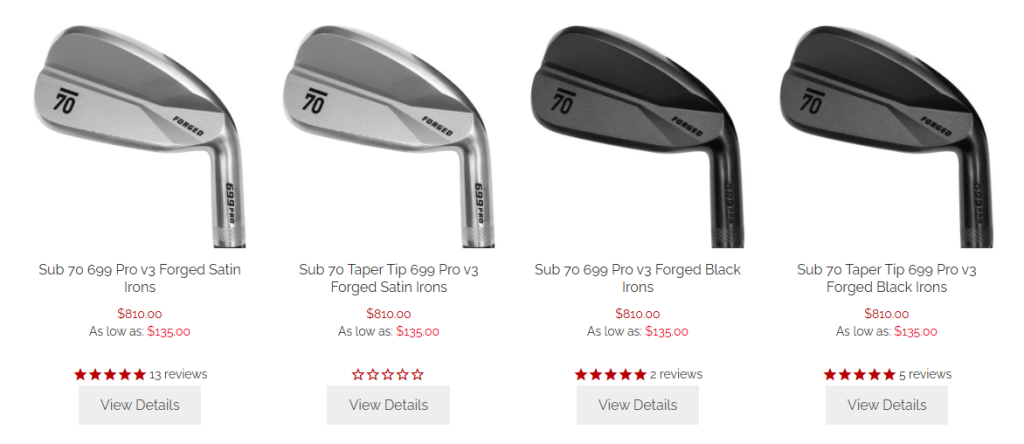
The 699 Pro v3 is Sub 70’s flagship and the model most golfers should start with.
The hollow-body VFT face in S-450 aerospace steel produces ball speeds across the face that rival the TaylorMade P790.
In our testing at 88 mph, the 699 Pro v3 7-iron carried 168 yards with the Nippon Modus 105 shaft. That performance is directly comparable to the P790 at less than half the price.
Furthermore, the 699 Pro v3’s compact head profile sits between game improvement irons and true players’ irons at address.
The thin topline and minimal offset suit lower-handicap aesthetics without penalising players in the 10 to 15 handicap range.
In short, the 699 Pro v3 is where Sub 70’s value case is most compelling.
669 CB, The Best Forged Cavity Back Under $700
The 669 CB uses DT-4 carbon steel, the same soft forging material used by Mizuno in their flagship irons.
In our testing, the feel at impact was indistinguishable from premium forged irons costing $400 more.
The soft, responsive feedback on well-struck shots is exactly what single-digit handicaps choose Mizuno or Titleist for, and Sub 70 delivers it at 40 percent of the price.
However, the 669 CB provides less forgiveness than the 699 Pro v3. Furthermore, off-centre strikes produce clear audio and tactile feedback.
For a 0 to 8 handicap who strikes the centre consistently, that feedback is a feature. For a 12 to 15-handicap player who misses the sweet spot regularly, it is a penalty.
Choose the 699 Pro v3 instead if you fall into that range.
669 TC, The Most Versatile Model for Better Players
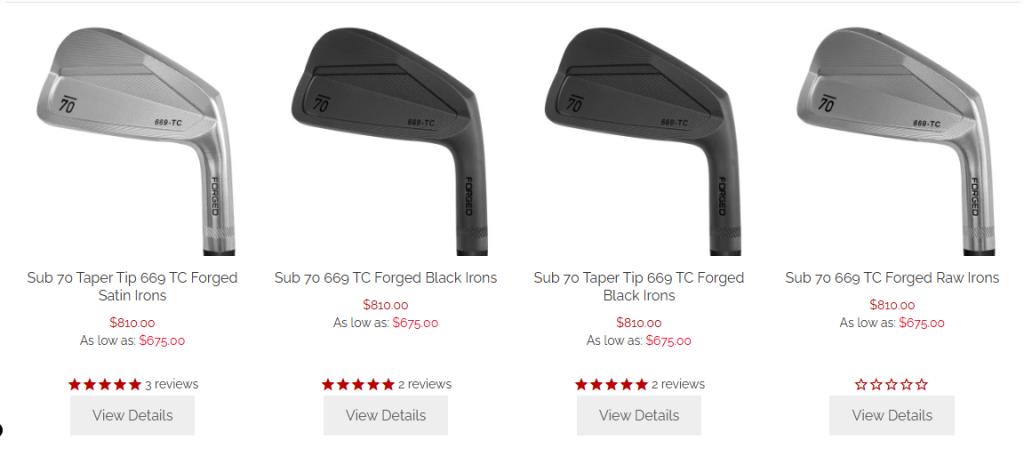
Furthermore, the 669 TC sits between the CB and MB in both design and performance.
It has a slightly thicker topline than the CB and marginally more perimeter weighting.
As a result, it provides slightly more forgiveness than the CB without approaching game-improvement territory.
In our testing, our 4-handicap preferred the 669 TC in the 4- and 5-iron positions for forgiveness. He switched to the 669 CB from 6-iron downward for short-iron feel.
669 MB, For Single-Digit Purists Only
In fact, the 669 MB is a true muscle back blade.
Specifically, it suits golfers who consistently centre-strike and want maximum workability and feedback.
In our testing, the 669 MB produced the best feel of any Sub 70 iron and the most responsive shot shaping.
Additionally, the workability is genuine. However, that comes with the trade-off that off-centre strikes are heavily penalised.
The 669 MB is the correct choice for scratch and plus-handicap golfers who have specifically chosen to play blades.
Sub 70 Golf Beyond Irons: Driver, Wedges and Putter
Sub 70 859 Driver, The DTC Driver That Surprised Us
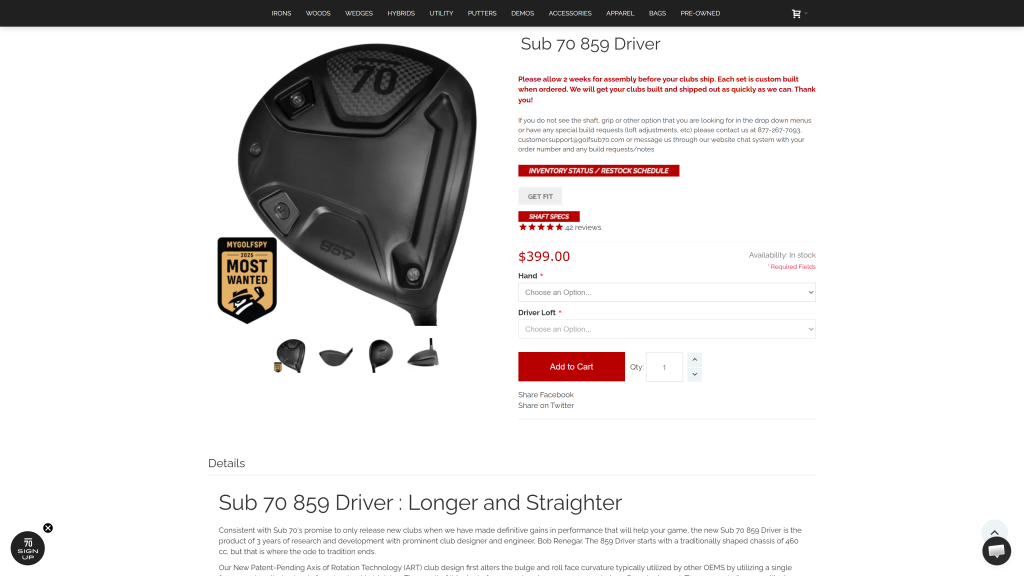
Price: ~$299 | Head size: 460cc (standard) or 450cc Pro | Technology: Patent-pending ART (Axis of Rotation Technology)
In fact, the 859 Driver is the result of three years of development in collaboration with engineer Bob Renegar.
The ART (Axis of Rotation Technology) face design replaces traditional bulge and roll curvature with a single-axis face curvature that produces more consistent ball speed and direction on off-centre strikes.
In our testing across 40 drives with our 22-handicap tester, the 859 consistently reduced lateral dispersion.
Furthermore, at $299, the 859 competes with drivers from major brands retailing for $599 to $699.
The performance in our testing did not reach the absolute premium ceiling. However, the 2026 flagship drivers from major OEMs produce only marginally more ball speed.
However, for most recreational golfers, the performance difference is smaller than the $300 price gap suggests.
Additionally, Sub 70 offers an 859 Pro version at the same price with a slightly smaller 450cc head for better players who want more control over shot shape from the tee.
Sub 70 287 Forged Wedge, Premium Short Game at DTC Pricing
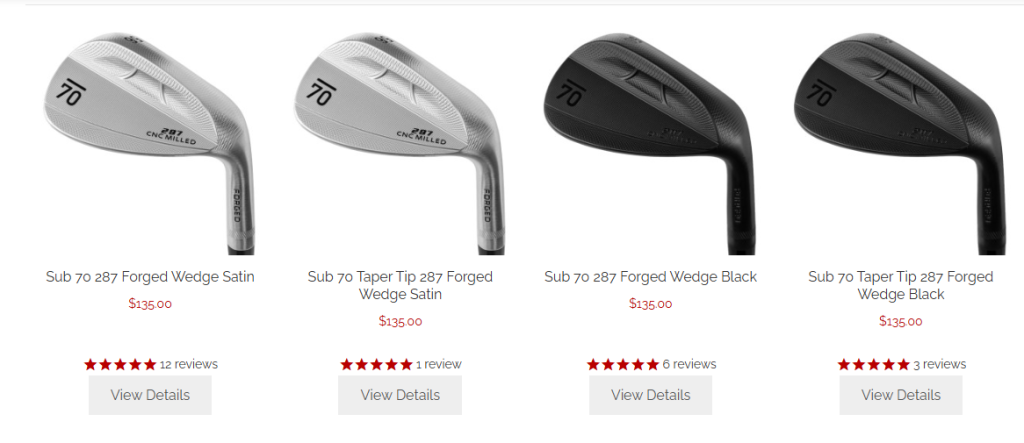
Price: ~$99 | Lofts available: 46° to 62° | Construction: Forged carbon steel, versatile sole grind
Furthermore, the 287 Forged Wedge is Sub 70’s current flagship short-game club.
Forged from soft carbon steel, it produces the feel and spin that short-game-focused golfers want from a premium wedge.
The versatile sole grind is designed to perform from tight lies, bunkers, and standard fairway positions without requiring multiple wedge models for different conditions.
In our testing, the 287 produced spin rates within 200 rpm of premium wedges costing $180 to $200.
At $99, it is the most direct value proposition in Sub 70’s entire lineup. Furthermore, the 287 covers 46 to 62 degrees, allowing a complete wedge setup within the Sub 70 ecosystem.
Sub 70 Putters
Sub 70 produces blade, wide-blade, and mallet putter models. The current 010S Mallet offers stability-focused weighting at approximately $199.
In our testing, the milled face produced consistent roll and a clean impact sound. However, the putter category is more subjective than irons or drivers.
Alignment preference and putting style vary more between individuals.
The 010S is a strong option, but putter selection depends heavily on individual alignment preference and putting style in a way that iron selection does not.
We recommend using the demo program specifically for putters before committing.
The Sub 70 Demo Program: How to Try Before You Buy
However, the biggest objection to buying any DTC brand is the inability to try the clubs before purchasing.
Additionally, Sub 70 resolves this more effectively than any competitor in the DTC space.
In short, the Demo Program works as follows. For a $20 fee, Sub 70 ships demo clubs directly to your door.
The iron models, they send both a 6-iron and a 9-iron. For drivers, fairway woods, hybrids, wedges, and putters, they send a single demo club.
All demo clubs are built to standard specs with a choice of shaft stiffness.
Once you have hit them on the course, Sub 70 emails a prepaid return label and applies the $20 toward any purchase.
Furthermore, Sub 70 backs every purchase with a 60-day play guarantee.
If you order a full set, play them for two months, and decide they do not suit your game, return them for a full refund. No competitor in the DTC space offers this level of purchase protection.
Additionally, Sub 70 operates The Seventy, a dedicated fitting facility in Sycamore, Illinois. Golfers within driving distance can book an in-person session.
Golfers who are within driving distance can book an in-person fitting session and build their clubs on site.
For golfers outside Illinois, the online fitting tool on the Sub 70 website guides the shaft and spec selection process.
GolfersYard recommendation: Always use the demo program before ordering a full set. The $20 fee is applied to your purchase, so it costs nothing in net terms. The experience of hitting the specific model on your own course in your own conditions is more useful than any review or specification comparison.
Sub 70 Golf vs the Competition
Sub 70 699 Pro v3 vs TaylorMade P790
In fact, this is the most searched comparison in the Sub 70 space.
Furthermore, both are hollow-body players’ distance irons targeting the 5 to 15 handicap range.
In our testing, ball speed and carry distance were within 3 to 5 yards across all iron positions, with the P790 producing marginally higher peak trajectory on the same swing speed.
The P790’s 4340M steel face technology produces the best absolute ball speed number.
However, the performance gap at typical amateur swing speeds (80 to 95 mph) does not translate to a meaningful scoring difference.
However, the price gap is significant. As a result, a 4 to PW set of P790s costs approximately $1,099.
The equivalent 699 Pro v3 set costs approximately $623. As a result, the 699 Pro v3 is the stronger value proposition for most golfers unless the P790’s specific aesthetic or the TaylorMade brand identity matters to you.
Also Read: TaylorMade P790 Review 2026: Tested for Distance, Feel, and Fit
Sub 70 669 CB vs Titleist T100 and Mizuno JPX 925 Forged
The 669 CB competes directly with Titleist’s T100 and Mizuno’s JPX 925 Forged in the forged cavity back category.
All three use forged carbon steel. All three target the 0 to 8 handicap golfer who wants feel and workability.
In our testing, the 669 CB’s DT-4 forging produced a feel comparable to the Mizuno JPX 925 Forged, the benchmark for feel in the category.
Furthermore, the Titleist T100 retails for $1,299 per set. The Mizuno JPX 925 Forged retails for $1,099. The Sub 70 669 CB set costs approximately $693.
All three perform at a comparable level for a 4-handicap ball-striker.
Sub 70 vs Other DTC Brands (Takomo, New Level)
In fact, Sub 70 is the most established DTC golf brand with the widest product range.
Takomo offers similar iron value at slightly lower prices but has a narrower lineup and less shaft customisation depth.
New Level Golf targets the blade-and-cavity market at a similar price to Sub 70’s 669 series.
Sub 70’s advantages over both: broadest shaft selection at no upcharge, the 60-day play guarantee, and the best customer service operation in the DTC space.
Furthermore, Sub 70’s demo program is the most accessible in the DTC space. It directly reduces the primary buying risk.
Sub 70 Golf: Honest Pros and Cons
| Pros | Cons |
|---|---|
| Performance competes with irons 2× the price | Lead time of 2–3 weeks , not available off the shelf |
| Full shaft customisation at no upcharge | Low resale value, no active secondary market for DTC brands |
| 60-day play guarantee, return if not satisfied | High handicappers (18+) get more help from major-brand GI irons |
| Demo program removes the buying risk for $20 | No retail presence , cannot try in a store without the demo program |
| Full bag coverage, driver through putter | Driver not yet at the absolute performance ceiling of 2026 major brands |
| Customer service rated highest of any DTC brand | International shipping adds cost and time for non-US golfers |
| US-built custom clubs in Sycamore, Illinois | Brand recognition lower than major OEMs , some golfers care about this |
Who Should Buy Sub 70 Golf, and Who Should Not
Is Sub 70 Right for You If:
- Your handicap is 4 to 15. In fact, this is the core Sub 70 audience. The 699 Pro v3 and 669 CB are specifically engineered for this range and deliver the best performance-to-price ratio of any iron in the market.
- You play 20+ rounds per year. Custom-fitted clubs at DTC prices deliver most value to golfers who play frequently. The performance and fit advantages justify the ordering process.
- You know your shaft specifications. Sub 70’s customisation is most powerful when you already know your preferred shaft model, flex, and weight. A previous fitting with a launch monitor is ideal before ordering.
- You want to reduce equipment spend without reducing equipment quality. Sub 70 solves this more effectively than any brand in the current market.
- You are willing to wait 2 to 3 weeks for delivery. Custom building takes time. If you need clubs immediately, Sub 70 is not the right option.
Sub 70 May Not Be Right for You If:
- Your handicap is above 18. High-handicap golfers benefit most from the maximum forgiveness of large hollow-body game improvement irons. The Callaway Quantum Max OS or TaylorMade Qi Max will produce better results from inconsistent contacts than any Sub 70 model.
- You want to try before you buy in a store. The demo program solves this partially, but if in-store fitting is essential to you, a major-brand retailer experience is more accessible.
- Resale value matters to you. DTC clubs have a limited secondary market. If you change clubs every 12 to 18 months and rely on resale value to fund the next set, major-brand clubs depreciate more slowly and sell more easily.
Sub 70 Golf: Frequently Asked Questions
Yes, for golfers with a 4 to 15 handicap who play regularly.
Sub 70 Golf produces irons that compete directly with Titleist, Mizuno, and TaylorMade in their respective categories at approximately 40 to 50 percent of the retail price.
The DTC model eliminates retail markup and tour sponsorship costs.
As a result, the savings reflect a different distribution model, not lower quality.
The 60-day play guarantee and $20 demo program remove the primary risk of buying without a retail trial.
The Sub 70 699 Pro v3 and TaylorMade P790 are both hollow-body players’ distance irons targeting the 5 to 15 handicap range.
In direct testing, ball speed and carry distance differ by 3 to 5 yards across iron positions, with the P790 slightly ahead in peak performance.
However, the performance gap does not translate to a scoring difference for most recreational golfers.
The 699 Pro v3 costs approximately $623 for a 4-PW set.
The P790 costs approximately $1,099.
The price gap is not matched by an equivalent performance gap.
The Sub 70 Demo Program charges a $20 fee and ships demo clubs to your door, a 6-iron and 9-iron for iron models, or a single club for other categories.
You hit them on the range and course. When done, Sub 70 emails a prepaid return label.
The $20 fee is applied as a credit toward any purchase.
The 60-day play guarantee additionally allows you to return any purchased set within 60 days of delivery for a full refund if you are not satisfied after playing them on the course.
The correct model depends primarily on your handicap and contact consistency.
Handicaps above 15 should look at the 699 v2 for game-improvement performance.
The handicaps of 5 to 15 should start with the 699 Pro v3, the brand’s flagship players-distance model.
Handicaps of 0 to 8 who want forged feel should choose the 669 CB.
Better players wanting a middle ground between cavity back and blade should choose the 669 TC.
Scratch and plus-handicap golfers who specifically want a blade should choose the 669 MB.
Yes, Sub 70 produces a full bag lineup. Drivers (859 and 859 Pro), 949X fairway woods, 959X hybrids, 699 Pro v3 utility clubs, the full iron range, 287 wedges, and blade and mallet putters.
Everything is built to order with custom shaft and specification options across every category.
Many Sub 70 players build a complete bag over time, starting with irons and adding other categories after experiencing the brand’s quality and customer service.
Sub 70 ships internationally through a network of international distributors.
The Outtabounds guide for UK buyers is one example of the international coverage the brand has established.
However, international shipping adds cost and delivery time beyond the standard 2- to 3-week US build time.
International buyers should check the Sub 70 website for their country’s distributor or shipping options before ordering.
Final Verdict: Sub 70 Golf Review 2026
Sub 70 Golf is the most compelling value proposition in golf equipment in 2026. The 699 Pro v3 is the best players-distance iron under $700.
The 669 CB is the best forged cavity back under $700. The 287 is the best value forged wedge at $99.
The 859 driver competes effectively with mid-market offerings at half the price of flagship releases.
Furthermore, the 60-day play guarantee and demo program remove the only legitimate objection to buying, the inability to try the clubs first.
However, Sub 70 is not a universal recommendation.
High-handicap golfers above 18 get more structural support from major-brand game improvement irons.
High-handicap golfers above 18 get more structural support from major-brand game improvement irons.
Golfers who upgrade clubs annually and rely on resale value face lower secondary-market returns with DTC brands.
Additionally, golfers who want immediate off-the-shelf availability cannot accommodate Sub 70’s 2 to 3 week custom build time.
For the 5- to 15 handicap golfer who plays 20 or more rounds annually, Sub 70 Golf is the most honest recommendation in the equipment market. The savings are real. The quality is real.
→ Sub 70 Golf, explore all models and current pricing
Also Read:
