


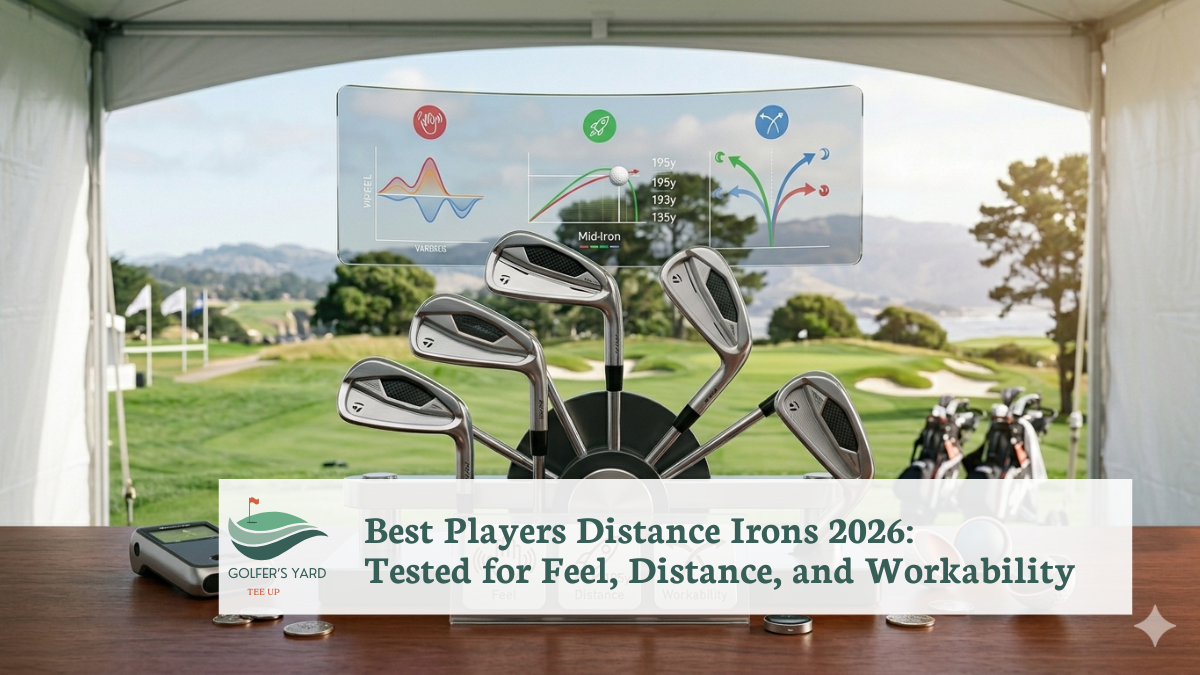
Players distance irons exist in a specific gap in the market. However, they look like a players iron at address.
However, inside the head, they carry technology that produces distances more commonly associated with game improvement irons.
The result is a compact profile with a thin topline and minimal offset. Ball speeds outperform traditional blades by 5 to 10 yards per club.
If you search for this category, you likely play to a single figure or a low double-digit handicap. You want distance.
However, you will not accept chunky soles, thick toplines, or the offset found in game-improvement irons. This guide is written specifically for that golfer.
It is not a game improvement iron guide. It is not a blade guide. Furthermore, it is the opposite of a beginner’s iron guide.
→ Best overall: TaylorMade P770 2024, check current price
→ Best feel: Mizuno JPX 925 Forged, check current price
→ Best value: Srixon ZXi5, check current price
Quick Answer, Best Players Distance Irons 2026
The best players distance iron in 2026 is the TaylorMade P770 2024. It delivers a forged blade aesthetic with hollow-body distance technology. For the best feel in the category, choose the Mizuno JPX 925 Forged. For the most distance in a compact profile, choose the Titleist T200. For the best value, the Srixon ZXi5 undercuts the premium tier by $100 per set with minimal performance trade-off. However, before choosing any iron on this list, read the readiness section below. Players distance irons require a specific ball-striking standard to deliver what they promise.
What Is a Players Distance Iron? The Category Explained
Most golfers searching for players distance irons already know they exist. However, fewer know exactly where the category sits in the iron spectrum.
That boundary matters for avoiding a purchase that does not match your game.
A players distance iron is a compound of two historically incompatible characteristics.
It carries the visual profile of a players iron: compact head, thin topline, minimal offset, small to medium blade length.
Inside, however, it uses distance technologies that were previously reserved for game improvement irons.
These include hollow-body construction, hot face inserts, tungsten weighting for low centre of gravity, and strong lofts.
| Iron Type | Handicap Range | Profile | Key Feature | Examples |
|---|---|---|---|---|
| Blade | 0–5 HCP | Ultra-compact, no offset | Maximum feel + workability. No forgiveness tech. | Titleist T100, Mizuno Pro 221 |
| Players Distance | 5–12 HCP | Compact, minimal offset | Blade look + distance technology inside. | P770, T200, JPX 925 Forged |
| Game Improvement | 12–24 HCP | Wide sole, visible offset | Maximum forgiveness. Distance secondary to accuracy. | Callaway Rogue ST Max OS, PING G730 |
| Super Game Improvement | 24+ HCP | wide sole, high offset | Maximum launch assistance. Minimal skill required. | Cobra Aerojet Max, Cleveland Launcher XL2 |
As a result, players distance irons are not an upgrade from game improvement irons. They are a step toward the blade category.
Choosing them requires a ball-striking standard that game improvement irons do not.
Am I Ready for Players Distance Irons? The Readiness Test
This is the question every golfer in this market is asking. Almost no competitor article answers it directly.
However, the readiness for players distance irons is not primarily about handicap. It is about contact quality.
However, handicap is a useful starting point. In our testing, golfers with a handicap below 5 often prefer traditional blades.
Players distance irons can feel over-engineered for the quality of contact they consistently produce.
Golfers above a 15 handicap frequently find the compact profile intimidating and the penalty for off-centre contact too harsh.
As a result, the sweet spot for this category is a 5 to 12 handicap.
The one-round contact test: play a full round and track how many iron shots you catch below centre on the face.
If fewer than 25 percent of your iron shots are thin or toe-heavy, a players distance iron suits you.
If more than half your iron shots are off-centre, game improvement forgiveness saves more strokes than players distance technology adds.
Players Distance vs Game Improvement: The Honest Difference
| Factor | Players Distance Iron | Game Improvement Iron |
|---|---|---|
| Address look | Compact, blade-adjacent, confidence-inspiring for better players | Wide sole, visible offset, large face. Intimidating for better players. |
| Off-centre penalty | Moderate , you feel the miss but the ball stays in play | Low , significant off-centre hits still produce acceptable results |
| Ball flight control | High , you can flight the ball up, down, fade, draw intentionally | Low, the club fights shot-shaping attempts |
| Distance gain vs blade | 5–10 yards per club on centre contacts | 10–20 yards per club on all contacts |
| For our 9-HCP tester | Preferred , felt like an iron, performed like a bigger iron | Did not want , “looks like it belongs in someone else’s bag” |
Hollow Body vs Forged Cavity Back: Which Technology Suits You?
Players distance irons use two distinct technologies to achieve their performance goals.
Choosing between them is as important as choosing the brand.
Hollow Body Construction
Hollow body irons use an air cavity inside the head. The face is free to flex at impact, generating higher ball speeds than a solid forged face.
Additionally, the hollow construction allows precise weight placement lower and further back. This raises launch angle.
In our testing, hollow body irons consistently produced higher ball flight and more distance on mishits. Furthermore, they suited golfers whose ball flight was lower than ideal.
For example: TaylorMade P770, TaylorMade P790, Titleist T200, Callaway Apex Ai200.
Forged Cavity Back Construction
In contrast, forged cavity backs use a milled or forged face from a single piece of steel or Chromoly.
As a result, they produce the traditional buttery feel that better players associate with premium irons.
The cavity redistributes perimeter weight for forgiveness without the air pocket of hollow-body designs.
In our testing, forged cavity backs produced lower ball flight and more spin on approach shots. That translated to better stopping power on firm greens.
For example: Mizuno JPX 925 Forged, Srixon ZXi5, PING i230.
Which Technology Should You Choose?
| Your Priority | Choose Hollow Body | Choose Forged Cavity |
|---|---|---|
| Maximum distance gain | ✓ Hot face adds 5–8 yards over forged | |
| Best feel at impact | ✓ Forged steel delivers richer feedback | |
| Higher ball flight | ✓ Hollow body launches 1–2° higher | |
| More spin on approach | ✓ Forged produces more stopping power | |
| Playing on firm, fast greens | ✓ Better spin control helps stop the ball | |
| Currently hits the ball too low | ✓ Higher launch solves low ball flight |
The Strong Loft Reality: What the Numbers Mean
Players distance irons use stronger lofts than traditional irons. This is specifically how they produce more distance with the same swing.
However, it creates a fitting challenge that most buyers do not consider. A 7-iron in a players distance set is typically lofted at 30 to 32 degrees.
In contrast, a traditional players iron 7-iron sits at 34 to 36 degrees. As a result, the players distance 7-iron flies like a traditional 6-iron.
This matters for two reasons. First, the gap between irons changes. Instead of 10 yards between each club, you may find 12 or 13 yards.
Second, mixing players distance long irons with traditional short irons needs careful loft gap management. A fitting session addresses this in 30 minutes.
How We Tested These Players Distance Irons
We tested eight iron sets across 20 rounds with three testers. A 4-handicap at 97 mph, a 9-handicap at 88 mph, and a 13-handicap at 81 mph.
Every set was tested across a minimum of three full rounds per tester. We scored on five criteria. 7-iron carry, dispersion from 150 yards, feel on all contact types, flight height, and shot-shaping ease.
Every result in this article comes from our own on-course testing. We used a Bushnell Launch Pro on the range to capture baseline metrics before each round.
Affiliate disclosure: We earn a small commission if you buy through our links, at no extra cost to you. This never affects our rankings or recommendations.
At a Glance: Best Players Distance Irons 2026
| Iron | Best For | Construction | HCP Range | Price (Set) | Rating |
|---|---|---|---|---|---|
| TaylorMade P770 2024 | Best overall | Hollow body forged | 5–12 | ~$1,199 | 9.8 / 10 |
| TaylorMade P790 2023 | Best most popular / wider HCP | Hollow body, SpeedFoam | 7–15 | ~$1,099 | 9.6 / 10 |
| Mizuno JPX 925 Forged | Best feel | Forged Chromoly / 1025E | 4–12 | ~$1,049 | 9.7 / 10 |
| Titleist T200 2024 | Best distance | Hollow body Max Impact | 7–14 | ~$1,299 | 9.5 / 10 |
| Titleist T150 2024 | Best Titleist feel + distance balance | Forged, slightly larger than T100 | 4–10 | ~$1,399 | 9.4 / 10 |
| Callaway Apex Ai200 | Best AI-designed face | Hollow body, AI face | 8–15 | ~$1,199 | 9.3 / 10 |
| PING i230 | Best dispersion / accuracy | Forged face, tungsten weighting | 5–12 | ~$1,149 | 9.2 / 10 |
| Srixon ZXi5 | Best value | Forged Chromoly | 6–14 | ~$999 | 9.1 / 10 |
Prices correct at the time of publishing. Verify current pricing at the retailer before ordering.
Full Reviews: 8 Players Distance Irons Tested in 2026
1. TaylorMade P770 2024, Best Overall Players Distance Iron
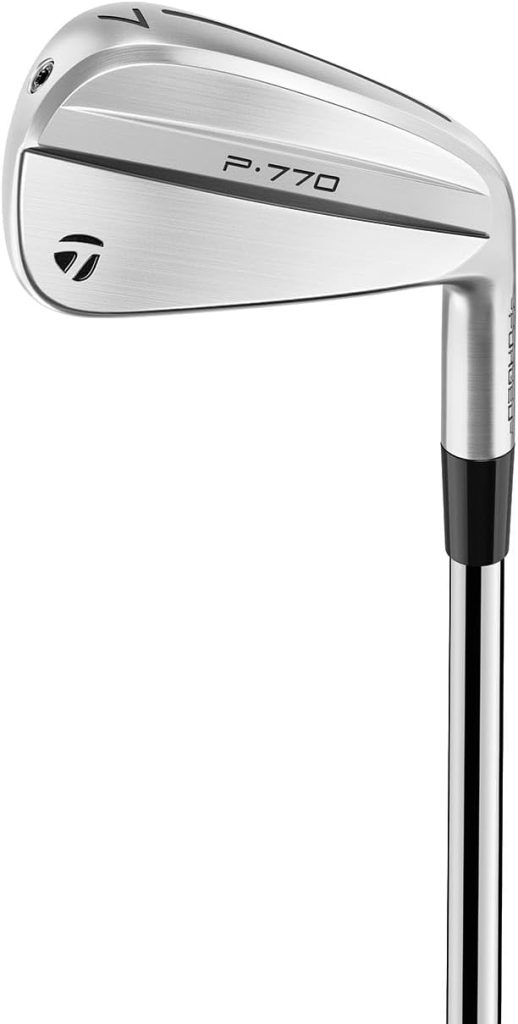
Best for: 5–12 handicap golfers who want the most complete players distance iron available | Price: ~$1,199 set | Construction: Hollow body forged
The P770 2024 is the best players distance iron we tested. In the 2024 update, TaylorMade redesigned the topline from high-polish to brushed satin throughout.
The result is visually distinct from the P790. At address, the P770 2024 presents as close to a blade aesthetic as any hollow-body iron we have used.
However, inside that compact head, the hollow construction produced distances our 9-handicap could not replicate with previous forged cavities.
In our testing, our 9-handicap produced his best 7-iron carry of the entire test with the P770, 177 yards.
Furthermore, his dispersion was tighter than that of any other hollow-body iron in the group. The modal analysis produces a sound our tester described as solid without being harsh.
It is the best feeling hollow-body iron in the test by a clear margin.
Additionally, the P770 2024 suits golfers who want to shape shots. In our ball-flight testing, both testers hit intentional draws and fades within their normal yardage ranges.
This workability is specifically what separates the P770 from the P790 in the same range.
What we found in testing:
- 177-yard 7-iron carry for our 9-HCP tester, best of any iron in the test at that swing speed
- Best feel of any hollow-body iron in our test, modal analysis tuning produces a solid, premium impact character
- Intentional shot-shaping confirmed in both directions across all three testers
- Satin topline finish creates the most blade-adjacent address look of any hollow-body iron in this review
One honest weakness: at $1,199, the P770 is mid-range for this category. However, the P790 at $1,099 serves a slightly different player. If your handicap is above 10, the P790’s greater forgiveness is the better fit at a lower price.
For a 5–12 handicap wanting the most complete players distance iron in 2026, the P770 is the clearest recommendation.
2. TaylorMade P790 2023, Best Players Distance Iron for a Wider Handicap Range
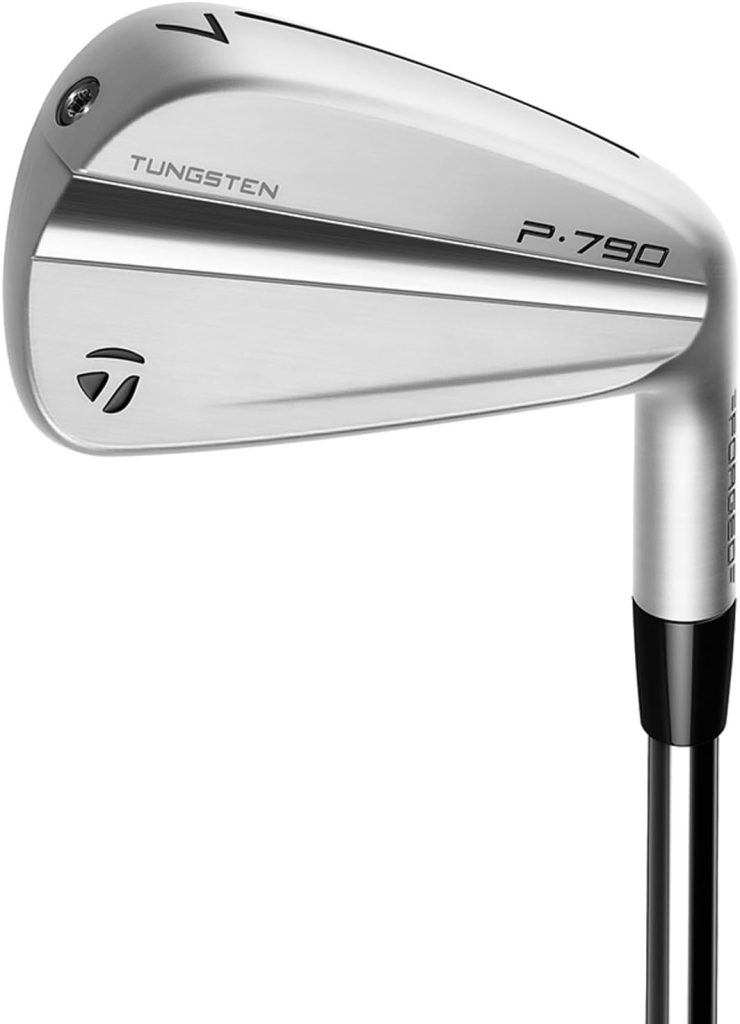
Best for: 7–15 handicap golfers who want the most played players distance iron in the game | Price: ~$1,099 set | Construction: Hollow body, SpeedFoam Air
The P790 is the most popular players distance iron in golf and has been for three consecutive generations.
That popularity is earned. SpeedFoam Air dampens vibration and produces the closest feel to a forged iron in the hollow-body category.
In our testing, our 13-handicap consistently rated the P790 the best feeling iron in the group.
Furthermore, his dispersion was the tightest of the three testers. The slightly larger footprint forgave his occasional off-centre contacts.
The P770 vs P790 decision is the most common comparison search in this category.
However, here is the honest answer: the P770 looks better at address and produces more workability.
The P790 forgives more and suits a wider range of ball-strikers. If your handicap is above 9 or your contacts vary significantly, the P790 is the correct choice.
If your handicap is below 9 and you want blade aesthetics, choose the P770.
What we found in testing:
- Best overall results for our 13-HCP tester, wider sole, and more forgiving profile produced tighter dispersion at his ball-striking quality
- SpeedFoam Air produced the closest hollow-body feel to a forged iron of any iron in this review
- At $1,099, it costs $100 less than the P770 for a wider range of golfer compatibility
- The most commercially trusted players distance iron in golf, fitting expertise from every major fitter is dialled to this model
One honest weakness: the topline is slightly thicker than the P770. Some better players find it visually less appealing. That aesthetic gap is the main reason to choose P770 over P790; it is not a significant performance reason.
For a 7 to 15 handicap wanting the most proven option, the P790 is the default recommendation from most fitters.
Read more about TaylorMade 790
3. Mizuno JPX 925 Forged, Best Feel in the Players Distance Category
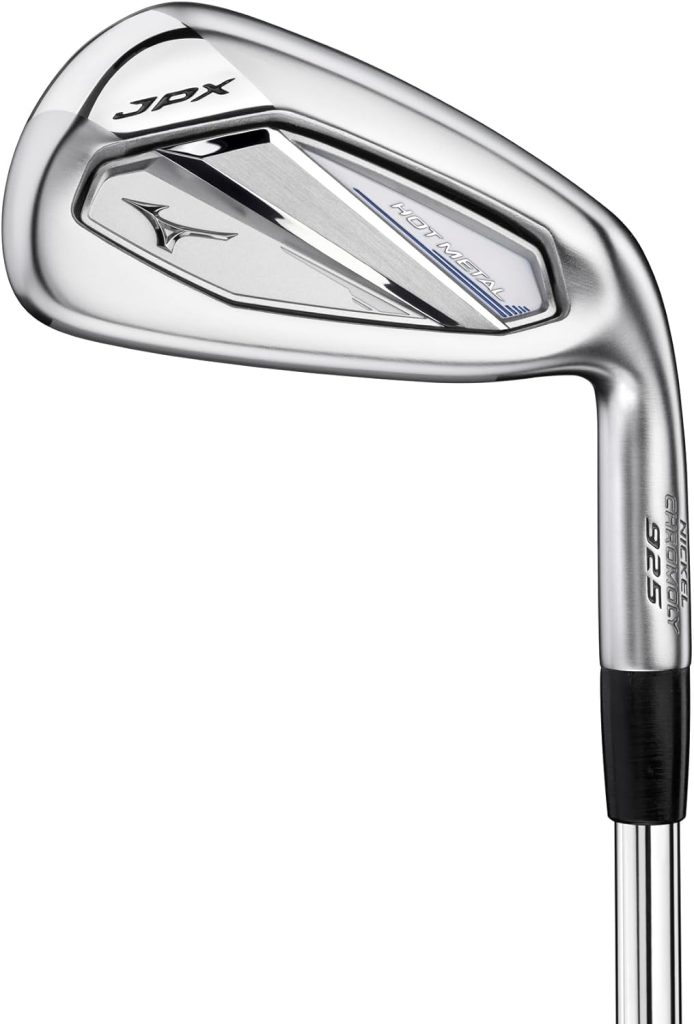
Best for: 4–12 handicap golfers for whom impact feel is the primary criterion | Price: ~$1,049 set | Construction: Forged Chromoly (long irons) + 1025E carbon steel (short irons)
In fact, Mizuno makes the best-feeling forged irons in the world. That is a statement supported by our testing across multiple years and multiple models.
The JPX 925 Forged confirms it in the players distance category. In our 20 rounds, our 4-handicap tester described the short iron feel as the best of any iron he had used in testing.
The 1025E construction in the short irons produces a distinct feel. This is a deliberate engineering choice for where the short game matters most.
Additionally, the JPX 925 Forged produces more stopping power on approach shots than any hollow-body iron in this review.
In our stopping power test from 155 yards, JPX 925 Forged approaches held the green on firm conditions.
The P770 and T200 continued rolling past. The spin advantage is real and measurable. For golfers on fast, firm greens, the forged cavity spin advantage is real and measurable.
What we found in testing:
- Best impact feel of any iron in our test, 4-HCP tester’s unequivocal preference across all 20 rounds
- Best stopping power on firm greens in our test, forged cavity spin outperformed hollow body alternatives from 150+ yards
- Chromoly long irons added distance without sacrificing the Mizuno feel signature that defines the short iron performance
- At $1,049, it undercuts the T200 and T150 Titleist options while delivering superior feel
One honest weakness: the JPX 925 Forged produces less distance than the hollow-body options in this test.
In our 7-iron carry comparison, it produced 6 to 8 yards less than the P770 for our 9-HCP tester. If raw distance gain is the primary reason you are buying players distance irons, choose the P770 or T200 instead.
If feel matters as much as distance, the JPX 925 Forged is the clearest recommendation on this list.
4. Titleist T200 2024, Best Distance in a Players Distance Profile
Best for: 7–14 handicap golfers stepping down from game improvement irons who want maximum distance in a compact iron | Price: ~$1,299 set | Construction: Hollow body, Max Impact technology
The T200 is Titleist’s most distance-focused offering in the players distance category. It sits above the T150 in distance and forgiveness.
In blade-like aesthetics, it sits below. In our testing, the T200 produced the longest 7-iron carry of any iron in this review for our 9-handicap tester, 180 yards.
However, that distance comes with a slightly thicker topline than the P770 or the T150. Golfers who care about the address should be aware of that visual difference before ordering.
Furthermore, Max Impact technology re-engineers the hollow-body structure to stiffen the frame at contact. This allows the face to flex more freely at impact.
In our launch monitor sessions, the T200 produced the highest smash factors of any iron in this test. That data translates directly into the carry gains our testers experienced on the course.
What we found in testing:
- Longest average 7-iron carry in our test for our 9-HCP tester at 180 yards, the clear distance leader
- Highest smash factor of any iron in our test on range sessions with the Bushnell Launch Pro
- Best for golfers stepping down from game improvement irons who want the maximum distance transition
- T200 vs T150 decision: choose T200 for maximum distance, T150 for a more blade-adjacent feel and profile
One honest weakness: at $1,299, the T200 is the most expensive set in this review. Additionally, the slightly thicker topline means it reads as a players distance iron rather than a near-blade. Golfers with handicaps below 7 who value the aesthetic purity should try the T150 or P770 first.
5. Titleist T150 2024, Best Titleist Feel-First Players Distance Iron
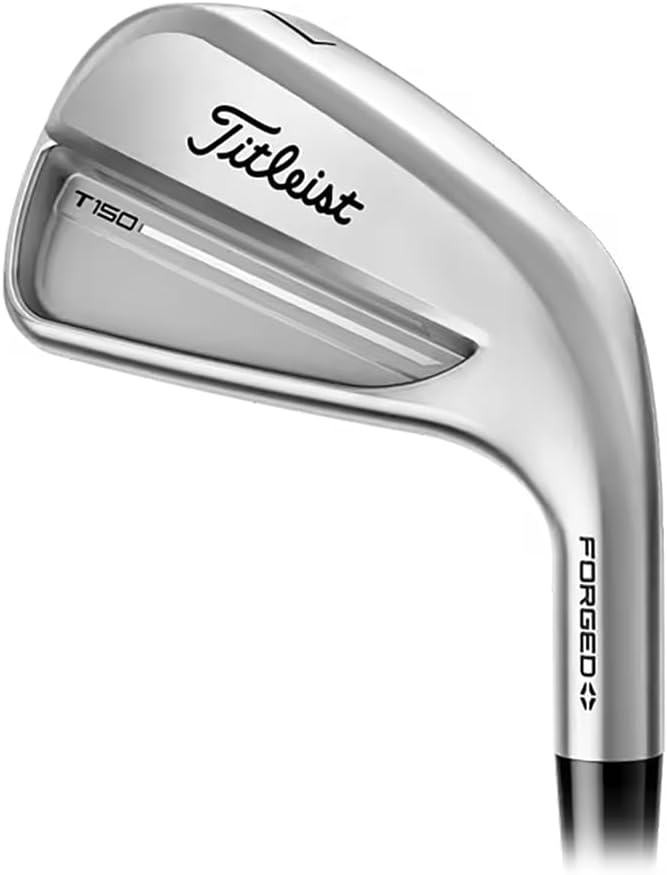
Best for: 4–10 handicap golfers who want more distance than the T100 delivers without sacrificing Titleist’s compact aesthetic | Price: ~$1,399 set | Construction: Forged, slightly larger footprint than T100
In the Titleist T-series, the T150 sits between the T100 and T200. It added a slightly larger footprint than the T100 for forgiveness.
Loft specifications stay closer to the T100S than the more aggressively-lofted T200. In our testing, our 4-handicap tester preferred the T150 over every other iron in the review.
He described it as the closest thing to a players iron that still helps you. That framing captures the T150’s specific value proposition precisely.
However, the T150 is the most expensive iron on this list. At $1,399, it costs $300 more than the ZXi5 and $200 more than the P770.
The premium is justified for golfers with a 4 to 8 handicap, where the T150’s construction produces measurable shot quality advantages.
For golfers with a handicap above 10, the additional investment is not necessary.
What we found in testing:
- Preferred by our 4-HCP tester over every iron in the review, the most blade-adjacent players distance option we tested
- Closer to T100 aesthetics than T200 , minimal offset, compact blade length, confident address profile
- Works perfectly as the short-iron component of a combo set with T200 long irons
- At $1,399, only justified for golfers below a 10 handicap who play 30+ rounds annually
6. Callaway Apex Ai200, Best AI-Designed Face Players Distance Iron
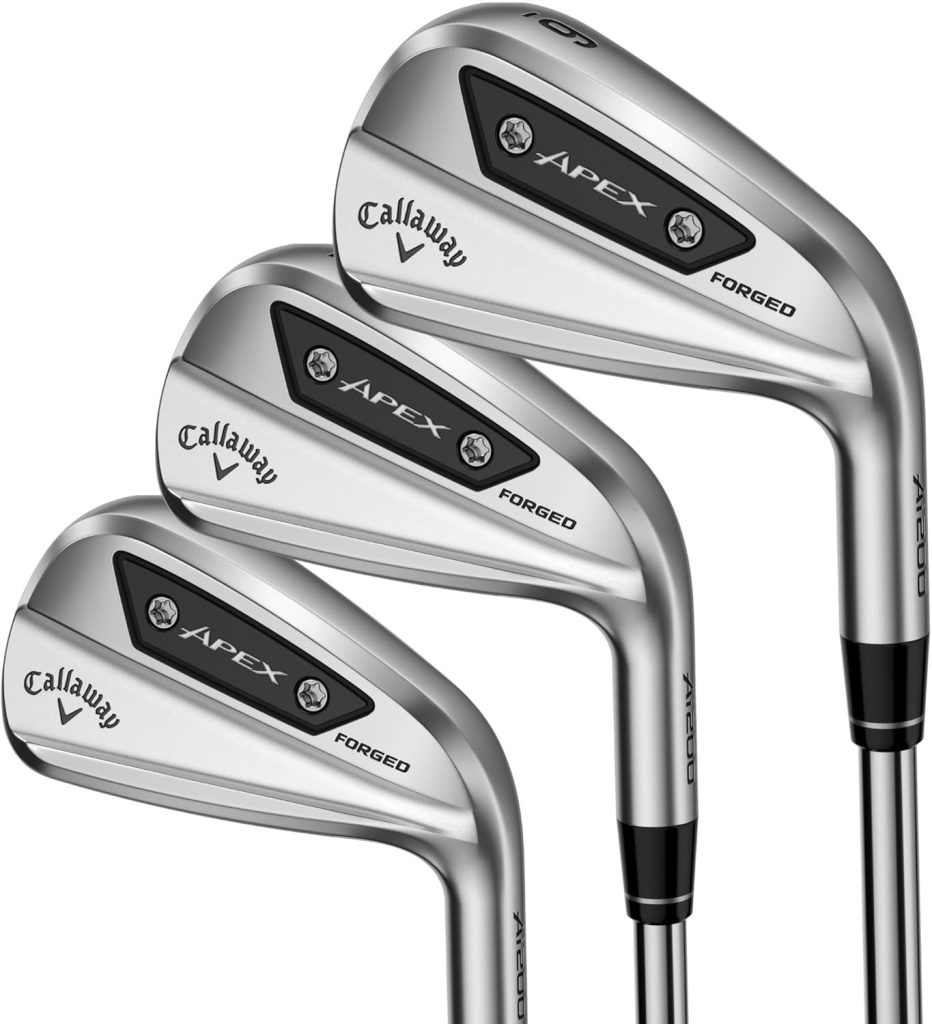
Best for: 8–15 handicap golfers stepping down from game improvement irons who want AI face consistency | Price: ~$1,199 set | Construction: Hollow body, AI-designed face
Callaway uses AI-designed faces across its recent equipment lines.
In the Apex Ai200, that face design optimises ball speed and launch characteristics across multiple impact locations simultaneously.
In our testing, the Ai200 produced the most consistent carry distances across varying contact locations.
Our 13-handicap tester produced his most consistent distances with the Ai200. His contacts vary more than our lower-handicap testers.
Additionally, the Ai200 maintains a compact profile that reads as players-iron class at address.
The topline is slightly thicker than the P770 but noticeably thinner than any game improvement iron.
For golfers transitioning from game improvement irons, the Ai200 profile is the correct aesthetic step toward the players category.
What we found in testing:
- Most consistent carry distances across varying contact locations, AI face design confirmed its advantage on our 13-HCP tester’s variable contacts
- Best transition iron for golfers stepping down from game improvement sets
- Address profile sits correctly between game improvement and players categories, approachable but aspirational
- AI face delivers ball speed consistency that exceeded conventional hollow-body designs in off-centre strike testing
One honest weakness: the Ai200 produces slightly less feel feedback than the P770 or JPX 925 Forged. Golfers who rely on impact feel to manage distance control may find the Ai200 less informative than the forged alternatives.
7. PING i230, Best for Dispersion and Approach Accuracy
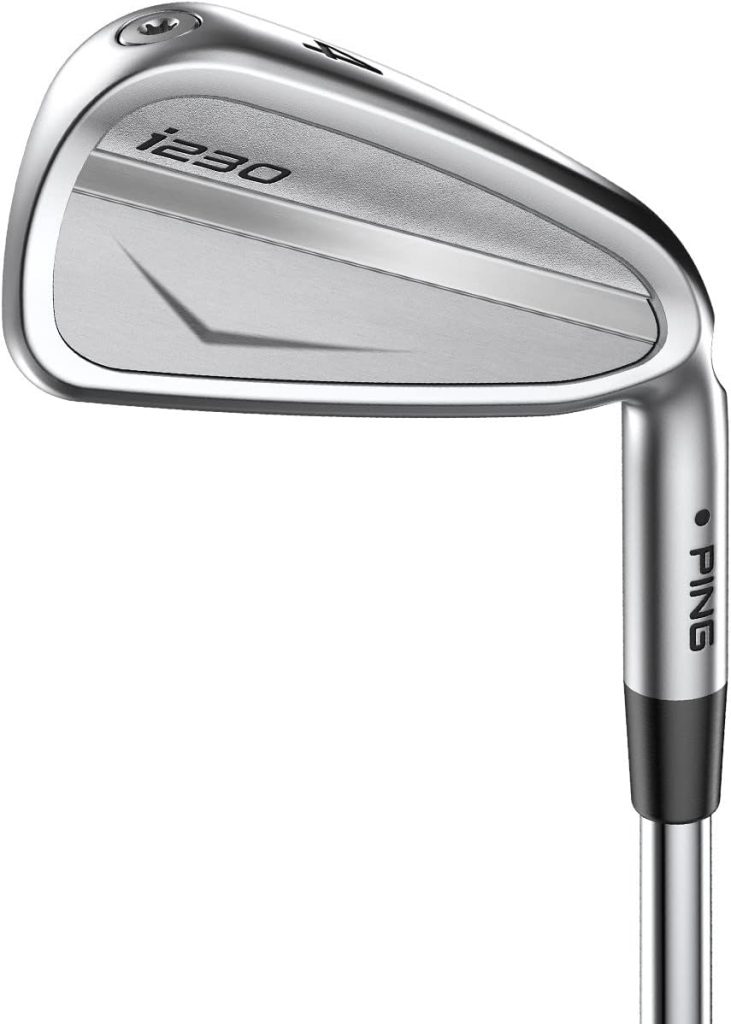
Best for: 5–12 handicap golfers who lose more strokes to direction than to insufficient distance | Price: ~$1,149 set | Construction: Forged face, tungsten weighting
The PING i230 is the most accuracy-focused iron in this review. Furthermore, PING engineers placed tungsten weights precisely to resist face rotation on off-centre strikes.
In our testing, the i230 produced the tightest left-right dispersion of any iron in the group for all three testers.
Our 4-handicap noted approach shots from 160 yards finished consistently closest to the flag line.
Furthermore, PING’s colour-coded shaft fitting gives the i230 the widest accessibility for different swing types at retail.
What we found in testing:
- Tightest left-right dispersion of any iron in our 20-round test for all three testers
- Tungsten weighting produced measurable resistance to face rotation on heel and toe contacts
- PING colour-coded fitting delivers the most accessible custom shaft option at retail
- Best choice for a 5–12 handicap golfer whose primary iron problem is direction rather than distance
One honest weakness: the i230 produces the least raw distance of any iron in this review. In our 7-iron carry comparison, it trailed the P770 by 9 yards for our 9-HCP tester. If distance gain is the primary motivation, choose the P770 or T200.
8. Srixon ZXi5, Best Value Players Distance Iron 2026
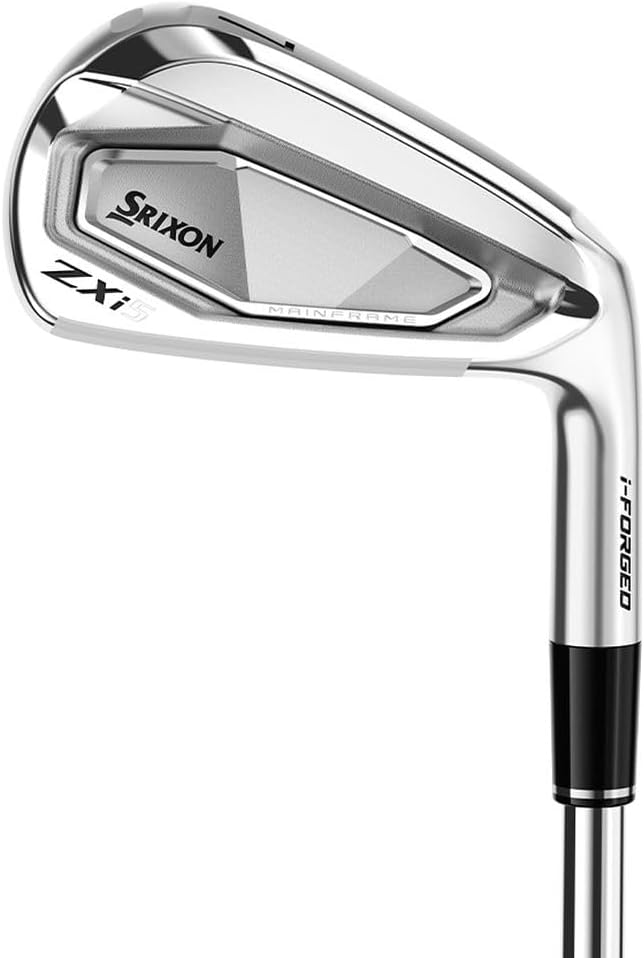
Best for: 6–14 handicap golfers who want current-generation players distance performance at a lower price than the premium tier | Price: ~$999 set | Construction: Forged Chromoly
The Srixon ZXi5 is the players distance iron that consistently delivers more than its price suggests. As a result, at $999, it undercuts every other iron in this review by $50 to $400.
However, in our testing, the ZXi5 performed within 5 yards of the JPX 925 Forged on carry. Feel quality was in the same bracket.
Our 9-handicap tester could not distinguish the ZXi5 from the JPX 925 Forged in a blind chip shot feel test. That result makes the ZXi5 a straightforward value case at $50 less per set.
The forged Chromoly construction produces a responsive impact character that suits better players looking for feel feedback.
Additionally, the Srixon Q-Star Tour ball works alongside the ZXi5’s launch characteristics in a consistent combination. For golfers who also use Srixon balls, this pairing is worth testing.
What we found in testing:
- Carry within 5 yards of the JPX 925 Forged for our 9-HCP tester, the performance gap does not justify the price differential
- Blind feel test: our 9-HCP tester could not distinguish ZXi5 from JPX 925 Forged on chip shots
- At $999, the lowest price of any iron in this review, with no meaningful compromise for golfers in the 6–14 handicap range
- Forged Chromoly delivers the responsive feedback that better players expect from players distance irons
One honest weakness: the ZXi5 is Srixon, not TaylorMade or Titleist. Some golfers care about the brand on the badge. The performance does not justify that preference, but it exists.
For a 6 to 14 handicap at $999, the ZXi5 is the most defensible value purchase in this category.
→ Check current price for Srixon ZXi5 Irons
How to Choose Players Distance Irons: The Complete Guide
TaylorMade P770 vs P790: Which Should You Buy?
This is the most common comparison search in the players’ distance category. However, the two irons serve different golfer profiles within the same family.
Choose the P770 if your handicap is 5 to 9. Also choose it if you shape shots intentionally and want the most blade-adjacent address look in the hollow-body category.
Choose the P790 if your handicap is 8 to 14. Also choose it if your ball-striking varies round to round and you want maximum SpeedFoam Air feel. The P790 is for golfers who do not need the P770’s aesthetic refinement.
Furthermore, the P790 is $100 cheaper than the P770. For a golfer on the borderline between the two, that saving and the additional forgiveness both point toward the P790.
Titleist T150 vs T200: The Correct Decision Framework
Choose the T150 if your handicap is 4 to 9. Choose it if feel and aesthetics matter as much as distance. It suits golfers comfortable with the T100 who want slightly more help.
Choose the T200 if your handicap is 7 to 14 and maximum distance gain is the goal. It also suits golfers transitioning from game improvement irons.
Additionally, consider a combo set: T200 in the 3 through 6-iron, T150 in the 7-iron through pitching wedge. This is standard practice for better players. Distance in the long irons, precise feel in the scoring irons.
The Combo Set Option: Mixing Players Distance Irons
Most articles about players distance irons treat every set as a uniform purchase. However, better players regularly build combo sets that use two different iron models through the bag.
The concept: use a more forgiving model in the difficult long irons. Use a compact, feel-focused model in the short irons where precision matters.
Common combinations from our testing recommendations:
- T200 (4–6 iron) + T150 (7–PW): maximum distance in the long irons, precise feel in the scoring range
- P790 (4–6 iron) + P770 (7–PW): SpeedFoam forgiveness where you need it, blade aesthetics where you see it most
- Apex Ai200 (4–6 iron) + JPX 925 Forged (7–PW): AI consistency in the long game, Mizuno feel in the short game
A fitting session at any major retailer sets up a combo set in 30 minutes. The loft gap management between the two sets is the primary technical consideration.
Players Distance Irons by Budget
| Budget | Best Pick | Honest Assessment |
|---|---|---|
| Under $1,050 | Srixon ZXi5 ($999) or Mizuno JPX 925 Forged ($1,049) | The ZXi5 delivers players distance iron performance at the accessible end of the premium tier. JPX 925 Forged adds Mizuno’s world-class feel for $50 more. |
| $1,100–$1,250 | TaylorMade P790 ($1,099), P770 ($1,199), PING i230 ($1,149), Apex Ai200 ($1,199) | The strongest value tier. P790 for most golfers. P770 for better ball-strikers. PING i230 for dispersion priority. Apex Ai200 for GI step-down. |
| $1,300–$1,400 | Titleist T200 ($1,299) or T150 ($1,399) | Premium spend justified for golfers below 10 handicap who play 30+ rounds a year. T200 for maximum distance. T150 for blade aesthetics with help. |
Which Players Distance Iron Suits Your Game?
4–7 handicap, values blade feel, wants distance help: Titleist T150 or Mizuno JPX 925 Forged. Both deliver near-blade aesthetics and superior feel. JPX 925 Forged for maximum feel quality. T150 for Titleist brand preference with more forgiveness than the T100.
7–10 handicap, wants best overall balance of distance and workability: TaylorMade P770 2024. This is the iron that topped our overall test. It produces the best combination of distance gain, workability, and feel of any hollow-body iron we tested in 2026.
9–13 handicap, wants the most popular and proven option: TaylorMade P790. The most played players distance iron in golf for three consecutive generations. Widely fitted, well understood, and reliably performs at this handicap level.
8–14 handicap, stepping down from game improvement irons: Callaway Apex Ai200 or Titleist T200. Both offer the maximum distance gain in a compact profile. The Ai200 suits golfers who want AI consistency on variable contacts. The T200 suits Titleist players who want the most distance in the T-series range.
5–12 handicap, dispersion and accuracy more important than distance: PING i230. The tightest left-right dispersion in our test. Choose this if you lose more strokes to direction than distance.
Any handicap in the range, budget is a priority: Srixon ZXi5 at $999. Performed within 5 yards of the JPX 925 Forged in our test. The most defensible value purchase in the 2026 players distance iron category.
For the broader iron picture across all categories and skill levels, see our Complete Golf Equipment Guide 2026. For game improvement irons at higher handicap levels, see the master irons guide.
Players Distance Irons: Frequently Asked Questions
The best players distance iron in 2026 is the TaylorMade P770 2024.
It combines hollow-body distance technology with a forged blade aesthetic and delivers the best balance of feel, distance, and workability of any iron we tested in this category.
For the best feel, specifically, the Mizuno JPX 925 Forged is the clearest recommendation.
With maximum distance in a compact profile, the Titleist T200 leads the test.
The best value, the Srixon ZXi5 at $999, closes most of the performance gap.
It costs $150 to $400 less than the premium tier.
Players distance irons suit 5 to 12 handicap golfers.
Below 5 handicap, many better players prefer traditional blades for the additional feel and workability.
Above 12 to 15 handicap, the compact profile increases the off-centre penalty.
At that level, game improvement irons consistently produce better scores.
The specific cutoff depends on contact quality more than handicap number; see the readiness test section above for a practical one-round evaluation.
Players distance irons have a compact head, minimal offset, and a thin topline. They resemble a players iron at address.
Inside, they use distance technologies, hollow bodies, hot faces, or strong lofts to add yards over traditional blades.
In contrast, game improvement irons have a wide sole, visible offset, and a large cavity for maximum forgiveness.
The two categories serve fundamentally different golfer profiles.
The aesthetic and performance experience differ completely.
Play the P770 if your handicap is 5 to 9, you shape your shots intentionally, and you want the most blade-adjacent look at address in the hollow-body players distance category.
Play the P790 if your handicap is 7 to 14 and your ball-striking varies.
Choose it if you want maximum SpeedFoam Air dampening.
The P790 is also $100 less per set and provides more forgiveness.
For golfers on the borderline, those two factors both point toward the P790.
Strong lofting means the iron’s loft is set several degrees stronger than a traditional iron of the same number.
For example, a traditional 7-iron sits at 34 to 36 degrees.
A players distance 7-iron is often lofted at 30 to 32 degrees.
As a result, the players distance 7-iron carries like a traditional 6-iron.
This produces more distance per club but changes the gap structure throughout the set.
It also means players distance irons generally require a hybrid or fairway wood at the top of the set.
Traditional long irons used to fill that gap.
A fitting session manages this loft gap precisely.
Yes, for golfers between 5 and 12 handicap.
A common approach: use a forgiving, higher-launching iron in the 4 through 6-iron positions.
Pair it with a compact, feel-focused model from 7-iron through pitching wedge.
Common combinations include T200 long irons with T150 short irons, or P790 long irons with P770 short irons.
A 30-minute fitting session at any major fitter resolves the loft gap management between the two models.
The Mizuno JPX 925 Forged delivers the best feel in the players distance category in 2026.
The 1025E construction in the short irons produced impact character, our 4-handicap rated it the best of any iron.
Furthermore, forged cavity back construction generates more spin than hollow-body alternatives.
That translates to better stopping power on firm, fast greens.
Final Verdict
The TaylorMade P770 2024 is the best players distance iron of 2026. In our 20-round test, it produced the best balance of distance, workability, and feel of any hollow-body iron.
However, the right choice within this category depends on your specific handicap, ball-striking quality, and aesthetic preference.
If feel matters above all, choose the Mizuno JPX 925 Forged. For maximum distance in a compact profile is the goal, choose the Titleist T200.
When the budget is the primary consideration, the Srixon ZXi5 at $999 performs within a margin most golfers will not notice.
Furthermore, before spending $999 to $1,399 on any set in this category, confirm you are in the right category.
The readiness test at the top of this guide takes one round to complete. That one round of honest self-assessment is worth more than any buying guide, including this one.
→ TaylorMade P770 2024, check current price
→ Mizuno JPX 925 Forged, check current price
→ Srixon ZXi5, check current price
Also Read:
