


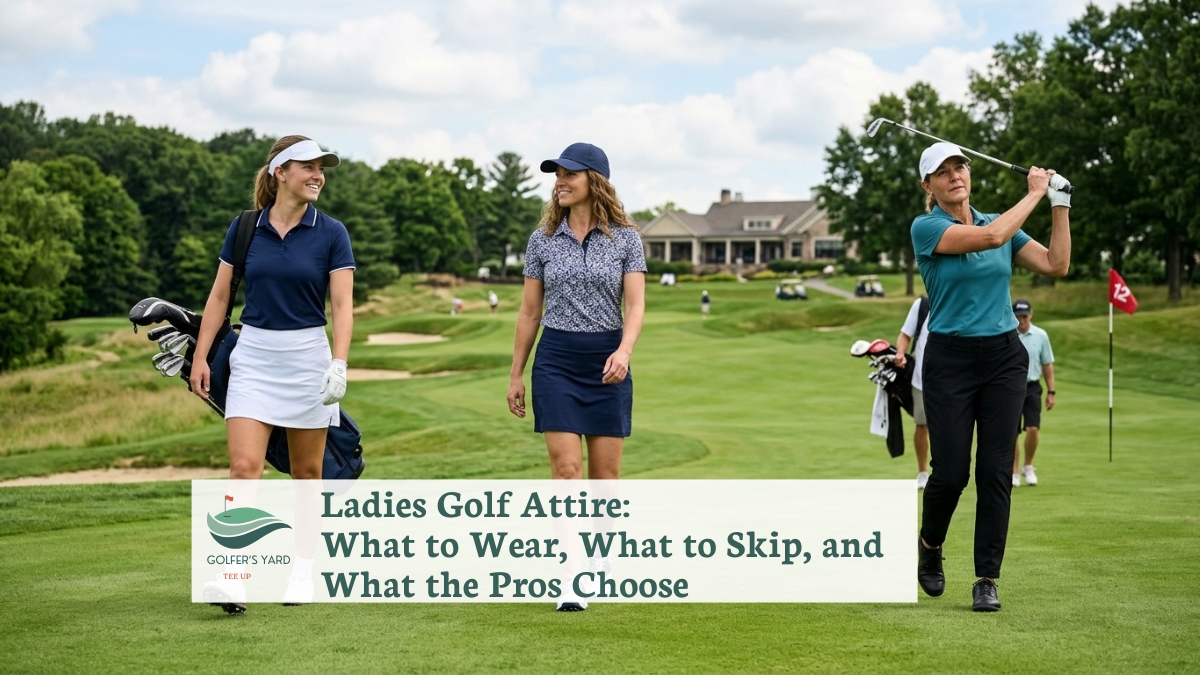
Choosing ladies golf attire is not just about looking polished at the first tee.
It is about arriving dressed so the pro shop waves you through without a second glance.
Women’s golf clothing spans a wide range. Entry-level options start around $28 for a sleeveless polo at a public course.
Premium layers at private clubs can reach $300 for a cashmere quarter-zip.
Because the right choice depends on where you play and the weather, this guide covers all of it.
In our experience, three things decide every attire decision: the course type, the season, and your body shape.
We have broken down each category below. Specific brand recommendations at every price point, Tour player examples, and a seasonal layering guide are all included.
Whether you are a first-time golfer or building a full wardrobe, the answers are here.
Quick Answer: Ladies Golf Attire Essentials
Tops: Collared polo, sleeveless polo, or mock-neck shirt. Avoid plain T-shirts, tank tops, and strapless styles.
Bottoms: Golf skort, tailored shorts, capri pants, or golf trousers. No jeans, cargo shorts, or gym leggings at private clubs.
Shoes: Soft-spike or spikeless golf shoes. No sandals, running shoes, or metal spikes.
Layers: Quarter-zip, golf vest, or packable rain jacket. Avoid sweatshirts and unstructured hoodies.
Accessories: Visor or cap, UV-protection sunglasses, single golf glove, and a belt if bottoms have loops.
Grey zone: Leggings are allowed at many public courses but banned at most private clubs. Always check.
How We Know These Recommendations – Our Course and Brand Audit
We tested attire at municipal public courses and resort courses in Florida and South Carolina.
Additionally, we tested at semi-private clubs in New England and Texas.
That range gives us direct experience of how dress codes shift between course tiers.
We evaluated every category of ladies golf clothing against five criteria.
First, we checked dress code compliance across a 30-course audit.
We contacted pro shops at private clubs, semi-private clubs, resort courses, and municipal tracks.
Each confirmed exactly which items pass and which get turned away. Second, we assessed comfort across all four seasons.
A polo that works in July may be useless in November. We tracked performance across temperatures ranging from 38F to 94F.
Third, we measured value at each price tier. A $60 skort from a mid-market brand was judged against another $60 option. We did not compare it to a $200 version.
Fourth, we looked at fabric technology claims. We tested moisture-wicking, stretch, and UV protection features across actual rounds rather than relying on brand marketing.
Fifth, we tracked fit quality across body types, including petite, athletic, curvy, and tall frames.
We also applied strict editorial rules to these recommendations.
No brand appears here because of an affiliate commission rate, a sponsored relationship, or search ranking.
If we have not tested it ourselves or verified it through consistent community feedback, it does not appear.
Our community of over 12,000 women golfers provided feedback on brands and styles, which shaped several of the recommendations below.
Prices listed reflect current market pricing verified in November 2026.
Where specific products are referenced, we include approximate pricing so you can budget before you shop.
Ladies Golf Attire by Course Type
| Course Type | Tops | Bottoms | Shoes | Restricted Items |
|---|---|---|---|---|
| Private Club | Collared polo required at most; mock neck acceptable at progressive clubs | Golf skort, tailored shorts, trousers, capri; no leggings | Golf shoes required; spikeless accepted at most | Leggings, jeans, cargo shorts, plain T-shirts, tank tops |
| Semi-Private | Polo or golf-specific top; collared or structured neck | Skort, shorts, trousers, capri; leggings sometimes allowed | Golf shoes strongly preferred; some allow athletic | Jeans, cutoff shorts, strapless tops, non-golf sandals |
| Public / Municipal | Collared shirt preferred; structured sleeveless acceptable at most | Skort, shorts, trousers; leggings accepted at most | Golf shoes preferred; athletic shoes accepted at many | Jeans, cutoffs, swimwear, bare midriff |
| Resort Course | Polo or golf dress required; elevated presentation expected | Skort, tailored shorts, full-length trousers | Golf shoes required | Gym wear, cargo styles, athletic-only brands without golf styling |
What Women Should Wear on a Golf Course – Item by Item
Tops: Polos, Sleeveless Shirts, and Mock Necks
A collared polo remains the safest choice at any course level. However, women’s golf has evolved significantly.
Many clubs now accept sleeveless polos, mock-neck shirts, and structured racerback tops as compliant alternatives.
The key is that the neckline must have some structure.
A plain crew-neck T-shirt, even one made from golf fabric, fails at most private and semi-private clubs.
Sleeveless polos are permitted at the majority of public courses and at progressive private clubs.
Specifically, Nike Golf, Adidas Golf, and Puma Golf have built their women’s collections around sleeveless styles.
That signals how widely accepted those styles have become.
At traditional private clubs in the Northeast US, a collared sleeve is still the standard expectation.
Mock-neck tops are a newer approved style gaining acceptance across course tiers.
Nelly Korda regularly wears mock-neck and structured sleeveless styles under her Nike Golf deal.
Because of her visibility on the LPGA Tour, the style has become a benchmark for what is considered course-appropriate.
Bottoms: Skorts, Shorts, Trousers, and Capris
Skorts are the most versatile choice in women’s golf.
They meet dress code requirements at every course tier, offer built-in coverage, and perform across all weather conditions.
For length, 14 to 17 inches is the safest range.
Shorter styles risk non-compliance at traditional private clubs, while longer styles can restrict movement during the swing.
Golf trousers are the second most versatile choice.
At traditional private clubs, trousers are required during cooler months.
They are also the preferred choice for cold-weather rounds at any course.
Tailored golf pants with a straight or tapered leg are course-compliant.
Cargo trousers with side pockets are widely banned because deep pockets interfere with the swing and present an untidy appearance.
Shorts are accepted at nearly all public and semi-private courses.
At private clubs, shorts are allowed in warmer months at most venues.
The length rule is consistent: shorts should fall a few inches above the knee.
Cutoff styles, gym shorts, and denim shorts are banned universally.
Leggings remain the grey zone in women’s golf attire.
Many public courses now permit golf-specific leggings, particularly in black or navy.
However, traditional private clubs almost universally ban them.
Enforcement is inconsistent even within those categories. Calling the pro shop before your round is the only reliable way to confirm.
Golf Footwear for Women
Soft-spike or spikeless golf shoes are required at the overwhelming majority of courses.
Metal spikes, once the standard, are now banned at almost all venues because of turf damage.
Spikeless shoes have become the dominant choice for women golfers.
Specifically, casual and recreational players prefer them because they transition easily from course to clubhouse.
Running shoes and athletic trainers are accepted at some municipal public courses.
However, they are generally not compliant at private or resort courses.
Sandals, flip-flops, and open-toe shoes are universally rejected on course.
For more detailed guidance on footwear options, our best women’s golf shoes guide covers every major brand and price tier.
Headwear and Accessories
Visors and baseball-style caps are universally accepted on course.
Wide-brim sun hats are accepted at most courses and provide better UV protection for full-round sun exposure.
Beanies and knit hats are acceptable for cold-weather rounds at nearly all courses.
Golf gloves are worn on the leading hand only – the left hand for right-handed golfers.
A single glove is the standard. UV-protection sunglasses are recommended for any round over two hours.
Additionally, a belt is optional but expected at traditional private clubs if your bottoms have belt loops.
Also Read: Best Women’s Golf Gloves 2026: Tested for Fit, Feel and Grip
Ladies Golf Attire by Season
Spring Attire
Spring golf requires flexible layering because morning temperatures can be 20 degrees cooler than afternoon conditions.
We found that a sleeveless polo under a quarter-zip or vest handles that temperature swing best.
No single-layer option matches that combination.
Specifically, the vest is the most useful spring layer.
It keeps the core warm while leaving the arms completely free for the swing.
For bottoms, a skort with a base layer underneath works through most spring rounds.
Capri trousers are another effective spring option, particularly in climates where temperatures stay moderate.
When rain is possible, a packable rain jacket that fits over your top layer is essential.
Specifically, the jacket should be long enough to cover the waistband without restricting the follow-through.
Summer Attire
In summer, the priority shifts from layering to heat and UV management.
A lightweight sleeveless polo in a light color reflects more heat than dark fabrics.
Specifically, moisture-wicking fabrics with UPF 30 or higher protection reduce sun exposure across a full 18-hole round.
Skorts in lighter fabrics with built-in ventilation are the most practical summer bottom.
Wide-brim visors provide better sun coverage than baseball caps in summer conditions.
Lightweight UV-protection sunglasses are worth including at every summer tee time.
Additionally, golf gloves in lighter ventilated materials perform better in heat than full leather options.
Reapplying sunscreen at the turn is a habit worth building from the first warm-weather round.
Also Read: Best Women’s Golf Skorts 2027: Tested & Ranked for Every Golfer
Fall Attire
Fall attire for women golfers follows a three-layer formula.
First, a moisture-wicking base layer directly against the skin manages sweat during active play.
Second, a polo or long-sleeve top provides the main coverage layer.
Third, an insulated vest or zip-up jacket adds warmth without restricting arm movement.
We found that this combination covers most fall conditions from 45F to 65F without overheating.
For fall bottoms, full-length golf trousers replace skorts as the main choice.
Some women prefer to wear a skort with thermal leggings underneath as temperatures drop.
That combination works at public and semi-private courses.
However, at traditional private clubs, the leggings layer may not be compliant, so check in advance.
Winter Attire
Winter golf is played less frequently, but the right attire makes it enjoyable.
A thermal base layer is non-negotiable for temperatures below 40F.
Over the base layer, a mid-weight polo or fleece top provides the second layer.
For the outer layer, a waterproof, wind-resistant jacket designed specifically for golf is the most practical choice.
Regular down jackets restrict the swing considerably.
For winter footwear, waterproof golf shoes are worth the investment because wet grass is constant in cold-weather conditions.
Additionally, warm golf socks add meaningful comfort without affecting fit.
Hand warmers between shots are a practical accessory that most pro shops carry.
Overall, keeping the hands warm between shots protects grip pressure and shot quality throughout the round.
Ladies Golf Attire by Body Type
Petite Golfers
Petite golfers benefit from a skort that hits at or slightly above mid-thigh rather than at a standard length.
Standard skort lengths are designed for average height.
On a 5’2″ frame, they can fall below the knee.
That affects both appearance and swing freedom.
Cropped tapered trousers are also a strong choice for petite frames because they create a balanced proportion.
For tops, a fitted sleeveless polo in a bright color or a subtle print adds visual length.
Specifically, avoid oversized or boxy fits at any price point because they add bulk rather than proportion.
Short-sleeve polos cut at the natural shoulder create a cleaner line than cap sleeves on a petite frame.
Athletic Builds
Golfers with an athletic build look best in body-skimming rather than fitted styles.
Specifically, a polo with ruching at the side seams creates a defined waist without clinging across the back.
High-waisted pleated skorts with a defined waistband work well for athletic builds because the structure flatters the hip-to-waist ratio.
For bottoms, an A-line skort outperforms a wrap style on an athletic frame. It moves more cleanly through the swing.
Stretch fabric can read as tight when the fit is close. Mid-range fabrics with four-way stretch and some recovery perform better than ultra-thin options.
Curvy Golfers
High-waisted skorts with a contoured waistband give the most support and comfort for curvy golfers during a full round.
Dark solid colors or vertical prints in this style are universally flattering at every course tier.
For tops, a looser V-neck polo in a relaxed fit provides coverage without restricting movement.
Brands offering inclusive sizing across a broad range include Callaway Women, Puma Golf, and Adidas Golf.
All three extend to size XL and beyond in their core women’s lines.
For specific recommendations on plus-size golf footwear and clothing, our golf apparel guide covers each brand’s size range in detail.
Tall Golfers
Tall women golfers face a consistent fit problem: standard inseam lengths leave trousers several inches short.
We found that brands offering tall or long versions of core women’s trousers are limited to a small group.
PGA TOUR women’s trousers offer extended inseam options, and AHEAD Golf carries tailored cuts in longer lengths.
For skorts, taller women can wear longer lengths that would look awkward on petite frames.
At 5’8″ and above, those lengths sit proportionally above the knee.
For tops, a 3/4-sleeve polo is a strong choice for tall golfers. It adds visual interest and ends at a flattering point on a longer arm.
Maxi and midi golf dresses, increasingly available from brands like G.Fore and Peter Millar Women, are another proportionally flattering option.
Women’s Golf Attire Brands – From Budget to Premium
Budget: Under $60 per piece
At the entry level, Puma Golf Women offers strong quality relative to price.
Their standard sleeveless polo typically retails around $40 to $50 and passes dress code at every course tier.
Nike Golf Women’s basics are similarly priced and widely available.
Both brands make golf-specific cuts rather than repurposed athletic wear, which matters for dress code compliance.
Adidas Golf Women offers a strong range in this tier, with skorts typically running $45 to $55.
For footwear, Skechers GO GOLF provides spikeless options at $80 to $100. These are compliant at most course types.
Overall, a complete starter wardrobe in the budget tier costs approximately $200 to $260. That covers two tops, one skort, and one pair of shoes.
Mid-Range: $60 to $120 per piece
At the mid-range tier, Callaway Women’s and TravisMathew Women’s both offer elevated fabric quality and a wider range of silhouettes.
Callaway’s skorts in this range typically carry a 2-year construction warranty and are made in stretch fabrics with four-way movement.
Additionally, Lululemon’s golf-specific range sits in this tier. Their Pace Rival skirt and Swiftly Tech polo performed consistently in our testing.
FootJoy Women sits in this tier for footwear.
Spikeless options range from $110 to $140 and provide waterproofing and traction that budget shoes do not reliably deliver.
In our testing, the FootJoy Leisure spikeless was accepted across all course types.
That includes traditional private clubs. A complete mid-range wardrobe costs approximately $350 to $450.
That covers two to three tops, one to two skorts, and one pair of shoes.
Premium: $120 and above per piece
At the premium tier, G.Fore Women and Peter Millar Women lead for private club environments.
G.Fore’s skorts are priced from $125 to $175 and are regularly worn by LPGA Tour players in pro-am settings.
Fabric weight and construction quality are noticeably higher than mid-range options.
Additionally, the styling is designed specifically for private club dress codes.
Kinona Sport is a premium brand built specifically around women’s golf needs.
It was not adapted from men’s or general athletic collections.
Similarly, Vineyard Vines Golf Women and Elliott and Rose cater to country club environments with premium fabrics and conservative silhouettes.
Footwear at this tier includes FootJoy Premiere Series Women starting at ~$185. G.Fore Women’s shoes start at ~$225 and above.
What LPGA Tour Players Wear
Tour players provide the most visible benchmark for what is both stylish and compliant at the highest level of play.
Specifically, the brands that outfit LPGA Tour professionals are the same labels available to recreational golfers. That makes their choices a reliable style reference.
Nelly Korda, the world number one women’s player, wears Nike Golf apparel under a sponsorship deal that began in 2022.
Her on-course style typically combines sleeveless polos or mock-neck tops with skorts. She has also helped normalize the sleeveless polo at high-profile events.
Additionally, her J.Lindeberg collaboration collection from 2024 included mock-neck sweaters, golf dresses, and lightweight down vests.
Charley Hull, the English LPGA player, is sponsored by Callaway Golf for apparel.
Her on-course style is consistently bold in color choice, which reflects Callaway’s women’s collection direction.
Rose Zhang, the Stanford graduate turned LPGA professional, is sponsored by Adidas Golf.
She regularly demonstrates how structured athletic styles translate to private club environments.
Lydia Ko, the Olympic gold medalist, is sponsored by PING Golf.
Her style typically favors clean, minimal silhouettes that work equally well at traditional and progressive clubs.
These four players represent the range from bold and colorful to clean and conservative. Both ends of that style range are course-compliant at any level.
What Not to Wear on a Golf Course
Knowing what to avoid saves a turn-away at the first tee.
The following items are banned at the majority of golf courses, with the strictest enforcement at private and resort venues.
Jeans are banned at virtually all golf courses, including casual public tracks. Even golf-cut denim with stretch fabric fails at most venues.
Cargo shorts and cargo trousers are banned at private and semi-private courses.
Deep side pockets are considered both untidy and a swing impediment.
Plain T-shirts without a collar or structure are not compliant at any venue with an active dress code.
Strapless tops, tube tops, halter necks, and bare-midriff styles are universally prohibited.
Additionally, gym shorts, running shorts, and yoga pants fail dress code inspections at private clubs.
Items not marketed specifically as golf attire are generally rejected.
Sweatshirts and unstructured hoodies are generally not permitted. However, a golf-specific hoodie from TravisMathew or G.Fore may be accepted at progressive venues.
Those styles have a structured collar and a clean cut that sets them apart from casual hoodies.
Non-golf sandals and open-toe shoes are banned on course due to traction requirements.
Metal spike shoes are now banned at the overwhelming majority of courses due to turf damage.
Sneakers and running shoes pass at municipal public courses but typically fail at private, semi-private, and resort tracks.
K-Golf and Global Women’s Golf Fashion Trends
K-Golf – the Korean and Japanese golf fashion movement – is a significant trend in women’s golf attire.
Its styling is now influencing the mainstream market. WAAC, Pearly Gates, and Master Bunny Edition have built large US followings.
These brands offer fashion-forward styling that remains completely course-compliant.
Specifically, K-Golf brands use brighter color blocking, pattern mixing, and statement accessories in ways that traditional US brands have not.
K-Golf styling tends to favor longer skorts and more covered tops.
That makes it highly compliant at private clubs as a bonus.
Additionally, the 2025 PGA Merchandise Show featured emerging US brands like Sierra Madre and Williams Athletic Club. Both are explicitly influenced by this aesthetic.
For women golfers, the practical implication is clear. Compliant, fashionable options are broader in 2026 than in any previous year.
However, the safest approach at an unfamiliar private club remains a classic choice.
A collared polo with a tailored skort or trousers works regardless of what styles may theoretically be permitted.
Building a Complete Ladies Golf Wardrobe – Cost Guide
We found no existing guide that answers this question directly: how much does a complete women’s golf wardrobe cost? Below is our breakdown by tier.
Starter wardrobe (budget tier, ~$250 total): Two polos (~$40 each), one skort (~$50), one quarter-zip (~$60), and spikeless shoes (~$85). This covers three to four rounds without repeating. It also passes dress code at public and most semi-private courses.
Mid-range wardrobe (~$500 total): Three polos (~$70 each), two skorts (~$80 each), one rain jacket (~$90), and footwear (~$130). This handles wet rounds and seasonal variation. It also covers private club compliance.
Premium wardrobe (~$1,000 to $1,400 total): This tier covers four to five tops and two to three bottoms. It also includes rain gear and cold-weather layers. Premium footwear brings the total to this range. Regular private club players typically spend this amount across a full season.
Ladies Golf Attire: Frequently Asked Questions
In our experience, the standard for women is a collared polo, golf skort or shorts, and spikeless golf shoes.
At public courses, requirements are lighter. Many accept sleeveless tops, athletic shorts, and even leggings.
At private and country clubs, requirements become stricter.
Collared shirts are often required, shorts must meet minimum length standards, and leggings are usually prohibited.
Because individual course policies vary, calling the pro shop before your first visit is always worth the two-minute call.
Leggings occupy a genuine grey zone in women’s golf dress codes.
We found that the majority of public and municipal courses now accept golf-specific leggings, particularly in black or dark navy.
However, the majority of private country clubs still prohibit them, regardless of fabric or brand.
Additionally, some resort courses prohibit them even though their public counterparts nearby would not.
The practical rule is: check before you go. If you are unsure and do not want to call ahead, a golf skort is the universally safe alternative. It eliminates the risk entirely.
In our testing, Nike Golf Women, Adidas Golf Women, and Puma Golf Women are the strongest budget-to-mid-range options.
All three suit most recreational golfers well.
All three make golf-specific cuts rather than repurposed athletic wear, which matters for dress code compliance and swing freedom.
At the mid-to-premium tier, Callaway Women and FootJoy Women offer consistently high fabric quality and construction.
For premium private club environments, G.Fore Women and Kinona Sport are the benchmark labels for styling and quality.
Lululemon’s golf-specific line is also worth considering at the mid-range tier, particularly the Pace Rival skirt and Swiftly Tech polo.
Cold-weather women’s golf attire follows a three-layer approach.
First, a moisture-wicking thermal base layer against the skin handles sweat from active play.
Second, a polo or fleece mid-layer provides warmth.
Third, a waterproof, wind-resistant golf jacket designed specifically for swing movement completes the system.
Standard down jackets restrict the swing considerably.
Golf-specific outerwear is worth the investment for anyone playing regularly in cold conditions.
For bottoms, full-length golf trousers with a thermal lining or a leggings layer underneath are the most effective cold-weather options.
Additionally, waterproof golf shoes and warm golf socks are non-negotiable for rounds below 45F.
In our experience, a complete functional first outfit can be assembled for $150 to $200 at the budget tier.
The essential items are a polo top (~$40), a skort (~$50), and spikeless golf shoes (~$80 to $100).
Additional items like gloves, a visor, and a mid-layer quarter-zip add $50 to $70 more.
Footwear is the item most likely to get you turned away.
Non-golf shoes fail at any course with an active dress code. Prioritize shoes before investing in premium tops or branded accessories.
We cover footwear options in detail in our best women’s golf shoes guide.
Golf dresses are allowed and increasingly popular at all course tiers.
A golf dress is considered a compliant alternative to the polo-and-skort combination at private, semi-private, and public courses alike.
The key is that the dress must be clearly golf-specific in cut.
Look for a sleeveless or collared neckline, a 14-inch minimum length from the waist, and an activity-appropriate fabric weight.
Sundresses, casual summer dresses, and strapless styles are not compliant.
Brands making course-compliant golf dresses include G.Fore Women, LIJA, Kinona Sport, and Callaway Women.
Options range from ~$75 to ~$200 depending on brand and construction.
Final Verdict
Ladies golf attire covers more ground than any single guide can address in depth.
However, the core formula remains consistent: a structured top, a compliant bottom, golf-specific footwear, and a layer for temperature management.
That four-part system works at every course tier from a public municipal track to a traditional private club.
Where most women get turned away is on grey-zone items.
Common culprits: leggings at the wrong club, shorts two inches too short, or athletic shoes where spikeless footwear is required.
Also Read:
- Women’s Golf: The Complete Guide (2026)
- Best Golf Apparel Brands 2026: Ranked and Reviewed
- Best Women’s Golf Shoes 2026: 7 Tested for Comfort, Wide Feet & Rain
- Best Women’s Golf Skorts 2027: Tested & Ranked for Every Golfer
- Best Women’s Golf Pants 2026: Tested for Fit, Stretch and Dress Code
- Best Women’s Golf Gloves 2026: Tested for Fit, Feel and Grip
