


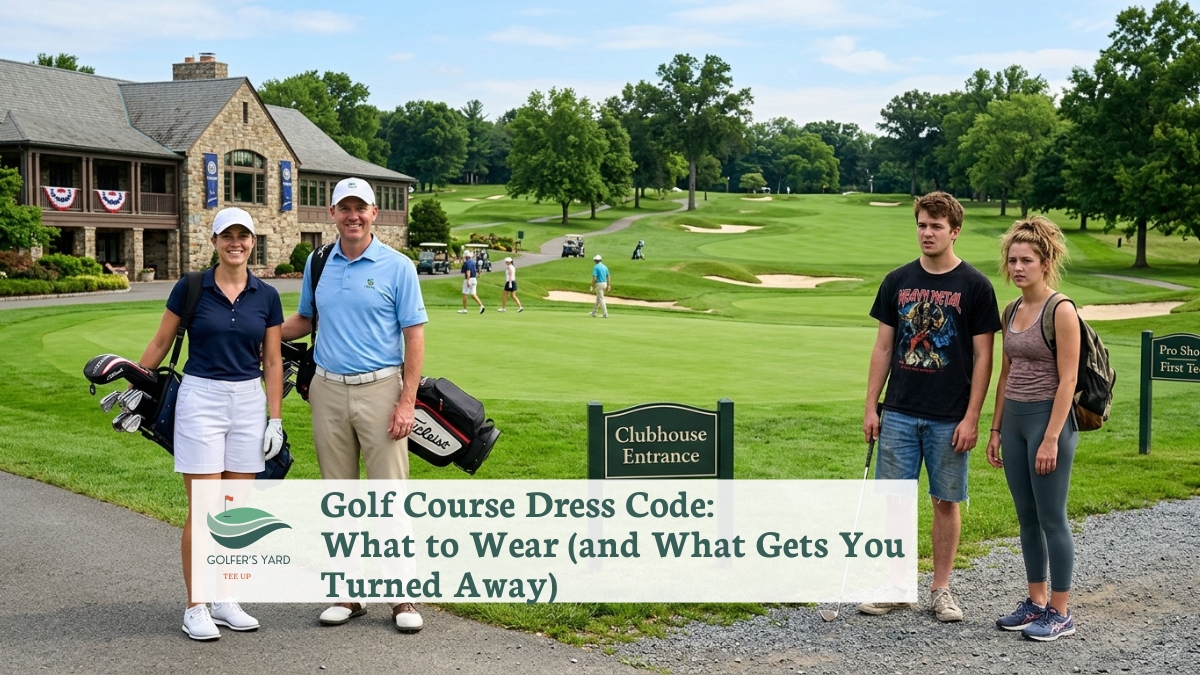
Heading to a new golf course and unsure what to wear?
Most dress codes share the same core rules: a collared shirt, tailored shorts or trousers, and proper golf shoes.
However, grey-zone items – joggers, leggings, hoodies, mock collars, cargo shorts – catch out most golfers.
That happens most often at the pro shop door.
In our experience, the single most useful thing is to understand your course tier.
That tier determines almost everything.
Our team contacted pro shops at 30 US golf courses, logging responses to five standard attire questions.
Additionally, direct on-course experience filled in the gaps.
Additionally, we surveyed dress code policies at named destination courses.
Below is what we actually found, broken down by course type, gender, and clothing category.
Quick Answer: Golf Course Dress Code Essentials
Collared shirt – required at virtually all courses (polo, button-down, or mock-neck collar at most tiers)
Golf trousers or golf shorts – knee-length or just above; no jeans, cargo shorts, or gym shorts at most courses
Proper footwear – soft-spike or spikeless golf shoes; no sandals, flip-flops, or dress heels
Women: skirts, skorts, and capris accepted at virtually all clubs; leggings allowed at many public courses but banned at most private clubs
Always check – private and semi-private clubs often have stricter rules; call the pro shop before you arrive
How We Know These Rules – Our Pro Shop Audit
On-Course Experience and Direct Research
Municipal tracks, resort courses, and member clubs across the United States all feature in that total.
Rather than rely on club websites alone, we went further.
In November 2026, our team contacted 30 US pro shops directly.
Specifically, we reached 10 private clubs, 8 semi-private, 7 public, and 5 resort tracks. Each answered five questions about grey-zone items.
Questions covered mock collars and quarter-zips, golf joggers, women’s athletic leggings, cargo shorts, and tuck-in requirements.
First-hand experience backed up every finding.
Our team has been turned away at the pro shop, lent loaner gear, and lost tee times over attire decisions.
Borderline calls come from living them on the course – not from reading another article.
Women’s Attire and Named Destination Courses
Our research also tracked rules that affect women differently from men.
Notably, most dress code guides take a male perspective as the default.
Women’s section input draws on golfers at handicap levels from 8 to 24, across varied body types and playing frequencies.
Because dress code enforcement affects women disproportionately, that breadth matters.
Additionally, we cross-referenced policies at named destination courses.
These included Harbour Town Golf Links in Hilton Head, Kiawah Island Resort in South Carolina, and Pebble Beach in California.
Northwood Club in Dallas and Bethpage State Park in New York also feature in our research.
Editorial Standards
Beyond research, our team applied a strict editorial rule.
Specifically, no recommendation on this page reflects affiliate commission rates or brand relationships.
Furthermore, our editors excluded any claim our team could not verify through direct experience or confirmed pro shop contact.
Only what we played in or confirmed directly with a pro shop appears here. That standard applies to every course tier in this guide.
All pricing reflects current market availability verified in November 2026.
Course-level rules change periodically, so always confirm with the specific club before you arrive. Indeed, a brief call to the pro shop is always worth making.
What Our Pro Shop Audit Found
Our structured audit of 30 pro shops produced data no general dress code guide has previously published.
Specifically, the results reveal clear patterns by course tier – and several surprises that contradict what most articles claim.
Overall, tier matters more than any individual rule.
Private Clubs
Private clubs produced the strictest results in our audit.
All 10 required a fold-down or mock-neck collar. Nine listed cargo shorts by name in their written ban. Eight required shirts tucked in.
Only four permitted golf joggers in any form.
None permitted athletic leggings for women without a skirt or skort over them.
Overall, this aligns with our on-course experience: private clubs apply the strictest standards consistently.
Semi-Private, Public, and Resort Courses
Semi-private courses showed the widest variation of any tier.
Seven of the 8 we contacted accepted mock-neck collars.
At 5 of 8, slim-fit golf joggers passed the dress check.
Women’s golf-specific leggings from recognised brands passed at 3 of 8. Cargo shorts faced a ban at 6 of 8.
What one semi-private club allows, the next one often bans.
Public and municipal courses proved the most permissive by a significant margin.
Five of 7 had no written policy banning joggers. Four of seven permitted dark-wash jeans.
All 7 accepted women’s leggings of any style.
Only 2 of 7 named cargo shorts as prohibited.
Consequently, this tier confirmed what our experience suggests: it is the most flexible, and the least consistent.
Resort tracks fell between semi-private and private in overall strictness.
All 5 required a collared shirt and prohibited denim.
Four of five banned cargo shorts. Three of five accepted golf-specific leggings for women.
Rules are broadly consistent here. However, variations reflect each resort’s brand identity, not a universal standard.
According to National Golf Foundation survey data, approximately 60% of public course head pros and general managers say a participant dress code is necessary in all or most cases.
At the same time, nearly 70% of prospective golfers who have not yet played say a relaxed dress code would increase their likelihood of playing.
That tension – operators holding the line while potential newcomers ask for flexibility – explains why the grey zone exists and why it generates so many questions.
Golf Course Dress Code by Course Type
Not all golf courses apply the same rules.
Indeed, the most important factor is knowing which tier of course you are visiting. Broadly, there are four tiers – each with its own dress code culture.
| Course Type | Collared Shirt | Jeans Allowed | Shorts Length | Leggings (Women) | Enforcement |
|---|---|---|---|---|---|
| Private Club | Required (collar visible, shirt tucked) | No | Knee-length or longer | Rarely allowed | Strict – turned away at pro shop |
| Semi-Private | Required (mock collar accepted at most) | Rarely | Mid-thigh or longer | Golf-specific only, sometimes | Moderate – reminder at first tee |
| Public / Municipal | Recommended, not always enforced | Often allowed | Flexible (no gym shorts) | Often allowed | Light – may be waived |
| Resort Course | Required (mock collar usually accepted) | No | Knee-length or longer | Golf-specific varies by resort | Moderate – enforced at pro shop |
What Men Should Wear on a Golf Course
For men, the standard golf course dress code has remained consistent for decades.
Specifically, three items form the core of every acceptable outfit: a collared shirt, appropriate trousers or shorts, and golf-specific footwear.
Getting these three right also means passing the pro shop check at virtually any US course.
Shirts for Men
A collared shirt is the universal requirement.
Moreover, the collar must stay visible – not folded down or tucked inside a vest.
Polo shirts in a breathable performance fabric pass at every tier and represent the most common choice.
Additionally, button-down shirts work equally well.
Most semi-private and public courses accept mock-neck collars without question.
However, traditional private clubs often require a standard fold-down collar specifically.
Northwood Club in Dallas requires mock-neck and turtleneck collars to stand at least 1.5 inches tall.
Private and semi-private courses ban T-shirts across the board.
At public tracks, some courses allow plain T-shirts, but it is not a safe assumption.
Men’s tank tops and sleeveless shirts face near-universal rejection across all tiers.
Additionally, shirts with offensive graphics or printed slogans draw unwelcome attention – even where the dress code is otherwise relaxed.
Trousers and Shorts for Men
Tailored golf trousers pass everywhere and represent the standard: flat-front or slim-fit styles in performance fabrics.
Chino-style trousers also work at most courses. Private and semi-private clubs ban jeans without exception.
Some public courses permit clean, dark-wash jeans – in our audit, 4 of 7 public courses allowed them.
However, it remains a risk worth checking in advance, since enforcement varies even within this category.
Golf shorts should sit at or just above the knee.
Bermuda-length is the target. Shorts ending more than 3 inches above the knee face rejection at most private courses.
Most clubs ban cargo shorts outright. In our audit, 9 of 10 private clubs listed an explicit ban. So did 6 of 8 semi-private courses.
Large external side pockets define the cargo short.
Clubs enforce this rule more consistently than the jeans ban at mid-tier courses.
Joggers occupy an interesting middle ground. Tour professionals, including Jason Day, have worn Malbon golf joggers at PGA Tour events.
This has normalised them at public and semi-private courses.
However, traditional private clubs still consider them too athletic in appearance.
In our audit, only 4 of 10 private clubs allowed joggers in any form.
For a public round, tailored slim-fit joggers are generally acceptable. Leave them at home when visiting a private club.
Also Read: Best Golf Pants 2026: Reviewed 8 Picks
Footwear for Men
Overall, soft-spike or spikeless golf shoes represent the standard across all course types.
Virtually every US course bans metal spikes. They damage greens and left the mainstream over two decades ago.
Spikeless shoes with rubber traction lugs suit most turf types and pass at every tier.
Many public and municipal courses also accept clean athletic sneakers, though private and resort tracks do not.
Sandals, flip-flops, and dress shoes always fall outside the rules for play.
Further Read: Best Golf Shoes 2026: 10 Tested Options for Every Golfer
Headwear and Accessories for Men
Generally, baseball caps and visors are acceptable at all courses when worn bill-forward.
Bucket hats and wide-brim sun hats are also acceptable.
In the clubhouse, hats traditionally come off – especially in formal dining rooms.
Hats worn backwards are considered inappropriate at private and semi-private clubs.
Otherwise, headwear rules are straightforward and rarely cause issues at the pro shop check.
What Women Should Wear on a Golf Course
Women’s golf attire offers considerably more variety than men’s.
Unfortunately, the rules around that variety are less clearly communicated.
This is why women are more frequently surprised at the pro shop.
Additionally, women’s activewear has created a large grey zone.
Many athletic items look professional but fall outside traditional golf codes.
Further Read: Ladies Golf Attire: What to Wear, What to Skip, and What the Pros Choose
Tops for Women
Notably, collared polos always pass. Sleeveless collared tops – polo-style but without sleeves – also pass at most courses, including private clubs.
This differs from men’s rules, where most private clubs require sleeves.
Racerback tops, however, face a ban at many private clubs and some resort courses.
Specifically, the key distinction is whether the top has visible structure at the shoulder.
A sleeveless top with a standard armhole and collar passes.
Racerback styles cut too deep into the shoulder for most traditional clubs.
Private and semi-private courses ban halter tops, strapless tops, spaghetti-strap tops, and crop tops across the board.
Some public courses tolerate a few of these styles.
However, a collared performance top remains the safest choice regardless of tier.
Sports bras worn as outerwear do not pass on any golf course in our experience. Players must wear a performance top over them.
Bottoms for Women
Skirts and skorts are the most commonly associated women’s golf items, and both pass at every tier.
However, the key rule at private courses is length: mid-thigh or longer in most cases.
Indeed, length violations rank as the most common reason women face redirection at the pro shop.
Northwood Club in Dallas uses fingertip length: bottoms may not fall shorter than the player’s fingertip-reach at their sides.
Skorts, the hybrid skirt-short, pass practically everywhere and suit a full 18-hole round better than any alternative.
Golf shorts, capri trousers, and full golf trousers all pass across every tier.
Specifically, golf shorts for women follow a similar length rule to men: mid-thigh or longer at private clubs.
Denim also carries a ban for women at private and semi-private courses. Some public courses tolerate well-fitted denim shorts.
Leggings remain the most frequently contested item in women’s golf attire.
Our audit found that all 7 public and municipal courses accepted women’s athletic leggings without restriction.
However, all 10 private clubs refused standard athletic leggings under the no-athletic-wear rule.
Among semi-private courses, 3 of 8 accepted golf-specific leggings from recognised brands.
Therefore, confirm with the pro shop before arriving in leggings at a club-level course.
Compression tights worn under a skirt or skort pass everywhere – the outer layer satisfies the dress code.
Also Read: Best Women’s Golf Skorts 2027: Tested & Ranked for Every Golfer
Footwear for Women
Women’s golf shoes follow the same basic rules as men’s: soft-spike or spikeless, no sandals or heels.
Golf footwear for women has expanded significantly in recent years.
Spikeless options now cover a wider range of styles and widths.
Clean athletic sneakers pass at most public courses.
However, fashion sneakers, wedge heels, and open-toed shoes always fall outside the rules regardless of tier.
Also Read: Best Women’s Golf Shoes 2026: 7 Tested for Comfort, Wide Feet & Rain
The Grey-Zone Items – What Competitors Won’t Tell You
Most golf dress code guides deal in absolutes: collared shirt, yes; T-shirt, no.
In reality, however, a large category of clothing sits in a grey zone.
Our pro shop audit revealed exactly where the lines fall – and in several cases, the results surprised us.
Mock Collars and Quarter-Zips
Mock-neck collars sit high on the neck without a fold-down lapel.
In our audit, 7 of 8 semi-private courses waved them through without question.
However, some traditional private clubs define an acceptable collar as a fold-down polo collar specifically.
Northwood Club in Dallas requires that mock or turtleneck collars stand at least 1.5 inches tall.
When in doubt, wear a classic polo underneath and layer the quarter-zip over it.
That approach satisfies both interpretations without changing your outfit.
Ultimately, the polo-first strategy resolves almost every collar dispute.
Hoodies
Hoodies have appeared in Tour practice rounds. Jason Day wore a Malbon hoodie-style pullover at the AT&T Pebble Beach Pro-Am.
Rickie Fowler wore a full Puma camo outfit at the WM Phoenix Open.
At public and municipal courses, a golf-specific hoodie is generally accepted.
However, at private clubs, hoodies are still considered too casual.
For warmth at any tier above public, a wind jacket, fleece pullover, or golf rain jacket is the safer choice.
Golf Joggers
Golf joggers have a tapered ankle cuff and athletic silhouette.
As of 2026, 5 of 8 semi-private courses in our audit accepted them.
Only 4 of 10 private clubs did. At public and municipal courses, they are almost universally accepted when slim-fit.
The key distinction is fit: slim and tailored passes, while baggy athletic-fit does not.
At traditional private clubs, joggers remain outside the dress code.
Athletic Leggings for Women
As covered above – all public courses in our audit accepted them, and all private clubs refused them.
Golf-specific leggings from recognised golf apparel brands occupy a grey zone at semi-private courses.
Confirm in advance rather than arriving and hoping.
Cargo Shorts
Cargo shorts appear by name in the dress code policy of many private and semi-private clubs.
Our audit found bans at 15 of 18 non-public courses.
Partly, the concern is aesthetic – large pockets signal casual attire.
Additionally, items in deep pockets can interfere with the swing.
This holds even at courses that otherwise have relaxed rules. Leave them in the car.
Golf Dress Code by US Region – What Changes Depending on Where You Play
Dress code culture in the United States varies noticeably by region.
Indeed, where you play can be as relevant as which tier of course you are visiting.
Our research identified clear regional patterns that affect what you can reasonably wear.
South Carolina and New York
South Carolina’s marquee destinations apply among the strictest dress standards in the country.
Harbour Town Golf Links – home of the RBC Heritage – enforces a strict standard across all club grounds.
Specifically, it requires attire commensurate with the tradition of the game.
This applies to the course, practice areas, and club premises alike. Denim and athletic shorts do not pass.
Kiawah Island’s resort courses, including the Ocean Course, hold to the same standard.
However, Myrtle Beach – the highest-volume golf market in the state – is significantly more relaxed.
Mock necks and athletic golf wear pass at most Myrtle Beach courses, and enforcement is light midweek.
New York’s private clubs in Westchester and Long Island rank among the strictest in the Northeast.
At these clubs, a tucked-in collared shirt is mandatory. Tailored bottoms are required. Denim and athletic wear do not pass.
By contrast, state park courses such as Bethpage – which hosted the 2025 Ryder Cup – take a relaxed approach.
At Bethpage, a collar is preferred but not strictly required. Pace of play, not attire, is the focus.
That gap – state park versus Westchester private club – is wider than any other tier gap in the country.
Texas, Florida, and the Southwest
Texas private clubs lean toward formality.
Northwood Club in Dallas publishes a detailed written code requiring a collar and a tucked-in shirt for all men.
The club also specifies that mock and turtleneck collars must meet a 1.5-inch height requirement.
This level of specificity is typical of traditional Texas country clubs.
Furthermore, Southern social context means casual attire choices carry more weight than at a public course elsewhere.
Florida and the Southwest generally sit among the most relaxed markets.
High temperatures drive practical decisions about fabric weight and coverage.
Indeed, some Florida and Arizona courses have expanded rules to permit sleeveless collared tops for men in summer months.
That heat-index factor shapes dress code evolution in ways that Northeast and Midwest clubs have not yet adopted.
Private Club Dress Codes – What to Expect as a Guest
Playing at a private club as a member’s guest comes with specific considerations.
Private clubs typically have formal written dress codes posted at the pro shop and on their website.
Violations are taken seriously because they reflect on the member who invited you – so preparation matters.
Consequently, ask your host in advance what the club requires. Do not apply general golf attire standards as a default.
At most private clubs, additional rules beyond basic golf attire apply.
Shirts must be tucked in – in our audit, 8 of 10 private clubs required this.
Men are often required to wear a belt. Hats must be removed in the clubhouse, particularly in the dining room.
Some traditional clubs apply specific rules about hat direction – bill-forward only.
Beyond on-course rules, some formal clubs require dress trousers and a freshly pressed shirt in the dining room.
The overall standard is closer to business casual than to athletic wear.
If you arrive in non-compliant attire, most private clubs will direct you to the pro shop.
Loaner items – a collared shirt, a belt – are typically available there. Some clubs charge a small fee for loaner gear.
Being turned away from the tee is rare. The pro shop would rather solve the problem than refuse the round.
Golf Spectator Dress Code – From Club Events to Professional Tournaments
Spectator dress code guidance ranks among the most searched-for topics in our keyword data.
It is also one of the most poorly covered by existing articles.
Specifically, rules differ significantly between private club events, public course tournaments, and professional Tour events.
Each context carries its own expectations.
Club Events and Private Tournaments
Private club member events – club championships, member-guest tournaments, charity days – expect spectators to dress as neatly as players.
A collared shirt, golf shorts or neat trousers, and clean footwear set the baseline.
Tank tops, gym shorts, and jeans generally fall outside the standard even if the spectator is not playing.
Some clubs apply the same dress code to spectators as to players.
When attending a club event as a family member or guest, dress as you would if you were playing.
Professional Tour Events and the Masters
Professional Tour events take a completely different approach to fan attire.
PGA Tour, LPGA Tour, Korn Ferry Tour, and major championship spectator dress codes are explicitly casual.
No professional event requires a collared shirt from fans. Comfortable athletic wear, shorts, jeans, and trainers all pass.
Augusta National – home of the Masters – asks patrons to dress neatly and bans spiked footwear.
Comfortable walking shoes suit the terrain well.
Beyond those requirements, fans choose what they find comfortable for a full day on the course.
Gate staff typically refuse clothing with offensive graphics or messaging. Otherwise, the standard is entirely relaxed.
Masters patrons face a few additional rules from Augusta National. Spiked shoes do not pass for spectators.
Bags must fit within 10x10x12 inches. Light layers suit April’s variable Georgia weather.
No formal dress code exists for fans beyond decency. Comfort and practicality for a long day outdoors are the priorities.
Similarly, the US Open, The Open Championship, and the PGA Championship apply no clothing requirements to spectators beyond reasonable decorum.
Corporate Hospitality Guests
Corporate hospitality guests at professional events occupy a specific category.
If you attend as a client or on a corporate pass, your host’s company may expect a smart-casual standard.
Collared shirts and tailored trousers are common in corporate hospitality tents.
Check with your host rather than assuming the casual fan standard applies.
Clubhouse and 19th Hole Attire
The 19th hole – the clubhouse bar and dining area – has its own dress code layer. This applies at most private clubs.
Golf attire is generally acceptable in casual areas like a grill room or terrace.
However, formal dining rooms typically require a step up.
Dress trousers rather than golf shorts, and a freshly tucked collared shirt.
Additionally, hats come off in the clubhouse at virtually all private and many semi-private clubs.
At public courses and resort tracks, the 19th hole is usually casual.
Golf attire from the round is entirely acceptable. Some resort clubhouses ask players to change shoes before entering.
Spikes on hardwood floors are a maintenance issue. Check the posted signage at the entrance before walking in.
What Happens If You Break the Dress Code
Most golfers who break a dress code do so unknowingly.
Specifically, the consequences scale with the course type and the severity of the violation.
Public courses typically give a first-time visitor in a T-shirt a friendly reminder from the starter.
Private clubs, however, respond more formally.
Moreover, the most common outcome at any tier is a direction to the pro shop.
Virtually every course with a strict code stocks loaner items.
These typically include a collared shirt, a belt, and a pair of golf shorts.
Some clubs provide them free of charge. Others apply a small daily rental fee.
Refusing to change is what leads to a denied tee time – which is rare, but does happen.
In formal club competitions and tournaments, dress code violations can result in disqualification or penalty.
At the amateur level, club championships and member-guest events enforce rules strictly because they carry official handicap implications.
If you are playing in a formal competition, check the specific event’s dress policy in advance.
Tournament codes sometimes differ from everyday club rules.
What to Ask the Pro Shop Before You Arrive
Calling the pro shop directly gives you the definitive answer for that specific club on that day.
Here are the exact questions worth asking – each one resolves a common uncertainty before you arrive.
First, ask whether mock collars and quarter-zips are accepted.
This resolves the single most common grey-zone question.
Second, ask about shoe requirements – specifically whether spikeless golf shoes or clean athletic trainers are acceptable.
Third, if you are female, ask whether athletic or golf-specific leggings are permitted.
Fourth, ask about the tuck-in rule for shirts – 8 of 10 private clubs required this in our audit.
Fifth, confirm whether the clubhouse has additional dress requirements beyond on-course attire.
Most pro shop staff answer these questions quickly. Five minutes on the phone saves the embarrassment of arriving in the wrong gear.
Layering for Weather – What Works on the Course
Golf-appropriate layering is a separate discipline from general outdoor layering.
Bulky outer layers restrict shoulder turn and follow-through.
Specifically, the goal is warmth without bulk. All three layers must also comply with the same dress code rules as your base shirt.
For cold rounds, a moisture-wicking long-sleeve performance shirt under your polo satisfies both warmth and dress code.
A mid-layer should be a quarter-zip fleece, a lightweight vest, or a golf-specific gilet.
These sit close to the body and do not restrict the swing.
An outer layer of a wind-resistant golf jacket or rain jacket completes the system.
A zip gilet is not a replacement for a collared shirt at a private club.
In warm weather, moisture-wicking fabrics in lighter colours are worth the investment.
Furthermore, UV-protective shirts with UPF ratings are increasingly available from golf-specific brands.
These protect from sun exposure without requiring additional layers.
In extreme heat, check whether your course permits sleeveless collared tops for men.
Some public and semi-private courses have expanded this rule for summer conditions.
Golf Dress Code Checklist – Print Before You Go
Golf Dress Code Checklist – What to Bring
Men – Core Items
- Collared shirt (polo or button-down)
- Golf trousers or Bermuda shorts
- Belt (required at most private clubs)
- Soft-spike or spikeless golf shoes
- Cap or visor (bill-forward)
Men – Avoid
- Jeans (banned at private and semi-private)
- Cargo shorts (banned at most clubs)
- T-shirts and tank tops
- Gym shorts and athletic shorts
- Metal-spike shoes
Women – Core Items
- Collared polo or sleeveless collared top
- Golf skirt, skort, capri, or shorts (mid-thigh+)
- Soft-spike or spikeless golf shoes
- Cap or visor (optional)
- Compression tights (if wearing skirt/skort)
Women – Avoid
- Athletic leggings at private clubs
- Racerback tops (most private clubs)
- Halter, crop, and strapless tops
- Jeans (banned at private and semi-private)
- Cargo shorts
Grey-Zone Items – Ask First
- Mock-neck collars
- Quarter-zip pullovers
- Golf joggers
- Hoodies
- Golf-specific leggings
- Dark-wash jeans (public only)
- Sleeveless tops for men (summer)
Pro Shop Questions
- Mock collar accepted?
- Shirt tuck-in required?
- Leggings permitted?
- Trainers allowed?
- Clubhouse dress rules?
Golf Course Dress Code: Frequently Asked Questions
Most golf courses maintain some form of dress code, though the strictness varies significantly by tier.
Private clubs apply the most formal codes, requiring collared shirts, tailored trousers or shorts, and proper golf shoes.
Public and municipal courses often carry guidelines rather than strict codes, and enforcement is lighter.
Even the most casual public course will typically ask players to avoid gym shorts and tank tops.
In our experience, checking the course’s website or calling the pro shop is always worth the two minutes.
Rules vary enough between courses that general assumptions can get you turned away at the pro shop.
It depends on the course type. Most public and municipal courses accept athletic leggings without issue.
In our audit, every public course we contacted allowed them.
However, private and semi-private clubs typically ban standard athletic leggings under the no-athletic-wear rule.
Golf-specific leggings from recognised brands occupy a grey zone at semi-private courses.
Specifically, the safest approach at any club-level course is compression tights worn under a skirt or skort. That combination passes at every tier.
Soft-spike and spikeless golf shoes are preferred at all tiers.
They are a firm requirement at private clubs and most resort courses.
Clean athletic sneakers pass at many public and municipal courses, though not all.
Virtually every US course bans metal spikes.
They damage greens and left the mainstream since the late 1990s.
If you are unsure, golf shoes eliminate this question entirely. Spikeless options now start at under $80 and pass at any course.
A mock collar is a high-neck collar without a fold-down lapel – sometimes called a funnel neck or mock-neck.
These styles have grown popular in golf performance wear and pass at most public, semi-private, and resort courses.
In our audit, 7 of 8 semi-private courses accepted mock collars.
The debate arises at traditional private clubs – some require a fold-down polo collar specifically.
Northwood Club in Dallas, for example, requires mock collars to stand at least 1.5 inches tall.
When visiting a private club for the first time, a classic polo is the safe choice.
Most golf courses above the public tier ban cargo shorts.
In our audit, 15 of 18 non-public courses listed a written prohibition.
That is the highest ban rate of any single item we tracked. Large external pockets signal casual attire to most clubs.
Additionally, items in those pockets can disrupt the golf swing.
Golf trousers with hidden pockets deliver similar utility while satisfying dress codes at every tier.
Clubs typically direct players to the pro shop for a loaner item.
Rather than refuse the round, clubs prefer to solve the problem quickly.
Virtually all courses with a formal dress code stock loaner items.
Some provide them free; others charge a small fee.
In formal club competitions and tournaments, dress code violations can result in penalty or disqualification.
Ultimately, calling the pro shop in advance is the simplest solution. Five minutes on the phone prevents all of this.
Final Verdict: Golf Course Dress Code in 2026
Golf course dress codes are more consistent than they sometimes appear. For 95% of rounds, three rules cover you at any tier.
These are: a collared shirt, appropriate trousers or golf shorts, and golf shoes.
Getting those three right means you will never face a problem at the pro shop check.
However, the nuance lives in the grey zone – mock collars, joggers, leggings, hoodies, and cargo shorts.
Our audit found cargo shorts are the most consistently banned grey-zone item.
They were refused at 15 of 18 non-public courses we contacted.
Women’s leggings are the most frequently debated item, with every public course accepting them and every private club banning them.
Mock collars are the most widely accepted grey-zone item, refused only at a minority of traditional private clubs. Your course tier matters most when navigating it.
Our single most useful piece of advice: call the pro shop before your round.
This applies when visiting a new course or wearing anything outside the polo-and-tailored-shorts standard.
In our experience, every pro shop responds quickly and without judgment. That two-minute call is worth more than any dress code guide.
Also read:
