




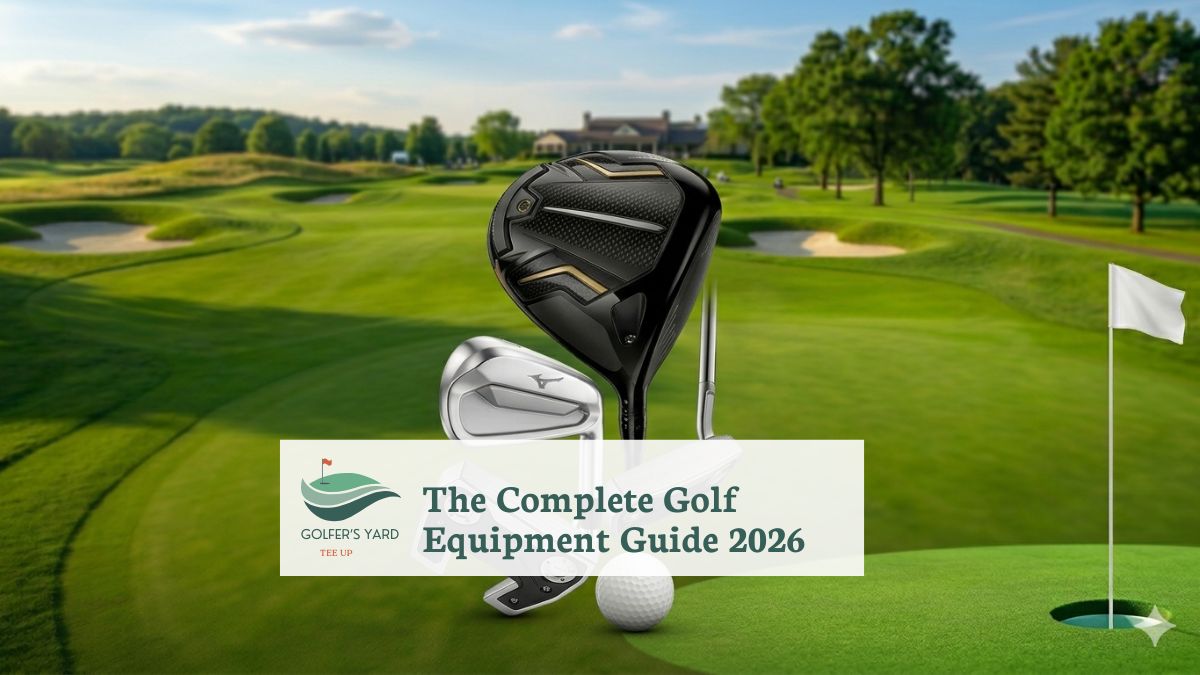
This is GolfersYard’s master golf equipment guide. Every equipment category links to our full tested reviews. If you are brand new to golf, start with our beginner’s guide to golf first.
Affiliate disclosure: GolfersYard earns a commission on purchases made through links on this page at no extra cost to you. All picks are based on independent testing. No brand pays to be featured.
What This Golf Equipment Guide Covers
This golf equipment guide is built around one principle: the right club for your swing speed and handicap outperforms the right brand name for someone else’s game.
Consequently, every section below starts with a clear decision filter, not a list of whatever the tour pros endorse, so you spend money on what actually improves your scores.
Club Champion fitting data shows that 60% of golfers who visit a launch monitor end up selecting a different configuration from what they planned to buy.
As a result, this golf equipment guide puts fitting decisions before brand decisions at every price level.
Use the section links in this golf equipment guide to jump to what you need:
- Drivers
- Irons
- Putters
- Wedges
- Hybrids and fairway woods
- Golf balls
- Bags and accessories
- Club fitting: when and why
- Golf brand guide
- Budget guide by level
Drivers
The driver market in 2026 is more competitive than at any point in independent testing history.
Specifically, GolfLens’s aggregated five-source analysis found the top-10 drivers separated by just 5.2 yards of carry distance, which means fitting matters more than head model selection within that competitive field.
TaylorMade’s Qi4D won MyGolfSpy’s 42-driver, 20,580-shot 2026 test as the only driver to rank in the top six for distance, accuracy, and forgiveness simultaneously.
Consequently, the Qi4D is the clearest overall recommendation in this golf equipment guide for golfers swinging at 90 to 110mph.
Furthermore, GolfLens confirms the performance gap between the GT3 and $600 flagships is within the 5.2-yard margin across the whole field.
For golfers swinging above 95mph, that gap is commercially irrelevant.
Our complete driver guides:
- Best Golf Drivers 2026: Tested by Swing Speed
- Best Drivers for High Handicappers 2026
- Best Drivers for Mid Handicappers 2026
- Best Drivers for Beginners 2026
Irons
Iron category selection is where most golfers go wrong in any golf equipment guide.
Specifically, they buy players’ irons because the compact head looks better at address, when their handicap calls for game improvement irons.
They stay in game improvement irons when their ball-striking consistency is ready for players’ distance irons. The clear breakdown for this golf equipment guide is as follows.
Game improvement irons: wide sole, deep cavity, maximum offset, suited to handicaps of 15 and above. They launch high and forgive off-centre strikes. The Callaway Apex Ai200 is the 2026 best-in-class pick.
Players distance irons: moderate forgiveness, better feel, less offset suit handicaps of 5 to 15. The TaylorMade P790 sits at the premium end.
Players irons: compact head, no offset, workability suits a scratch to 5 handicap. The Mizuno MP-225 remains the benchmark for pure feel in this category.
Additionally, a fitting before any iron purchase confirms the correct lie angle, shaft flex, and club length.
The three variables that affect directional accuracy in ways that no head model compensates for. As a result, any golfer spending above $600 on irons who skips a fitting is leaving measurable performance on the table.
Our complete iron guides:
- Best Players Distance Irons 2026
- Best Players Irons 2026
- Kirkland Irons Review 2026
- TaylorMade P790 Full Review 2026
Putters
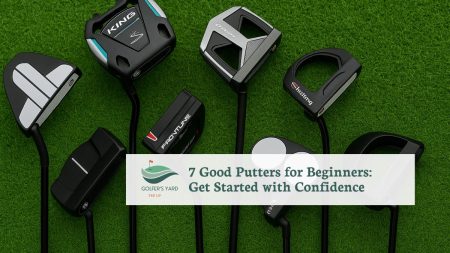
Putters are split into two categories based on stroke type, and this guide is direct about which matters more than brand.
Blade putters suit an arcing stroke where the face opens and closes naturally through the swing.
Mallet putters suit a straight-back, straight-through stroke where high MOI keeps the face stable.
Buying the wrong putter style for your stroke type costs as many strokes as playing an outdated driver.
Consequently, any teaching professional can assess your stroke type in five minutes on a putting green before you commit to a purchase.
In 2026, Odyssey Ai-ONE mallets lead for Tour adoption in the forgiveness category.
Scotty Cameron Studio Style blades dominate feel preference among low handicappers.
Furthermore, L.A.B. Golf putters engineer out the face torque at impact. The data support them specifically for golfers whose primary complaint is inconsistent starting direction on putts.
Our complete putter guides:
- Best Golf Putters 2026
- Best Putters for Beginners 2026
- Blade vs Mallet Putter: Which Should You Choose?
Wedges
Wedge grooves generate the spin that stops the ball near the flag.
After 75 to 100 rounds, those grooves lose measurable spin performance from microscopic dulling rather than visible damage.
If your wedges are more than two seasons old and you play regularly, they are already underperforming new equipment, not because of design, but because of groove wear.
As a result, this section of the guide treats wedge replacement as maintenance rather than an optional upgrade.
Most golfers need three wedges: a pitching wedge at 44 to 47 degrees (included with the iron set), a gap wedge at 50 to 52 degrees, and a sand wedge at 54 to 56 degrees.
Low handicap golfers add a lob wedge at 58 to 60 degrees.
The Titleist Vokey SM10 and Cleveland RTX 6 ZipCore lead independent testing for 2026 in their respective loft ranges.
Specifically, the Cleveland ZipCore repositions weight low in the head, producing more forgiveness on off-centre short-game strikes that more forgiving game-improvement golfers need most.
Our complete wedge guides:
Hybrids and Fairway Woods
Hybrids replaced long irons for most recreational golfers because they launch higher and forgive mishits from rough and tight lies that 3-irons and 4-irons punish.
Consequently, any golfer with a handicap above 15 benefits from replacing at least one long iron with a hybrid equivalent before upgrading any other club in the bag.
The 7-wood has made a significant comeback in 2026. Its higher loft and shorter shaft make it noticeably easier to hit for golfers who struggle with 3-wood consistency from tight fairway lies.
Furthermore, it performs better from light rough than either a long iron or a standard fairway wood at equivalent loft.
Our complete hybrid and fairway wood guides:
- Best Golf Hybrids 2026
- Best Hybrids for High Handicappers 2026
- 7 Wood Loft Explained + Best 7-Woods 2026
Golf Balls
Ball compression should match your swing speed, and this page is specific about the thresholds.
Under 90mph: use a low-compression ball below 70 compression, such as the Srixon Soft Feel or Callaway Supersoft.
These compress more easily at impact and recover distance on slower swings.
Between 90 and 105mph: a mid-compression urethane ball, like the Titleist Pro V1 or Callaway Chrome Soft, balances distance and spin control.
Above 105mph: high-compression tour balls produce the lowest spin and longest carry for fast swing speeds.
Additionally, one practical rule for beginners this our equipment hub recommends: do not play Pro V1s until you stop losing more than three balls per round.
A $50 box of Pro V1s disappearing into water hazards costs five times more per round than a $25 box of mid-range balls.
As a result, start with Srixon Soft Feel or Callaway Supersoft and upgrade when your handicap drops below 20.
Our complete golf ball guides:
- Best Golf Balls 2026: Top 12 by Golfer Type
- Best Golf Balls for High Handicappers 2026
- Best Golf Balls for Mid Handicappers 2026
- Best Golf Balls for Distance 2026
- Best Golf Balls for Women 2026
- Kirkland Golf Balls Review 2026
Club Fitting: When and Why: The Core of This Golf Equipment Guide
The central argument of this hub is that fitting matters more than brand selection at every price above $400.
Club Champion fitting data shows 60% of golfers who visit a launch monitor end up selecting a different driver or iron configuration from what they planned to buy.
Consequently, golfers who skip fitting and buy based on brand reputation consistently underperform their fitted equivalent.
The minimum any golfer should confirm before any purchase: swing speed and approximate iron carry distances.
Those two numbers narrow the entire list of these recommendations from hundreds of options to a manageable three or four immediately.
A fitting at any major retailer that sells the clubs you intend to buy is typically free with purchase.
An independent fitting at True Spec or Club Champion costs $75 to $200 and takes 90 minutes.
For any iron purchase above $600, that fitting cost is irrelevant compared to the performance recovered from correctly fitted lie angles and shaft flex.
As a result, this resource treats fitting as a required step rather than an optional extra for any purchase above that threshold.
Golf Brand Guide
| Brand | Known for | Best suited to | Price tier |
|---|---|---|---|
| TaylorMade | Driver technology, carbon faces, Tour adoption | Distance-focused, 5–18 handicap | Premium |
| Callaway | Forgiveness, AI face design, wide product range | All handicaps | Mid to premium |
| PING | Consistency, forgiveness, precision engineering | Mid to high handicap, reliability-focused | Premium |
| Titleist | Golf balls (Pro V1), players irons, precision | Single-figure and scratch golfers | Premium |
| Cobra | Speed, lightweight, value, draw-bias | Beginners, women, seniors, value-conscious | Mid |
| Cleveland/Srixon | Wedges (RTX), mid-market irons and balls | Wedge performance at any level | Mid |
| Mizuno | Iron feel, forged construction, craftsmanship | Low handicap who prioritises feel | Premium |
| Sub 70 | Direct-to-consumer, value, customisation | Mid handicappers wanting quality without Tour prices | Budget to mid |
Budget Guide: What to Spend at Each Level
Complete beginner: $300 to $500 total
A complete beginner set from Cobra, Callaway or Wilson covers driver, woods, hybrids, irons, wedge, putter and bag in one purchase for $200 to $400.
The Cobra Fly XL at $350 is the top-tested option for 2026. Add a sleeve of mid-range balls, a glove, and tees.
Consequently, the entire first-year equipment spend sits under $500 for most beginners who follow this section recommendation rather than overspending on premium options they will not yet use.
Best Golf Club Sets for Beginners 2026 →
Established beginner to mid-handicap: $800 to $1,500 for upgrades
Upgrade in this order: wedges first at $300 to $400 for two quality wedges, then driver at $400 to $600, then irons last at $600 to $900 fitted.
That sequence produces the fastest score improvement per dollar at this stage.
As a result, most golfers at this level can lower their handicap by 5 to 8 strokes without spending more than $1,200 total if they follow the upgrade order this the recommendations here recommends.
Best Golf Clubs for Beginners to Intermediate 2026 →
Mid to low handicap — $1,500 to $3,000 for a full fitted bag
At this level, fitting is non-negotiable.
Fitted players distance irons at $900 to $1,400, a fitted driver at $500 to $600, and two quality wedges at $150 to $200 each, build a bag that serves three to five seasons.
Furthermore, independent testing at this price level consistently shows that correctly fitted mid-range clubs outperform unfitted premium clubs.
Lastly, this is why this overview emphasises fitting over brand choice at every tier above $600.
Frequently Asked Questions
A beginner needs a complete starter set covering driver, fairway wood or hybrid, irons from 6 or 7 through pitching wedge, sand wedge, and putter.
Typically, 9 to 11 clubs in one box for $200 to $400. Add a golf glove, a sleeve of mid-range balls, and a packet of tees.
The guide recommends the Cobra Fly XL at $350 as the top-tested first set for 2026.
Draw-biased to reduce slicing, endorsed by a PGA teaching professional who purchased two of them for university use.
Beginners should spend $200 to $500 on a complete set.
Mid-handicap golfers upgrading individual clubs should budget $300 to $400 for two quality wedges.
Next, $400 to $600 for a driver and $600 to $900 for fitted irons.
Lastly, single-figure golfers buying premium fitted equipment should expect to spend $1,500 to $3,000 for a full bag.
At every level, this page recommends a fitting at any major retailer before buying.
It is free with purchase and prevents the most expensive mistake in golf: buying the wrong shaft flex or lie angle.
Yes. Club Champion fitting data shows 60% of golfers select a different configuration on a launch monitor than they planned to buy.
Specifically, the fitting identifies the optimal loft, shaft flex, and head shape for your swing.
Information that brand comparison alone cannot provide.
A fitting at a retailer is typically free with purchase.
An independent fitting costs $75 to $200. For any iron purchase above $600.
That fitting cost is negligible compared to what correctly fitted equipment recovers across a full season.
Consequently, this is our equipment hub that treats fitting as required, not optional, at that price threshold.
The Rules of Golf permit a maximum of 14 clubs in your bag during any round.
Then, carrying more incurs a two-stroke penalty per hole in stroke play.
There is no minimum; beginners often play with 9 to 11 clubs and benefit from having fewer choices per shot.
Then, the 14-club rule applies in all formats of competitive golf and most casual rounds at courses that follow official rules.
As a result, most complete sets in this hub include 11 to 13 clubs.
This covers every on-course situation without requiring decisions a developing golfer cannot yet make confidently.
Key Takeaways
- These findings are built on one data point: Club Champion confirms that 60% of golfers select a different driver or iron configuration on a launch monitor than they planned. Consequently, fitting before buying produces better outcomes than brand comparison alone.
- The top-10 drivers in 2026 are separated by just 5.2 yards of carry. As a result, a fitting session delivers more improvement than any specific model choice within that competitive performance band.
- Wedge grooves lose measurable spin after 75 to 100 rounds. This is the hub that treats wedge replacement every two seasons as maintenance rather than an optional upgrade for regular golfers.
- Ball compression should match your swing speed: under 90mph, use low-compression balls. Between 90 and 105mph, use mid-compression urethane; above 105mph, use high-compression tour balls. Matching this correctly recovers distance without changing anything about your swing.
- Game improvement irons suit handicaps above 15, players distance irons suit 5 to 15, and players irons suit scratch to 5. Buying the wrong iron category costs more strokes than buying the wrong brand within the correct category. This is why this guide leads with category before brand at every tier.