






This article may contain affiliate links. Golfer’s Yard participates in the Amazon Associates Program and may earn commissions from qualifying purchases at no extra cost to you.
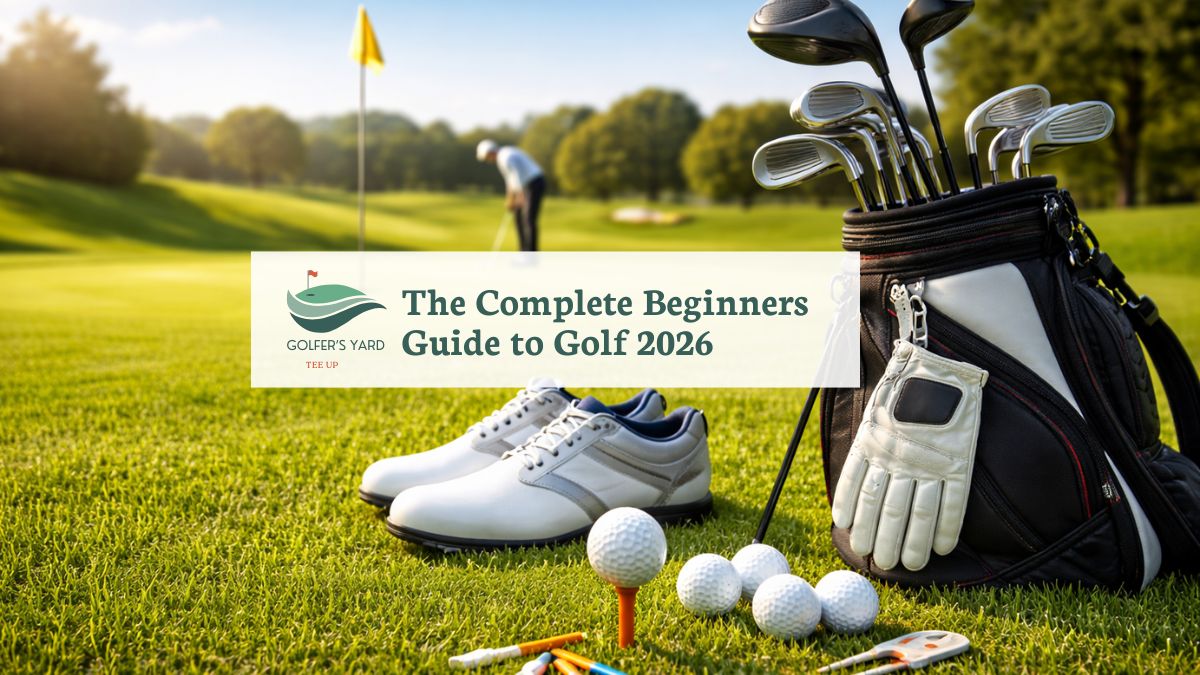
Golf has a reputation for being complicated, expensive, and unwelcoming to beginners. Two of those three have been largely fixed.
The rules simplified significantly in 2019, and beginner-friendly courses, driving ranges with technology, and affordable starter equipment all exist in 2026 in ways they did not a decade ago.
This guide covers exactly what you need in the right order from your first club purchase through your first round on a real course.
Quick Answer
To start playing golf in 2026, you need four things: a starter set of clubs ($200 to $400), a bucket of range balls to practise basic contact ($10 to $15 per session), a lesson or two from a PGA professional to establish grip and posture ($50 to $80 each), and a willingness to finish every hole rather than walking off frustrated. Total cost for your first month including equipment: around $350 to $550. Everything after that is course fees and practice.
What You Need Before Your First Round
Step 1: Buy a Starter Set
Do not buy individual clubs as your first purchase. A complete starter set gives you everything in one box, ensures all clubs match in shaft weight and flex, and costs $200 to $400 at reputable brands. The Cobra Fly XL at around $350 is the top-tested beginner set in 2026.
A PGA professional purchased two of them for his university golf programme. For a tighter budget, the Callaway Strata at $230 covers everything you need to get started.
A starter set typically includes a driver, one or two fairway woods or hybrids, irons from 6 or 7 through pitching wedge, a sand wedge and a putter.
That is 9 to 11 clubs enough for every situation on the course. See our complete guide: Best Golf Club Sets for Beginners 2026.
Step 2: Get One Lesson Before Anything Else
One 60-minute lesson with a PGA teaching professional before you hit your first range bucket will save you months of learning bad habits that are expensive to unlearn.
A good teacher establishes your grip, your posture, and your basic takeaway, the three fundamentals that determine 80% of what happens in every swing for years afterward.
Most public facilities charge $50 to $80 per lesson. That is the best golf investment any beginner makes.
Step 3: Practise on the Driving Range First
Visit a driving range before a real course. A bucket of 60 balls costs $10 to $15 at most public facilities and gives you 60 attempts to make contact without the pressure of other golfers watching or the pace-of-play expectations of a real round.
Specifically, use those early range sessions to work on the two shortest clubs in your bag first, your pitching wedge and your 7-iron. Distance does not matter.
Consistent contact matters. When you can hit 7 in 10 shots with your 7-iron, making clean contact, you are ready for a course.
Step 4: Play a Par-3 Course or Executive Course First
A par-3 course has no holes over 200 yards and requires only short irons and a putter. An executive course has a mix of short par-3 and par-4 holes.
Both are significantly shorter and less intimidating than a full 18-hole course, take 90 minutes instead of four hours and cost $15 to $25 in green fees.
Play a par-3 or executive course for your first three or four rounds before attempting a standard 18-hole course.
The Rules Every Beginner Actually Needs
The full Rules of Golf run to over 200 pages. You need four for your first rounds.
Rule 1: Fourteen club maximum. You carry up to 14 clubs. Most starter sets include 11 to 13. If you accidentally carry more than 14, the penalty is two strokes per hole where the violation occurred in stroke play.
Rule 2: Play the ball as it lies. Hit the ball from where it stopped. Move it only under specific Rules situations, such as unplayable lie, relief from water hazard, and maintenance areas marked with a free drop. As a beginner, take free drops whenever you find them and do not worry about the details.
Rule 3: Out of bounds and lost balls. If your ball goes out of bounds (marked by white stakes) or you cannot find it within three minutes, add a penalty stroke and play from as close to where the original ball was hit as possible. As a beginner, carry extra balls in your bag and treat lost balls as a learning moment rather than a disaster.
Rule 4: Stroke and distance vs lateral relief. Many courses now offer a local rule allowing a lateral drop within two club lengths of where a ball was lost or went out of bounds, adding two penalty strokes but avoiding a walk back to the tee. Ask at the pro shop whether your course offers this local rule, as it significantly speeds up play for beginners.
Golf Etiquette: What Nobody Tells You
Etiquette in golf matters more than rules for most beginners because violations make you unpopular with playing partners before your game is good enough to make you popular for the right reasons.
Pace of play is the most important etiquette rule. Keep up with the group ahead of you, not ahead of the group behind. If you are falling behind, pick up your ball after taking a reasonable number of shots (most beginners cap this at double bogey, meaning two over par for each hole) and move on. Nobody minds a beginner. Everyone minds slow play.
Be ready to play when it is your turn. Decide on your club selection, plan your shot and set up to the ball while other players are still approaching theirs. Do not start your pre-shot routine after everyone else has played.
Rake bunkers after every shot. When you hit from a sand bunker, smooth the sand with the rake provided (usually lying beside the bunker) before leaving. Replace divots on fairways press the turf back down or use the sand/seed mix from the bottle on your golf cart. Repair ball marks on the green with a repair tool.
Silence and stillness during other players’ shots. No talking, no movement and no practice swings in another player’s peripheral vision while they address the ball. Step back and be still. This is the most fundamental courtesy in the game.
Your First Round: What to Expect
A standard 18-hole round takes three and a half to four and a half hours. Nine holes take 90 minutes to two hours. Your first round will feel long regardless of which you choose.
The single most useful instruction for your first round is this: finish every hole. Regardless of how many shots you take, keep playing until the ball goes in the hole.
Picking up and moving on teaches you nothing about how to escape the situations you will face repeatedly.
Walking every hole and holing out every putt gives you the experience that eventually translates into lower scores.
Green fees at a public course run $25 to $50 for 18 holes on a weekday at most US facilities, rising to $50 to $90 on weekends at better-maintained courses.
Twilight rates after 3 pm are typically $15 to $25 cheaper. Riding in a cart adds $15 to $20 for 18 holes; walking is free, and better for developing your feel for distance and the course.
How the Handicap System Works
A golf handicap is a number that represents how many strokes above par you typically play. A 0 handicap (scratch) means you play to the difficulty rating of any course.
A 36 handicap means you average 36 strokes over par per round. The system allows golfers of different abilities to compete fairly against each other.
You earn a handicap by registering with a club or through the World Handicap System (WHS) app and submitting scorecards from official rounds.
The system calculates your handicap from your best eight scores out of your last 20. As a beginner, your first target should be breaking 100, which puts you around a 27 to 30 handicap, absolutely normal and nothing to be embarrassed about.
The Real Cost of Starting Golf
| Item | One-time cost | Ongoing cost |
|---|---|---|
| Starter club set | $230–$400 | Replace in 2–3 years |
| Golf shoes | $80–$180 | Replace in 2–3 years |
| Golf balls (dozen) | $20–$30 | $20–$50/month while learning |
| Tees, glove, ball marker | $15–$25 | $5–$10/month |
| First lessons (2–3) | $100–$240 | Optional ongoing |
| Range sessions (monthly) | — | $30–$60/month (4 sessions) |
| Green fees (monthly) | — | $80–$200/month (2–4 rounds) |
| First year total | $425–$845 | $130–$310/month |
Golf can cost as much or as little as you choose to spend. Walking public courses with a starter set, buying range balls in bulk, and taking two or three lessons rather than ongoing coaching keeps the first year under $2,000.
Playing premium courses every weekend with premium equipment at premium lesson rates pushes that to $5,000 or more. Most recreational golfers settle comfortably in the middle.
Frequently Asked Questions
Buy a complete starter set for $200 to $400 from a reputable brand like Cobra, Callaway, or Wilson. Book one lesson with a PGA teaching professional before hitting range balls, establishing correct grip and posture from the start saves months of correcting bad habits.
Spend three to five range sessions making consistent contact with a 7-iron before playing a course. Start with a par-3 or executive course for your first few rounds rather than a full 18-hole course. The complete beginner’s path takes about four to six weeks from first purchase to first full round.
First-year costs for most new golfers run from $425 to $845 in one-time purchases (clubs, shoes, accessories, first lessons) and $130 to $310 per month in ongoing costs (range sessions, green fees, balls).
Walking public courses with a starter set and taking two or three lessons rather than ongoing coaching keeps total first-year spend under $2,000. The starter set, at $200 to $400, is the largest single purchase; everything else scales with how much you play.
Four rules cover 95% of what a beginner needs: maximum 14 clubs in the bag; play the ball from where it lies; out of bounds and lost balls incur a penalty stroke with replay from the original spot; and finish the hole by holing out rather than picking up.
Beyond these, the free relief situations (maintenance areas, cart paths, water hazards) are learned naturally through play.
Ask your playing partners or the pro shop about any rule you are unsure of. Golfers are almost universally happy to help beginners understand the game.
A beginner needs 9 to 11 clubs: a driver, one or two fairway woods or hybrids, irons from 6 or 7 through pitching wedge, a sand wedge, and a putter.
A complete starter set includes all of these in one purchase for $200 to $400. You do not need 14 clubs to start.
More clubs mean more decisions per shot, which adds confusion rather than helping. Adding clubs as your game develops and you understand your distances makes more sense than starting with a full bag of clubs you cannot yet use effectively.
Consistent ball contact, solid contact on more than half of full swing attempts, typically develops in four to eight weeks of regular practice when fundamentals are established early through lessons.
Breaking 100 for the first time typically takes three to six months of regular play. Breaking 90 is a one to two-year target for most adult beginners who practise consistently.
Golf improvement is not linear; some weeks everything clicks, and some weeks nothing does, and that experience is universal regardless of how long someone has played.
Key Takeaways
- Start with one lesson from a PGA professional before hitting your first range bucket, one hour establishing correct grip, posture, and takeaway saves months of correcting bad habits that are expensive to unlearn.
- Buy a complete starter set rather than individual clubs for your first purchase. Matched clubs in one box at $200 to $400 remove sourcing complexity and ensures all shafts suit the same swing speed profile.
- Play a par-3 or executive course for your first three or four rounds before attempting a standard 18-hole course. Shorter holes, faster pace, and lower pressure allow you to focus on fundamentals rather than survival.
- Finish every hole in your first rounds regardless of score, holing out every putt, and playing from every lie builds the on-course experience that eventually translates into lower numbers, while picking up teaches you nothing.
- Pace of play is the most important beginner etiquette rule. Keeping up with the group ahead and being ready to play when it is your turn makes you a welcome playing partner before your game is good enough to do so on its own merits.
All the Beginner Golf Guides on GolfersYard
| Topic | Article |
|---|---|
| First set of clubs | Best Golf Club Sets for Beginners 2026 |
| Upgrading after 6–18 months | Best Golf Clubs for Beginners to Intermediate 2026 |
| Swing tips and drills | Golf Swing Tips for Beginners: 17 Drills That Work |
| First drivers for beginners | Best Golf Drivers for Beginners 2026 |
| First putters for beginners | Best Putters for Beginners 2026 |
| Which club to use when | Which Golf Club to Use: Beginners Guide |
| How many clubs in a bag | How Many Golf Clubs in a Golf Bag? |
| Golf terms explained | 20 Golf Terms Every Beginner Needs to Know |
| How scoring works | Stableford Scoring Explained |
| Best YouTube channels | Best Golf YouTube Channels for Beginners |


