


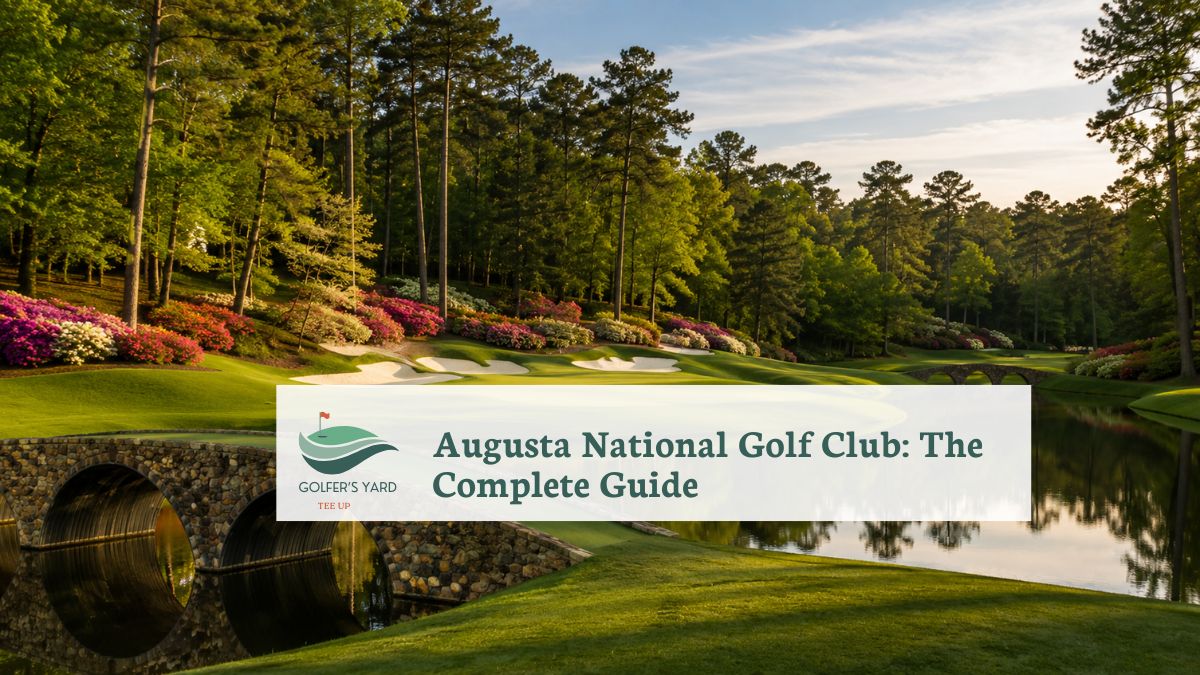
Augusta National Golf Club stands as the most famous golf course in the world. Every April, millions of golfers watch the Masters Tournament and feel as though they know the place.
Most, however, only recognise three holes, a green jacket, and the name Amen Corner.
This guide goes considerably further. We cover the full history of Augusta National, all 18 holes with names and yardages, the 2026 course changes, how Amen Corner actually works, what membership costs, how to get Masters tickets, and the best nearby courses to visit if you plan a trip to Augusta, Georgia.
Quick Answer: Augusta National Golf Club is a private, members-only golf club in Augusta, Georgia, founded in 1932 by Bobby Jones and Clifford Roberts. It hosts the Masters Tournament every April the only major championship played on the same course each year. The course runs as a par 72 at 7,565 yards. Membership requires an invitation. The public cannot play the course. Attending the Masters Tournament through the annual ticket ballot represents the only way for the public to visit the grounds.
The History of Augusta National Golf Club
Augusta National did not begin as the legendary institution it is today. In fact, it nearly failed to survive its first decade.
Bobby Jones, the greatest amateur golfer of his era, retired from competitive golf in 1930 after completing the Grand Slam. Also, he had long dreamed of building a world-class winter course in his home state of Georgia.
In 1931, Jones and his business partner Clifford Roberts discovered a 365-acre former nursery called Fruitland on the outskirts of Augusta.
The Berckmans family, Belgian horticulturists who had owned the land since the 1850s, planted hundreds of species of trees, shrubs, and flowers across the property.
As a result, the azaleas, dogwoods, and magnolias that define Augusta National today were already growing when Jones and Roberts arrived.
Jones hired Scottish architect Alister MacKenzie to design the course. MacKenzie had already designed Cypress Point and drew inspiration from the strategic layout of the Old Course at St Andrews. Together, they opened the course officially in January 1933.
Nevertheless, the early years proved difficult. The Great Depression limited membership and crippled the club’s finances.
MacKenzie died in January 1934, before seeing the completed course and before receiving his full design fee. Next, Roberts later admitted that had they known how long the Depression would last, they would never have proceeded with the project.
Despite those early struggles, the first Masters Tournament was held in 1934, initially under the name the Augusta National Invitation Tournament.
It drew modest crowds. However, as television brought the course’s beauty into living rooms across America during the 1950s, the Masters grew into the most-watched event in golf.
Furthermore, Augusta National has continued changing the course ever since adding length, adjusting holes, and acquiring surrounding land.
From 1999 to 2019 alone, the club spent approximately $200 million acquiring over 270 acres of surrounding land to protect the property from encroachment.
Augusta National Golf Club: Course Overview
| Detail | Information |
|---|---|
| Location | 2604 Washington Road, Augusta, Georgia 30904 |
| Founded | 1932 |
| Designers | Bobby Jones and Alister MacKenzie |
| Par | 72 |
| Yardage (Masters tees) | 7,565 yards |
| Type | Private — members and guests only |
| Annual tournament | The Masters Tournament — held every April |
| Open to public | No. Only accessible during the Masters via ticket ballot |
| Season | October to May. Closed every summer from late May through mid-October |
All 18 Holes at Augusta National: Names, Yardages, and What Makes Each One Distinctive
Bobby Jones personally chose the name of every hole at Augusta National, each one named after a plant or tree growing on the property.
Notably, the course plays out nine holes away from the clubhouse and nine holes back. In particular, the back nine is where Masters tournaments are won and lost.
| Hole | Name | Par | Yards | What Makes It Distinctive |
|---|---|---|---|---|
| 1 | Tea Olive | 4 | 445 | No gentle opener. Historically the sixth-hardest hole on the course. A deep fairway bunker guards the approach. All-time scoring average of 4.24. |
| 2 | Pink Dogwood | 5 | 585 | Reachable par 5 for fast swingers, though the 2024 tee relocation made the tee shot considerably more demanding. Deep greenside bunkers punish anything short or right. |
| 3 | Flowering Peach | 4 | 350 | The least-changed hole on the course. Short by modern standards, however fairway bunkers make shot selection critical off the tee. |
| 4 | Flowering Crab Apple | 3 | 240 | The longest par 3 on the course. A tee relocation in 2019 added 40 yards, now requiring a 313-yard carry over bunkers. Jack Nicklaus made two eagles here in 1995. |
| 5 | Magnolia | 4 | 495 | A long, uphill dogleg left. Carrying the fairway bunkers requires 310-plus yards. The green slopes back to front. All-time average of 4.27 — fifth hardest on the course. |
| 6 | Juniper | 3 | 180 | A downhill par 3 with a large bunker protecting the front. The three-tiered green creates wildly different pin positions. Distance control matters more than anything else here. |
| 7 | Pampas | 4 | 450 | Five bunkers surround the green, with three guarding the front. No bunkers protect the tee shot, however an accurate drive is essential to set up a manageable approach. |
| 8 | Yellow Jasmine | 5 | 570 | A scoring opportunity on the front nine if you avoid the right fairway bunker. Distinctive mounding around the green can deflect errant shots in any direction. |
| 9 | Carolina Cherry | 4 | 460 | A steeply sloped green from back to front makes distance control critical on the approach. The right side of the fairway offers the safest angle into the pin. |
| 10 | Camellia | 4 | 495 | Historically the hardest hole on the course. A dramatic downhill tee shot plunges left. Getting enough draw to chase the ball down the slope is the key to a good score. |
| 11 | White Dogwood | 4 | 520 | The start of Amen Corner. In 2026 it became the hardest hole on the course by scoring average. A pond guards the left side of the green. Larry Mize holed a 140-foot chip here in a 1987 playoff to win the Masters. |
| 12 | Golden Bell | 3 | 155 | The most famous par 3 in golf. Swirling winds caused by an eddy effect in the bowl make club selection nearly impossible. Rae’s Creek runs in front. Jordan Spieth made a quadruple-bogey 7 here in 2016. |
| 13 | Azalea | 5 | 545 | The end of Amen Corner. A risk-reward par 5 that rewards a drawn tee shot around the corner. Rae’s Creek runs the full length of the hole. Going for the green in two demands a precise carry over the creek. |
| 14 | Chinese Fir | 4 | 440 | The only hole at Augusta National with no bunkers. That does not make it easy. Undulating green contours punish imprecise approaches severely. |
| 15 | Firethorn | 5 | 550 | The most famous risk-reward decision in golf. Go for the green in two over the pond, or lay up? Gene Sarazen made a double eagle here in 1935 — still the most celebrated shot in Masters history. |
| 16 | Redbud | 3 | 170 | A par 3 played over water with three bunkers surrounding the green. Tiger Woods chipped in on this hole at the 2005 Masters in the most memorable moment the hole has ever produced. |
| 17 | Nandina | 4 | 450 | Augusta National lengthened this hole by 10 yards for 2026 following a tee box change. Bunkers on both sides of the fairway force precision off the tee. Back-right pin positions are notoriously difficult. |
| 18 | Holly | 4 | 465 | An uphill dogleg right with two bunkers at the left elbow of the dogleg and two greenside bunkers protecting the approach. One of the most dramatic finishing holes in sport. |
Amen Corner: The Heart of Augusta National Golf Club
No stretch of golf course carries more weight than Amen Corner. Golf journalist Herbert Warren Wind coined the name during the 1958 Masters.
Most people assume Amen Corner refers to holes 11, 12, and 13. Technically, however, it covers the second shot on the 11th, the entire par-3 12th, and the tee shot on the 13th.
Throughout history, this specific stretch has won more Masters titles than any other part of the property.
Hole 11 — White Dogwood (Par 4, 520 yards)
The walk to the 11th tee is immediately intimidating. The fairway narrows through a wooded chute before opening downhill toward a green where a pond guards the left side and a bunker guards the back right.
Consequently, there is no safe miss. Bail right and you face a near-impossible pitch. Go at the pin aggressively, and the pond punishes any pull.
In 2026, hole 11 became the hardest hole on the course by scoring average, overtaking the 10th for the first time.
Hole 12 — Golden Bell (Par 3, 155 yards)
This hole stands as the most famous par 3 in golf. At 155 yards, it should not present the difficulty it does. The problem, however, is the wind.
The green sits in a natural bowl at the lowest point of the property. Above it, the hill rises over 150 feet.
Wind funnels down from the clubhouse and swirls unpredictably in what meteorologists describe as an eddy effect.
As a result, the flag on hole 11 can blow in one direction while the flag on hole 12, just 50 yards away, blows the opposite way.
Furthermore, players cannot see the wind move at ground level. They guess, and even the best players in the world guess wrong regularly.
Rae’s Creek runs directly in front of the shallow green. Two bunkers sit behind it. Additionally, the margin for error on this hole ranks among the smallest in major championship golf.
Jordan Spieth hit two balls into Rae’s Creek here in the final round of the 2016 Masters, surrendering a five-shot lead he never recovered.
Hole 13 — Azalea (Par 5, 545 yards)
After the punishment of holes 11 and 12, the 13th offers a reward — but only to players who have earned it.
A draw around the corner sets up the chance to go for the green in two over Rae’s Creek. In contrast, a straight or faded tee shot leaves the creek in play and forces a lay-up.
Throughout Masters history, the decision at 13 has settled more titles than any other single moment on the course.
Augusta National Membership
Augusta National membership stands as the most coveted in golf. You cannot apply. You can only wait for an invitation.
The club does not publish its membership list. Most estimates place the total number of members at around 300.
During Masters week, members wear the club’s traditional green jacket on the grounds, making them identifiable at Butler Cabin, in the galleries, and at the Champions Dinner on Tuesday evening.
Among the known members, reports confirm Bill Gates, Warren Buffett, Peyton Manning, Eli Manning, Roger Goodell, and Annika Sorenstam.
In 2012, the club admitted its first female members, extending invitations to former US Secretary of State Condoleezza Rice and businesswoman Darla Moore. That decision ended decades of controversy over the club’s all-male policy.
Furthermore, Augusta National does not publicly disclose its financial terms. However, reports suggest initiation fees range from $40,000 to $500,000, with annual dues between $10,000 and $50,000.
The club operates as a for-profit corporation, not a non-profit like most private clubs, and therefore discloses nothing beyond what it chooses to share.
Can You Play Augusta National Golf Club?
No, Augusta National is a private club. Only members and their guests may play the course.
Additionally, the course closes every summer. From late May through mid-October, Augusta National shuts entirely.
Bobby Jones originally designed the club as a winter course, and the club has honoured that intention every year since 1933.
If you want to stand on Augusta National ground, attending the Masters Tournament remains the only legitimate option available to the public.
How to Get Masters Tournament Tickets
Master’s tickets rank among the most difficult to obtain in all of sport. Augusta National runs an annual public ballot for practice round tickets only.
Tournament round tickets, Thursday through Sunday, stay almost entirely in the hands of members and long-standing patrons who have held their tickets for decades.
Practice round tickets through the public ballot: Augusta National opens a three-week application window each year.
In 2026, that window ran from June 1 to June 20 for the 2027 tournament. Applicants submit entries at masters.com.
Winners are then selected by lottery and notified by email. Many applicants go years without winning a place, so applying early and consistently is essential.
Tournament round tickets: These are not publicly available through the ballot. Members and long-standing patrons hold them.
Nevertheless, a secondary market exists, with prices frequently ranging from $2,000 to $8,000 per day for premium rounds.
Augusta National explicitly prohibits resale. Anyone caught reselling faces a permanent ban from ever attending again.
Masters Tournament Rules and Traditions
Attending the Masters differs from every other sporting event. Augusta National enforces rules that would seem extreme in any other setting.
They work, however, because every patron who attends understands what Augusta National is and accepts the terms on arrival.
No mobile phones or electronic devices: The club bans phones on the grounds entirely. Staff conduct spot checks throughout the day.
Anyone caught with a phone faces permanent exclusion. As a result, the course feels genuinely quiet. You hear the birds. Then, you hear the crowd react. You do not hear ringtones or see people filming instead of watching.
No running, no loud talking, no cheering when a player makes a mistake: Augusta National refers to spectators as patrons, not fans. The culture of respect for the players and the course is real and actively enforced throughout the week.
In addition, hats worn backwards are not permitted.
Rule breakers receive a permanent ban. Augusta National does not operate a warning system. One violation results in a lifetime ban from the property.
The Champions Dinner: Each Tuesday of Masters week, the defending champion chooses the menu and hosts past champions at the clubhouse. It is entirely private. In 2026, Rory McIlroy hosted the dinner as defending champion, following his first Masters victory in 2025.
The Par 3 Contest: Every Wednesday before the tournament, players compete on Augusta National’s nine-hole par-3 course with family members serving as caddies.
It stands as one of the warmest traditions in golf. Notably, no player who has won the Par 3 Contest has ever won the Masters in the same week.
The Green Jacket: Club members first wore the green jacket in 1937 to make themselves identifiable to tournament patrons.
Sam Snead became the first Masters champion to receive one in 1949. Every Masters champion now receives a green jacket.
The jacket itself belongs to the Augusta National champions, who may keep it for one year before it returns to the club’s custody. Jack Nicklaus and Gary Player are the only two players who have received permission to keep theirs permanently at home.
The bird sounds: Augusta National plays recorded bird sounds through speakers placed discreetly throughout the property.
Additionally, staff import pine needles to ensure the grounds look perfect throughout the week. At times, the ponds have been dyed blue for television coverage. Nothing about Augusta National happens accidentally.
The 2026 Masters: What Changed
The 2026 Masters marked the 90th edition of the tournament, running from April 9 to 12.
Rory McIlroy, who won his first Masters title in 2025 to complete the career Grand Slam, returned to defend his green jacket.
On the course, Augusta National made one significant change for 2026. The club moved the tee box at the 17th hole, lengthening Nandina by 10 yards to 450 yards on the scorecard.
Off the course, a new Player Services Building reached completion on the property during the year.
Furthermore, the course had recovered substantially from the damage Hurricane Helene caused in 2024, which flooded sections of the property.
By the time the 2026 tournament arrived, the course was largely back to its pre-storm condition.
Augusta National Insider Details
These are the details that television does not typically share.
The clubhouse dates to 1854. Dennis Redmond built it as the home of an indigo plantation, and it is widely believed to be the first concrete house built in the American South.
Today, it contains one of the best-stocked wine cellars in the state of Georgia.
Magnolia Lane stretches 330 yards. The Berckmans family planted the magnolia trees lining the entrance drive in the 1850s. Players and members enter through Magnolia Lane. Patrons, however, enter through a different gate entirely.
Food prices at Augusta National are famously low. The club has kept concession prices artificially low for decades as a deliberate point of principle.
A pimento cheese sandwich has served as a Master’s staple for generations. Augusta National views affordable food as a fundamental part of the patron experience, not an afterthought.
Pinkerton Security officers enforce the rules quietly. They are the ones who apply the phone ban, the dress code, and the behaviour standards with calm authority throughout the week.
Volunteers operate the scoreboards by hand. The distinctive yellow and green manual scoreboards placed throughout the course receive no credit in the official Masters programme. Volunteers update every score manually throughout each round.
Best Golf Courses Near Augusta National
You cannot play Augusta National. However, Georgia offers outstanding public and semi-private courses within driving distance of the club.
If you plan a trip to Augusta for the Masters or as a golf pilgrimage, these courses are worth booking.
Our Best Golf Courses in Georgia 2026 guide covers the top options across the state in full detail. For tee time bookings on any course near Augusta, GolfNow provides live availability and competitive rates across thousands of courses.
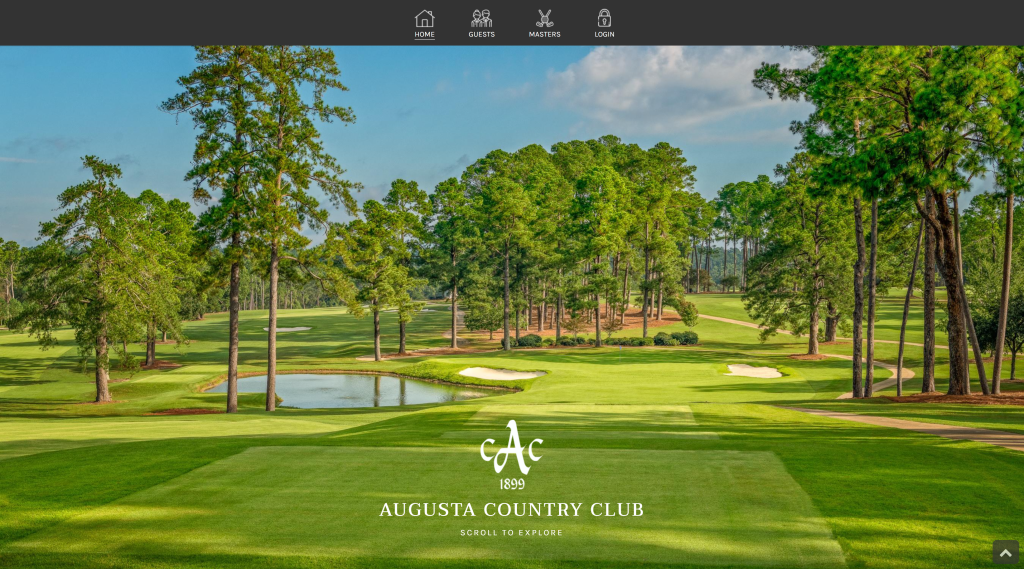
The Augusta area itself offers several publicly accessible courses, including Augusta Country Club, one of the oldest clubs in the state and established in the 1890s, and Forest Hills Golf Club, which hosted the Augusta Open in the 1930s.
Additionally, several resort properties in the region see significant demand during Masters week. If you plan a broader Georgia golf trip around the tournament, book accommodation and tee times at least six months in advance.
The Augusta hotel and rental market during Masters week ranks among the tightest in American sport.
For the full picture of American golf travel, our Best Golf Courses in the US 2026 hub covers every state worth visiting with current green fees and booking guidance.
Frequently Asked Questions
No, Augusta National is a private, members-only club. The general public cannot book tee times or access the course.
Attending the Masters Tournament through the annual public ballot for practice rounds, or through the secondary market for tournament rounds, represents the only way for members of the public to visit the grounds.
Augusta National does not disclose its membership fees publicly.
Reports suggest initiation fees range from $40,000 to $500,000, with annual dues between $10,000 and $50,000.
Furthermore, membership requires an invitation. You cannot apply.
Bobby Jones and Clifford Roberts founded Augusta National Golf Club in 1932.
Jones and Scottish architect Alister MacKenzie designed the course on the site of a former plant nursery. The club officially opened in January 1933.
Practice round tickets are available through an annual public ballot at masters.com.
The application window opens in June each year for the following April’s tournament. Tournament round tickets from Thursday through Sunday are not publicly available.
Members and long-standing patrons hold these tickets. A secondary market exists, however Augusta National explicitly prohibits resale and imposes a lifetime ban on anyone caught selling their tickets.
Amen Corner refers technically to the second shot on hole 11, the entire par-3 12th hole, and the tee shot on hole 13.
Herbert Warren Wind coined the name during the 1958 Masters. Throughout Masters history, this stretch has decided more titles than any other part of the course.
Swirling winds, water hazards, and narrow margins combine to create the most dramatic scoring stretch in major championship golf.
Members first wore the green jacket in 1937 to make themselves identifiable to tournament patrons.
Since 1949, Augusta National has awarded it to every Masters champion. The jacket belongs to the club, however.
Champions may keep it for one year before it returns to Augusta National’s custody.
Augusta National closes every summer from late May through mid-October.
Bobby Jones designed the club as a winter course, and the club has honoured that original intention every year since opening.
It operates from October through May only.
Bobby Jones named every hole after a plant or tree on the property. In order, they are: Tea Olive, Pink Dogwood, Flowering Peach, Flowering Crab Apple, Magnolia, Juniper, Pampas, Yellow Jasmine, Carolina Cherry, Camellia, White Dogwood, Golden Bell, Azalea, Chinese Fir, Firethorn, Redbud, Nandina, and Holly.
Final Verdict
Augusta National Golf Club is not simply the best golf course in America. It is the most carefully maintained sporting venue in the world.
Every detail, the imported pine needles, the recorded bird songs, the banned phones, the hand-operated scoreboards, exists to protect an experience that nowhere else in golf can replicate.
You will almost certainly never play it. Nevertheless, understanding what makes Augusta National the place it is transforms watching the Masters into a fundamentally different experience. You stop seeing a golf tournament.
Instead, you start seeing 90 years of history, tradition, and deliberate design converging on four days every April.
If you plan a trip to Augusta, our Best Golf Courses in Georgia 2026 guide covers every top course you can actually play in the state.
For the broader picture of American golf travel, our Best Golf Courses in the US hub covers every state worth visiting.
